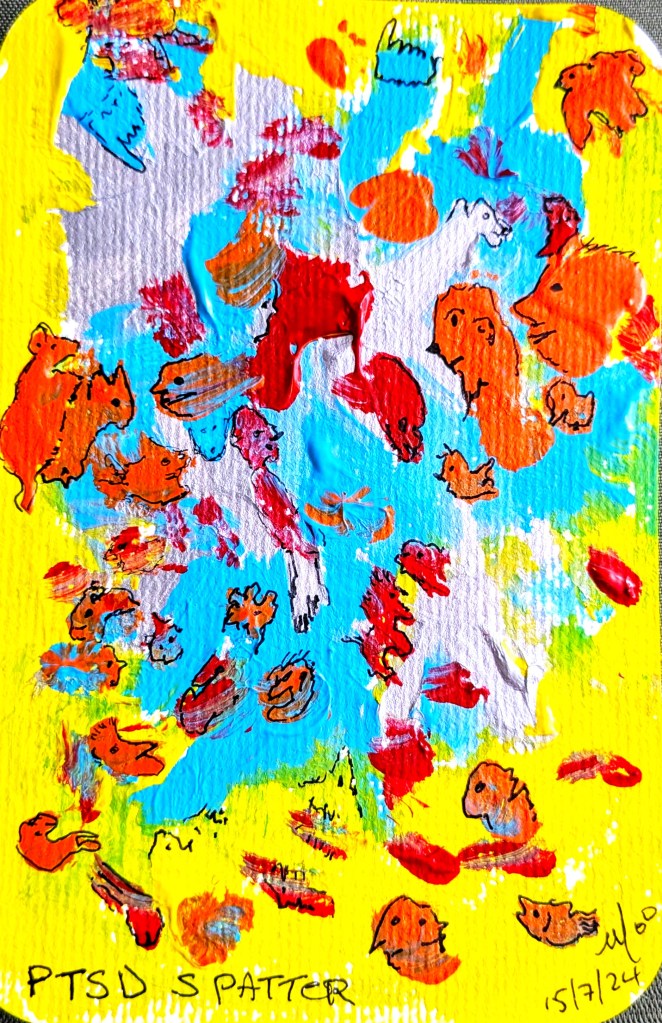
Painting by Moo
PTSD Spatter
aka
The tangled web we weave
when first we practice to deceive
Ryan and Don Roger
9
The Sowing of Acorns
Metatheatre can be defined as a play within a play. In DQI,7, the priest and the barber decide that one of the easiest ways to cure Don Quixote of his madness will be to wall up his library, so that he can find no trace of the room in which it was contained. They thought it might stop him from thinking about his books. Then they agreed to tell him that an enchanter had taken the books away, room and all.
When Don Quixote asks the housekeeper about his books, she tells him that there is neither room nor books because the devil has taken them away. The niece joins in and corrects her saying that no, it wasn’t the devil. A sage enchanter descended one night in a cloud, dismounted from his dragon, went into the room, came out through the roof in a puff of smoke, and left no trace of room or books. He called himself Muñaton and said he had a grudge against the books’ owner. Don Quixote corrects her and tells her is must have been Freston. The housekeeper joined in with “Freston or Friton, but it ended in ton.”
Cervantes has now planted several little acorns in the mind of the reader. Sooner or later, they will grow into large oak trees.
1. Metatheatre is based on a falsehood. The main character does not see the dramatic irony in the situation, but believes the lie that the other characters have spun for him. They write the play within a play, and Don Quixote becomes the actor in that play written specifically for him. This metatheatrical theme will recur throughout the novel and will become dominant in DQII.
2. The correction of speech – Muñaton (housekeeper and niece) becomes Freston (DQ), becomes Freston (the housekeeper), and then Friton, or something ending in -ton. The correction of spoken language will play a much larger role later in the novel.
3. The role of the evil enchanter who dogs Don Quixote’s footsteps and robs him of his greatest triumphs. This will start in the very near future with the adventure of the windmills.
4. The intersection of illusion and reality. This is really important for several reasons. Cervantes, as author, causes his characters to reveal the truth behind any metatheatrical (or other) illusion that concerns Don Quixote. He does not wish to trade, like Lazarillo de Tormes in false miracle. Clearly, he has no wish to be, like Lazarillo, castigado.
The simplest conflict between illusion and reality occurs in the first sortie. Don Quixote sees an inn, a humble country inn. Totally deluded, he believes it is a castle. Nobody contradicts him. Inn – reality / castle / illusion – but nobody really points out the difference. The adventure of the windmills is similar. Don Quixote sees giants. Sancho Panza sees windmills. Now the conflict is supported by a sane and reliable witness aka his squire. When one of the characters reveals the illusion, the author does not need to step in and do so. Throughout part one of the novel (DQI), we will see Don Quixote reacting in different ways to the unmasking of the illusion in which he so strongly believed. This situation, as we will see, will be presented in very different fashion in DQII. One fictional month between the two parts – but, in reality, ten years in which Cervantes thinks, plans, rewrites, and deepens his plots while polishing his skills.
So many little acorns. So many sown seeds. Hopefully, we will soon be able to watch them grow.
 rogermoorepoet