Carved in Stone
Brief Introduction
“Poetry explains itself. If it doesn’t, it’s inexplicable.” Pedro Salinas.
I entered this collection of poems for the Alfred G. Bailey Awad (poetry manuscript), WFNB, 2025. Alas, it did not win an award, but the judge, Kathy Mac, made some excellent suggestions as to how I might improve the manuscript. I have followed her advice to the best of my ability.
Carved in Stone is the second dialog (Chronotopos II) in my Bakhtinian Dialogs with my time and my place. Clepsydra, Chronotopos I, won third place in the Bailey Award (2025) and has already been published. I have one, possibly two, more Dialogs planned.
Reception Theory – I write, you read. Any meaning that you extract from my poetry will depend on your own culture and background. Tolle, Lege – Take and read. Read slowly, and with care.
I am a poet, a dreamer, if you will. These are my dreams. When you enter my world, you mingle your dreams with mine. The result, I hope, will be an interesting intellectual blend of new creativity. Pax amorque.
1
Behold me here,
filled with a sort of shallow,
hollowed-out wisdom
accumulated over decades
while listening with my eyes
to the words and thoughts
of writers, long-dead.
Imprisoned in book pages,
do they bang their heads
against walls that bind,
or hammer with their fists
at the barred lines
of their printed cages?
These spirits long to break free,
but they choke on library dust
and pollen from verbal flowers
that bloom unseen.
Those old ones avoided
the traps of temporal power,
or, once trapped,
gnawed off a precious limb
to limp into freedom.
Comment:
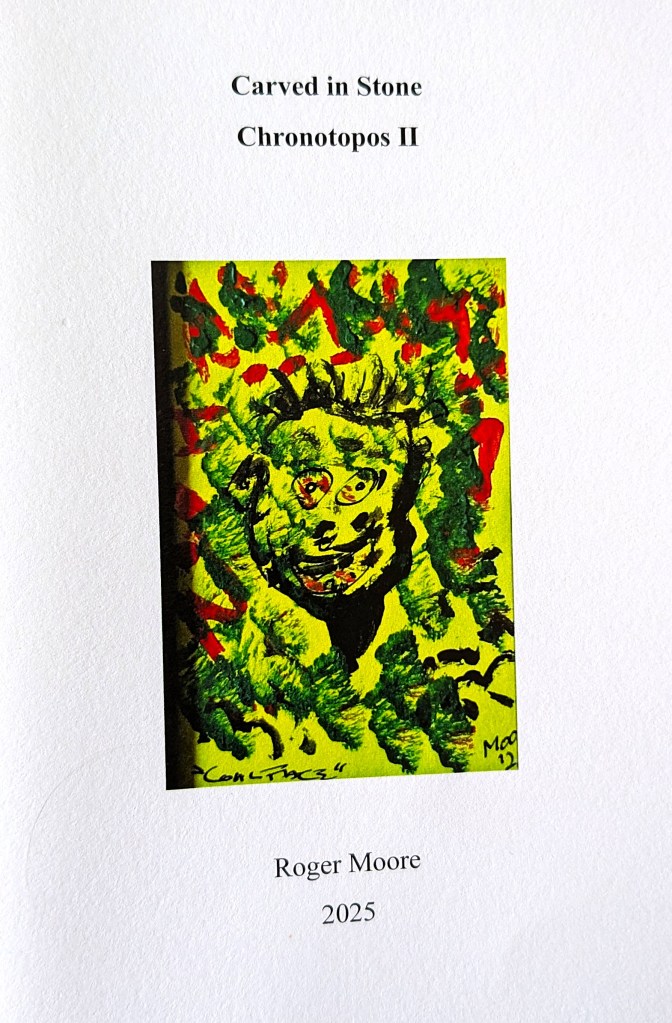
The cover painting, painted for me by my friend Moo when he read the manuscript of this book, is called Coal Face. It refers to the young Welsh boys in the Rhondda coal fields, aged 8-12 years old, who went down the mines to work at the coal face. This happened when the coal seams grew thin and only small children had the ability to work at the coal face and carve and mine the coal. Here are the relevant verses (44 – 45).
44
The old man, withered,
last house on the left,
leaning on his garden wall,
coughing, spitting up
coal dust and blood.
He’s not old, when you get close,
just grown old, underground,
where emphysema
and pneumoconiosis
devour men and boys.
He spits on the side walk.
Mining souvenirs,
Max Boyce calls them,
and they appear
every time the young man,
turned suddenly old,
starts to cough.
He can’t walk far,
wearing carpet slippers,
soft and furry,
just leans on the wall.
He fell, or was pushed,
into the trap at an early age,
when the coal seams
had grown so thin,
that only a small boy
could kneel at the coal face
before the black altar
of the underground god.
There, with a pick and shovel
he learned to carve and shape
those seams.
45
No candles burned at that altar.
A single match, let alone
a candle flame,
would spell the end,
if gas leaked from the seam.
Only the canaries,
confined in their cages,
sang songs.
Doomed,
like the blind pit ponies,
never to see the light of day,
they lived out their lives
down there.
So many died underground,
unable to get out,
buried alive,
before they were even dead.
 rogermoorepoet