Knowledge

F1040022

Knowledge
Thursday Thoughts
9 August 2018

In response to yesterday’s post, The Curse of Cursive, I received this comment.

“I have always blamed my own illegible (except – well sometimes – to me) scribble on the hours sitting in college lectures attempting to make a record of what was being said. Consequently, I could only ever record about every 3rd sentence. Something which I claim accounts for all those gaps in my learning.”

This comment merits a Thursday Thought.

First thought: the whole process of note-taking. One of my professors in Bristol University, where I did my undergraduate degree, was in the habit of sipping Harvey’s Bristol Cream while munching his sandwiches, consequently his post-lunch thoughts were always most enlightening. Here is his post-lunch declaration on knowledge: “Knowledge is that which passes from my notes to your notes without passing through anyone’s head.” This statement was followed by a closing of the drowsy eyes and an enormous hiccup.

For me, the art of note-taking goes way beyond the copying down of another’s ideas. As  note-takers, we must sift the incoming information, break it into salient and important features, and get the main drift of the argument down on the page. And not just the argument, but our own questions and challenges as well. Much of what I was taught at the various schools I attended was, frankly, nonsense. However, I learned a great deal about teaching from those who taught me that nonsense. A dictated note from an early geography class, preserved for ever in the young student’s mind: “The earth is geoidal, ie, earth-shaped.” Good one, teacher. “Please sir, if the earth is earth-shaped, what shape is the moon?” “Don’t be cheeky, boy, I’ll see you afterwards.”

When I received my first important teaching award I realized that it came to me on account of what I had avoided (all those inadequate lectures and lessons) and that what I was doing was engaging students and challenging them to challenge me by developing their own questions and ideas, by doing their own background checks, and by establishing their own thought processes, rather than trying to imitate somebody else’s dictated and regurgitated notes with their partial pictures of (in)complete and often antiquated knowledge, and all this often dredged up and recycled in the form of ancient, dusty scrawlings from pre-historic graduate courses.

I realize that this is unfair to several lecturers I encountered over the years who were able to deliver riveting and thought-provoking adresses. However, these were few, very scarce, and much appreciated. Their names and ideas are engraved on my mind. They and their methods are not forgotten, even now, but, as I say, there weren’t many of them.

As for knowledge, it is so personal and becomes an integral part of who we are and what we do. I know people who received everything they knew about life with their first degrees. They thought they possessed everything, the complete tree of knowledge in one rolled up certificate. Alas, many of them spent their lives never progressing, standing still and contemplating their known world, neither learning nor needing to learn anything else.

Our knowledge is incomplete. If we are at all ‘thinking people’, we know this. We also know we can never get enough knowledge. A PhD is great: knowledge Piled higher and Deeper. But often it is Reinforced Ignorance, the false knowledge that this knowledge is the only knowledge, well, the only knowledge that matters to the individual who, at a substantial living wage, ekes it out with great care and tests other people on their ability to reproduce it in its exactitude. “And I never-ever thought for myself at all” (I am the Monarch of the Sea, the Ruler of the Queen’s Navy, HMS Pinafore).

And here we enter the world of clichés: life-long learning, an everlasting thirst for enlightenment, for more light, more knowledge. The only real knowledge that we simply must transfer to our students, our followers, is how they can gain knowledge and even more knowledge for themselves. A love of and a desire for life-long-learning is the teacher’s greatest gift. If the teacher can pass that on, then the world of ideas will not fail, knowledge will not become carved in stone, set in concrete, entrenched in notes ‘that pass from my notes to your notes without going through anyone’s head’.

Here ends my Thursday Thought. A rant, really, and a very satisfying one. Thank you, Roland of Roland’s Ragbag, for turning on the tap and allowing these refreshing waters to once again flow.

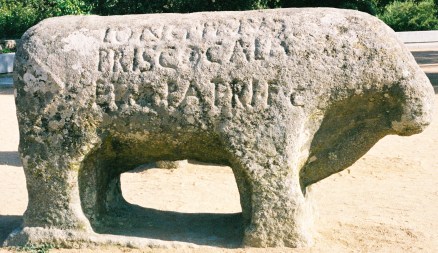
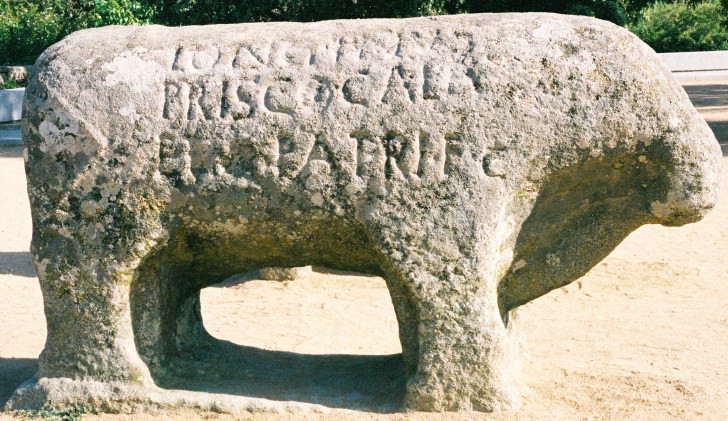
Comment: Opening photo, knowledge set in stone. One of the Bulls of Guisando (Province of Avila, Spain), with graffiti carved by a Roman legion.
Purple

IMG_0067

Purple

I write poems
in green ink,

but I prefer
purple.

Bruised clouds
on an evening sky,
dark depths
of a rainbow glow,
Northern Lights
singing at the deep
end of their scale …

or just a desire
to be different …
slightly different ..

as if that one thing,
the color of my ink,
might tip the scales
and turn me
from mediocrity
to celebrity

with a wave
of a violet wand.

or the click
of a pair
of ink-stained
fingers.

Curse of Cursive

IMG_0004 (2)

The Curse of Cursive
Wednesday Workshop
8 August 2018

It appears we will no longer teach cursive writing in our schools. Instead, we will teach our children to print. I will not pass judgement on this decision. Quite simply, my handwriting has always been bad. Very bad. I have never worked out why, but I suspect that it is because I think very quickly and my hand tries to keep up with my brain, and the result is the scrawl that I call my handwriting.

I type with two fingers, too, and stare at the keyboard as I am doing so. I tried to follow a typing course one year. I worked at it for two months. At the end of that time, I tried my touch typing examination and managed a rate of 78 words a minute with an accuracy of  82%. I did the same test with my trusted two fingers: 114 words a minute accuracy rate 98%. Oh dear. I still type with two fingers and I still write badly and no, my thoughts have not slowed down.

Just glance through the above photograph, taken from the journal I keep everyday. “Almas de Violeta,” it reads, “an early poetry book by Juan Ramón Jiménez, the Nobel winning poet, was first published in violet ink. I have a copy of his complete works, Obras completas, in which these early poems still appear in purple, or violet rather, to match the color of the title. He published in green ink too, but personally I prefer the purple. Bruised clouds on an evening sky, dark depths of a rainbow glow, Northern Lights singing at the deep end of their scale … or just a desire to be different … slightly different, as if that one thing, the color of my ink, might tip the scales and turn me from mediocre to celebrity with a wave of a violet wand or the click of a pair of ink-stained fingers.”

Now, wasn’t that easy! And there’s so much personality in tone and color, ebb and flow, the link of a poet to the words on his page.

Once, in a faraway library in a distant, magical land, I was studying an autograph manuscript, written by Francisco de Quevedo (1580-1645). The hand-writing began very steadily. Then I noticed a red dot or two on the page. Then a larger stain. Our poet was a notorious drinker. The letters grew large and loopy. The paragraphs sprawled. Punctuation marks and accents, slashed and splashed, and missed their targets. By the end of his evening, with his bottle surely empty and gone, I could just about make out what the good man had written.

When I turned the manuscript folio, from recto to verso, it was a new day and the original handwriting was back, small and neat. I have noticed the same phenomenon when I write late at night. Unreadable words, occasional wine splutters, spelling and grammar mistakes, disjointed readability … but the thoughts and the ideas are still there, still clear. Sure, I need a bit of hard work to interpret some things, but that’s the curse of the cursive, I guess.

Welsh Miners

img_0184

Miners

What has become of the caged
canary who lit up my life?
I hear the pit pines creaking.
Now nobody dares strike a match.

Birds descending in an iron cage,
our lungs blackened and scarred,
scared, we sing dark hymns
knowing we are doomed.

On hands and knees, we crawl
to the coal-black altars of our gods.
Blind from birth, pit ponies
trust us in their solitudes.

Don’t they know that when
the canary falls from its perch,
we’ll abandon them and claw
our way, anywhere, to safety?

Within the chalk tomb-tunnels
of my calcined skull,
a lone thought searches
an abandoned mine for a memory
it can no longer find.

Procrastination

IMG_0146

Procrastination
for my friend, Mr. Cake

It’s old age, I think:
I can manage
one thing a day,
depends on the weather,
then I forget,
then I remember,
but the weather isn’t right,
so I put it off again,
start a story,
write a poem,
the phone rings,
someone texts me,
there’s a knock on the door,
the crows in the garden
make me procrastinate,
(crass  Latin joke*),
then I remember
and feel sad,
and hair leaks from my head
like straw from a scarecrow,
and my teddy bear brain
turns to sawdust
when I scratch,
and what was I saying?
I guess I’ve forgotten,
I’ll sleep on it tonight,
and write again
tomorrow.

Note:
Crass Latin joke*
Cras is the Latin for tomorrow. Cras is also the sound, in Latin, that the crows make. Hence Pro-cras-tinate: to leave things for tomorrow, or to abandon them for tomorrow’s crows. The joke probably doesn’t belong in the poem, but darn, it’s my poem and I’m leaving it in there.

Comment:
This collection of thoughts started in a casual online exchange with my good friend, Mr. Cake. Sometimes words flow and it’s impossible to stop them. Sometimes, they hover like crows or croak at us from the tree tops where they sit ungraspable. My spellcheck tells me that’s not a word, but if it isn’t, it ought to be. Whatever: the world and its words are sometimes surreal and if you are interested in the surreal, then Mr. Cake’s blog is the place to be. Here’s the link. The site comes highly recommended. Click on it now and don’t procrastinate. Mr. Cake’s Blog.

Butterflies

img_0189

Butterflies

“Poetry gives permanence to the temporal forms of the self.”
Miguel de Unamuno.

That is what my writing is all about,
those temporal forms, fluttering and changing.
Butterflies, they live for a day or two,
perch and flourish, spread their wings,
excel for a moment, catch my attention,
then blown by a sudden gust of wind,
they tear their wings on a thorn
and perish in the blink of an eye.

Reborn in ditches, they cluster and gather,
congregate, black and yellow, on bees’ balm,
smother Cape Daisies and Black-eyed Susans.

Like shadows they shimmer, butterflies by day,
fireflies by night, terrestrial stars, lost, wandering,
floating in their forest firmament, hackmatack,
black oak, bird’s eye maple, silver birch, fir …

Impermanence surrounds us, dances beneath stars,
sings with robins, echoes the owl’s cry through woodlands,
poetry, the elemental soul, our words capturing nothing,
turning it into eternity, holding it for the briefest moment,
then letting it go. Island View, New Brunswick, Canada,
my home in the woods, my dialog with my place and time.

Dandelion Flowers

IMG_0174

Dandelion Flowers

My flowers fly bright flags as if trooping their colors
for Her Majesty, the Queen of England. They drink water
dosed with chemicals to keep them healthy and alive,
refusing to fade, flourishing in their vase on the table.

They withstand both sunshine and shade, neither wilting
nor fainting under the hot summer sun. In this house
there dwells no queen, just a domestic pussy cat
called Princess Squiffy who knows she may look at a Queen.

“Your Majesty,” say Cape Daisies as the pussy cat passes.
“Ma’am,” say Peonies and Pansies, bending knees, bobbing heads.
Outside my window, the garden fills up with onlookers,
still green Tomatoes, Clematis, and a tall Hollyhock.

A multitude of weeds crowds onto the lawn. Dandelions
standing splendiferous, waiting to take plebeian selfies,
for plebs, they are, vox populi, people’s voice, people’s choice.

Some ancient god must have loved them very much,
for they are ubiquitous, and totally indestructible.
That said, you must never trust them in your flower bed.

Book Burning

IMG_0192

Book Burning

A sharp-edged double sword,
this down-sizing,
this clearing out of odds and ends.

Library shelves emptying.
books disappearing, one by one.

So many memories
trapped between each page,
covers, dust-bound now,
dust to dust and books to ashes.

Sorrowful, not sweet, each parting,
multiple losses, characters
never to be met again,
except in dreams.

Heroes, thinkers, philosophers, poets,
their life work condemned to conflagration.

Alpha: such love at their beginnings.
Omega: such despair,
with Guy Fawkes celebrations
the means to their ends.

Word-fires:
the means of forging
those book worlds that surrounded us.

Bonfires:
the means to end them.

Steadfast, the book-fires,
flames fast devouring

all but an occasional volume
snatched, burnt fingers,
from the flames.

Fire Storm

IMG_0038

Fire Storm

Yesterday, it was difficult to breathe.
We inhaled dust and ashes as smoke
from forest fires scuttled towards us,
carried piggy-back on a strong west wind.

Today, the wind herds clouds into aerial castles,
pinnacles and pyramids piled upwards,
tall ships’ canvases painted dark, thundery,
raised by fierce wedges thrust beneath them,
lofting them into darkening skies.

Beyond a certain height, water becomes ice.
Particles group together. Hail stones form,
small at first, growing ever larger
until the very air can no longer bear
their weight. Golf ball big,  they tumble down
the sky’s steep ladder and fall to earth.

The dry drum roll of distant thunder rumbles.
A scissor-slash of light shreds black skies.
An executioner’s hay wain rolls towards us,
a runaway train destined to tear our lives
apart. It leaves us helpless, clamoring for safety,
our world torn apart, our earth sore wounded.

Death scythes away downing rich and poor alike.
Who now knows which way thrown dice will fall?
The dye’s sharp edge, once cast, cuts like a blade.
Hailstones clatter, battering us down.