Chairman Tigger

IMG_0122.JPG

Chairman Tigger and the Cult of Personality

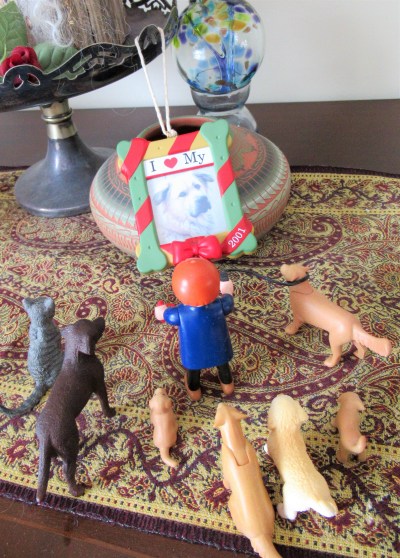
My 110 lb dog, Tigger, decided he wished to become a cult figure. So he placed this photo of himself in a prominent position by the Nativity this year and was happy to see a gathering of puppies and other dogs coming to welcome him and admire his good looks.

I’m not yet sure if Tigger has determined to run in the 2020 elections. With 20/20 foresight, I would be able to predict the results if he did and with 20/20 hind(leg) sight, I’ll be able, in 2021, to analyse whatever has happened by that stage. Was it Caligula who turned his horse into a god to be worshiped? Tigger was reading about him the other day in Suetonius’s Twelve Caesars. He told me “Surely if a horse can be a god, albeit a Roman god, I, who am as big as a small pony, can be a member of something, an MLA, perhaps, or an MP, maybe even a Representative, or even a Senator.”

“Tigger,” I replied. “You are certainly big enough to be a Senator. If only you could skate, and shoot the puck, and find a uniform to fit, I am sure the Ottawa Senators would be proud to have you as a mascot.” “If I am to be a hockey dog, I want to be a Maple Leaf, lik eddy the Entertainer,” he growled. That should tell you something about his state of mind.

Anyway, he is determined to get out there and run, which he does most days anyway. But he doesn’t have enough money for a deposit, let alone a genuine campaign, and he wants to stand as an independent. He doesn’t want to be tied down with a party line, if you see what I mean. He wants to be off the leash, so to speak. So, I suggested Crowd Funding and he quite liked the idea of that. So, backde by plastic Lego worshipers and followers, Crowd Funded with Monopoly Money, and a determination to create a first of some kind or another, Tigger the Democratic Dog, will soon be heading for either the Senate Kennels or the Parliamentary Kennels. He just hasn’t decided which as yet. I guess with 2020 foresight, I should be able to tell.

By the way, if he actually makes it to the Doggy Dreamland of Representative Status, he’s going to sponsor a bill for a Two-Way Rainbow Bridge. Apparently, he wants to come back again. And we want him back too.

Advent Calendars

IMG_0068.JPG

Advent Calendars

We have multiple Advent Calendars. Some are online, others are religious, and yet others, like the one pictured above, are forest scenes with Santa, courtesy of my daughter and Playmobile. We particularly like this one. Each day, from December 1 to December 24, we get a different set of pieces to add to the background. Then, on December 25, Santa arrives ad we keep him around, usually until the New Year, sometimes until Reyes, the Spanish and Mexican Christmas, on January 6.

Every morning, Clare opens the large Playmobile Box and adds the day’s pieces to the scene. Bit by bit, the scene grows until everyone is present in the same forest glade they have inhabited for many years now. Every year, I search for new animals, and they live in the scene next door, cats and dogs and kittens and puppies, all watched over by a framed photo (2001) of my favorite dog: Tigger.

No, the spirit of Christmas doesn’t reside in a cardboard box and its plastic figurines. Rather it resides in happy memories (horas non numero nisi serenas / I count only the happy hours) and in the new memories, usually very happy, that we create each year. Clare is a sun-watcher. Each day, she calls out the minutes as the days lengthen, post-mid-winter, and the earth tilts slowly back into spring, then summer. We also watch the sun shadow creeping up the wall (pre-Christmas) and then slowly back down again, post-Christmas, into the New Year, Reyes, and my birthday.

Christmas visitors in our plastic Christmas forest scene are joined by real visitors in the world outside. Deer walk up to the bird feeders by night and squirrels (red and grey), chipmunks, and a variety of birds feed there by day. By night we also get raccoons and the occasional fox. By day, our neighbors’ thin, predatory cats tinkle their Christmas bells, and patrol the garden in search of their Christmas dinners. Every year, we watch the splendor of birds at the feeder and hope that the cats go hungry for now, to be filled later in the safety of their own feline dishes safe indoors.

Washington Bear


IMG_0065.JPG

Washington Bear

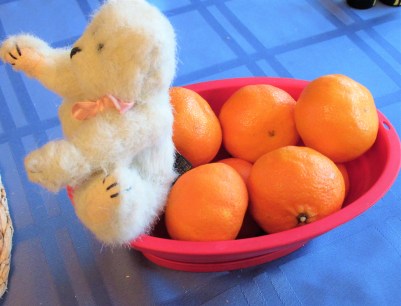
Washington Bear crosses the Potomac in a boat filled with Christmas oranges. Well, that’s what it looks like. Though of course they may be tangerines, or clementines, or mandarin oranges. It doesn’t really matter, because Christmas is now over, the Potomac is crossed, and world and wold have returned to whatever normality is currently available.

Brave Washington Bear. He was the first to pose for my pre-Christmas present: a new small Canon Camera. Hand-size, it fits in a pocket but takes the sharpest of pictures. It’s a Wifi camera, so they say, but we spent the largest part of Christmas Eve, Christmas Day, and Boxing Day trying to set up the Wifi connection, without success. When we checked trouble-shooting online, we found about 400 links complaining of the difficulty of linking Windows 10 with the Wifi Canon cameras. Oh dear: all fingers, thumbs, and steamed up glasses, with miniscule codes thumbed onto Lilliputian screens. How frustrating and, as we grow older and sight and touch grow frailer, and brain power for new things lessens, and new things encroach more and more and faster and faster onto our sensibilities … how triply and quadruply and really bigly, big league frustrating. As we slow down the world and the increase in daily innovations speed up. It is only now, that I begin to understand the frustrations of my grand-mother: “Thread the needle for me, Roger, for I cannot see too well and my hand is shaking.” Little did I know then that I too would be making the same and similar pleas when my turn came around, as it is coming.

The optometrist scheduled three eye operations. all minor, for me in October. I have had one already, the removal of a cyst, and now have two more to go: cataracts in both eyes. It will be good to see clearly again. Perhaps I will be able, once more, to thread my own sewing needles. I like sewing. I find it very relaxing. I have a wire needle threader (from Spain), an automatic needle threader (from my time quilting in Moncton), and I have my own sense of direction, corrupted now both by vision and shakiness. I guess that, like Washington Bear, I will be crossing my own Potomac soon, not to mention my Rubicon.

Not that it matters. Not that much matters in the enormous scheme of this world that rolls onwards and onwards, perhaps to its own inevitable end. Others have become extinct before us. We too are faced, once more, with our own extinction. Washington Bears, one and all and all for one, we must stand together in the prows of our boats laden with oranges and step forward, bravely, into whatever awaits us. Fortune favors the brave or so they say. But don’t be too happy about it, for they also say that “those whom the gods would destroy, they first make happy.” So bravery, yes, but with a little pinch of doubt and a peck of cynicism, please. Enjoy the old year. Welcome in the new. But don’t be too happy, not just yet. Let’s see what’s ahead of us first.


Xmas Birthdays

IMG_0013

Xmas Birthdays

They come in all shapes and sizes. The ones closest to Christmas, are they the best? Good question. Are the later ones any better? Who knows? In my case, January born, all I remember are the broken promises.

“I’m not buying you a Christmas present this year. I’m saving up to buy you something special for your birthday. What do you say to that?”

“Thank you, Auntie Gladys. You are so kind. I’ll look forward to my birthday.”

I next meet Auntie Gladys two weeks after my birthday. “Oh,” she says. “Was that your birthday just went by? I forgot all about it. Sorry.”

That’s just one example, but I remember many broken promises. I had to be older, sadder, and very much wiser before I realized that perhaps my Auntie Gladys didn’t have enough money to buy me one present, let alone two.

Then there was my mother’s mother’s birthday. It took place on December 23rd every year. During November, my mother never mentioned it. At the beginning of December, silence reigned. When my father’s office parties for Christmas drew closer, around the 15th or 16th of December, my mother’s mother’s birthday grew in stature and importance.

“Where’s your father?”

“I don’t know.”

“It’s late. He should be home. Did he tell you what he’d be doing tonight?”

“No.”

9 pm, 10 pm, 11 pm … then a key in the lock, I’d run to the door and heave at it with enthusiasm, and my father, pushing against a door I was now pulling open, would fall face first onto the mat, writhing and giggling.

Two or three nights like this and, on the evening of the 22nd or the morning of the 23rd, my mother would announce to me in a loud voice and in my father’s absence: “It’s my mother’s birthday. Pack your bag. We’re going to see her.”

“Aren’t you going to wait for dad?”

“No.”

“Aren’t we going to tell him where we’re going?”

“No.”

She’d call a taxi that would drive us to the train station or the bus station. She’d buy us tickets to her mother’s hometown, 40 miles down the road, and off we’d go.

I was often too tired to note the anxious tones of my grandparents’ questions. The mumbled conversations behind my back. The little errands that I was asked to run while the ‘grown-us’ discussed the nature of the current situational crisis.

“What do you want for Christmas?” my mother’s family would ask.

“I want my dad,” I’d reply.

Then, On Christmas Eve, still fatherless, but full of hope and the promises of presents and joy, I would go to bed and fall asleep, too tired to wait up and spy on dear old Santa.

Next morning, my father, hung over, rather smelly having slept in his shirt, unshaven, and looking sleepily sheepish, would appear and offer me whatever special gift he had been looking for during the past three days.

“Just for you,” my father would say, handing me his wrist watch (one year) or his fountain pen (another). “I went up to the North Pole specially to get it,” his smile lit up the room.

“Liar,” my mother would say and her family would roll their own sheep eyes and look at the ceiling or at their shoes.

“Well, maybe not the North Pole,” my father, now a little moth or butterfly, would wriggle on the pin my mother was sticking into him. “I went to London, actually.”

“Liar, liar.”

“But it was the office club’s official party trip. We saved a shilling a week to hire a coach and drive up to London to see Swansea playing Tottenham Hotspur.”

“Liar, liar, liar.”

“Well,” my mother’s father would mediate, “Swansea were playing Tottenham yesterday.”

“Told you so,” said my dad.

It was Christmas. Mistletoe would appear, kisses would be exchanged, peace would be bought, my watch wouldn’t work, and next time my father saw me he was wearing a brand new wrist watch that actually went tick-tock.

23 December … it’s my mother’s mother’s birthday again. I welcome the day with open arms, yet I always fear what might happen, and I always wait for the worst to come when the first of those Christmas birthday ghosts arrives to sit on the end of my bed and taunt me as I lie there, eyes wide open, haunted, sleepless remembering …


Twits, Tweets, and Twitter

img_0281


Twits, Tweets, and Twitter
aka
Bits and Bytes

After a very cold and snowy December, with low temperatures, way below average and dropping at times to -24C, with snow on the ground almost all month, and all this in the fall, aka autumn, since winter didn’t officially begin until 6 pm yesterday, December 21, it was a real shock and surprise to listen to the rain fall and high winds batter the windows all night as the overnight temperature rose to +14C and we received 40 mms of rain. As a result, we awoke to warnings of flash floods from melting snow and an influx of rain as winter has begun with a more of a whimper and a watery splash rather than with a flash freeze and a bang as your bottom hits the ice. I wonder what the deer think as they paddle through the puddles on their way to and fro from the water-logged feeders. I know what I’m thinking: ‘thank heavens we don’t have to shovel it’, but it will be a totally different story when it all freezes over, the road are like bottles, and we descend the hill in first gear with an ever-present fear of a much too welcoming ditch.

I have just read an interesting article on how, accustomed as we are to Twits and Tweets, many of us are no longer capable of unravelling a long interesting sentence that rambles on and on and refuses to make an immediate Twitter Point, usually underlined by the use of CAPITAL letters for KEY WORDS and all of this for a sound byte audience that is becoming less and less literate as social media proliferates and news is telescoped into tiny jam jars of meaning that are spread around with an illiterate spoon and many exclamation marks. There: you have just read a 96 word sentence. I wonder how you did with it? Did you persevere? Did you give up half way through?

In my former life, when I encouraged young people to read Miguel de Cervantes’s Don Quixote from cover to cover (and they did), I was surprised to discover the difficulties they had with his long sentences, some so long that they continued for a whole paragraph or a full page. I was also surprised to discover that many Spanish speaking people are now incapable of reading Don Quixote in the original Spanish as it is too complicated for them and too difficult in meaning and structure. I have cartoon versions of Cervantes’s master-piece, but have always found them to be simplistic and undignified. I have read the original, in Spanish, twenty-seven times, usually in the Martin de Riquer edition, and have never found the language to be a problem. Indeed, it is refreshing to enter the labyrinth of a long sentence and to struggle for a little while with the exact meaning of a complicated structure that offers so many multiple readings that no single meaning can easily be extricated, if at all, and so the mind wanders on and on in the Cervantine maze spun by a spider-web pen and a brilliant mind, now no longer accessible to the multitudes: a paradise now closed to so many, a garden open to a only a select few / Paraíso cerrado para muchos, jardines abiertos para pocos.

The spirit of Cervantes, the creator, appeared to me last night in a dream. ‘Rogelio,’ the master said. ‘Spare me and spare my creation.’ ‘Don Miguel,’ I mumbled sleepily, ‘here sit beside me on my bed. Welcome to my humble home.’ ‘I am not don Miguel,’ Cervantes replied. ‘I never was a don and I never will be one. I am humble Miguel, writer, poet, and son of a vagabond surgeon who, like father, like son, often entered the debtor’s prison’. ‘That same debtor’s prison where the history of your hero was engendered,’ I replied. ‘So they say, but I am not here for that. I have come for you to save me.’ ‘How, my Lord, how can I save you?’ ‘Rogelio, I am not a Lord, but a rumor has reached me in my after-life, that they have modernized my knight, given him a car, not a horse, set the Civil Guard against him, ridiculed him with condoms that he blows up like balloons, sent him to Salamanca, and Galicia, where he never went, continued his adventures, reborn, in a foreign language that I loathed …’ ‘That is bad, my Lord, I mean don Miguel, I mean Miguel …’ ‘Worse is to come.’ ‘Worse? How can it get worse?’ ‘Indeed, it arrived at my ears, you might say a little bird told me, that they are releasing my book in a series of 240 word tweets on a thing called Twitter that speaks like a Jesuit with false flickering words.’ ‘But you were brought up by the Jesuits …’ ‘That’s how I know of what I speak. This cannot be, the history of my knight reduced to episodes of 240 words, the whole 124 chapters, 1000 pus pages of finely scrawled ink, reduced to tweets on twitter by some poor twit … you must stop this nonsense. I and my knight depend upon you.’ ‘How can I stop it, don Miguel?’ ‘Charge the windmills of Twitter. Attack the falsehoods of Tweets. Stand up for the long, soulful sentence that will withstand the winds of time …’ ‘As your book has withstood, until now, the literary storm that is about to engulf it in an Alfred Hitchcock swarm of wild birds that is poised to twitter and tweet you to your doom?’

The ghost of Miguel de Cervantes vanished with a howl, only to be replaced by that of Pierre Menard, Borgian author of the renewed Quixotic page. ‘To tweet,” the ghost whispered in a thin, shrill voice, ‘or not to tweet, that is the question, and therein lies the Cervantine rub.’

Xmas Trees

tree.png


This year we have abandoned real, once living trees in favor of plastic trees with LED lights. The house doesn’t smell the same, nor did cool air fill the space beneath the tree. No more watering the tree. No more collecting dry pine needles. No more worrying about the cat climbing the tree or the dog pulling the tree down as it chases the cat or tugs and worries at a string of lights. Nor do we have to worry that the puppy might chew its way through the electric cord and electrocute itself. And no more electric eels in the fish tank, even though they are the current thing.

That doesn’t mean to say we are in for a bleak mid-winter, not at all. We have strings of lights, music on the stereo, and even  peces en el rio que ven a Dios nacer, as they sing in Oaxaca (the fishes in the river who come to see God born). And who could not be merry at Christmas time with a fire in the fireplace, a Charlie Brown Christmas on the stereo, and guelaguetza music from Oaxaca waiting to be played and warm the party up. Nobody, but nobody, not even the meanest Scrooge or the most insistent Grinch, can resist the Oaxacan pineapple dance, played at full volume by the state orchestra or a local village band, at midnight, in the zócalo, when the rockets climb skywards to knock on the front door of the gods and the Virgen de la Soledad parades in all her mystery and glory through the candle-lit city streets.

Add to all of this a small miracle: the reappearance this year of the Christmas tree Clare’s auntie used to place every Christmas upon the counter in her shop in Cheap Street, Frome: one of the most famous and eligible streets in Merrie Olde England. We have placed auntie’s Christmas tree on the table in the hall by the front door and surrounded it with lights. What joy: the old and the new, hand in hand, in this new found land that is itself, so very, very old and where we now live together with our memories of a distant past.

And for those who still wish to decorate their very own Christmas tree, you can do so online, adding toys and lights, and an angel on the top, whenever you wish. And remember: where there’s a will there’s always a way.

An old song …

img_0448


An old song … 

            … words wrapping themselves around your neck, the tune a loose scarf, brilliant in the sunshine, and so warm, flapping as you walk the street … people see frayed ends … wave back at you … the sun picking out gold spots in your hair … all’s well with the world … a marching song … the world walks over the hills … and far away … you march to work or play … every day is a new day … blood stirring with this call to arms … to alarms … everything up for grabs … tunes in your head … words wrapped around you  … warming you …

            … a sad song … rain drops falling … mist or mizzle … you walk through damp, low clouds … you are sad … but comforted … wrapped warm in a verbal comforter … the sun breaks through … throws its arms around you … hugs you …. until raindrops radiate … gathering on eye-lash … at leaf’s end … twinkling on an abundance of radiant flowers …

            … a Nor’easter … snow in the air … on the trees … on the ground … a steady accumulation … you know how it is, East Coast Canada … down by the Fundy …  a fire in the fireplace … warm heart … warm hearth … no travel today … books and computer beckon … a time to read … to write … to remember the old ways … the old days … those memories … a warm scarf wrapped around the neck … and the comforter … so comforting … so much to wrap around you … so much to wrap your head around …

Even tho it was Xmas


IMG_0150


Even though it was Christmas

I am as free as my father was free. He was free to walk on his walker, as far as he could go down the street. Free to walk in the wind and the rain. Free to sit on his neighbor’s wall when his legs and back got tired. Free to sit there, although it was raining, until he had recovered his strength and energy. Free to get soaked so badly that he caught a cold. And the cold was free to turn into bronchitis and the bronchitis was free to turn into pneumonia and the pneumonia was free to perform its assassin’s work as it tried to kill him. But my father was still free and strong enough to call the doctor and the doctor was free enough to call at the house and visit my father and write him a prescription for a free anti-biotic that would free his body from the pneumonia that was free to leave when it’s time was up and it felt ready to go. Pneumonia, the old man’s friend, they used to call it, sitting there, in my father’s lungs, muttering away to him, day after day, louder at night, and my father slowly getting stronger and the pneumonia growing weaker until one day it felt free to leave and freed my father from his immediate ills. Then my father was free to get up or to stay in bed. Being a free man, he chose to stay in bed all day and to listen to the radio and to read a book and when he got bored with reading he just lay there and counted the dots on the wall “one, two, three…” and “seventy five thousand, one hundred and forty three,” he told me one day when I was free to visit him, “though I have lost count once or twice and have had to start again from the very beginning. And the sun gets up at seven-oh-three, and strikes the third dot at seven fifty-three … and goes round the wall thirty-three dots to the minute; and leaves that third dot from the right at a quarter past three …” And there he stayed, day after day. But he was free. And sometimes the home help came and sometimes she didn’t, for she too was as free as the birds in the garden. And sometimes she remembered to buy him some food and sometimes she didn’t. And she was free to come and go, free to remember or forget. And my father was free to mumble or complain or grumble, though he rarely did. And he was free to eat, so long as there was food in the house. But when I went there to visit him I often saw that the cupboard was bare and my father had neither milk, nor eggs, nor bread nor cereal, nor tea nor butter. And all those people, those acquaintances, those friends, they too were as free as the sea-gulls in the sky. But to find the time to set my father free from the hunger and thirst he seemed predestined to freely suffer, they were never free enough for that.

Neither was I. Even though it was Christmas.

Even though it was Christmas
Voice Recording


This story is dedicated to all who spend time alone this Christmas, be they street people, homeless, or merely forgotten and neglected. Please consider sharing this story. And if you know someone who is alone at this time of the year, please phone them or visit them.


Touch and Go

15-may-2002-pre-rimouski-224


Touch and Go

            Rain. Persistent rain. Cornish mizzle that chills and wets. Basque chirrimirri penetrating flesh and bone. Low clouds blanket buildings, wrap themselves round the windshield. Cling with the tenacity of Saran wrap. Visibility variable, now clear, now a muffler round the car’s headlights. Darkness gathered, still gathering. Lights moving, cars moving, the road moving, blending first with the lights then with the shadows, shape-shifting.

            Down the hill now, out of the city lights, into the countryside. The road changing, patches and potholes, lights flickering in and out, darkness and light. Small animals of light, the potholes, shimmering, bumping by. Another pothole, moving, turning from side to side, a pothole with a ringed tail and two tiny eyes. A baby pothole, misses the front wheels, not the back. One dull, dry thump.

            What were you doing there, in the middle of the road? Why alone? Why no mother, no brothers? Why so small? I didn’t mean to … I didn’t want to … Why me? Why you? Why now? If only …

            Light breaks through the darkness clouding my mind. Memories: the driver on the road to Kincardine, chasing a jackrabbit, trapped in the headlights, a Belgian Hare, dodging down the middle of the country road. Laughing, the driver, with the joy of his hunt. Then: one dry thump. The car stopped, the hare, still twitching, held by its long ears, shown as a trophy at the car window, then thrown in the trunk. Memories: two lads in a half-ton, on a back road by Grand Lake. A sunny Sunday. Spotting the ground hog at the roadside. Driving at it with the truck. Swerving to hit it. The joy and laughter in their faces, looking back. One dry thump. The ground hog, front half viable, spine fractured, back legs paralyzed, dragging itself with its forearms to the roadside, dropping into the ditch.

            Legend tells of the man who met Death in Cairo. Death looked surprised to see him. “What are you doing here?” he asked. Fear filled the man. He ran, packed his bags, left Cairo with its vision of Death. Traveled to Baghdad. Met there with Death, who welcomed him. “Why were you surprised to see me in Cairo?” the man asked. “Because we had a meeting here in Baghdad, tonight,” Death replied. “And I didn’t know if you’d show up.”

“Every morning, at day break,
oh Lord, this little prayer I make,
that thou wilt keep thy watchful eye,
on all poor creatures born to die.”

            Dylan Thomas wrote those words in his poetry play for radio, Under Milkwood. All poor creatures born to die. That’s us. That’s you and me. We don’t know how, or why, or where, or when. And it doesn’t matter. That’s the whole point: it doesn’t matter. Our death was born with us, walks with us, lives inside us, and one day will take us by the hand, each of us, we poor creatures, born to die. What matters is that we live while we can, rejoice while we can, thrive while we can, think while we can, write while we can, enjoy every moment of every day that is gifted to us …

            Enlightenment came last night, at the darkest, warmest of times. It followed me home and crept with me into my bed. I thought of all the creatures found each spring morning, their lives cut short at night along the sides of our New Brunswick roads: deer, porcupine, squirrels, groundhogs, foxes, domestic and feral cats, dogs, skunks, and yes, one, very special, baby raccoon, a tiny raccoon, so small as to be almost invisible in chirimirri, mizzle, and mist.

            His spirit came to me in the under-blanket dark, wrapped itself warm around me, and brought me comfort. “You too,” he whispered. “You too. But not just yet. My work is done. I can go now. But you still have lots of work to do. Remember: Vis brevis, ars longa,” his raccoon spirit nuzzled me and I reached out and patted him. Then both of us settled down to dream our different dreams of a life and death that is surely nothing but a dream, or a game of touch and go.

Safety Blankets

IMG_5811_2


Serendipity, really, that the links below should appear so close together. First, Meg Sorick’s post on drawing toys  and childhood memories. Some of us can draw (well done, Meg, congratulations). Others can’t, and must take a line for a walk, or must color or crayon or live with their black and white memories. Yet we never forget these early comforters, these early friends.

Traumatic, sometimes, the separation of us from our childhood beloveds and then the substitution of wool and cotton, of Teddy and struggle from the flesh and blood that never quite fulfilled the hollowness within us.

“Grow up,” the grown ups said. And offered us a world of cynicism and misery.

I remember when I asked the priest (I was about 4 years old at the time) if I would see my dead dog when I got to heaven.  He told me that dogs didn’t have souls and I’d never see him him again. Tough luck. I was lucky. The dog wasn’t. Apparently that particular priest had never heard of the Rainbow Bridge.

‘You must grow up,’ he said.

“If that’s your reality,’ I said, echoing the words of Atahualpa, ruler of the Incas,  “I don’t want to go to your heaven, and I don’t want to grow up. Ever.”

“So what will you do, who will you be?”

“I’ll be Peter Pan,” I said. I think I was four, but I might have been five.

At an international conference, a few years ago, while I was still recognized, before the age of 65, as a real, productive human being, a young lady, hearing my strange, outlandish accent, asked me “Where did you grow up?” “I don’t think I have,” I replied.

Why do we have to grow up? Picasso said that he had spent most of his adult life learning to see the world once more through the eyes of a child. And why ever not? Metaphors, beliefs, myths, acceptance, understanding, friendship, openness, willingness to learn  … things that are gradually worn away as hierarchy, authority, obedience, socialization are taught to us by those who think know best.

Are these the ones who also brought us so many things that are wrong with our world? The inability to think for ourselves, fear of authority, the need to fit in and be accepted, fear of the mob, the crowd, of those who believe in what they are told to believe. The fear of the other. The need to destroy that which we don’t understand.

Advertisements? I love them and sing them all day long. Tee-shirts with slogans? Wonderful. I wear them and show them proudly to my friends. Sound bytes? I never question them and I circulate them to my friends. For ‘whether I think for myself or no, I’m sure is only touch and go’. You may or may not recognize the poet, but I do. I was born less than a mile down the road  from him. You’ve probably never heard of him, but I have.

Accept my poet-neighbor and reject what modern society throws at me? It’s a difficult choice, isn’t it? How do we choose and why? What do we think and why do we think it? Or do we just follow the mob, the herd instinct, the sheep?

“If there were five sheep in the field, and one got out, how many would be left? Mary.”

“None, miss.”

“What do you mean, none? What’s one from five, Mary.”

Mary was the local farmer’s daughter. She didn’t think like that.

“No, miss,” said Mary. ” Sheep don’t think like that. If one got out the field, the rest would follow. There’d be none left.”

Terrible mathematics. Wonderful sheep psychology. A young creative mind thrown on the rubbish heap of ‘true’ knowledge at five years of age. Dismissed as an ignorant fool. What a pity.

And what’s wrong with Teddy Bears and childhood toys? I love them. I still have my daughter’s Paddington Bear beside my bed. Yellow Sou’wester, yellow welligogs, for those who know what they are. Here’s Meg Sorick’s take on my folly:

https://megsorick.com/2018/12/09/the-year-of-drawing-adventurously-week-49-toys/

Who is Meg Sorick? In my own mind, she is a bright, intelligent human being, who looks upon our ageing and cynical world with childhood in her mind, and intelligence in her paint-brush and her pen.

As for the real world? What’s it all about, Alfie, Bertie, Cecily, Dewi?

Living in my own world, with a creative Joey in my Kangaroo pouch, not really Roger the Ripper Roo, I honestly don’t know. A Marsupalian view of the universe? Why ever not? If you can believe in the koala, and the marsupials, and the kookaburra, and the platypus duck, you can believe in anything. Read the linked article below about childhood teddies … if you dare … I did … many won’t.

https://www.theguardian.com/society/2018/dec/12/still-have-childhood-teddy-psychological-power-toys-we-keep