Mist

IMG_0009

Kingsbrae 19.1
19 June 2017

Mist

Full sail, the sailing ship, clawing
into the mist. For a moment, only
mast-head showing, then hazy at
last, vanishing, appearing again,
doubt in the beholder’s mind: is she
or isn’t she, real or apparition? So
easy to believe in ghosts and ghost
ships when mist deceives and eyes
grieve for the subtlety of a clear
day, not mist enveloping the bay,
holding the boat back with tenuous
tendrils, ghostly fingers, damp music
on sails and cordage, shallow the sea,
the channel through sand banks and
pebbles, half -seen, yet known about,
both sensed and scented, heard from
water –sound, wave-pitch changing
and lost again the schooner, grey ship,
grey camouflage blanket of clinging mist.

Three Visitors

img_0221

Kingsbrae 18.3
18 June 2017

Three Visitors

The first one knocked on my door,
called out my name, knocked again.
I got out of bed, opened the door,
looked out: but the corridor was empty.

The second one stood in the corner,
calling, calling … I tried to answer
but I couldn’t unseal my lips. “No,”
the visitor said. “No. Don’t go.”

Lips and throat dry, tongue tied,
I lay in my bed.

My third visitor was David,
and I knew he was dead.

Insomnia

IMG_0147

Kingsbrae 18.2
18 June 2017

Insomnia

When the gate-keeper sleeps,
who will open the gate?
Dreamland lies before us
but the gate is closed.
Where now is the gate-keeper?

How many sheep must we count
before the gate-keeper comes?
What will we do if he doesn’t arrive?
Must we just stand here and wait?

The sheep grow weary before our eyes.
They age and become frail.
Who now will count the motionless flock?
Where is the gate-keeper? Who will open
the gate that leads to the land of dreams?
Who will open the gate?

Sandman 3

IMG_0052

Kingsbrae 18.1
18 June 2017

Sandman 3

The sandman brings sand
to put in the sandwiches
we have packed for the beach.
It’s as coarse and fierce as salt
flowing through an hourglass,
or red sand in an egg-timer,
not clockwork and wound,
but the sort you turn upside
down. Sand: it counts each
minute of each day, turns
minutes into hours, hours
into days, sands the stone
block of our lives, like a sculptor,
into smaller, more manageable
shapes and chunks. Sand sticks
to our clothes, makes us wash
our hands and brush ourselves
thoroughly before we sit down
to eat the sand that has sneaked
into the lunch-time sandwiches
we brought to nibble on the sands.

Sand in the sandwiches:
grit in the machine.
Sand in the sand glass:
measuring our lives.
Sand on a childhood beach:
timeless.

Comment: My thanks to Dwight Roth, a fellow poet, for sowing the seed that grew into that last stanza. It’s funny how art can grow. A suggestion from a friend, a chance encounter, a moment of madness. As artists, we must keep our minds open for these moments when the small universe of the poem turns and changes, pivoting sometimes on a single thought or a seemingly careless word. A careless word: that is sometimes how and why the greatest books are written: “En un lugar de la Mancha, de cuyo nombre no quiero acordarme …”

Writer

IMG_0024

 Kingsbrae 17.2
17 June 2017

Writer

Writer, write not your words in the sand.
The seas are rising on an incoming tide.
Strong winds push waves towards the shore
and night descends.

Your words are shadows written on sand.
Like footsteps they will wash away and soon
you, your words, your footprints,
will exist no more.

Writer, cast your words in stone.
Stamp them into monuments.
Sculpt earth’s bones into words
and let them take form.

Climb high into the hills. Heaven will bring
words on the white wings of gulls.
Carve them slowly on stone tablets.
Bring them home from the hills.
The world will rejoice in the magic of your words.

Sandman 2

IMG_0052.JPG
Kingsbrae 17.1
17 June 2017

Sandman 2

The sandman brings sand
to put in the sandwiches
we have packed for the beach.
It’s as coarse and fierce as salt
flowing through an hourglass,
or red sand in an egg-timer,
not clockwork and wound,
but the sort you turn upside
down. Sand: it counts each
minute of each day, turns
minutes into hours, hours
into days, sands the stone
block of our lives, like a sculptor,
into smaller, more manageable
shapes and chunks. Sand sticks
to our clothes, makes us wash
our hands and brush ourselves
thoroughly before we sit down
to eat the sand that has sneaked
into the lunch-time sandwiches
we brought to nibble on the sands.

Comment: This is another example of the effects of a rewrite that takes place in a different time and place. The original of this poem appeared in the blog on my father’s birthday, 17 May 2017. Sandman 1 can be see by clicking on the title. A quick comparison shows how the themes have changed an meaning has been deepened in the later version, Sandman 2, published above. I am intrigued by the differences caused by a change of time and place.  There is room for still more development in this poem. It will be un to see Sandman 3, if it evolves further.

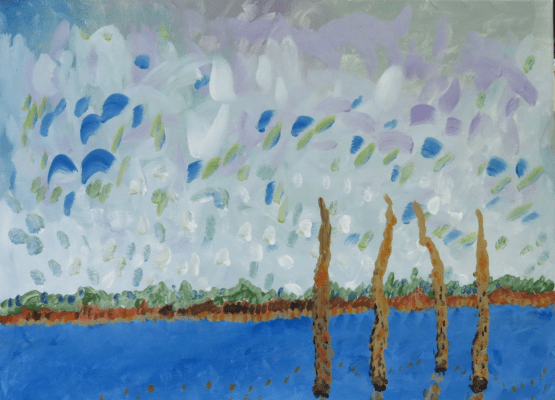
Pinot & Palette

weir 2.png

Kingsbrae 16.5
16 June 2017

Pinot & Paint

“Slap it on,” says the instructor,
“the sky first, various shades of blue,
darker at the top, lighter down below,
by the horizon line you dribble
across the bottom third of the page.
Add some white to lighten the blue
and maybe a little touch of yellow.
Now the landline, on the horizon,
brown first for the rocky shore,
a rub of green for foliage and trees.
Now, for the sea, take blues,
light and dark, mix them with a touch,
yellow, green and lighten them
a little with a touch of white.
Next come the cedar weir poles,
dark down below where the high tide
soaks them, lighter on top, use red
and yellow and a touch of orange.
Remember the shadows, and don’t
forget the way the poles are reflected
in the water, use broken lines for that,
matching colors. When you’re done,
just sign your name in the corner.
Finish your wine and cheese, now,
tell me: wasn’t that so much fun?”

Comment: We, the resident artists of KIRA, went to Geoff Slater’s workshop / studio to join in his Friday afternoon Pinot & Palette painting session. This was a two hour extravaganza with two glasses of wine, a cheese plate with bread and pickles, an empty canvas that we were obliged to fill, and a palette of acrylic paints with which to fill it. Geoff, the artistic director at Kingsbrae Gardens, led us step by step (as sequenced above) through ‘how to paint a picture’. The subject he chose for us was a fishing weir from Passamaquoddy Bay. He began by giving us a history of the weirs (click here for the appropriate poem) and their uses by the Passamaquoddy peoples and then he led us step by step through the painting process. At the end of the afternoon, the participants saw their paintings held up for all to see. They were mounted in a standard frame that highlighted the art as art. At the session’s end we parted with a great gift: our paintings, done by ourselves, and a deeper understanding of the history of the local region, the workings of the fishing weirs, and a deeper knowledge of how to paint. All in all it was a wonderful experience.
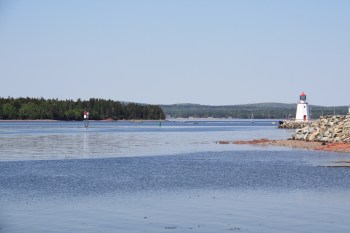
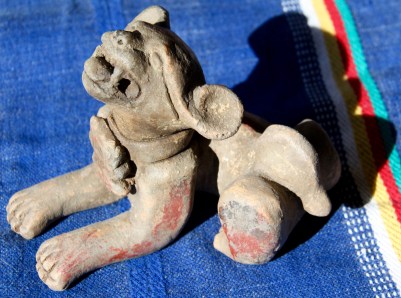
Weir

IMG_0233

Kingsbrae 16.4
16 June 2017
Weirs

Weirs are where the were-wolves
bay at midnight as they dance on
cedar weir-poles, stars above them,
the herring trapped, swimming
silent circles beneath the waves
while the white horses, prancing,
dancing, avoid bridle and bit and
the saddle’s leather shame placed
over wild, bucking backs, no blind
-folds here, just dumb fish, circling,
their DNA hard-wired for what
Vikings called their weird, or fate.

Stand Off

IMG_0170.JPG

Kingsbrae 16.3
16 June 2017

Stand off

Yesterday,
a raven and an eagle,
bald-headed,
faced off on the ice.

They stared at each other,
necks tucked into
hunched shoulders,
feathers fluffed,
otherwise unmoved,
unmoving.

Each dared the other
to make himself vulnerable,
to stretch out his neck
for the dead fish lying
beside the ice hole
they both guarded.

It seemed as if
they were waiting
for the opening whistle
that would send them
head to head
in mortal combat.

Immobile combatants.
Slow dance of moving ice,
cracked and crackling.
Sudden swift sparring:
a dance of death.

This Old Man

IMG_0067.JPG

Kingsbrae 16.1
16 June 2017

This Old Man

This old man, with his bundle of memories
carried on his back like a snail carries his shell,
a broken record, he played, with the gramophone needle
stuck in a groove and the same tales repeated.

The ancient  mariner who lives in his brain
stops people in the street and retells
the old story: life’s doldrums where
no winds blew and his ship just drifted,
with no wind to bring it home.

Then blew the wind of change, and suddenly
the sun was just as warm as it was in his youth.
The sea became blue again.  Flowers flourished
brighter, stronger. Birds chirped in the trees.
Light grew bright and he felt beauty return to
the new-born world of his second childhood.

Comment: My journal tells me that I wrote the original version of this poem on Friday, 21 April 2017, and posted it to my blog on Sunday, 23 April 2017 . Today’s rewrite changes the structure and tone of the poem and illustrates how time and place can influence any previously generated word sequence. For time and place we can also substitute attitude and change of heart, as Ludwig Wittgenstein suggests. More important, perhaps, our attitude and outlook can change with the weather and the state of our digestion. This is the same poem, then, written by the same person, on two different days. Or was it the same person? My stay at this residency would suggest that perhaps the person has changed along with his attitude, his outlook, his digestion, and the weather.