Here, in Island View, my lawn’s parched grass longs for water, long-promised but never drawing near. Do my flowers remember when the earth slept without form and darkness lay upon the face of the deep?
The waters under heaven gathered into one place. When they separated, the firmament appeared. Light sprang apart from darkness and with the beginning of light came the word, more words, and then the world …
… my own world of water in which my mother carried me until her waters broke and the life sustaining substance drained away throwing me from dark to light.
In Oaxaca, water was born free, yet everywhere lies imprisoned in bottles, in jars, in frozen cubes, its captive essence staring out with grief-filled eyes.
A young boy on a tricycle pedals the streets with a dozen prison cells, each with forty captives: forty fresh clean litres of drinkable water. He holds out his hand for money and invites the villagers to pay a ransom, to set these prisoners free.
Real water yearns to be released, to be spontaneous, to trickle out of the corner of your mouth, to drip from your chin, and fall to the ground.
It is a mirage of palm trees upon burning sand. It is the hot sun dragging its blood red tongue across the sky and panting for water like a great big thirsty dog.
Amnesia fades in these amniotic waters, moving in time to the water pump’s heart beat. I close my eyes. Nothing is the same.
Do I drift dreamily or dreamily drift? The tub’s rose-petals bring garden memories: primrose, bluebells, cowslips, daffodils dancing
sprightly in Blackweir Gardens or Roath Park, beside the lake or along the gravel paths where we used to bike, so many years ago.
Photos float before me, pictures of moments I alone recall. Spring in Paris, the trees breaking buds along the Champs-Élysées.
Santander in summer, walking the Piquío, Segunda Playa, beneath the jacarandas. Winter in Wales, up in Snowdonia where,
on a Relay Run to Tipperary, I ran down a valley between high hills, on a freezing night, with only the stars
to keep me company along a ribbon of road. Autumn in Mactaquac. An orgy of gaudily painted trees, leaves floating
on this first chill wind, to perch like sparrows, on my beloved’s hair. The look in her eyes as I catch a falling leaf and put it in her pocket to save it for another day.
Angel Choir (on seeing the Northern Lights at Ste. Luce-sur-mer)
listen to the choristers with their red and green voices light’s counterpoint flowering across this unexpected son et lumière we tremble with the sky fire’s crackle and roar
once upon another time twinned in our heavenly bodies we surely flew to those great heights and hovered in wonderment now our earthbound feet are rooted to the concrete if only our hearts could sprout new wings and soar upwards together
the moon’s phosphorescent wake swims shimmering before us the lighthouse’s fingers tingle up and down our spines our bodies flow fire and blood till we crave light and yet more light
when the lights go out we are left in darkness our hearts fill with dreams of what might have been
Between Two Places Dianne Fitzpatrick Where’s Home?
Where’s Home (3) Part III of an open letter to Jan Hull
The Little Things
In 1898, Spain fought and lost a war with America over possession of Cuba. Cuba was the last of Spain’s overseas Empire and when it went, the all conquering fatherland, upon whose empire the sun never set, was reduced to its original territory in the Spanish Peninsula. That same year, the literary Generation of 1898 started a new movement, one that made Spain itself central to its imagery and thought. Theirs was not the Spain of Imperial History, with its wars and treaties, battles and conquests. Theirs was the eternal countryside of Spain, the Spain of Old Castille that was rooted to the soil, and that had remained virtually unchanged in the small towns, fishing ports, and villages, for hundreds of years. This was the Spain of Miguel de Unamuno’s Intra-historia: the history of small things.
St. David, Dewi Sant, the patron saint of Wales, a historical figure flourishing circa 600 CE, is famous within Wales for his many sayings. But for me, one stands out. “Byddwch lawen a chadwch eich ffyd a’ch credd, a gwnewch y petheu bychainmewn bwywd” / Be joyful and keep your faith and creed and do the little things in life. In these times of stress and strain, faced by enormous changes brought about by the pandemic, to these prophetic words I turn.
Poets, creators, artists, stoneists, craft-workers of all kinds … we are the antennae of the people. We sense the directions in which life flows and will flow and we are ahead of our times, not behind them. We are the ones who ‘do the little things’, often abandoning larger, more financially rewarding projects in favor of smaller ones that spiritually enrich both us and the people around us. And that is what I am now reading in Jan Hull’s Where’s Home? People, real, live, flesh-and-blood people, many of them artists at heart, abandoning the big city’s rush and rock and roll to enjoy the quietude of small communities which they help to build with their own hands.
Troglodytes, cavemen, people living in the past, I have heard ‘so-called saner citizens’ mutter about some of our contemporary artists. They live off hand-outs and charity and welfare, and they live in the past. Grey-suited, working in concrete boxes, these well-heeled critics are all made out of ticky-tacky, as the old song says, and they work in little boxes, and they come out all the same. Fine fr some, but you certainly cannot say that of the characters who inhabit the small towns, villages, and ports, as Where’s Home? demonstrates so clearly, with quote after quote from contented people, all resident in Nova Scotia, some CFA (Come From Away), others CBC (Come By Choice), and yet others native to the province.
Living in the past … when Hurricane Arthur struck, we went without power for twelve days. No water, no warm food, no cooking, no refrigeration, no flush toilets, no showers, no air conditioning, no television, no Wifi, no internet … In 1928, my grandfather and my father built a summer home, a bungalow, in Gower. I remember, even in the late fifties, living there during the summer with my grandparents: wood stove, rain water barrels, no running water, outhouse, no electricity, no refrigeration, oil lamps … Hurricane Arthur … and Clare and I went back to bungalow living. Several of our neighbors did not know how to cope with the ‘problems’. A couple moved into hotels or stayed with family elsewhere until the crisis was over. As for us, this was the life I was used to as a child. We went into bungalow mode and had more fun than anyone could imagine… living in the past? … or preparing for the future? … Think about it, and don’t jump too quickly to the wrong conclusion.
Above all, Jan Hull’s book, Where’s Home?, has made me think. It has made me think deeply about my own life, my own memories, my own restless, rootless existence, my own attempts to settle and resettle. More, in light of the pandemic with so many working from home, so much home schooling, and so much online back and forth, maybe we, the artists, the returnees, the WAH (Work At Homers), maybe we are not stranded, forgotten, on the back-burners of modern life. Maybe, just maybe, we are the fore-tellers, the front-runners, the pioneers of how a better, more meaningful existence may be created and kept. Thank you, Jan, and please thank all your contributors on my behalf.
Where’s Home (2) Part II of an open letter to Jan Hull
I ended yesterday’s letter with the words “There is a brighter side too, and I will get to that another day.” This is the day, and the brighter side is the sacredness of place. The Celtic Nations believe strongly in the sacredness of place. In the old religions we believed that places held spirits who dwelt in the rivers and streams, who lived in the trees and the orchards, who were a large part of the spirit of place and sacred space. You can still read some of this innate pantheism in The Chronicles of Narnia. Irish, Scottish, Welsh, French … we all have Celtic roots and, like the First Nations of Canada, we still believe in the sanctity of the land. This is an old tradition and a worthy one. Not all great ideas were born in Western Culture post the Industrial Revolution. Many pre-date our so called modern culture. Some should replace it.
I believe very strongly in the power of place. Sometimes, turning a corner one day, we know we are home. This is the feeling that comes so strongly through the second chapter of your book, Jan. Yes, the Maritimes (NB, NS, and PEI) are home for many people. It is indeed their One Small Corner. their querencia. What is a querencia, you ask? Well, it is the place that calls you, the place in which you want to live, the place in which you want to die. And yes, in this time of pandemic, death is on all our minds: those twin realities, sickness and death. Neither is easy. These times are not easy. But they become easier for those of us rooted in our time and our place and, like it or not, the human being, male, female, or other, must live in a dialog with their own time and place. This is the chrono- (time) -topos (place) of the Russian Philosopher, Mikhail Bakhtin.
Life is so much easier when we are in our own beloved space. When we are out of it, away from home, down the road, that is when we suffer most, Sometimes we are still able to flourish. Oftentimes, we wither and perish, like leaves on the tree. You, in your book, Where’s Home?, have offered us a glimpse of what that one small corner, the province of Nova Scotia, means to your correspondents and the ones with whom you have held dialog. We are all of us richer for that experience. Thank you, Jan, and on all our behalves, mine particularly, please thank your contributors.
And this is the good thing, to find your one small corner and to have your one small candle, then to light it, and leave it burning its sharp bright hole in the night.
Around you, the walls you constructed; inside, the reduced space, the secret garden, the Holy of Holies where roses grow and no cold wind disturbs you.
“Is it over here?” you ask: “Or over here?”
If you do not know, I cannot tell you.
But I will say this: turning a corner one day you will suddenly know that you have found a perfection that you will seek again, in vain, for the rest of your life.
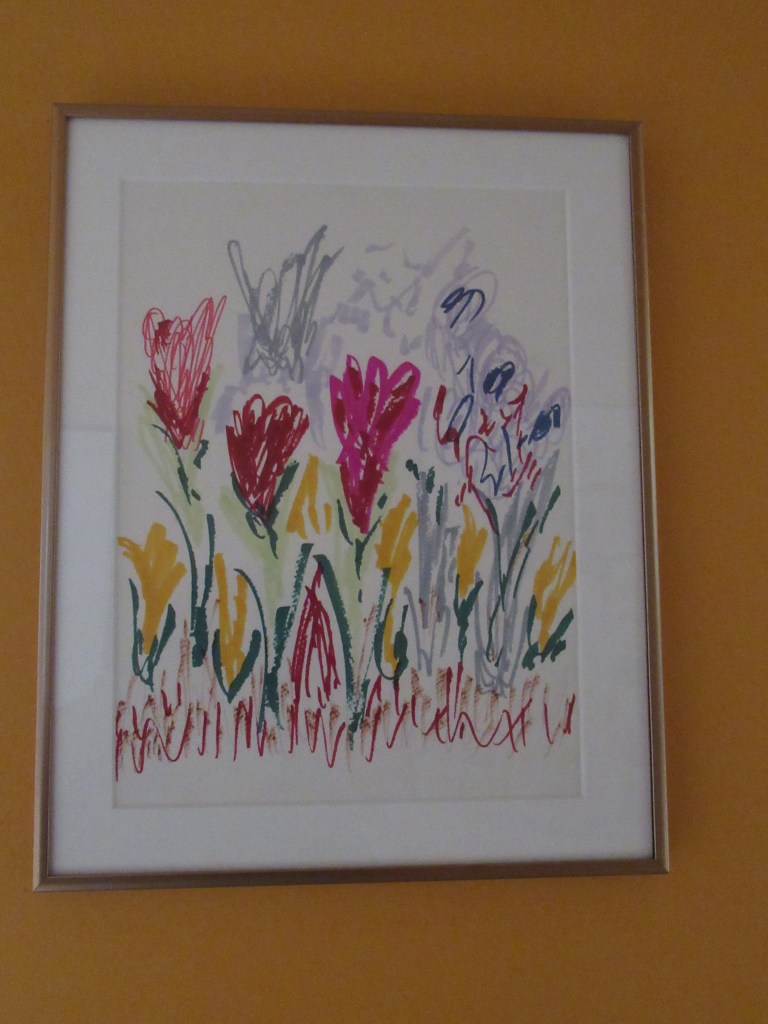
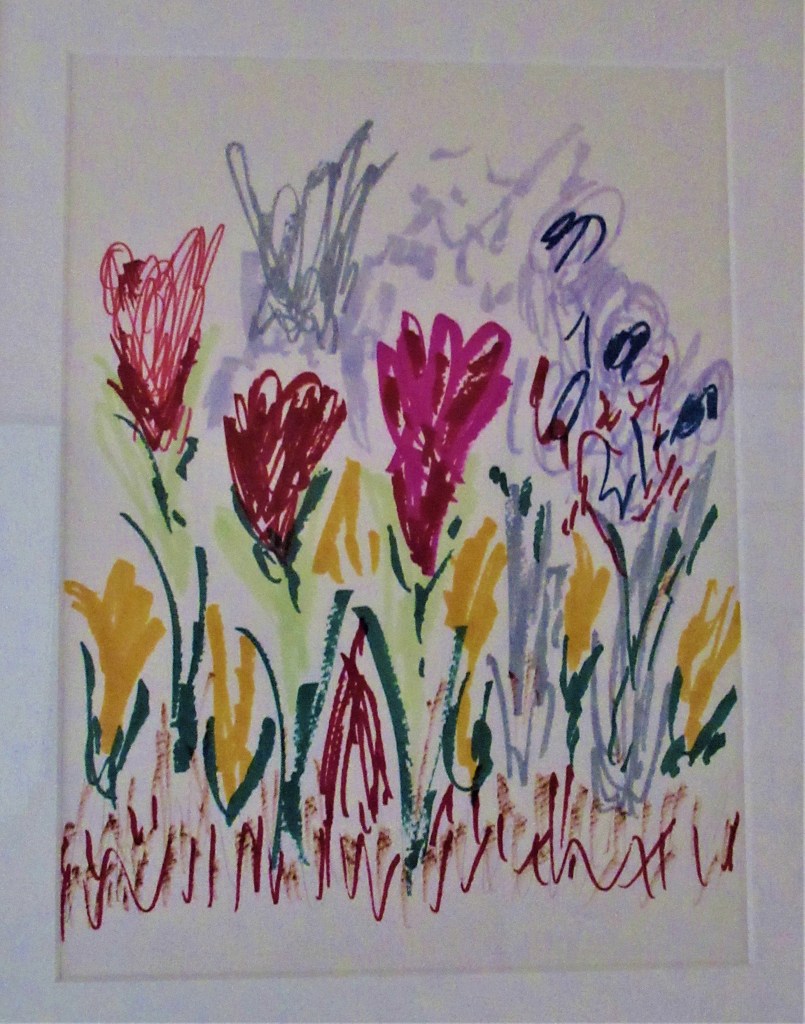
“The flowers that bloom in the spring, tra-la, bring promise of merry sunshine …” Gilbert and Sullivan, from The Mikado, if I remember correctly, and not at all anonymous like the Anonymous Bosch artist who painted this painting. Still, I like it, and it certainly lends a little bit of color to the pale cheeks of these walls.
“And we merrily dance and we sing, tr-la, as we welcome the promise they bring, tra-la, of a summer with roses and wine …” I can remember my grandfather singing that in the kitchen in Swansea. He would conduct with one hand, and encourage me to join in with the other. And I did. Merry days, they were, before the fire in winter and out in the greenhouse in early spring.
So, where have all the flowers gone? Gone with the grosbeaks, everyone. Which reminds me, I saw an Evening Grosbeak at the feeder this morning. The first one in years. There used to be several nesting nearby and they were regular visitors, as were the Gray Jays, aka Whisky Jacks, aka Gorbies, aka Ghosts of the Woods and all of them long, long gone.
Will they naw come back again? Who knows? The world is changing even as I sit at my window and watch it go by. February, March, April, May, June, and now July. The lock down has been lifted, but the fear of going unmasked in the great outdoors is still with us, as are the anonymous givers of the virus, a donation I do not want, and nor does anyone else, in their right minds, compus mentis, and not yet willing to on the anonymous ranks of the Gorbies, the Grosbeaks, the Swallows, and the other birds that have fled elsewhere, leaving our yard to the crows, the blue jays, the squirrels, the chipmunks, and the occasional more colorful visitors.
I can’t put a real ice-cream up here, it might melt and spoil the computers, yours and mine, so here’s a cardboard one instead!
… after my grandfather died I slept with my grandmother in her large double bed when I was there on my own … but when all the cousins were there we shared a double bed and three or four of us slept at the top and three or four of us slept at the bottom and we were so small and short in those days that our feet never touched in the middle and the bed was like an earth worm … an octopus earth worm with several heads and no feet … or all the feet in the middle … like a centipede … and sometimes my parents would have to snuggle in with us too … though we scarcely woke up when they arrived or departed … and with tears we would go tired to bed … and the grown-ups would promise that it was only for an hour or two … for a little rest … and we were so far north that the summer sun was in the sky until late at night … but sleep we did and they never woke us up … and we didn’t wake up until the dawn chorus of birdsong … bird after bird chirping and singing in the hedge with its bluebells and primroses … the hedge that divided one bungalow field from the other …
… and we were in the first bungalow field, which was the best one, obviously, because we lived in it … and there was another bungalow field behind us and we could look through the gaps in the hedge and occasionally there were gaps we could crawl through … but they were well guarded because there was an all out war between the two fields and we didn’t like the boys in that second field and they didn’t like us … and we fought our skirmishes through the hedge and at the gaps in the hedge and the people in the field behind us would rent out their bungalows to boys with strange accents who would be instant enemies the moment they opened their mouths or heard us talk and vice versa, the other way round … and it was the silent arrow or spear shot or thrown through the hedge … and the long trailing root set out to trip the unwary, and once we tied a rope across the field, a trip wire to trip those foreign warriors, and we meant to take the rope down before it got dark, but we forgot and we missed the enemy but we caught my father and all the uncles walking back home in the dark from the local pub … and didn’t they trip and all fall down in a great big squealing piglet pile … and the aunties thought it very funny because once they were down, they couldn’t get up again … and the aunties said it had nothing to do with the rope … that they were all falling down anyway, falling down all the way home from the pub they were, and stumbling … but we had hoisted our allies with our own petard and next day we were brought to justice and the justice was severe … and what, they said, if we had caught one of the farmer’s cows … and if it had broken a leg … then who would be responsible then, to the farmer, for payment, and we all hung our heads in shame for those days everyone was big on responsibility and being responsible was a big thing … and even the dog, our scout and protector, our war horse and chariot, for we were Ancient Britons that summer, sat there silent and serious and hung his head in shame at the hot bitter words and he wasn’t even wagging his tail … and the adult jury, twelve sober uncles, tried men and true, all pronounced us guilty and sentenced us to a day without cricket, a day with no jam on the bread, a day in which we must eat up all the greens, a day with no puddings, a day with no sweets, no treats, no ice cream …
… but summer was ice-cream! Who wants ice cream in winter when the hands are cold and the ice wind blows straight down from the Arctic? But in summer, to rob a child of ice-cream is to commit a capital crime against childhood … and the ice cream was miles away, and to run to get it and to bring it back before it melted was a rare adventure that had to be carefully planned … go to the end of the field, run through two sets of lanes, stop at the first ice cream shop and if there was no ice cream there because it had all been eaten by that awful foreign army, run another mile to the next shop … and if you were lucky there would be some ice cream there … and no we didn’t want cones … cones were for the babies … the tiny children who couldn’t control their ice creams … we wanted wafers, like the big boys we were, although we were all still in short trousers … and there were three penny wafers and six penny wafers, and even chocolate bars with thin chocolate on the outside and the ice cream inside … and there were lollipops and other marvels … like Cadbury’s ’99’ … but that day all this was forbidden … forbidden because we had set a trip wire for the enemy and caught, by accident, our very own men … oh the injustice, the burning injustice of it all …




 rogermoorepoet