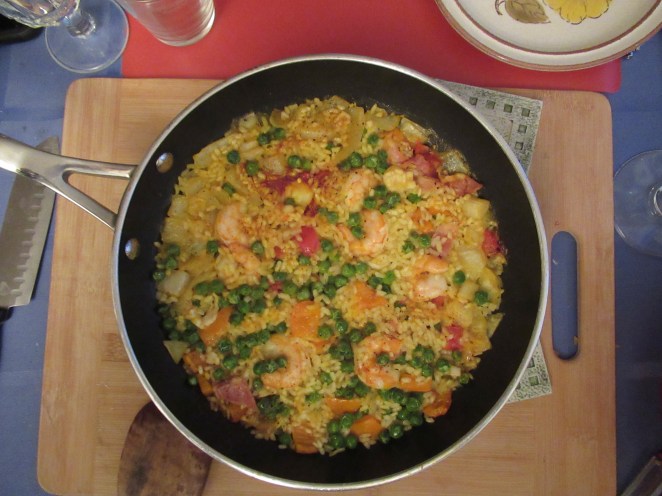
Latch-Key Kid

Latch-Key Kid

In one room in my head, I stand on a stool beside my father’s mother helping her to mix the cake she will later bake in the wood-fired oven of her black, cast-iron stove. Every time she mixes a cake, she places a small piece in a dish and bakes it just for me. As a child, I spent hours in that kitchen, watching her cook. When she boiled vegetables, she never threw out the vegetable water, but used it for boiling other vegetables or for making rich, thick, delicious gravy.

Later, with both my parents working, I became a latch-key kid. I spent all day in an otherwise empty house and cooked my own breakfast and lunch. I also prepared supper for my parents so that it would be waiting when they came home. I grew up loving to cook.

When I went abroad to spend my summers in Spain or in France, I spent as much time as possible in the kitchens, watching, listening, learning. The women always had time for a small child. Then men seldom did. Children should be seen and not heard. They just got in the way. That was the male attitude. I learned so much in those kitchens.

Later, in Santander, my landlady would place one egg, one onion, and one potato beside the stove. It didn’t matter what time I came back from a night out with the boys, my supper was there, a Spanish omelet, una tortilla Española, waiting for me to cook it. Sometimes she left me a piece of chorizo, but I preferred the omelets. I did enjoy making shapes and designs out of the chorizo – that was always fun.

Not many people knew about my cooking skills. One of my aunties always cooked for me. She told me that her husband didn’t even know how to boil an egg. The men in my family seldom cooked, except for my maternal grandfather, who learned how to fend for himself in the trenches and dug-outs during WWI. He taught me how to make stews and soups, rich and nourishing, and always better on the third day. He also told me what he put in them – and you wouldn’t want to know about what he hunted and scavenged to stay alive in those cold, dark days. Nowadays, so many of us just don’t know how lucky we are. I do know how happy and lucky I am, not to be homeless, not to be living out on the streets, dependent on soup kitchens, charity, and fighting the elements just to stay alive.

What could you do less of?

Daily writing prompt
What could you do less of?

What could you do less of?
I shall deliberately misinterpret that prompt / question and answer it my way. I could do less of listening to stupid adverts, repeated ad nauseam, sometimes with gimmicky tunes – one to two lines maximum – again and again, all day, every day. Surf the channels to escape an ad, and what do you get? A synchronized set up where almost every channel is blasting out the same, or similar, ads at the same time. Have you noticed that when you leave the TV room, and retreat to the kitchen to get some limited peace, the ads follow you because the volume is turned up at ad time so you just can’t escape.

I remember my grandfather, back in the sixties, with the advent of ITV in Wales – the Independent TV channel that used ads – sitting before the TV set, his foot up before the screen and his fingers in his ears so he would not be able to see or hear those ads. Alas, once heard, seldom forgotten, and I can still sing most of those meaningless jingles heard back in my childhood. How it I hate when I go shopping in the supermarket and shoppers tunelessly whistle a TV ad as they shuffle along behind their carts. Alas, ad free programming, all too often, is either expensive or non-existent.

And what about those telephone calls when they put you on hold until the next agent is free to attend to you? I won’t mention names, because I don’t want to get sued, but I guess we have all had the same experience. I had a ninety minute online wait one day, with horrible music, an exhortation to stay on the line so I wouldn’t lose my place in the queue aka line-up, and a 90 second ad that glorified the joys of the company’s product, repeated once every five minutes. I suffered through that ad 18 times on that one call alone. Another local firm gave me the similar treatment, except that it was a one minute ad, repeated once every ninety seconds. I suffered through 10 repetitions in a wait of 15 minutes, got fed up, and hung up the phone.

Look at the peaceful scene above. That’s the view from my bedroom window in Island View. Even the crows are absent, and the early morning silence, like the sun, is golden. Two birds with one stone – a morning person or an evening person? A morning person with dawns like this, but an evening person when a sunset like this one miraculously occurs.

What is one thing you would change about yourself?

Daily writing prompt
What is one thing you would change about yourself?

What is the one thing you would change about yourself?

Only one thing? I remember a story about a boy who boarded in a monastery school, and there, like the monks, they all changed their dirty habits once a week. So, is a dirty habit a thing? Probably is, if its a brown, sackcloth habit, tightened around the waist with a white cord by a man wearing open-toed sandals and no socks. So, there we go, once a week, on Wednesdays, like those monks, I also change my dirty habits. I also change my shoes, my socks, my shirts, my sweaters, my jeans.

More important, as I grow older, I have permitted myself to change my mind as often as I like. So, yes, I also change my mind, and not just on Wednesdays. And I really do change it when, like my habits, it gets dirty. “Oooh, you’ve got a dirty mind, you have.” “Well, so I do. Never mind, I’ll just go and change it.”

“What did Big Ben say to the Leaning Tower of Pizza?” – I’ve got the time, if you’ve got the inclination.
“How many ears did Davy Crocket have?” – Three – a left ear, a right ear, and a wild front ear.
“What’s yellow and deadly?” – Shark infested custard.
“What’s black and deadly?” – A crow in a tree with an AK47.
“When is a door not a door?” – When it’s a jar.
“What time is it Eccles?” – “It’s eight o’clock.” “Here, how do you know it’s eight o’clock?” “I’ve got it written down on a piece of paper.” “What do you do if it’s not eight o’clock?” “I don’t look at the paper.”
“Ding-a-ling” – That’s my ear ringing. I’ll just pick it up and answer it.
“What’s the first sign of madness?” – Hairs in the palm of your hand. “What’s the second sign of madness?” – Looking for them.

So what is one thing I would change about myself? Possibly the absolute necessity to tell awfully bad jokes. Easy to say – I’ll probably keep adding to these as I remember more of them. Take care – you have been warned.

“How many – men – does it take to change a light bulb?” – Five. One to hold the bulb and four to turn the ladder. Jokes like these can be good or bad. Good because they are occasionally funny. Bad, because it so easy to insert an adjective before – men – and to turn the joke into something more devious and not necessarily very pleasant.

“And that is the end of the gnus,” said the lion on BBC television, as he licked his paws. “Enough, no more. It is not as sweet now, nor as sour, as it was before. Pass the chow mean, please.”