Dolphins

Dolphins.png

Dolphins

Another life, another world, another dream …  dream of freedom perhaps. A great white shark, fifteen feet long, has broken into the peace of Passamaquoddy Bay. Yesterday, or was it the day before, he snagged a seal and devoured it before the eyes of tourists on a tourist boat. You can see the video on YouTube, but I won’t watch it. There’s too much violence in the world around me. Too much hate, illness, sickness, death, too many predators.

We have fallen in love with violence. Ketchup Violence I call it, because the victims get up after the shootings and appear next day on another eppy-sode, another video, another film. Except in real life, they really don’t. The shootings are real. The victims are really dead. And no, they don’t recover. Red blood is red blood and when we shed enough of it, and when the shock is violent enough, or the hit brutal enough, no, we don’t recover. Human blood is not ketchup spread on the french fries of old bones and recirculated later. It is ours, it is vital, and when it flows out, it does not flow back in.

Contrasts: the gentleness of the beginning, versus the harshness of the end. The hatred and tension that drives us on and on. Perhaps we should all join the army, for a year or two. “There’s no life like it.” We live in a bilingual country, at least, I do. “Pour ceux qui aiment la vie.” Or, as Socrates once said: “The unlived life is not worth examining.” So, join he armed forces: there’s no life like it. Pour ceux qui aiment la vie. Vietnam, Afghanistan, Iraq, Iran, Ukraine, Crimea, Yemen, Syria … where next, where ever next?

As Pink Floyd once said: Is there anybody out there?

Ghosts

IMG_1055 (2)

Ghosts

My grandfather would wheeze, then cough, as he leaned on the old black dresser in the Welsh kitchen with its vast, cast iron fireplace. “As black as the hobs of hell,” he would say, and “as warm as our kitchen.” It was full of nooks and crannies where pasties and pies could stay warm, soup cauldrons could hang from iron chains, and copper kettles could whistle wild tunes and call us all to endless cups of tea. Sergeant-major tea: so strong and filled with so much sugar that a tea-spoon could stand upright and never fall over. Gassed in the First World War, my grandfather was always out of breath and each time he coughed, he brought up a tiny part of his lungs. “One day,” he announced between wheezes, “there’ll be nothing left.”
Twice a day, my grandfather would roll up the newspaper and brandish it like a conductor’s baton. The first time would be when I came home from school and it was time to do my homework. The second time would be after supper when it was time for me to go to bed. Each time he rolled up that newspaper, he would tap it gently on the dresser to get my attention, and then he would speak those famous words: “Let battle commence.” I would fight to escape to the street to play with my friends. I would fight to stay on my feet and I never, never wanted to go to bed. I hated to be entrenched alone, upstairs, in the cold shadows of that ghostly no-boys-land where I could hear mice and rats scuffling behind the dugout walls and smell the sour smells of old age and illness that stalked my dreams.
“Up the wooden hill to Bedfordshire,” my grandfather would sing, conducting with his baton and pointing to the stairs. I was never afraid of him. He was dark, strong, tall, and very gentle, a great man in his own right, one of those tall men who would always stoop to help a little child. If I was too troublesome, he would start to cough. And if he started to cough, the pink phlegm would come and he’d spit it into the red and blue polka-dot handkerchief he always carried. The pink phlegm caused consternation and in the ensuing panic, I would bolt for the stairs, go up to my room, undress, put on my pajamas, and bury myself in the vast double bed I shared with my grandmother. My grandfather’s bed was in the middle room downstairs. I didn’t realize then, as I do now, that he could no longer climb those stairs up which I scuttled.
After a while, I left of my grandfather’s house and went back to live with my father. One day, my grandfather, as he prophesied, coughed too much and that was the end of him. After the funeral, my father took me back to see my grandmother. Aunties and uncles, cousins, family friends that I didn’t know, neighbors known and unknown, spilled over the house in an invasion of tears and grief. After the friends had gone, my father and I decided to leave and the family gathered on the doorstep to wave us goodbye. I waved back to them all. “Goodbye,” I shouted. “Goodbye aunties, goodbye uncles, goodbye grandmother.” I paused. My grandfather stood there waving to me. “Look: there he is. I knew he couldn’t have gone.” I pointed and waved. “Goodbye grandfather!”
“Don’t be stupid. He’s not there,” my father said. “He’s dead.”
“I can see him,” I said. “He’s there. I can see him.”
“He’s not there. He’s dead.” Tears ran down my father’s face.
Sitting here, writing these words, I can still  see my grandfather, standing on that doorstep, waving goodbye. And I can still feel my father’s long dead, shadowy hands reach down, grab me by the shoulders and shake me, shake me, shake me, until I too am crying and the ghosts of my milk teeth are again rattling in my head.


IMG_1063 (2).JPG


Things

18581930_1306791786107970_4016640231053970709_n-1

Things I carry with me

            That old black cast-iron stove, wood-fired, that baked the best ever breads and cakes and warmed the bungalow on cold, summer mornings. The Welsh dresser with its age-blackened rails that displayed the plates, and cups, and saucers. The old tin cans that ferried the water from the one tap located at the end of the field. Full and wholesome, its weight still weighs me down as I carry it in my dreams. The Elsan toilet from the shed by the hedge and the shovels that appeared, every so often, as if by magic, as my uncle braved the evening shadows to dig a hole on the opposite side of the field, as far from the bungalow as possible.

            The outhouse at the end of the garden. The steps down to the coal cellar where they went when the sirens sounded, to sleep in the make-shift air raid shelter, along with the rats and mice that scurried from the candles. The corrugated iron work shop in the garden where my uncle built his model ships, the Half-Penny Galleon and the Nonesuch. The broken razor blades I used to carve my own planes from Keil Kraft Kits, Hurricanes and Spitfires, an SE5, and once, a Bristol Bulldog. Twisted and warped, they winged their ways into nobody’s skies, though once we built a paper kite that flew far away in a powerful wind and got tangled in a tree. The greenhouse from which I stole countless tomatoes, red and green. Kilvey Hill towering above the window ledge where the little ones sat when there were more guests than chairs in the kitchen. The old bombed buildings across the street. The bullet holes in the front of the house where the Messerschmidt strafed us.

            The old men spitting up coal dust from shrivelled lungs. The widows who took in lodgers and overnight travelers. The BRS lorries, parked overnight, that littered the street. The steep climb upwards into those lorries. The burrowing under dirty tarpaulins to explore the heavy loads, and many other things. The untouchable, forbidden drawer where the rent money waited for the rent collector’s visit. The old lady, five houses down who, when the shops were shut, sold warm Dandelion & Burdock and Orange pop for an extra penny a bottle.  The vicious, snub-faced Pekinese that yapped fierce defiance from the fortress of her lap. The unemployed soccer referee who on Saturdays walked five miles to the match and five miles back just to save the bus fare, his only financial reward. My father’s shadowy childhood. His first pair of shoes, bought at five years old, so he wouldn’t go barefoot to school.

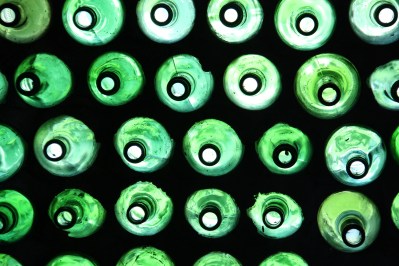
            Wet cement molded onto the garden wall, then filled with empty bottles to be smashed when the cement set solid. The coal shed where the coal man delivered the coal: cobbledy-cobbledy, down the hole. The outside toilet with its nails and squares torn from yesterday’s newspaper. The lamp-lighter who lit the lamps every evening as the sun went down. The arrival of electricity. The old blackout curtains that shut in the light and shut out the night. The hand rolled fabric sausage that lay on the floor by the door and kept the heat of the coal fire in the kitchen. The kitchen itself with its great wooden chair drawn up by the fire. That chair: the only material possession I still have from that distant past.

Wanderer

Wanderer
El Árbol de Tule

caminante.png

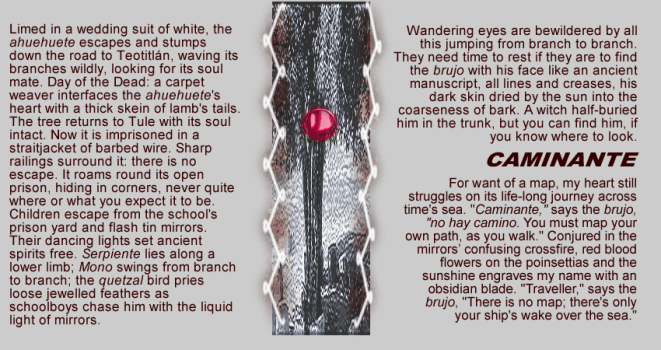
So many tales are told about the árbol de Tule, that thousand year old tree standing outside the city of Oaxaca. Hernán Cortés is said to have sat beneath it when he came to Oaxaca in 1525, or thereabouts. And it was old then, and famous in folklore. The tree is also famous for the pictures that nestle in trunk and branches. For small change, the little boys, released early from school, will point their mirrors up, into the tree, and spotlight with reflected sunshine the features that you seek. A thousand years, or more, have produced a thousand images, or more. Even the face of  Hernán Cortés himself is said to be captured somewhere along the tree-trunk’s art gallery, if you can only find it.

Like Borges’s eternal library, your own portrait can be found there, somewhere. You must search patiently for it, staring into the tree bark until it takes on your features. Then you can move on, knowing that whatever happens you will be caught forever in the life of one of the world’s wonders: el árbol de Tule. But beware of imitations and avoid the plastic imitations and the photos from cheap camera’s that will trap your soul forever, leaving no trace of you in the real world. Ignore these warnings at your peril, or you too will be locked into your cell phone and sentenced to life imprisonment within those digital walls.

Ghost Train

IMG_0251

Ghost Train

Old fair grounds, I remember them well, the coconut shy, the dodgems, the swing boats, what the butler saw, the bearded lady, the tunnel of love, the ghost train … with its skeleton that loomed out of the darkness, the spider webs that draped themselves over your face unless you ducked, the witch on her broomstick, cackling, the flashing lights, the eerie voices,  the laughter, the screams …

… I arrived early so I could sit in my usual place. I watched the men enter, tapping hesitant, unsteady, slow, leaning heavily on sticks. I saw the women bald and beautiful , naked skulls hidden beneath hats and head scarves. Haunted looks lurked behind staring, wide-open eyes as the outpatients waited for something to leap out and frighten them, not spider webs and skeletons,  but the ghastly visions of tubes, pills, chemo, needles, all the paraphernalia that tortured them first time round.

The annual check-up seems so much easier. Blood tests, screenings, fervent hopes that the devil in the detail, horned, fork-tongued, cloven hoofed, red tailed, hasn’t been hiding, like a wayward ghost, in the small print of blood tests, scans, urine samples, all too ready to break free, leap out and beat us once again into submission.

The ghost train: has that cancer really gone or could it come back, condemning us once more to hospice or ward, to chemo and radiation, to the knife, or to other things more radical?

I sniff the double hospital smells of despair and ill-health, of hope and cures for all those ills, and I am there again, arms folded across my chest, lying motionless on that moving bed of bleached white sheets, heading slowly into that tunnel that smells of polished steel, where machinery coughs and starts and stops as flashing lights whirl their cadences of kill or cure above my troubled head.

Tunnel of love or ghost train? I guess I’ll soon find out.

IMG_0265

Cell Phone

IMG_0135

Cell Phone

    Fingers slip across the telephone key board, pressing  wrong numbers or punching them in in the wrong order. Strange voices reply from the other end. This morning a woman spoke to me in a language I didn’t understand, Then a man came on the line and yelled at me in broken English to “Go away! Go away! Leave alone!” I imagined him tearing the telephone from his wife and berating her for answering this call from a total stranger.

    Often, I am too clever for my own good. I think I recall the right number for a friend, but when I punch it in, I find I have reversed two of the figures. I imagine other people doing that when they call me: “Sorry,” I say. “I think you have the wrong number.” “Is that 472 …?” they query. I say that it isn’t and they say sorry and end the call. Then they call me straight back and get the same answer.

    I hate running through my list of callers to get to the name that I want to call. But that’s what I have to do most days now. At least I don’t run into so many wrong numbers.

    And as for answering the phone … well … I am tired of robot calls, especially around election time. I am fed up with telephone surveys. I am driven crazy by heavily accented, high-pitched voices that call me from overseas, in the middle of the night or wake me early in the morning to tell me that my computer needs repair. “Suh, suh, we have discovered a werry nasty wirus [sic, or should that be sick] on your computer. Give me all your passwords and let me in to your computer and I will repair it instantly.”

    I have had calls from the telly-phony tax men who tell me the RCMP are about to knock on my door and arrest me if I don’t immediately give them my VISA Card number, passwords, and send them, right now, the $7,200 I owe them in taxes. I have grown to loathe the harbor boat hooter that announces I have won a cruise from Florida to Mexico on a super cruise ship …. probably a rusty tug boat that will take me twice around the harbor, be declared un-seaworthy, and leave me stranded, miles from anywhere, and paying a fortune to get myself home … and all I have to do, they say, is … I put the phone down. Click!

    I think it’s the marketing surveys that really get my goat though. I am no expert, but I have read up on surveys and designed some myself. What I love-hate about telephone surveys is the lack of real choice, the forced direction in which they push you, the pre-determined result on which the designers are fixated. I know it’s a waste of time, but I occasionally indulge: “On a scale of 1-5, where 5 is good and 1 is poor, how would you rate …” I explain that the question and the ratings do not work, but they are adamant that I must answer from 1-5. Yes, they understand that it can’t really be done, but yes, it must be done, because that’s what they are paid to ask me to do.  Click!

    O tempora o mores … the Latin phrase translates literally as Oh the times! Oh the customs! but more accurately as Oh what times! Oh what customs! or yet again, Alas the times, and the manners (Wikipedia). No wonder they call it a cell phone: all too often I feel I am a prisoner in the cell of the telephone system, incarcerated in my love-hate relationship with the cell.

Butterfingers

IMG_0730 (2)

Butterfingers

My fingers turn to butter, but they taste of nicotine, garlic, and soap when I bite my nails. These butterfingers encourage cups to slip, saucers to fly off, run out of energy, stall, and crash to the kitchen floor where they lie in broken pieces, resting in peace, waiting to be picked up, one by one, and buried in the waste bin.

Arthritic fingers, grown clumsy now, struggle with bottle tops and glass containers screwed up so tight they refuse to open, even when soaked under the hot tap. I stick those jars in door jambs, lid first, closing the door with one hand, and twisting the jar with the other. Sometimes it slips and crashes to the floor, often with a portion of the contents spilling out.

I hate layer after layer of plastic wrapping. Flagrant in its defiance, it wages its guerrilla war against these ageing, uncoordinated fingers. I am often forced to use a knife, but a knife can slip or twist so easily. Occasionally, blunt, it will not even penetrate indomitable, multi-folded Saran wrap. So many slips between plate, teeth, and lips. Multiple precious items drop to the floor.

I cannot always bend to pick them up, and I cannot easily grasp them, not even with my new mechanical claw.

Memory

IMG_0437 (4)

Memory

By the time I remembered your name, I had forgotten your face. Then I couldn’t recall why I wanted to talk to you. I trace dark landmarks on the back of scarred hands: blood maps, unremembered, encounters with door knobs and unseen furniture, dust covered photographs, grey, grim, anonymous, hanging on the walls, not belonging in any family album. At night I cruise among islands, emerald green against sapphire seas. Why didn’t I visit these places when I was able to? Golden sand trickles through night’s fingers and time’s hour glass trickles out as stars sparkle and planets dance in Platonic skies. My memory is gradually fading into the distance, like a sailing ship leaving harbour. Each day, I wave another couple of memories good-bye. Each morning I wake unaware of where I have been the night before. It’s not that I sleep walk, just that things pass me by in the blink of a blurred eye. I still track the sails of drifting ships. I think of them as white moths, caught in overnight traps, chloroformed into oblivion, their bodies sometimes soaked in formaldehyde. Occasionally they come to life in the morning, batter their wings briefly against my fingers, leaving them covered with the finest moth-dust, before fluttering away into dawn’s forgiving light. I give chase with pen and paper, the worst of butterfly nets for wild thoughts waiting to be caught, then tamed. I stare at the mesh of the snow-white page and strive to grasp something just beyond my fingertips, trying to decipher it and deliver its message, but I can’t quite remember what it is.

Moon Walk

IMG_0456 (2).JPG

Moon Walk
Friday Flash Fiction

Full moon over the Bay.  For the second time this month I walk along the wharf and watch the moon’s perfect disc as it creates over the bayside mountain its miracle of geometry: a golden circle balanced on a high triangle of rock.  Moonlight carves its golden pathway across the waves. I want to walk that walkway and end my earthly existence.

At night, in my boarding school, that grey stone prison where I spend interminable days and fearful nights, lying awake, I watch the moonlight as it moves across the dormitory walls.  I lie awake so I will not be caught napping by those stealthy footsteps followed by the rough, punishing hands that still haunt my dreams.

Is that a face I see in the moon?  Is that the grinning visage I see in the beer glass on the Guinness advertisements that adorn the railway tracks behind my parents’ house where I am sometimes permitted to eke out my existence? In boarding school, the masters observe me. The prefects and monitors observe me. The school bullies observe me.  But in geography class, they have never taught me that the lunar body observes me with its unwinking eye.

I watch the moon as it swims in the water.  I sense the movement of the night fish as they shimmer beneath the waves and a shiver moves a chill finger up and down my spine. The moon is the other, the other that faces me, speaks to me, reasons with me, the unfathomable other. But what am I other than one of these cold fish swimming silent beneath the waves?

It’s very quiet tonight down here by the docks. I have been in this city for six weeks now and I still have no friends. There’s always a glass barrier into which I bump at various intervals. I do not leave for another six weeks, that’s what my tickets say anyway, but I am thinking of changing that.

Here, on the wharf I stand in the shadow cast by the Customs House. I taste the bitter salt of homelessness and I know that I will never belong in this world.

I look across the water. How beautiful is the bay beneath the moon.  I look up at the hills from whence cometh my salvation.

My grandfather walks towards me over the waves. He helps me choose stones and pebbles, helps me to fill my pockets with them. He takes me by the hand and gives me courage. He and I walk down the slip way, hand in hand, and then we walk out across the moon path and into the sea.

Hair of the Dog

IMG_0040 (3)

Hair of the Dog

I awoke to the dog’s tongue licking my hand. When I moved, he jumped off the bed, ran to the door, turned and barked. The hall clock chimed six times, early for me to get up, but I did because I needed a pee. The dog followed me into the bathroom, whimpering. Street noises seemed louder than usual. The dog started barking again and a voice called out from the hall below.
“Anyone home?”
The dog clattered down the stairs woofing wildly. Still in my pajamas, I looked over the balustrade to see the milkman standing below.
“Hello,” he said. “The door was open and I just dropped in to see if everything was all right. Where’s your mother?”
“In bed, asleep,” I dug with my index finger at the sleepy crackling gathered in the corner of my eye.
“Not if I know her,” the milkman said. “She’s run off again and taken a bottle with her. You’d better get dressed.”
I scowled at the milkman, went back upstairs, and looked in my mother’s bedroom. Her red flannel nightie lay in a heap on the floor by the unmade bed, with its rumpled sheets and pillows all higgledy-piggledy. The bed felt cold beneath my fingertips and the clothes she had worn the day before had gone.
“I’ll get dressed,” I shouted. “I’ll just be a moment.”
“Sure,” the reply floated up the staircase.
“You’re right,” I said to the milkman as I met him at the bottom of the stairs. “She’s gone.” The first rays of sunshine touched the stained-glass windows above the door, and fragmented colors danced with dust motes, turning the milkman’s white uniform into a harlequin suit of lights.
“Not the first time she’s gone AWOL,” the milkman winked at me.  “She’s got quite the reputation round here. You’d better go out and find her. I bet she’s in the park with the others. That’s where she goes when the mood takes her. I see her sometimes when I’m in the milk float. I’d take the dog, if I were you. He’ll find her. He usually does.”
The dog whimpered as we got to the end of the drive. I checked my watch: 6:30 AM. The early sun slowly sliced through the morning’s damp creating rainbows in the mist. I shivered.  The milkman waggled his fingers in a silent good-bye and his electric milk float hummed then lurched out into the street with a clinking of bottles.

I stood at the roundabout at the corner and didn’t know which way to go.
“Find mum,” I said and patted the dog’s head. He wagged his tail, put his nose down, turned right, and set off down the main road towards the city center.
Shadows danced on the lower ironwork of the locked park gates. A child’s swing creaked gently in the breeze. The dog sniffed at the gates, lifted his leg on them, gave them a generous squirt, then put down his nose and tugged at the leash.
I followed the dog as he went past the gates and pulled me towards a hole in the hedge, just large enough to squeeze through. The dog whined with excitement and pawed at the gap. I followed pushing aside the bushes.
The dog whined again and tugged me towards a sort of mound that lay on the nearest park bench. Newspapers offered scant warmth to the body that they covered. A hand hung down and the dog licked it frantically. I touched that hand and the dog’s lick joined us in an unholy matrimony. Beside the sleeping figure on the bench, an inch or two of what appeared to be whisky huddled at the bottom of a forty-ounce bottle. Other empty bottles lay on the wet grass, like spent cartridges, some of them pointing at the woman’s head.
Shuffling feet had worn down the grass where the woman lay. I saw traces of blood on bandages and empty syringes. Some needles had been wiped on the pair of torn pink panties that peeped out of the grass.
The dog continued licking at the woman’s hand then stopped, pointed his nose at the sky and let out a single, piercing howl.
I shook my mother’s shoulder.
“Mum, Mum,” I called, but she didn’t move. She was locked in a land where I dared not follow her. I took out my cell phone and called the police.

They arrived with a park attendant who opened the gates and let their car in. They took one look at my mum and called for an ambulance. When it got there, the ambulance men examined my mum, said she was alive, put her on a stretcher, and carried her to the ambulance. I told them I wanted to accompany my mum to the hospital.
“Not with that dog, you don’t,” the driver replied. He got in, started the engine, turned on the siren, and pulled away.

I took the dog home, called for a taxi, and it took me to the hospital. When I got to the room in which they had caged her, she was unconscious. She never woke up.
I buried what was left of my mum ten days later, after the autopsy.