Garbage Day

image1 (17) - Copy.jpeg

Garbage Day
(1789 AD)

all the dustbins
dancing down the street
trying no doubt to achieve
a spring time copulation
so they can give birth
to even more dustbins

you can’t have a revolution
without dustbins
dusty … dusty … filthy
dusty dustbins
a sadistic way to look at
dustbins full of sawdust
heading off down the street
between potholes
and blowing bins
a right Danse Macabre
conducted by
St. Vitus

me sitting there knitting
Montreal Canadians
this Red Cap
I keep flying high

even though I stand
upon Gibraltar’s Rock so fair
not to mention Paris
the Place de la Bastille
with tumbrils rattling

Old Moll in a Moll’s Cap
toothless fairy
at a Goblin Party
watch out
for toad s’tools
[sick this poem
this joke

and all that’s in it]

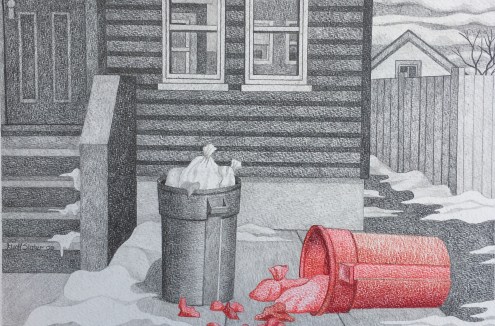
Comment: A wonderful drawing by my friend, line painter Geoff Slater. The poem, of course, represents the garbage in (and out of) the garbage can. 1789 is the date of the French Revolution. I found this poem in my discard file, so it was one of those that didn’t make it anywhere. Maybe it shouldn’t have made it here either. But it takes all sorts to make a world and Geoff’s red dustbin reminds me of the red caps knitted by the old women beneath the scaffold and the guillotine. Funny things, guillotines: invent them and they drop on you when you fall out of favor. There are so many allusions in this poem that I am ashamed to say I remember them all, and not all of them are pleasant. Mind you, few things are pleasant nowadays and remember: it is better to leave your dustbins out to roam the streets and be plundered by the crows and swept away by the high winds than to leave them festering and smelling bad and all cooped up in the locked down garage.

Daffodils

IMG_0617

Daffodils

My daffodil day-dreams carry me back to Wales, that Land of Song where every valley conducts choirs of daffodils and their pale, brass voices are raised in an annual springtime hymn of hope. Beneath the trees, in Bishopston Valley, between Pyle Corner and Pwll Ddu, sheltered bluebells tinkle sweet tunes, lilies-of-the-valley bloom, and primroses raise their faces to the sky while hearkening to those springtime airs that sound where’er you walk. In Blackweir Gardens, the Feeder Brook flows into the castle moat and the castle’s central keep stands on the mound the Normans dug when they converted into a motte and bailey the old Roman camp that was built on an earthworks constructed by the Silures long before that countenance divine shone forth upon these clouded hills and long before the Roman came to Rye or out to Severn strode. Generation after generation, all those who witnessed the birth of these flowers and strove to be the first to hear the cuckoo’s call, come alive again in this floral tribute. Oh, Land of Song: the bluebells may have gone, the larks may sing no more, cuckoo and cowslip may have fled the valleys, but all is not lost, not while the daffodils still toss their heads in sprightly dance and spring breaks out its freckled sunshine.

Comment: Win some, lose some. Survival is all. At the same time as I mourn everything  that is lost, I also celebrate all that survive. The grosbeaks have left us, moving further north as the weather warms. They have left more room for cardinals and hummingbirds have moved in to replace them, as have turkey vultures. Turkey Vultures, Zopilote, The Trickster, in Oaxaca, the bird that flew high up into heaven, stole the fire of the gods, and brought it back on his wings, now flies over the St. John River Valley, having moved up here with the warmer air from the south.

“The olde order changeth lest one good custom should corrupt the world” … indeed it does. And we must mourn and celebrate the olde order while preparing for, and celebrating, the arrival of the new. For the world has changed and is changing as I sit here and type these words and it will have twitched and changed again by the time you read them. Who knows exactly what is coming? How do we prepare for the unknown? How do we open our arms and embrace an uncertain future? Good questions all. I cannot answer them for anyone but myself, but I must ask them. Many of them were discussed today by Suzanne Moore in an article entitled: The way we once lived is now redundant. We must reinvent ourselves. Read it and start thinking about how we can be strong, daring, caring, and best prepare ourselves, not for our own extinction, but for our own reinvention.


Southern Platform

Southern platform2.png

Comment: The wind that whistles through Island View today carries snowflakes and ice pellets that pitter-patter across the window. The wind brought in clouds, grey wisps of drapery that curtained the sky. When the wind falls silent, the trees continue to wave and thereby fan the air into action and the wind starts up again. Yellow sunshine, warmth, the sun in Mexico, in Oaxaca, in Monte Alban where the danzantes dance in stone and my friends and I wander at will among sunshine and shadow. On grey days like these when I crave the sun, I conjure images of Oaxaca, its warmth and its mysteries of mescal, that early-morning spinner of inner myths, word music, and magic metaphors.

Lamplighter


img_0218

Lamplighter

When I was very young, many of our streets still had gas lamps.  The lamp-lighter would appear in winter around three or three-thirty to light those lamps. I remember him walking up the street with his long pole over his shoulder, moving from lamp to lamp. We had one outside our front door. He would turn on the gas, then light the lamp from the lighted wick at the end of his pole.  Sometimes he carried a ladder with him. Then, every so often, when the lamp needed tending, he would climb the ladder and adjust the wick. These gas lights were not very bright but they stood out like light houses between stretches of darkness and we would walk from pool to glowing pool, as if they were stepping stones leading us up the hill to home. We all knew the lamplighter and he would often wave to us as we sat in the front room window to watch him walk by. We rarely saw him in the mornings when he came back to turn off the lamps. We were all tucked safely into our beds. I remember that I wanted to be lamplighter. Later I realized that there are many ways to light a lamp and spread brightness through the world. When I qualified as an academic and a teacher, I became a lighter of a very different set of lamps.

IMG_0262

Comment: I discovered this prose poem in an old and dusty manuscript. I can’t even remember when I wrote it. Prose poems: I discovered Charles Baudelaire’s Petits Poèmes en Prose in a small bouquiniste along the banks of the Seine when I studied French in Paris during the school year I spent in France, 1962-63. I have always loved his prose poems and I have always wanted to write some of my own. That I did, and then promptly forgot about them, is one of the wonders of my creative life. How could I forget these creations? Funny: reading what I wrote back then takes me straight into the front room in my grandmother’s house in Brynmill. She would sit in the bay window playing eternal games of patience and together we would eat grapes, peep at the cards, wait, we didn’t know for what, and watch the light slowly fade. Nobody ever told me my grandmother had cancer. She died from it one day when I was away at school and when I came home for the holidays, she just wasn’t there. Her chair and her table were still there, but her warm presence, her loving kindness, had all gone. I never had a chance to properly say good-bye to her. Maybe these belated words will serve that purpose.


Purple


different kinf of doorway

Purple

 I write poems
in green ink,
but I prefer
purple.

Bruised clouds
on an evening sky,
dark depths
of a rainbow glow,
Northern Lights
singing at the deep
end of their scale …

… or just a desire
to be different …
slightly different …

as if that one thing,
the color of my ink,
might tip the scales
and turn me
from mediocrity
to celebrity

with a wave
of a violet wand,
or the click
of a pair
of ink-stained
fingers.

Comment: Juan Ramón Jiménez, Nobel Prize winner and author of Platero y yo, wrote a book entitled Almas de Violeta that was published in purple ink. He also wrote a book, printed in green ink. I used to have copies of them in my library, but alas, I gave my library away, so I cannot check for the title. I often wonder whether the color of the ink makes any difference to the quality of the writing. Same question with the keyboard or the pen. Some things seem to come more easily on keyboard or screen, but really, there is something about the smooth flow of pen and ink across the page that is enchanting just in itself. Now, back to my revisions for I am not just a writer, I am a re-writer. So off I go.

Hope

image1-1

Hope

Faith, hope, and charity
help us see with much more clarity.

We have faith in a vaccine cure,
though when it will happen,
we can’t be sure.

Charity comes from the rank and file
serving in supermarkets with a smile,
doctors and nurses work the day round.
On night shifts too, they can be found.

The garbage men, patrolling the street,
keeping homes and gardens neat,
tidy, clean and rubbish free,
helping to restore our sanity.

Police and army play their part
keeping us six feet apart,
doing the work we cannot do,
helping all not just the few.

Essential people, women and men,
bringing life back to normal again.

Comment: Many thanks to line painter Geoff Slater for this wonderful drawing from Scarecrow, one of my favorites. Scarecrow is a joint production between Geoff and I, with his drawings illustrating my story. This is the moment when Scarecrow dares to dream and hope that he will soon find and dance with his own beloved. Even in this current world of stress and sorrow, we are still allowed to have our hopes and dreams. Dream on my friends. Hope on. Hopefully this nightmare will soon be over.

Writing a Poem Video


cropped-39948917_706398923049634_3046174897211441152_o-1.jpg

Writing a Poem

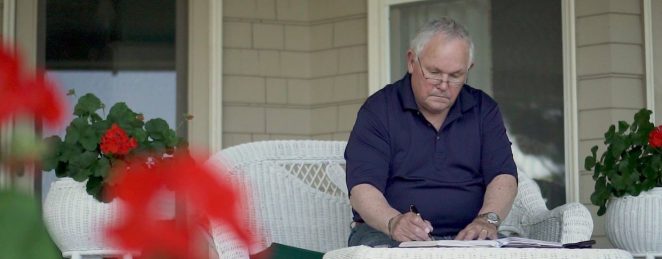
The KIRA artists (Roger Moore, June, 2017) were invited to make a video on the ways in which they worked. Here is my KIRA video. This is the first time I have ever made a video of myself. I am not into selfies (wrong generation) and had to be ‘persuaded’ to do this. The instructions were simple: something easy that anyone could do under lock down or in a home-schooling situation. I hope you enjoy the show!


Life is a Dream

cropped-img_0279-1.jpg

Life is a Dream

This life is nothing but a dream.
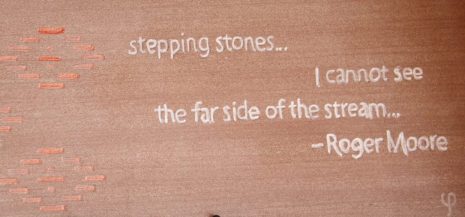
I cannot see the far side of the stream.

Life is a frenzy, a fiction, a story,
sometimes a romance filled with glory,
often a nightmare, bloody and gory.

We seek for answers, no confusion,
but all of our life is an  illusion.

We are but shadows in Plato’s Cave:
reality is what we crave,
but all we get is an early grave.

I’m not the first person who has said it,
but I’d love to take full credit.

Comment:  So many things here. My photo of Jan Hull’s carving that adorns my web page. It is carved in stone, Old Welsh red sandstone, unlike these ephemeral words. Thank you Jan. It links to Segismundo’s soliloquy from Calderón de la Barca’s La Vida es Sueño. I have adapted that piece to the current pandemic because Spain has instructed its people to wash their hands in time with this soliloquy.

¿Qué es la vida? Un frenesí.
¿Qué es la vida? Una ilusión,
una sombra, una ficción,
y el mayor bien es pequeño,
porque toda la vida es un sueño,
y los sueños, sueños son.

What is life? A frenzy.
What is life? An illusion,
a shadow, a fiction,
and the greatest good is small,
because life is a dream,
and dreams are nothing
but dreams, after all.


Spring

IMG_1786 (2)

Spring

Slow going
this snow going
but at least
it isn’t snowing

Snow forecast
on the weather show
but we know
it cannot last
now the equinox
is past

With a roll of drums
Easter comes
but friends and family
stay away

so all alone
and safe at home
we’ll spend
our Easter day

Everybody understands
how often we must
wash our hands
and all our friends
must safely stay
at least six feet away

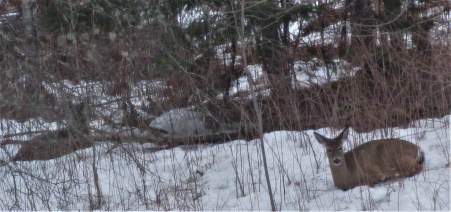
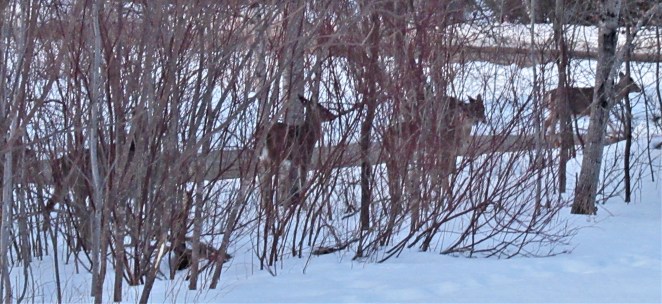
Comment: They are difficult to see, these deer nesting at the bottom of our garden. There are at least three of them, all safely distanced, the clever little things. The poem was written as a challenge from a friend. More about that later. Keep safe, keep well, keep six feet apart, keep hoping! Spring will eventually come. The drawing below is by my friend, line artist Geoff Slater. It is one of my favourite illustrations, taken from Scarecrow.

image2 (1)


Deer

IMG_1783 (2).JPG

Deer
CV-19 Day 24

I woke up this morning, looked out of the window at a grey, sunless day, and saw this deer at the foot of the garden, abut 50 feet away. I couldn’t believe it. Thirty years we have lived in this house, and I have never seen a deer sleeping in the yard before. Well, it wasn’t sleeping. It’s eyes were open, the head was turning, and the ears flickered with every step I took. What a way to start the day.

IMG_1786 (2).JPG

Then I did a double-take and blinked. What I thought was a rock, to the first deer’s left, was another deer, also lying down. I realized it wasn’t a rock when it wiggled its ears. Behind the first deer and above it, scarcely visible among the trees is a third deer. You’ll have to look hard to see it, but it’s there. I apologize for the qualities of the photos, but grey day, early morning light, and shooting threw fly netting at a well camouflaged deer does not guarantee high artistic quality, as you will understand.

IMG_1784.JPG

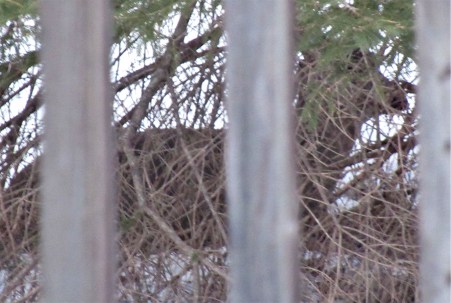
Actually, the third deer is more clearly visible in this photo. It also shows a little bit more of the late-winter / early spring landscape. Then, when I got downstairs, lo and behold, a fourth deer underneath the fir tree. From a lower angle, I could only just sight it through the bars of the porch.

IMG_1787 (2).JPG

Again, my apologies: but what a morning … four deer, ‘nesting’ in the garden, where I have never seen deer before, except wandering through.

IMG_1740 (2).JPG