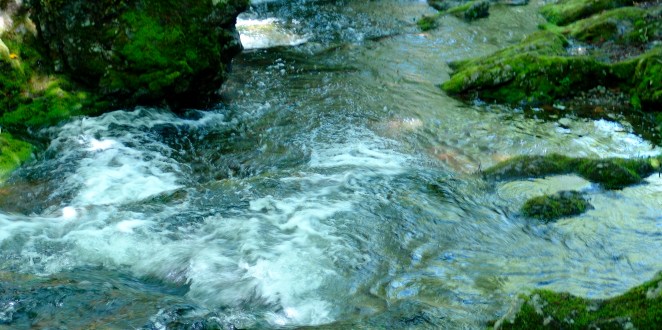
Carved in Stone

Carved in Stone

28

The man who cannot cry
is dry indeed,
his inner space
a wasteland without rain.

Who can now walk forty days
in a desert wilderness,
without water?

Where is that crystal fountain,
with its healing streams
flowing from the rock,
its waters flowing through us,
bringing us tears of sorrow
and tears of joy.

Water and words –
they drift through me
and shadowed waves move,
shifting shape in the changing light.

29

A rising moon,
shimmers over the bay.
It reveals the path
that leads me back
to my primal waters.

Oh, salt flow of tears,
salty the waters
of the baptismal font
washing away all stain of sin.

Immersion in water,
a new start, a new life,
and all the soul-sweet eternities
of water and the word.

Commentary:

Water – such an important commodity, and filled with so much symbolism, religious and otherwise. And our bodies, on average, are composed of 60% water. We can survive for three days without water, if we are lucky. How precious it is. How much we depend on it.

The Bay of Santander, so beautiful beneath the moon. And I remember the full moon’s circle touching a rocky triangle as it rose above Peña Cabarga. Oh, the night life of the fish as they rose in the bay and basked in the moonlight. How often was I tempted to walk out along that moon path and walk the waves to Somo and Pedreña on the far side of the bay.

Immersion in water, a new start, a new life, and all the soul-sweet eternities of water and the word. Total immersion, then, not just in languages, but also in water. Where would we be without those life-long commitments, not to mention the crystal fountain whence the healing streams do flow?


Bay of Santander – 1963

Bay of Santander
1963

I stood there
on the sea wall
calling out to the dark
“Help!” “Save me!”

Moon hid her face
behind veiled clouds.
All hope denied
I called out to the tide,

outgoing, to take me
with it, out to sea,
past the island
and the lighthouse,

out to where the waves,
stronger than anything
I ever knew, would thrust
strong fingers under my arms

and lift me up,
then drag me down,
so I could finally rest
in peace, and drown.

Comment:
This painting is called Picking at Scars. Some scars run so deep that they are always there. When they itch, you scratch them, and they bleed afresh. The scar of loneliness is one such scar. Alone, in a foreign land, learning their language, the culture, their customs, feeling not just unaccepted, but unacceptable, and the moon at night shining on a land, a bay, a city, to which you know, deep in your heart, you will never belong. That loneliness walks with me still and, sixty years later, it still leaves me desolate.

Cave Paintings

Spotify
Don’t forget to scroll down to appropriate audio episode.

Cave Paintings
Cantabria

Who painted these pictures on the walls of night’s cave?
This grayish hand, fingers flexed, outlined in black soot,
that deer dancing, those bears, horses, bison, running?


Did they come from nowhere, plucked from nothing but
the artist’s memories of what he saw as the ice age faded
and heat and warmth returned to warm his world? Drawn
from life, without doubt. Unless these Neanderthals were
truly creating art from a literal vacuum with nothing new
invented since according to Picasso. And he should know.

Imagine them as sounds, as letters from distant relatives,
as colored vowels scored on the blocks of a child’s first
alphabet set. Sit and stare. Watch flames flitter over
sharp shapes. See life enter the drawings as flimsy
light flickers over the cave walls’ dips and bumps.

Once seen, never forgotten. Not just the paintings, but also
the clammy cave damp, the red hanky draped over a pocket torch
to imitate firelight, the drip of water, slow growth of limestone
deposits growing into stalagmite and stalactite. Such things
flit in and out of my mind like owls or bats, drop in on my sleep
wake me with predatory beaks and claws, calling for my skull’s shut
doors to open wide, to let them in, and to bring them back to life.

Comment: The picture comes from an ash-tray my parents bought at the Cuevas de Altamira, in Santillana del Mar (Cantabria, Santander as it was known then) in 1963. We visited many cave sites in Cantabria including Puente Viesgo, where we saw the sooty hands. Back then, the caves had only just been opened. At Altamira, a young lady came to greet us. We asked her if we might view the caves and she whistled loudly. Her husband came down from the fields where he was working. He took a large iron key from his pocket, opened a huge door set in the rock, and in we went. One light bulb illumined the inner chamber. Only a small segment had been dug out. We reclined on a rocky bank. He doused the electric light, took a torch from his pocket, and covered it with a red pocket handkerchief. He moved this back and forth to imitate firelight and immediately the whole wall came to life and the animals moved in the flickering light. Pure magic. Unforgettable. We were the only people there. Four of us. A few years later, you had to book an appointment and a place. Within six years, the caves were closed as the heat of human bodies raised the cave temperatures and caused the paintings to deteriorate. I was so fortunate, so privileged, to see those paintings in what was almost their pristine state. In 1991, I visited the facsimile of the caves built in Madrid. I paid my money, went in, sat down, and came out crying for all those things we had lost, for all that beauty that had been denied.

Time

Spotify:
Remember to scroll down to the appropriate audio episode.

Time
A Theory of the Absurd

I wonder what I’m doing here, so far from home, sitting
at the bar, with my beer before me, my face distorted
in half a dozen fairground mirrors, surrounded by
people half my age, or less, all smoking, cursing, using
foreign forms of meta-language, gestures I no longer recall:
the single finger on the nose, two fingers on the forehead,
the back of the hand rammed against the chin with a sort
of snort of disapproval. It’s way beyond my bedtime, yet
I am held here, captured, body and soul, by foreign rhythms,
unreal expectations of a daily ritual that runs on unbroken
cycles of time: morning brandy, pre-lunch wine and tapas,
home for the mid-day meal, a brief siesta, back to the café
for a post-prandial raising of spirits, more blanco, then back
to work at four and struggle on until seven or eight when
the bar routine begins again with pre-supper tapas and tinto.
Time, comprehended in this new life-cycle, lacks meaning.
Time, in a cycle I have long abandoned, is absurd as well.