Four Geese

15 May 2002 Pre-Rimouski 020

Four Geese

Early this morning,
high above the car
in the sky’s giant highway,
four geese flew overhead
honking.

 A welcome sign of spring,
they reminded me of summer sunshine
as they framed themselves
for a moment in the moon roof.

“Remember those happy days,”
they seemed to cry
as they carved their sky path
far above my head.

 I remembered a moonless night
with the admiral out ahead
steering by the stars
and, seemingly sightless,
the great flock following.

That night
I pinpointed their calls
leaning back, looking up,
straining my neck,
and for a moment
there were no stars,
just a feathered blackness
shutting out the Big Dipper
as it hung in the sky
above the river St. John.

 At Montmagny,
on the St. Lawrence River,
the great white geese
will soon be gathering.

White on their arrival
they will drift like snow
and accumulate on the land.

 Alban angels,
harbingers of spring,
guardians of summer’s perfection.,
they too will blotting out the sky
and leaving me breathless,
overwhelmed
by my many memories.


Metatheatre: Wednesday Workshop

img_0177

Metatheatre
Wednesday Workshop
22 March 2017

It sounds complicated and, in the ivory tower of academia, it can be. Wikipedia describes metatheatre (or metatheater), as describing “aspects of a play that draw attention to its nature as drama or theatre (theater), or to the circumstances of its performance.” A more complex description of metatheatre and its effects follows.

“Metatheatre” is a convenient name for the quality or force in a play which challenges theatre’s claim to be simply realistic — to be nothing but a mirror in which we view the actions and sufferings of characters like ourselves, suspending our disbelief in their reality. Metatheatre begins by sharpening our awareness of the unlikeness of life to dramatic art; it may end by making us aware of life’s uncanny likeness to art or illusion. By calling attention to the strangeness, artificiality, illusoriness, or arbitrariness — in short, the theatricality — of the life we live, it marks those frames and boundaries that conventional dramatic realism would hide. It may present action so alien, improbable, stylized, or absurd that we are forced to acknowledge the estranging frame that encloses a whole play. It may, on the other hand, break the frame of the “fourth wall” of conventional theatre, reaching out to assault the audience or to draw it into the realm of the play. It may — by devices like plays within plays, self-consciously “theatrical” characters, and commentary on the theatre itself — dwell on the boundaries between “illusion” or artifice and “reality” within a play, making us speculate on the complex mixture of illusion and reality in our ordinary experience. Any theatrical device can work metatheatrically if we sense in it a certain deliberate reflexiveness, a tendency to refer to itself or to its context in a more general mode: to theatre itself; to art, artifice, and illusion; and perhaps above all to language as such. (Quoted from https://courses.cit.cornell.edu/engl3270/327.meta.html)

While metatheatre is usually connected with the theatre, it occurs in other areas as well. Miguel de Cervantes, for example, uses it as a device early in the Quixote. Don Quixote returns from his first venture to find that his library has been boarded up and no longer exists. When he asks how this has happened he is told that a magician appeared on a fiery dragon and magicked the library away. DQ is left wondering how and why these sage enchanters have picked him for an enemy and delight in tormenting him. At one level, this is comic. At another, it is tragic. Metatheatre often has this tragi-comic edge to it. Comic: that anybody would believe the lie in the first place; comic when the reactions of the deceived are viewed in light of the lie. Tragic when the fabric of the real world is destroyed by deceit.

Later, in Part One of the Quixote, the priest and the barber set up an elaborate play in which they act out their roles as supplicants to the knight. The priest is saved from the necessity of wearing an ox-tail beard by the appearance of a beautiful young lady who plays the role of distressed maiden to perfection. In this play within the novel, the plan is for Don Quixote to be persuaded to return home under oath and not to wander anymore. Of course, it all goes wrong with emphasis throughout on the comic, rather than the tragic, nature of deceit believed.

In Part Two of Don Quixote, published some ten years after Part one (1605 / 1615), metatheatre takes on a more sinister role. In the castle of the Duke and Duchess, an elaborate theatrical plot is laid out in which Don Quixote and Sancho Panza are the principal actors. Crucial to this plot is the episode of Clavileño in which DQ and SP are blindfolded, set on the back of a wooden horse, and flown to the moon and the stars. Lies within lies within lies: the entrapment and enhancement of madness, and who is the real madman when the mad lead the insane on a spectacular and fictitious dance?

Again, when Sancho receives the long-promised governorship of his island, the cruelties, beatings, purges, and indignities that descend upon him in the name of a third party’s so-called humor, make him walk a thin tight-trope between comedy on one side and tragedy on the other. And what can we say about the appearance of the Knight of the Woods and the Knight of the Mirrors? Real knights (apparently), out of time and out of place, as mad as the madman they are baiting, and they bait him by challenging him to fanciful, dressed-up jousting duels on horse-back. Mind you, the ‘they’ is fictitious too, since ‘they’ are yet another character, a single character, who engages falsely in two different but equally fictitious roles.

As with all academic and artistic concepts, much depends on how you define and frame your terms. At its most simple level, metatheatre is crying wolf. When the little boy cries “Wolf!” he creates a situation in which other people believe the lie (there is no wolf) and come running to the rescue. Of course, when the wolf does appear, the boy cries “Wolf!” but nobody believes him. That is when comedy turns to tragedy and the boy and his flock of sheep are devoured. There may be amusement as the elders of the village mill around looking for the wolf, but there can be no comedy when the elders are absent, or refuse to turn out in force, and both sheep and boy disappear down the wolf’s dark throat.

So, in addition to crying “wolf,” one can set out simple or elaborate plans to enmesh other people in a new and mendacious reality. By distorting this reality so that the false appears to be true, we get metatheatre, even though there is no theatre present, save in the minds of those, manipulators and manipulated, who are engaged in the action. All of these things are used in literature, both poetry and prose, to create theatre within theatre, plots within plots, deceits within lies. But what happens when we encounter the same thing, not in literature, but in real life?

In exile from the land of my birth, I come face to face with doubt and fear. I am deceived by my senses; in what can I put my trust? I am subject to delusions. I cannot separate wakefulness from sleep nor dreams from reality nor the truth from these pictures I create in the wood-fire’s flames. And in my philosophy book I read that “… there is no earth, no heaven, no extended body, no magnitude, no place and that nonetheless I perceive these things and they seem good to me. And this is the most harrowing possibility of all, that our world is commanded by a deity who deceives humanity and we cannot avoid being misled for there may be systematic deception and then all is lost. And even the most reliable information is dubious, for we may be faced with an evil genius who is deceiving us and then there can be no reassurance in the foundations of our knowledge.”

René Descartes wrote those last words to express in philosophical terms what Cervantes, and other members of Spain’s literary circles, especially the theatre, had created in literary terms about fifty years earlier. Spain’s Golden Age may be a long way away and it may even have been re- named the Early Modern Period, but the danger of the application of a literary device, metatheatre, to real life is ever-present.

What if our world is indeed commanded, not by a deity, but by a human being, or a set of human beings, who deceive humanity on a regular basis? What if there is systematic deception? What if the most reliable information is dubious and we can no longer trust it? What if we are faced with an evil genius who deceives us with misinformation, disinformation, false knowledge, and outright lies that destroy the foundations of our knowledge? If such is the case, when our knowledge is suddenly without foundation, then we are indeed in deep trouble.
Not On My Watch!

img_0141-2

Not On My Watch!

The black-and-white cat
sits in the window and watches
the ginger cat who lounges on the porch
and watches the five deer
who stand in the woods at the garden’s foot
and watch the neighbor’s little dog
who watches the raccoon
who disdainfully removes the garbage can lid
and fishes out the food, scattering
paper and wrappers and cans
as four crows sit in the tree and watch
the wind as it whistles the papers
round and round in a windmill
that wraps itself round the feet
of another neighbor who is watching
the raccoon with open-eyes
as a seagull flies above him
and bombs him from above,
damn seagulls, and the bird poop
falls right on my neighbor’s watch face
and he cries out
“Oh no, not on my watch!”

Red Star

empress-077

Red Star

“Fly me to that red star,
the one outside the window.”
Teddy’s voice droned
its mosquito in my ear,
but made no sense.

“I’ll try,” Owl said.
I hadn’t noticed him there,
snuggled in beside me.

“That’s not a star,” I said.
“It’s a planet, Mars.
It’s in conjunction with Venus,
that other bright blob.”

Owl flapped his wings
and flew out of the window.
Up and up he went
until he faded out of sight.

“He’s gone,” said Teddy.
“He’ll never come back.”

But return he did and
“A star too far,” he said,
as he pulled up the blankets
and snuggled into bed.

“It’s not a star,” I said,
but my words were ignored
by the snores emerging from
two nodding, sleepy heads.

The Return

Avila 2008 003

The Return

I opened the car door
and he ran across the parking lot
and jumped into the back seat.

“Where have you been?” I asked.
He thumped his great tail, sniffed,
and licked the hand I placed on his shadowy head.

As we drove back home, he thrust his head
between the seats and placed his paw upon my shoulder.
Then he licked my ear and the side of my face.

I pulled into the garage and let him out of the car.
He raced to the end of the drive, surveyed the neighborhood,
and drilled an invisible pee into the snow.

I whistled, and he ran back to the door,
whimpering and scratching, impatient.
I held the door open and he bounded in.
“You’re back home now,” I told him.

He ran to the cat’s bowl and lapped some water,
scoffed her kibble, and lay down in his usual place.

At night, he lies beside me in bed,
a fluffy spoon carved into my body’s curve.
In the morning he walks through the kitchen
and doesn’t make a sound.
The cat senses he’s there and bristles and hisses
at rainbow motes dancing in the sun.

He’s sitting beside me now,
head on my knee, as I type these words,
one-handed, because I’m scratching him
in his favorite spot behind the ear.

Vixen


IMG_0190

Vixen

Meductic,
New Brunswick.

She climbs up from the head pond
a ripple of red and orange over the highway.

 As quick as a fox, they say:
black socks, brush winter-thick
held high and proud,
as quick as a shadow
melting into dark woods
on the highway’s far side.

She is followed by her cub
who is not quite as quick.
He is struck by a truck
and ground into the gravel.

 The fox-stink of memory
clings to my nostrils
like slow-motion death
dreamed at night
frame by bitter frame
.

 Now a night-time of silence
falls from the lips of fading lovers.

Raccoon

IMG_0080.JPG

Raccoon

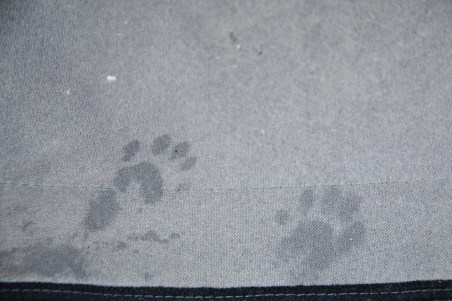
Two footprints on the dew damp chair
show that he has been here.

We know he visits at night.
The cat wakes up, jumps off the bed,
leaps to the window, and hisses.
Then she falls silent.

The raccoon steals food from the feeder
and shuffles the pottery shards
we leave out to gather water for the birds.

We never see him.
Sometimes we hear him grunt;
occasionally the wind chimes rattle furiously
as if caught by a giant gust..

We peer into the dark,
turn on the outside lights,
but his absence greets us
like a long lost friend.

Last night, nothing:
this morning, an empty feeder,
those footmark in the dew on the chair:
we know he was there.

Full Moon Fading

IMG_0033

Full Moon Fading

Full Moon fading outside my window
still draws up water, attracts high tides,
drags the wolves by their drawstrings
struggling, bedraggled, out of my chest.
Soon to be invisible, they clutch and claw
as they climb the moon path’s golden light.

The piper has paid his rent and packed
up his pipes, leaving me at last alone.
A silence rules my lungs. Five deer stand
silent in the woods beneath my window
and I watch them as they watch the piper go.

My body’s house lies drained and empty.
The Fading Moon flushed out my body,
leaving it high and dry like a great white whale
abandoned, breathless, on a summer shore.

It’s all over now, the cough, the splutter,
the sharp reality, the aches and pains
that told me I was alive. I miss my music.
I miss the swish and roar of my incoming,
outgoing breath. I miss those Full Moon
fingers tinkling the tides of my inner being,
making me strive to keep myself alive.

Pibroch

img_0385img_0385

Pibroch

This morning, the bailiff, Mr. Kovdrop,
evicted the two gnomes from my lungs.

Landlord Bodie placed an ad on Kiji
then rented the free space in the left lung
to a tiny piper who took up residence by my heart.
This piper piped a pibroch, sad to play,
on his worn and wheezy bagpipes.

A pack of miniature wolves infiltrated
the midnight forest flourishing in my other lung.
When the pibroch played, they pointed their noses
at that spot in my throat where the full moon
would have been, if she could have broken in.
They mingled their howls with the bagpipes caterwaul
and I lay awake all night with my heart beating
arrhythmic suspicions on its blood red drum.

The drum played, the pibroch wailed, the wolves howled
and my body lay scarred by an absence of moon and stars.

Intertextuality: Wednesday Workshop

Intertextuality

Intertextuality is the dialog that takes place between texts or as Merriam-Webster explains it: “the complex interrelationship between a text and other texts taken as a basic to the creation or interpretation of the text.”

Often we write from an intertextual perspective when we respond to other writers and their thoughts and imagery. This is why, in the creative process, reading can be as important as writing. Reading expands our vocabulary. It reinforces some of our own opinions and challenges others. Without reading, we are lonely rocks in sunless seas.

To be creative, we need to be aware of what others are writing and how they view the world we inhabit. When we read creatively we read with an eye to improving our creativity and our structures. We look for new ideas, new images, new words, new ways of expressing our thoughts.

Often we think we are being original when in fact we are re-processing, just as I am now, the ideas of other people. Given the nature of modern media, we are not always aware of all the multiple sources of our material: telephone, twitter, blogs, radio, television, newspapers (less and less), books, chapbooks, magazines, e-sources, lectures, chat groups, Facebook, and general conversations with other people who are also unaware of their sources. Thus ideas abound, float in the air, circulate and recirculate, submerge and resurface, shift their shapes and colors.

As writers we dip into that enormous moving mass of current and past culture and creativity and we choose our narrative lines, our characters, our structures, our images, our metaphors. As Jean-Baptiste Poquelin, better known as Molière, once wrote, “Mes idées? Je les prends où je les trouve.” My ideas? I take them from wherever I find them.

Imitation is the best form of flattery. Indeed it is. We cannot, however, borrow wholesale and just copy. Miguel de Cervantes borrowed the first five chapters of Don Quixote (the first sortie) from an earlier entremés entitled El Entremés de los romances. For a very long time, critics thought that Cervantes was the author of both pieces: they are very similar. However, even a quick analysis also shows that they are very different. The language of the entremés is much older while the conversion of theatre into narrative distinguishes them at a very basic level. Cervantes borrowed: but in borrowing, he adapted, he changed, he took the old form and converted it into something new and completely original. Nevertheless, we are still aware of the origins of the great novel that has many other borrowings woven into its fabric.

So, we indulge in intertextuality when we engage in a dialog with other texts and ‘borrow’ from other authors. To be original, we have to take that borrowing and turn it into something entirely different, something that becomes a part of ourselves and no longer exists as a part of that other text. Intertextuality is not copying. If we take a text in its entirety, if we ‘copy’, then we must acknowledge the source. However, when we indulge in a dialog with a text, when we transform a text, when we are ourselves transformed by a text, then that is a totally different situation. Think of the links between Akira Kurosawa’s 1954 film, The Seven Samurai, and its offspring, the 1960 western entitled The Magnificent Seven. They are very similar in so many ways … and yet they are so very different.

While intertextuality refers more to the larger elements of character and narrative structure, it also exists at the level of metaphor and image. Sometimes, without thinking, we use metaphors that we have heard before. Often we like the sound of a group of words, shuffle them around, and come up with a new meaning for them, a new metaphoric reality. This too is intertextuality.

At its best it is a very valuable addition to our creative tool kit.

While on the topic of creativity, let us spare a thought for our needs for creative time and space. We cannot create when we lack the blessings of time and space. Creativity is greatly hindered when we go hungry and need to complete back-breaking work just to sustain our lives and feed our families. Our relative wealth and leisure is a blessing: without them, we would be floundering in the pre-industrial world of subsistence farming, working at manual labor from dawn to dusk.

Let us spare a thought too for those oral societies that existed when people could not write. Or those early societies in which only the few, the happy few, were educated to the level at which they could actually read and write.

Intertextuality is a blessing, not a curse. Use it wisely, use it well.

Comment: I would like to thank Meg Sorick who suggested that I expand an earlier conversation that we had on the topic of Intertextuality. If you have other literary topics that you would like me to investigate, please suggest them to me and I’ll see what I can do.