Letter to a friend

Letter to a friend

The Beetle Crusher
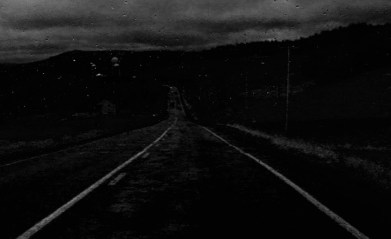
Railway tracks:
two parallel lines
joining together
in that impossible distance:
the single line
a mathematical mystery.
Boys crossed the tracks
walking here and there
on Sunday outings,
or cross-country runs.
Nobody ever saw it,
but they all knew it was there,
that unexpected train,
the one that crushed the beetles,
too slow to get off the rails.
One boy swore
he heard it once,
the Beetle Crusher.
He said it had
the cobwebbed hoot
and whistling wail
of a ghost train
entering a scary tunnel.

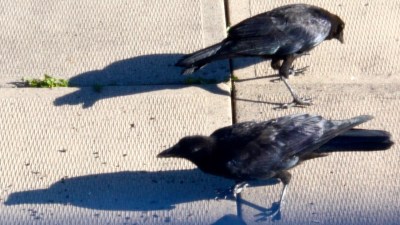
Crows
commas
full stops
exclamations
periods
rain
drops
blossoms blur
censers
those branch ends
bending
beneath water
Van Gogh
flourishes
yellow
orange
red berries
distorted
on the rowan
black streaks
the crows
clogged
their wing
flaps
flying
from what
corn field
glistening
with gold

Telling a Tale
Wednesday Workshop
21 February 2018
Story telling: we all tell stories. We have told stories for thousands of years. Later we learned, as intelligent human beings, how to remember our stories by writing them down. People tell stories. They also sing stories. The singer of songs. The teller of tales. But we must never forget the oral tradition.
The oral tradition is fascinating because it is not a fixed medium: it is a very flexible one. As each tale is told, repeated from mouth to mouth, so it changes, a bit at a time. Do you remember the old story of the British soldiers in the trenches of WWI? They passed their orders whispering from man to man, mouth to ear. Legend has it that the original order “Send reinforcements, we’re going to advance” was all too easily corrupted into “Send three and four pence, we’re going to a dance.”
The oral tradition may be said to corrupt its stories. Singers who claim that they always sing their songs exactly the same way have been shown, by the objectivity of tape recordings, to alter their words at different times in different performances. Ramón Menéndez Pidal, that famous Spanish medievalist, proposed the term poeta-pueblo, the people as a poet, for the oral transformation of poems, especially the ballads / romances of the romancero, that were revised and polished and improved as they circulated orally.
Several people that I have spoken to recently (or corresponded with online) have suggested that they have problems writing their stories down. They confuse the writing process, a very slow one, with the telling process, a much quicker one, and one that is amenable to rapid revision. So, a suggestion: if you are having problems writing your story, try thinking it through, plotting it in your head, not on the page. Think before you ink. And repeat constantly so that when you write, you know what you want to write.
Using this very simple, very traditional method, stories can be told, revised, polished … and then they can be written down. It takes some practice, but practice makes perfect, and thousands of years of literary and creative history must be respected. Become a story teller once more. And when you have told your tale, multiple times if necessary, write it down.
Whatever you do, do not confuse telling a story with the critical adage “show don’t tell”. Once you have told your tale, once it is on the page, then you can rewrite, revise, restructure, layer, improve, polish, intensify or simplify to your heart’s content. Remember: you can do this on the page (long and slow) or in your head (fast and furious). Personally, I use a combination of both methods. Try the oral method: you may like it.
Keep experimenting. Remember, you must choose what is best for you. Best wishes. Keep writing. Don’t get off the bus.

Iceberg
yesterday
part of my life
broke off
a glacier calving
an iceberg
floating free
my
tongue tip
tip-toes
round
my mouth
touches
the tooth
I cracked
I look
in the mirror
wrinkles
mask
my face
I no longer
know
the man
I see
I fear
each sharp-
edged scar
each violent
abrasion

Change
summer walks
garden paths
footprints of flowers
green dreams
wind-lisped grass
multitudinous tongues.
bright birds
morning bells
midsummer madness.
forced feeding
a million beaks
and bellies
cloudy morning
a chill in the air
rowan berries
bright yellow
little red faces
crab apples
bending branches
winter never far
fear of frost
always upon us

Bilingual
I went on a French immersion course last week. The instructor asked each one of us to address the class for ten minutes in French. When my turn came, I stood up and announced that I didn’t know what to say.
The instructor then suggested I tell the class about my dreams. What do you dream of? I said that I didn’t have any dreams, I just had nightmares, not rêves but cauchemars, you know, nightmares. She asked me to describe my nightmares and I said I couldn’t. So, she repeated, describe your dreams. I don’t have any. Do you dream about your mother? Yes, I said, but I don’t call them rêves / dreams I call them night-mères / cauche-mères, sometimes couche-mères. Couche-mères, the instructor repeated the word. The look she gave me: finger-nails scraping down a chalkboard. She turned her headlights on me and I sat there, frozen in the twin beams emanating from her eyes. Yes, night-mères, I repeated, because I set myself goals, not just dreams, achievable goals, and then I have night-mères, inspired by my mother, who says I will never achieve any of my dreams, because they are not her dreams, the ones she has for me, and they are the only ones that count.
You are here to speak in French, the instructor said, and you must speak French for another five minutes. So I told the class about the seals in the Parc du Bic in Quebec. The seals are like a plague, I said, like mosquitoes, only bigger and nastier, quite vicious, in fact. So the people who made Off to keep the mosquitoes away designed a new chemical spray that would keep the seals away. Now the French for seals is phoques, and since this is mainly a problem in Quebec, at the Parc du Bic, and not elsewhere, they called their product, you guessed it, Phoque–Off. It’s quite simple to use, I said. It’s a spray, not an ointment, and you point the spray in the general direction of the seals. Then you squeeze the button and loudly say “Phoque–Off” at which point all the seals slide off their rocks with a little splash and vanish into the sea, leaving you alone on the beach. I have tried it myself, I tell them, and I know it works so I highly recommend it to anyone who is plagued by seals.
I still don’t know why she threw me out of the class.
We have been spending time at our cabin.
~

~
In the window, on our bench, the light flows through green bottles.
~

~
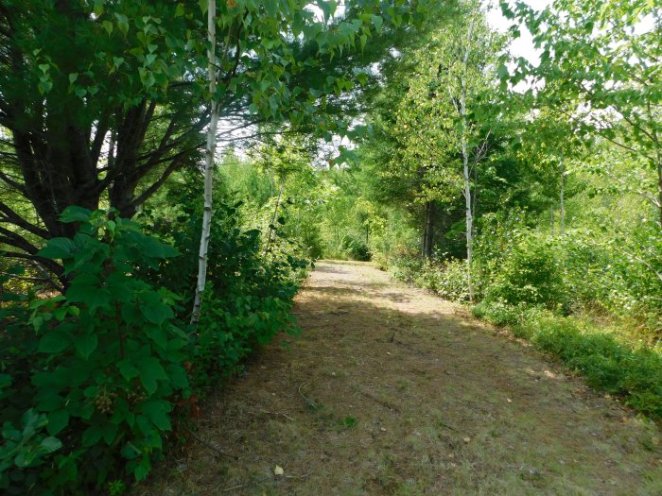
Our paths are green tunnels.
~

~
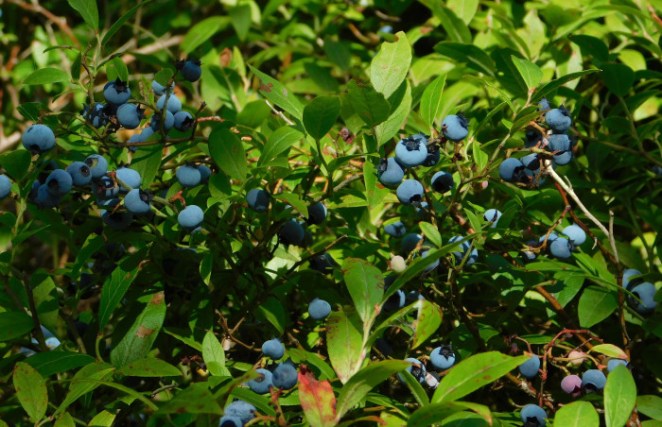
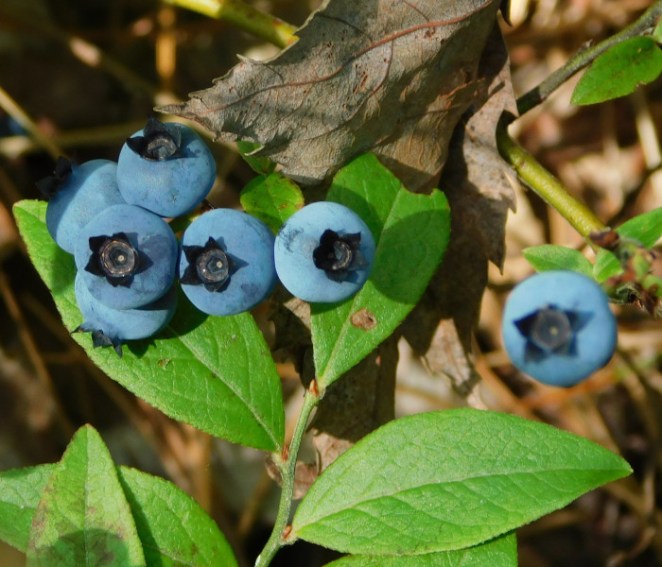
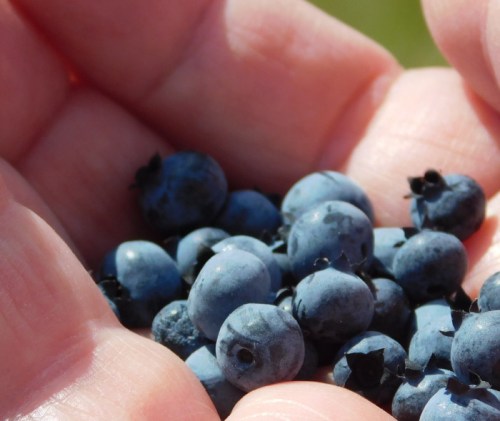
And in the fields and along the trails are blueberries.
~

~
Lots to pick and eat.
~

~
~
for Mom
~
of all the silvery summer days we spent none so warm sun on granite boulders round blue berry field miles across hazy miles away from hearing anything but bees
and berries
plopping in the pail
~
beside you I draped my lazy bones on bushes crushed berries and thick red leaves over moss dark animal trails nudged between rocks berries baking brown musk rising to meet blue heat
or the still fleet scent
of a waxy berry bell
~
melting in my mouth crammed with fruit sometimes pulled from laden stems more often scooped…
View original post 56 more words

Change
Summer walks along the garden path,
imprinting its footprints of flowers.
Green dreams wander the wind-lisped
grass with its multitudinous tongues.
Bright birds toll the morning bells
and announce a midsummer madness.
Occupational therapy, this forced feeding:
a million beaks and bellies nurtured.
All too soon, the shortening of days,
fall’s stealthy approach, the long trip home.
The moon will then swing its winter lantern.
Orion, dog at heel, will hunt his star-frosted sky.
Crows, those eternal survivors, will take salt
and the occasional meal from icy roads.
Comment:
It’s cloudy this morning and there is a chill in the air. The rowan berries are a bright yellow-turning-rapidly-to-orange. The crab apples are little red faces peering from laden tree and branch. The whole world has a sense of imminent change. Winter is never far away and the fear of frost-on-high-ground is always upon us.

My body
My body has so many rooms and you,
my love, possess me in them, wander
through them, and I see you, here, there,
everywhere, your presence a shadow
glimpsed in a mirror, or your warm touch
a breath upon forehead or cheek. Where
have you gone? Why did you leave me
here on my own to languish in your absence?
I walk from room to room, but when I knock
you open no doors, and though I seek,
I fail to find. I know you are somewhere near.
I hear your footstep on the stair, your voice
in the silence that surrounds me. My name,
a syllable or two, whispered in the way
I so clearly remember. How can it be true,
my love, that you have gone, that you have
left me here and forged ahead into another
time and space? I count the hours and days.
Will you prepare me a place? Will your face
be there to greet me? Alone, I clutch at straws,
embracing dust motes, counting the angels that
dance on the rainbows on the head of a pin.