Touch and Go

15-may-2002-pre-rimouski-224


Touch and Go

            Rain. Persistent rain. Cornish mizzle that chills and wets. Basque chirrimirri penetrating flesh and bone. Low clouds blanket buildings, wrap themselves round the windshield. Cling with the tenacity of Saran wrap. Visibility variable, now clear, now a muffler round the car’s headlights. Darkness gathered, still gathering. Lights moving, cars moving, the road moving, blending first with the lights then with the shadows, shape-shifting.

            Down the hill now, out of the city lights, into the countryside. The road changing, patches and potholes, lights flickering in and out, darkness and light. Small animals of light, the potholes, shimmering, bumping by. Another pothole, moving, turning from side to side, a pothole with a ringed tail and two tiny eyes. A baby pothole, misses the front wheels, not the back. One dull, dry thump.

            What were you doing there, in the middle of the road? Why alone? Why no mother, no brothers? Why so small? I didn’t mean to … I didn’t want to … Why me? Why you? Why now? If only …

            Light breaks through the darkness clouding my mind. Memories: the driver on the road to Kincardine, chasing a jackrabbit, trapped in the headlights, a Belgian Hare, dodging down the middle of the country road. Laughing, the driver, with the joy of his hunt. Then: one dry thump. The car stopped, the hare, still twitching, held by its long ears, shown as a trophy at the car window, then thrown in the trunk. Memories: two lads in a half-ton, on a back road by Grand Lake. A sunny Sunday. Spotting the ground hog at the roadside. Driving at it with the truck. Swerving to hit it. The joy and laughter in their faces, looking back. One dry thump. The ground hog, front half viable, spine fractured, back legs paralyzed, dragging itself with its forearms to the roadside, dropping into the ditch.

            Legend tells of the man who met Death in Cairo. Death looked surprised to see him. “What are you doing here?” he asked. Fear filled the man. He ran, packed his bags, left Cairo with its vision of Death. Traveled to Baghdad. Met there with Death, who welcomed him. “Why were you surprised to see me in Cairo?” the man asked. “Because we had a meeting here in Baghdad, tonight,” Death replied. “And I didn’t know if you’d show up.”

“Every morning, at day break,
oh Lord, this little prayer I make,
that thou wilt keep thy watchful eye,
on all poor creatures born to die.”

            Dylan Thomas wrote those words in his poetry play for radio, Under Milkwood. All poor creatures born to die. That’s us. That’s you and me. We don’t know how, or why, or where, or when. And it doesn’t matter. That’s the whole point: it doesn’t matter. Our death was born with us, walks with us, lives inside us, and one day will take us by the hand, each of us, we poor creatures, born to die. What matters is that we live while we can, rejoice while we can, thrive while we can, think while we can, write while we can, enjoy every moment of every day that is gifted to us …

            Enlightenment came last night, at the darkest, warmest of times. It followed me home and crept with me into my bed. I thought of all the creatures found each spring morning, their lives cut short at night along the sides of our New Brunswick roads: deer, porcupine, squirrels, groundhogs, foxes, domestic and feral cats, dogs, skunks, and yes, one, very special, baby raccoon, a tiny raccoon, so small as to be almost invisible in chirimirri, mizzle, and mist.

            His spirit came to me in the under-blanket dark, wrapped itself warm around me, and brought me comfort. “You too,” he whispered. “You too. But not just yet. My work is done. I can go now. But you still have lots of work to do. Remember: Vis brevis, ars longa,” his raccoon spirit nuzzled me and I reached out and patted him. Then both of us settled down to dream our different dreams of a life and death that is surely nothing but a dream, or a game of touch and go.

Cricket

IMG_0236


Cricket

            Street cricket. Played on ancient, cracked tarmac. The wicket: three sticks whitewashed on to the high stone wall of the cul-de-sac where my grandmother lived. It backed onto the wall that cut us off from the railway yards that led into High Street Station. That wall was the boundary, as were the neighbor’s front yards. Six and out if you hooked the cricket ball and hit it behind the wicket and over the railway wall. And you had to retrieve that ball. Lost ball stopped play and play stopped until you went across the bombed buildings at square leg, for a right-handed batsman, climbed the railway wall at its lowest spot, looked down at the rail yards forty feet below, and shouted until someone emerged from a workman’s hut to find the ball and threw it back.

            No worker … no ball … no game. Then you had to run out of your street, down the main road, up the hill for two streets, beg permission at the locked railyard iron gates: “Please, mister, can I get my ball?” Then run all the way back to where the waiting cricketers hung over your own street wall, by those bombed buildings, shouting and cheering. Search for the ball among shiny rails, shunting rails, rusty rails, dandelions, thistles, and nettles. Avoid the occasional shunting engine, with the driver leaning out of the cab and screaming warnings as the steam hisses out from the engine, brakes squeal, and wheels slowly clack on crossing tracks. Find the ball. Try unsuccessfully to throw it back over the wall. Try again. No good. Wall too high. Carry ball back to iron gates. Thank gateman politely so you can come back next time. Return ball to game. Game continues, rain or shine. Unless it’s real rain. The pissing down type. If so, run for nearest house and shelter by fire in kitchen.

            Other rules. Six and out over the railway wall. Two runs and fetch the ball yourself if you hit it into the bomb buildings at square leg, next to that railway wall. No fielders there. Too many loose bricks and too much scattered debris. Fragile walls still wobble or crumble warning you of cellars that might open up. Low walls that might collapse. You score four and out if you hit the ball into neighbor’s front yard. Some neighbors are nice and don’t mind. But watch out for the old witch whose fenced off garden is guarded by a gate.  If you hit her window, even with a tennis ball, she’ll be out quick as a flash, and steal your ball or stick a knitting needle in it, old spoil-sport. Otherwise, it’s single batsmen. You run your runs and walk back from singles. One hand one bounce, and tip and run once you’ve scored twenty. Much more difficult to stay in and everyone gets a chance to bat. One hand off the wall if you don’t clear it for a six and out. Dog stops play if your fox terrier gets the ball and runs around in circles, chasing its tail, with the ball getting soggy in his mouth. Damned dog. Damn difficult to catch. Lost ball stops match if dog runs back into the house and gives the ball you stole in secret back to your gran who was saving it for tennis.

            Cricket, in those days, was civilization. It had survived the bombing raids that missed the railway yards and bombed the bomb buildings. It had survived the machine-gun fire from the fighter-bombers that had strafed the street leaving bullet-holes, still unrepaired, in walls and shattering now-mended windows. It gave us a sense of rule and law, for the rules were strict and nobody broke them and stealing runs, touch and go, in tip and run was a skill and never a crime.

            Cricket: a small, bright window on the back-street where I lived, a window filled with happiness and light, even when it’s over the wall and six and out, or the dog runs away with the tennis ball, or the ball vanishes down a mysterious rabbit-hole in the bomb buildings and slides down to someone’s ruined cellar.

            Game’s over. The real Test Match is on, England versus Australia, though we live in Wales. The one primitive, tiny black-and-white tv screen in the street lights up with flickering figures and we sit around on the floor watching real men playing the real game on a sunny field in another world, the world, the world of black and white that many of us, us backstreet children from a ruined neighborhood, will never be allowed to know or see.

Safety Blankets

IMG_5811_2


Serendipity, really, that the links below should appear so close together. First, Meg Sorick’s post on drawing toys  and childhood memories. Some of us can draw (well done, Meg, congratulations). Others can’t, and must take a line for a walk, or must color or crayon or live with their black and white memories. Yet we never forget these early comforters, these early friends.

Traumatic, sometimes, the separation of us from our childhood beloveds and then the substitution of wool and cotton, of Teddy and struggle from the flesh and blood that never quite fulfilled the hollowness within us.

“Grow up,” the grown ups said. And offered us a world of cynicism and misery.

I remember when I asked the priest (I was about 4 years old at the time) if I would see my dead dog when I got to heaven.  He told me that dogs didn’t have souls and I’d never see him him again. Tough luck. I was lucky. The dog wasn’t. Apparently that particular priest had never heard of the Rainbow Bridge.

‘You must grow up,’ he said.

“If that’s your reality,’ I said, echoing the words of Atahualpa, ruler of the Incas,  “I don’t want to go to your heaven, and I don’t want to grow up. Ever.”

“So what will you do, who will you be?”

“I’ll be Peter Pan,” I said. I think I was four, but I might have been five.

At an international conference, a few years ago, while I was still recognized, before the age of 65, as a real, productive human being, a young lady, hearing my strange, outlandish accent, asked me “Where did you grow up?” “I don’t think I have,” I replied.

Why do we have to grow up? Picasso said that he had spent most of his adult life learning to see the world once more through the eyes of a child. And why ever not? Metaphors, beliefs, myths, acceptance, understanding, friendship, openness, willingness to learn  … things that are gradually worn away as hierarchy, authority, obedience, socialization are taught to us by those who think know best.

Are these the ones who also brought us so many things that are wrong with our world? The inability to think for ourselves, fear of authority, the need to fit in and be accepted, fear of the mob, the crowd, of those who believe in what they are told to believe. The fear of the other. The need to destroy that which we don’t understand.

Advertisements? I love them and sing them all day long. Tee-shirts with slogans? Wonderful. I wear them and show them proudly to my friends. Sound bytes? I never question them and I circulate them to my friends. For ‘whether I think for myself or no, I’m sure is only touch and go’. You may or may not recognize the poet, but I do. I was born less than a mile down the road  from him. You’ve probably never heard of him, but I have.

Accept my poet-neighbor and reject what modern society throws at me? It’s a difficult choice, isn’t it? How do we choose and why? What do we think and why do we think it? Or do we just follow the mob, the herd instinct, the sheep?

“If there were five sheep in the field, and one got out, how many would be left? Mary.”

“None, miss.”

“What do you mean, none? What’s one from five, Mary.”

Mary was the local farmer’s daughter. She didn’t think like that.

“No, miss,” said Mary. ” Sheep don’t think like that. If one got out the field, the rest would follow. There’d be none left.”

Terrible mathematics. Wonderful sheep psychology. A young creative mind thrown on the rubbish heap of ‘true’ knowledge at five years of age. Dismissed as an ignorant fool. What a pity.

And what’s wrong with Teddy Bears and childhood toys? I love them. I still have my daughter’s Paddington Bear beside my bed. Yellow Sou’wester, yellow welligogs, for those who know what they are. Here’s Meg Sorick’s take on my folly:

https://megsorick.com/2018/12/09/the-year-of-drawing-adventurously-week-49-toys/

Who is Meg Sorick? In my own mind, she is a bright, intelligent human being, who looks upon our ageing and cynical world with childhood in her mind, and intelligence in her paint-brush and her pen.

As for the real world? What’s it all about, Alfie, Bertie, Cecily, Dewi?

Living in my own world, with a creative Joey in my Kangaroo pouch, not really Roger the Ripper Roo, I honestly don’t know. A Marsupalian view of the universe? Why ever not? If you can believe in the koala, and the marsupials, and the kookaburra, and the platypus duck, you can believe in anything. Read the linked article below about childhood teddies … if you dare … I did … many won’t.

https://www.theguardian.com/society/2018/dec/12/still-have-childhood-teddy-psychological-power-toys-we-keep


Rejection

IMG_0023.JPG


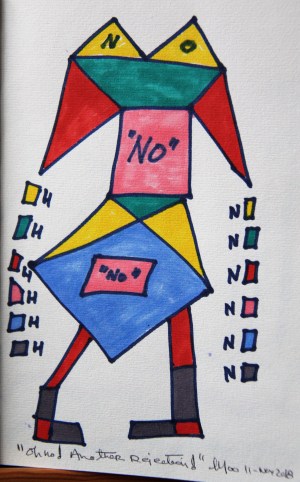
“Oh no, another rejection!”

“And rejection equals dejection, or doesn’t it?”

“Only if you let it get you down. I wait until I am in a foul mood and ready to tear things to pieces because my mean streak is surfacing. Then I go to my rejections pile, re-read the rejection letters, then read again the pieces that have been rejected.”

“Why on earth would you do that?”

“Above all to work out why the work was rejected. What did the editors see that I didn’t? When I write, I wear rose-tinted glasses and all my little babies are the prettiest, the strongest, the fairest in the land, especially when I give them the ‘mirror, mirror on the wall’ test.”

“I’ve never heard of that.”

“It’s simple: you look in the mirror and ask ‘Who’s the fairest writer of all?’ and the mirror answers ‘Why, you are, of course.’ If you believe that, and as writers, we often do, then rejection becomes a hard realistic rock, shattering both Ego and Id. The immediate response is to deny the editor’s taste and judgement. It is amazing how many stupid, dumb, and uncultured editors there are out there. They hate us and don’t understand us.”

“That’s true.”

“No it isn’t. The fault, dear Brutus, lies in ourselves, not in our editors, that we are not great writers. Understand that, and you have a chance to succeed and to improve. Re-reading allows me to try and understand what went wrong, why the mirror lied, how the rose-tinted glasses distorted the actuality of the written page. Understand the other and how the other perceives what and how you write and maybe, just maybe, you can condition yourself to improve. Many budding writers are dropped on stony ground and fall by the wayside. Others land in the desert and their things of beauty bloom where nobody sees them. Some fall on seemingly fertile ground and earn an immediate immortality that fades in a season when the fad wears off. A few writers, an occasional few, go back to the drawing board and water their flowers with the sweat of their brow. Eventually, if they are lucky, their work may be accepted.”

“You always preach the bus story, Julius.”

“Of course I do. Get off the bus early, and you’ll never finish your journey. Remember Sir Walter Raleigh: ‘it’s not the beginning, but the continuing of the same until it be thoroughly finished that yieldeth the true glory.’ He didn’t sail the Golden Hind around the word by setting up house in Cadiz and living in luxury on a beach in the south of Spain. He continued on and on, always forward, until he arrived back in his home port.”

“So we must just keep going, then?”

“Of course. But never blindly. Take criticism to heart, remembering that it comes from another’s heart. Learn from your mistakes. Correct them when you find them. Never give up.”

“You’re always happy, Julius. I bet you never get rejected.”

“Oh I do, Brutus, I do. And each rejection is a dagger to the heart. But I keep going. For example, last week I received my fifteenth consecutive rejection. So much work, so much genius, and all denied.”

“But you’re still smiling.”

“Indeed I am. I have just received my second acceptance in two days. I no longer feel betrayed by my editors.”

“I’ll never betray you, Julius.”

“You will, Brutus, you will. Never fear, et tu, Brute.”

Anniversary

Empress 048


Anniversary

Kicked him out, she did, just like that. Told him to sleep in the spare bedroom. She couldn’t take it any more. She couldn’t sleep. He had to go.  It was the diuretic that did it, mind, the diuretic.

After the radiation treatment, they gave him hormone injections, told him he’d put on ten to fifteen per cent of his current body weight, but not to worry. It was quite natural. It was the hormones, see?

He stood on the bathroom scales without a care in his heart. Watched his weight rise, five per cent, ten per cent, fifteen per cent. When he reached twenty per cent, he started to worry. Swollen ankles. Swollen knees.

At twenty-five per cent, he was really worried. Socks no longer fitted. Couldn’t put on his shoes. Couldn’t bend to tie his laces. Had to wear sandals and slip-ons.

At thirty per cent, he started to cry. He was ugly, so ugly. He was down to one pair of shoes and one pair of sandals that fitted. He went to the pharmacy. The pharmacist took one look at his feet and gave him a long list of Latin names. Told him he’d need a perscription, from his doctor, to get pressure socks, and medical shoes that would help him walk.

“It’s the feet, see, the feet. Once they start to swell, you’re in big trouble. There’s nothing we can do. Go see your doctor.”

“I’ve seen the doctor.”

“Go see him again.”

So he did. Broke down crying when he entered the surgery.

“I’m down to one pair of shoes. You’ve got to do something, doc.”

So the doctor wrote him out a perscription for pressure socks, medical shoes, appointment with a psycho-something, attendance at a clinic, everything he wanted. Then, just as he was about to leave, the doc stopped him.

“Hang on a sec,” he said. Sat at the desk. Checked the computer. Wrote out another perscription. “New tablets,” he said. “Take these yellow ones. Stop taking those brown ones.”

He went away happy. Stopped at the pharmacy. Got the new pills. Went home. Took them. And straight away started to pee. He peed all day and he peed all night. Every 15 minutes. That’s when his missus kicked him out of bed.

“Go,” she said. “Every fifteen minutes. I can’t stand it.”

So he went. Grabbed his faithful Teddy Bear and went to the spare room with its cold, lonely bed. Except he had his Ted.

Lost four pound that first night. Twelve pound the first week. Twenty pound the first month. God, he felt good.  Tried to get back to his own bed. Missus wouldn’t let him in.

“Go sleep with your Teddy,” she said. So he did.

He’s looking pretty good now. Back down to ten per cent body weight up. Says he can live with that. Likes sleeping with his Teddy. Says it doesn’t snore. Or kick. Or punch him. Unlike his missus. It’s the first anniversary next week. He says he and his Teddy are doing fine. They’re going to have a Teddy Bears Picnic to celebrate.

No, sorry, I don’t know what his missus thinks about that.

Teddy Bear’s Nick Pit

IMG_0173.JPG


Today’s the day the teddy bears have their nit-pick: and what a nick pit it’s going to be. Who knows who’s starting what? Who knows where it will go? Who knows where it will end? More than anything else it reminds me of the monkeys in the monkey temple, sitting on their steps and pinnacles, in hierarchical orders, each searching the other monkey for nits and fleas and squeezing them between thumb-nail and middle finger nail, with a blood-red ‘click’ and a life-ending ‘clack’.

“Great fleas have lesser fleas upon their backs to bite them. And lesser fleas have smaller fleas, and so ad infinitum.” I remember this from my childhood, but, more important, the rhyme bite ’em / ad infinitum goes back much father than that, as you will see if you click on this Wikipedia article. Oh boy, Jonathan Swift, and you thought I was bad. I am Canadian Maple Syrup compared to his Irish Thistle Honey. And don’t talk to me about Swift’s views on famine, and how to avoid it.

Anyway, who knows what will happen. Apparently, my former family and clan, the Brits, do not know the old Spanish proverb: Martes, ni te cases, ni te embarques‘ / Tuesday: don’t get married and don’t set out on a journey. Why ever not? Because Tuesdays were apparently the days when the Spanish Inquisition punished the adulterers, male and female, set them upon donkeys, naked from the waist up, and whipped them round the streets while the town criers sang out their crimes in time to the executioners who wielded the whips and painted their sins in red stripes upon their criminal flesh.

Tuesday, bruise day: it’s going to be fun (gallows’ humor). What will become of (once great) Great Britain? What will become of Europe? What will become of our cultural and philosophical world order? Climate change, cultural change, ideological change, political change, the wind of change …  I guess it’s blowing, but who knows in what directions it will blow us all? So easy to open Pandora’s Box: so difficult to pack everything back inside.

Martes, ni te cases, ni te embarques‘  …

By the bye:

I wrote this two or three days ago, before the test squad for the West Indies was selected. Today (Monday, Monday), Theresa a decided not to hold the vote tomorrow, Tuesday, Tuesday, which is now today. Does anyone really know what is happening? How United is the Untied Kingdom [sick]. I certainly don’t know. Meanwhile, the Teddy Bears are having a picnic, and they are all out there, in the woods, Sherwood Forest probably, watching out for the Sheriff of Nottingham, and nit-picking.


Name Game

IMG_0129.JPG

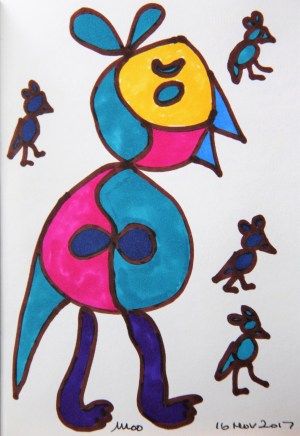
Quacker-quack-quack: I suppose there are better names for a sort of quacking duck cartoon. But then, what’s in a name? A rose by any other name would smell as sweet. But would it? What if we called it a dead rat or a mushroom riot fungal infection, would it then smell as sweet? Good question.

With names, we are looking for le mot juste, the single word or short phrase that sums up the moment and seizes it, framing it forever. As the Welshman once said, when Wales beat the South African Springboks rugby team: “Now I can die happy.” And that’s what he was called ever afterwards: Dai Appy. Then there’s Dai Arrears, who could never pay his bills on time, and Dai Lemmer, who never knew what to do, and Dai Alysis, who had a kidney problem, and Dai A’Beckett, who ate too much sugar and chocolate, and Dai Ear-Kneed, who always held his hand out for a little extra financial help, and Dai Lingual, who couldn’t speak any Welsh (you’ll have to think about that one), and Dai Ap Bolockal, who had a devilish sense of humor and always played practical jokes on his siblings, and Dai Urnal, who slept all night and only woke up in the day time, and Dai Heederal, who threw stones at sea-gulls, and Dai Nasty, who lived in a shoe with so many children that he didn’t know what to do, and Dai Rection, who always knew the way home no matter how much he had had to drink, and Dai Late, who never arrived early and thought he would live for ever, not to forget Dai Anthus, the florist, with a personality so split he was also known as Bill and Ben the Flower Pot Man,  and there’s Dai Yallog, who always mumbling to himself, born in the Mumbles, mind, and mumbled so much his wife called him Mono, and there’s Dai Verse, a rotten poet, couldn’t ever make his poems rhyme in either unofficial language, and Dai Vulge, the village gossip, who could never keep a secret, and … and … One day, I will write a book about all my Welsh friends called Dai, and indeed, there are a great many of them. What adventures they would have. Enough to turn Under Milkwood sour with jealousy, probably.

Meanwhile, back at the duck farm, Quacker-quack-quack is looking for a nice, friendly duck name. Please let me know if you have any suggestions. And stop throwing sand in the Winky Bird’s eye: he’s got enough problems as it is.


Coat of Arms

coatofarms.png


I’ve never yearned for a coat of arms. All those advertisements for this and that, DNA tests to prove your ancestry, where your family name comes from, how many famous people were in your past, how many convicts … and the convicts were often poorer family members, wallowing in poverty and forced into theft, money, a loaf of bread,  a chicken, a lamb, some eggs, something to feed the children, to pay the bills … the possibility of blue bloods and royalty outweighed by the probability of some dark skeletons swinging on gallows somewhere in the distant past.

Yet when I got my online advent calendar this year, there was the coat of arms game … make your own coat of arms. So I did. The choices were very limited, not too original, and came with a ‘clan history’ that has absolutely nothing to do with me. A bear and a dog … I can live with those, especially as the bear is apparently my Canadian spirit animal. A Welsh dragon draped round the top of the frame … wrong color and definitely not Y Ddraig Coch, the blood Red Dragon of Wales, but still a symbol I can happily live with. Down below, we have Sun and Moon, the symbol of Oaxaca and title of the first book in the Oaxacan Trilogy (first published in 2000). Unfortunately, I have reversed the symbols to give us Moon and Sun. Oh dear. Such things happen.

Then we have a snowman and a beer tankard. Sounds good to me. I have now lived in Canada for more than fifty years in Canada and I know all about snowmen, and the taste of beer, sometimes mulled, to take away the cold. I am not so sure about ‘my clan’ as I don’t really think that I have one. I feel it is a very foreign term  like Hi there, gang. I can take Robin Hood and his Merry Men, but Roger and his Merry Gang, no thank you, that’s not for me. Sorry. As for ‘throughout the land’, I wonder which land they are referring to: Wales, England, France, Spain, Mexico, Canada … I don’t really feel that any of these stand up as my ‘land’ … except possibly for Canada, and as for Canada, well, this land is enormous. I have certainly visited some of it, but by no means all, and there is so much more to see and hear.

‘In Battle’, well, I have never been in a battle. I dislike violence and fighting, and I cannot imagine how a phrase like that got in there. ‘Fierceness’ same thing, I am as mild as milk and very easy-going. ‘Loyalty’, yes: that’s what the bear and the dog are famed for. ‘Us bears never forget’, or words like it, from the Chronicles of Narnia. Oh dear, there I go … I can hear mother bear now … ‘Stop sucking your paw’.

Seize the day is goodCarpe Diem … but never in battle … in poetry, maybe, or else in gathering old age where every moment of every day seems more and more precious. I wold have preferred Horas non numero nisi serenas, but they didn’t have that one, even though, nowadays particularly, it is the happy hours that I count, and not all of them spent in a local bar, or home alone, with my own beer mug.


Show Don’t Tell

IMG_0141.JPG


A barber shop quartet, four of them, singing in unison, spring birds at a feeder, early morning sparrows at a jug of milk, abandoned by the milkman on the doorstep.

Except they were none of that. How could they be? They were four brothers, torn apart at birth. They never knew each other, never sang together, never embraced each other, never held each other in their arms. How could they have done so? The first one was stillborn. The second one survived for a while, but struggled to live, succumbed, and drifted away. The third one lived, marked for life by the scars on his forehead where they dragged him from the womb. The fourth one stopped struggling in the seventh month, but the mother carried him to term, even though she knew he was dead.

She carried them, blessed them, gave them all names, and buried three of them. They were her babies and she never got over their loss. Oh, she survived physically, but mentally she was destroyed.

The priests wanted to know what sins she had committed for God to be so angry with her that He destroyed the fruit of her womb. She had no answer. Some refused to bless her. Others ignored her completely. A few used her sorrows to drag the survivor into the tangled web of the church. “He has been spared. He will be one of us,” they said, and rejoiced at the potential strengthening of their celibate ranks.

Three of her children were ever before her. But the fourth lodged like an albatross on her shoulders and hung like a crucifix round her neck. She could never see him clearly. How could she? He was rarely before her eyes, never in the range of her sight. She tried to mold him like putty, but like water or sand, he slipped through her fingers.

Her husband hated him. Was he the father? It’s a wise man knows his father, or his son. Yet they looked alike. But no, they never thought alike, or walked alike. Nor moved in the same circles.

The father, a gambler, had borrowed a large sum of money and placed it with a bookie, betting that this third son would never live and that his death would make his father’s fortune, if the child was indeed a product of the seed his father deposited in his wife’s child bank.

The father lost his bet. The son lived. The father hated him every day of his life.  A rich man he would have been, if … if only … and the scars of that lost bet raged ragged on his face as the father cursed the doctor who had pulled his  son, if he was his son, alive and struggling from the womb.

If he was his son … a strong man, magnificently muscled , it was not his fault, never his fault, it was the fault of that worthless woman, the woman who had carried his seed, if it was his seed, the woman who carried his other three sons, and never brought them alive into this world …

The ostrich sees danger, and buries his head in the sand. The son sees danger and learns to run. The wife sees danger and  learns to suffer, to be beaten, to be abused, to be the victim because yes, she is filled with guilt, and how could it be otherwise, when the spirit is willing and the flesh is weak, so weak that it cannot give birth and eventually takes to the black holes of victimization, of alcoholism, and eventually of oblivion.

And the son learned to hide, to make himself invisible, never to be there, never to accept responsibility, never to sit at the desk when the buck was about to stop anywhere nearby, never to be blamed … never to turn down the solace to be found in the darkest depths of those same bottles that finally destroyed the woman he loved, who was also his mother.

Instructor’s Comments:

Rewrite.
Next time, show don’t tell.
Minimally acceptable.

D


Siege Perilous

IMG_0168.JPG

Siege Perilous

           My second name begins with G … G for Galahad.

         Siege Perilous: the chair calls me, sings out my name, craves my body warmth and blood. I move towards it, hear it groan to me in greeting. I feel it sink beneath my weight, feel its heat and comfort, sense the heart-sound of its old, carved, polished wood. My father sat here before me and his father before him, and his father … and so on down the ringing halls of time.

           Siege Perilous welcomes me as it welcomed them. It cherishes me, nourishes my flesh and blood, my sense of belonging within a great chain of being whose links vanish backwards into forgotten, far-off mists. The chair understands that we are weaklings. It accepts us are we are, strengthening our strong points, filling in for our gaffes, gifting us with the ability that allows us to see ourselves as we truly are, willing spirits in an all too flimsy flesh. Impervious its wood to words or tears, it strips away our masks, dismantles our disguises, meets our inner being face to face, seat of wisdom carved from the tree of knowledge of good and evil.

           The chair rarely rejects us, though sometimes it senses the rot within and moves us on. More often than not, it brings light to our darkness, pierces our clouds of unknowing with its beam of sunshine, illuminates our darkest nights. It cares for us, wraps us in the warm wings of its radiance, carries us onward when we are alone, shapes our own heart-wood with its hand-carved arms that cling and clutch and cleanse of impurities. Blood warms its veins, the blood of the generations that have climbed here as children, sat on the elders’ laps, listened to their tales, then shared their inheritance, before sitting here themselves.

           A sense of entitlement wraps its veil around Siege Perilous and the Forgotten Table. It shuts out doubt and fear. We feel its power transmitted through us, fear, fire, foes all defeated. Power: the power of good to defeat evil, of truth to conquer lies, of my people to survive. They may seem to be crushed, and yet they will rise; defeated, they will overcome; victorious, they will be magnanimous in their victory.

           King Arthur: the Once and Future King … King Arthur and his Knights of the Round Table … Siege Perilous … the Vacant Chair … the Holy Grail … Excalibur: the Sword in the Stone … Arthur himself … Galahad, Geraint, Percival, Gawain, Lancelot … all equal … all pure, honest, innocent, celibate … Camelot …

Merlin the Magician and Wondrous Wizard, conjurer of truth and falsehoods … the historian-poet adjusts his rose-tinted spectacles, smiles, clacks the false white teeth that spin-doctored so much verbal magic, so many mystical myths, fabulous fables, phenomenal falsehoods … and started, pen on paper, to create yet again another set of nonsensical, downright gut-jarring lies.