Things

18581930_1306791786107970_4016640231053970709_n-1

Things I carry with me

            That old black cast-iron stove, wood-fired, that baked the best ever breads and cakes and warmed the bungalow on cold, summer mornings. The Welsh dresser with its age-blackened rails that displayed the plates, and cups, and saucers. The old tin cans that ferried the water from the one tap located at the end of the field. Full and wholesome, its weight still weighs me down as I carry it in my dreams. The Elsan toilet from the shed by the hedge and the shovels that appeared, every so often, as if by magic, as my uncle braved the evening shadows to dig a hole on the opposite side of the field, as far from the bungalow as possible.

            The outhouse at the end of the garden. The steps down to the coal cellar where they went when the sirens sounded, to sleep in the make-shift air raid shelter, along with the rats and mice that scurried from the candles. The corrugated iron work shop in the garden where my uncle built his model ships, the Half-Penny Galleon and the Nonesuch. The broken razor blades I used to carve my own planes from Keil Kraft Kits, Hurricanes and Spitfires, an SE5, and once, a Bristol Bulldog. Twisted and warped, they winged their ways into nobody’s skies, though once we built a paper kite that flew far away in a powerful wind and got tangled in a tree. The greenhouse from which I stole countless tomatoes, red and green. Kilvey Hill towering above the window ledge where the little ones sat when there were more guests than chairs in the kitchen. The old bombed buildings across the street. The bullet holes in the front of the house where the Messerschmidt strafed us.

            The old men spitting up coal dust from shrivelled lungs. The widows who took in lodgers and overnight travelers. The BRS lorries, parked overnight, that littered the street. The steep climb upwards into those lorries. The burrowing under dirty tarpaulins to explore the heavy loads, and many other things. The untouchable, forbidden drawer where the rent money waited for the rent collector’s visit. The old lady, five houses down who, when the shops were shut, sold warm Dandelion & Burdock and Orange pop for an extra penny a bottle.  The vicious, snub-faced Pekinese that yapped fierce defiance from the fortress of her lap. The unemployed soccer referee who on Saturdays walked five miles to the match and five miles back just to save the bus fare, his only financial reward. My father’s shadowy childhood. His first pair of shoes, bought at five years old, so he wouldn’t go barefoot to school.

            Wet cement molded onto the garden wall, then filled with empty bottles to be smashed when the cement set solid. The coal shed where the coal man delivered the coal: cobbledy-cobbledy, down the hole. The outside toilet with its nails and squares torn from yesterday’s newspaper. The lamp-lighter who lit the lamps every evening as the sun went down. The arrival of electricity. The old blackout curtains that shut in the light and shut out the night. The hand rolled fabric sausage that lay on the floor by the door and kept the heat of the coal fire in the kitchen. The kitchen itself with its great wooden chair drawn up by the fire. That chair: the only material possession I still have from that distant past.

Herding Cats

IMG_0790 (2)

Herding Cats

Finley herds cats. At least, she thinks she does.
She spots them with an eager eagle eye,
then herds them, Murdoch, Logan, and Jenkins.

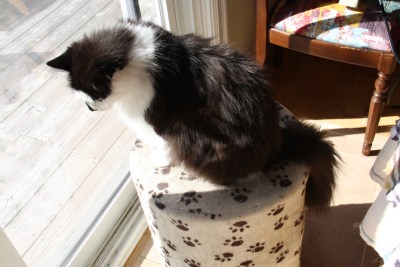
Murdoch sleeps on top of the cabinet.
“Come down,” Finley shrieks. Logan seems to sleep
beneath the settee. “Come out,” Finley pleads.

Jenkins catalogues himself between books.
Finley can’t find him. She climbs on a stool.
Murdoch opens a round grey eye, checks the
distance between them, and goes back to sleep.

Finley gets down from the stool and searches
for Logan and Jenkins. They have disappeared.

IMG_0032

Commentary: Finley loves cats and misses the three she has left behind her in Ottawa. She wants to cuddle Princess Squiffy but Princess Squiffy aka Vomit does not like noisy little girls who pursue her shrieking loudly. Result: we have hardly seen PS for nearly a week. She hides throughout the day in those mysterious priest-holes known only to catholics and cats, and waits for nightfall and an almost quiet house. Soft and silent, she emerges from the shadows where she has been hiding to sleep at the foot of the bed.

PS doesn’t love me either, but she has become so needy of quiet, respectful human contact that she has started to tolerate me, just a little bit. She raises her ears instead of flattening them and plumes out her tail, just to encourage me. Now she permits me to touch her gently and scratch her in her favorite spots, behind the ears and at the root of the tail. I look on this as a great favor … but I still think she scorns me completely, showering me with  total disdain most of the time.

“Moo,” Finley asks me. “Do you have a pussy cat?”
“Yes, Finley.”
“Where is she?”
“I don’t know.”
“Is she hiding?”
“Yes, Finley.”
“Can I see her?”
“If you can find her …”

And the great cat hunt begins: upstairs, downstairs, in my lady’s chamber. Goose steps everywhere, but there is no sign of the cat.

“Moo.”
“Yes, Finley.”
“Are you sure you’ve got a cat?”
“Yes, Finley. I’m sure.”
“I want to play with her.”
“I’m sure she’ll come out and play with you one day soon.”
“I don’t think you’ve got a cat, Moo.”

Seeing is believing / ver es creer. Whether seeing is believing, or not, what we don’t want to see is A’r gath wedi sgrapo Finley bach / the cat has scratched little Finley. Oh the joys of learning Welsh, especially as the day drags on, the cat cannot be found, and Mae’r baban yn y crud yn crio / the baby in the cradle is crying and tears of sadness blend slowly into snores, as the cat creeps up from her hiding place in the basement, pushes open the door, mews for her last food, and cuddles up beside me on the chair beside which I type.

Here is a link to Sosban Fach sung  Welsh by Cerys Matthews.  Turn your sound on and up and enjoy!

https://parallel.cymru/sosban-fach/?lang=en


IMG_0425

Alphabet

Chaos

Alphabet

So everything is now as yellow as the yellow alphabet.
Bellow below cello, above fellow, saying “Hello,” jello,
always yellow, nobody eats orange jello, mellow, sello
or sellotape, tellow, as in “Tell old salt …” pronounced
“tellow salt” … so many verbal adventures, scales falling
from young eyes, and old ones as wello,
and the melody of music in tone,
on tongue, wonder in the eyes of everyone,
golden yellow, hair high-lighted in the early morning sun.

Commentary:

An endless jumble of words, all joined together rhythmically and linking one thought to another in a succession of jumps that wander from here to there and back again. Team tag: each one of us chosen for a moment, teased, played with, abandoned, picked up again, delight in each adventure.
My party tricks are e-cards, typing on the computer, her name, my name, the alphabet, her mother’ name, another name, and then another. Coloring is my trick too, and finding empty pages that can be followed with color and scrawl and everything that turns the blank page from a wilderness to a new world covered in endless manufactures of meaningful, meaningless scratches.
Joy in small things.  Albert Camus’s theory of the absurd present in almost every moment of the day. Moments that stretch into eternities, eternities seen in a grain of sand. Dw i mwynhau … what do I enjoy? These timeless moments, these glimpses back into my family’s past, Dych chi mind am dro? … these walks into my DNA’s future. Nach ydw: no, I will not be here. But tiny segments of my existence, words and phrases of my Welsh grandfather’s DNA and language, they will be here. Recycled. Again and again. Somehow. Somewhere. Forever. What more could I ask?

F-F-F-Forgetting

IMG_0486

F-F-F-Forgetting

    The apps and programs that no longer work. The computer files you can no longer access. The photos that vanish leaving a blank space in the album.
Now your memory goes on the blink and you forget faces and voices, friends, phone numbers, addresses, street names, the houses where people live, when to turn, where the best parking spots are, how far you can walk, where you were really going, and what you were sent out to buy.
Snow banks don’t help: that banked-up whiteness, that sticking out of the car’s snout into traffic, that stretch of your neck peering round corners. How many number plates have vanished into those white mists? How many cars? How many phone numbers have you forgotten?
You have forgotten the birthdays of your closest family and friends. When was your father born? When did he die? When and where did you bury him? Did you actually scatter his ashes or did someone else do it for you? When was your cousin born? When did he die? How close were you at the beginning, in the middle, and at the end? What color were his eyes, his hair? Did he even have any, hair, I mean of course?
What happened to that carton of eggs you abandoned in the store? Do you remember buying it, let alone leaving it there? How about your brothers, their faces, the sound of their voices? Did your own voice change when you emigrated?
Have those who live in Australia forgotten that they are Welsh? Do they speak like Australians, now, or do they still have those rich Welsh voices and rhythms that nobody in Wales ever wanted because they made us stand out when we moved, unwanted, to England? How many times have we, the Welsh, heard those threatening words: why don’t you go back home to Wales. Countless times, no doubt. In fact you have forgotten how many and you have forgotten so much.
Do you remember the parking spot in which you left your car? Do you recall your number plate or what model your car is, or what color?
“What day is it today,” you ask, for the second or third time. “I’m sure I know you,” you say to a friend who stops to talk to you in the shopping mall, “but I’m sorry, I can’t remember where we met and I can’t remember your name.”

IMG_0452

Free

IMG_0624 (3).JPG

Free
Flash Fiction

            I am as free as my father was free. He was free to walk on his walker, as far as he could go down the street. Free to walk in the wind and the rain. Free to sit on his neighbor’s wall when his legs and back got tired. Free to sit there, although it was raining, until he had recovered his strength and energy. Free to get soaked so badly that he caught a cold. And the cold was free to turn into bronchitis and the bronchitis was free to turn into pneumonia and the pneumonia was free to perform its assassin’s work as it tried to kill him. But my father was still free and strong enough to call the doctor and the doctor was free enough to call at the house and visit my father and write him a prescription for an anti-biotic that would free his body from the pneumonia that was free to leave when its time was up and it felt ready to go. Pneumonia, the old man’s friend, they used to call it, sitting there, in my father’s lungs, muttering away to him, day after day, louder at night, and my father slowly getting stronger and the pneumonia growing weaker until one day it left and freed my father from his immediate ills. Then my father was free to get up or to stay in bed. Being a free man, he chose to stay in bed all day and to listen to the radio and to read a book and when he got bored with reading he just lay there and counted the lines on the wall “one, two, three…” and “one hundred and seventy five” he told me one day when I was free to visit him, “though I have lost count once or twice and have had to start again from the very beginning. And the sun gets up at 7:03, and strikes the third line at 7:53 … and goes around the wall 33 lines a minute; and leaves that third line from the right at a 3:15 …” And there he stayed, day after day. But he was free. And sometimes the home help came and sometimes she didn’t, for she too was as free as the birds in the garden. And sometimes she remembered to buy him some food and sometimes she didn’t. And she was free to come and go, free to remember or forget. And my father was free to mumble or complain or grumble, though he rarely did. And he was free to eat, so long as there was food in the house. But I went there I often saw that the cupboard was bare and my father had neither milk, nor eggs, nor bread nor cereal, nor tea nor butter. And all those people, those acquaintances, those friends, they too were as free as the sea-gulls in the sky. But to find the time to set my father free from the hunger and thirst he seemed predestined to freely suffer, they were never free enough for that, not even at Christmas.
Neither was I.

Friday Fiction: Finding Fault

IMG_0169

Finding Fault
Friday Fiction

It wasn’t your fault. You look at yourself in the mirror and see your tear-stained cheeks. Your red eyes look back out at you and you lose yourself in them, swimming desperately as their still ponds down you with tears.

“Stop hammering at the door,” you yell at him. “Stop hammering.”

Open the door,” he shouts, stammering in his rage. “Open this door.”

Thank God you locked it is what you think. Thank heavens you kept the key. And here it is in your hand, so it can’t fall down to floor and be hooked away, under the door, so that he can open the door and come at you again. He is shaking the door handle now, rattling it, shaking it like he said he’d shake you.

“I’ll shake you till your teeth rattle,” that’s what he said. And you know he meant it. You could see it in his eyes. You were just too quick for him. That’s all. Just too quick. He raised his walking stick to beat you and you slipped away, in a flash. Just like that. He was too slow to catch you. His one chance came in the kitchen. Once you were out of there, out of that trap, you were up the stairs, into your bedroom. You shut the door, slammed it shut, and turned the key in the lock. Then you relaxed for just a second and that was enough to set you crying. Thick, heavy tears ran down your cheeks. Sobs shook your chest and rattled your bones. You heard him clumping up the stairs, one foot at a time. Clump. Clump. Then he was at the door again. A big, bad wolf, huffing and puffing.

Open this door,” he shouted. “You wicked child.”

“I’m not wicked,” you said.

“Wicked,” he shouted. “Wicked. Just like your father. You should never have been born.”

You placed the bedroom chair against the door, just under the door handle. Then you wedged your father’s sandal under the door.

Earlier, down in the kitchen, you had taken the bread knife and started to cut the bread. But the knife was blunt. So you sharpened it, scraping it up and down against another knife blade, like you’d seen your dad doing. Trying to make it sharp. Then you started to cut the bread. And that’s when he appeared screaming at you.

“Put that knife down.”

“Why? You asked.

“Because I’m telling you to.”

“That’s not a very good reason,” you said.

“You cheeky girl. I’ll shake you till your teeth rattle.” That’s what he said. And then he raised his stick. Red in the face, he was going to hit you. He wanted to hit you with his stick. Only he couldn’t. You were too quick. You went left, then right, then ducked under his outstretched arm as he lost his balance. You ran into the corridor and up the stairs.  You hear him now puffing outside the locked door.

“Open this door now, you wicked child.”

You move away from the door and move to the window. No escape there. You’re on the second floor. No way down. Where’s dad, you wonder. Where’s my dad? He went out shopping. Said he’d be back soon. Where is he? You hear the old wolf as he keeps huffing and puffing, pounding at the door.

“You’ll never come to my house again,” he screams.

“I don’t want to, grampy,” you scream back. “I hate you.”

You wicked girl. You’re worse than your father, you wicked girl.”

Just then, you hear the front door open. The old wolf backs away from the door. You feel a release, a wave of comfort sweeps over you.

“Dad,” you shout. “Dad.”

“She’s wicked,” you hear your grampy say. “Wicked. You have to beat her. Chastise her. Drive the devil out from her soul.”

“What on earth are you on about?” your father asks. “What’s happening here? Look, go down to the kitchen and make a cup of tea. I’ll talk to the little one and try and make some sense out of this.”

Wicked. She’s never coming to my house again.”

Clump. Clump. You hear his footsteps fade away on the stairs.

“Has he gone?”

“Yes. You can come out now.”

You remove the sandal, you turn the key in the lock, you open the door, you jump into your father’s arms ….
“Daddy, daddy …”

“Now tell me what happened.”

It was all his fault,” you say. “Daddy, I didn’t do anything. It was all his fault. He tried to beat me with his stick. He told me he’d shake me till my teeth rattled. I was so frightened. It wasn’t my fault, dad. Honest. It wasn’t my fault.”

Gower

Empress 070.jpg

Gower

To be Welsh in Gower is to spell it funny
and pronounce it worse: Gwyr.
It’s to know how to say Pwll Ddu.
It’s meeting the cows in the lane to Brandy Cove
and knowing them all by name and reputation,
which one kicks, which one gores,
when to walk in the middle of the lane,
and when to jump for the safety of the hedge.

It’s to know the difference between the twin farmers
Upper and Lower Jones.
It’s to recognize their sheepdogs, Floss and Jess,
and to call them with their different whistles.
It’s knowing the time of day by sun and shadow;
it’s knowing the tide is in or out
by the salt smell in the air
without ever needing to see the sea;

and now, in this far away land called Canada,
it’s hearing your stomach growl for crempog or teisen lap
whilst memory’s fish‑hook tugs at your heart
in the same way your father hauled in salmon bass
at Rhossili, Brandy Cove, Pennard, Oxwich, and Three Cliffs.

Commentary: I was checking Gwyr, the Welsh for Gower, where I was born, and found this interpretation of the name. <<G is for generous, your giving nature. W is for wise, more tomorrow than today. Y is for young, the years never show. R is for rapport, friends seek you.>> I don’t know if that’s me, but it certainly wouldn’t be a bad set of descriptors to live up to.


Growing Up

IMG_0817 (4).JPG

Growing Up
in Brynmill

They drag the kids kicking and squealing
from childhood’s universe into an older
world of smoking and drinking, forbidden
fruits stolen after Christmas dinner when
drowsy grown-ups’ eyes are turned away.

Why do bigger boys follow smaller ones,
buying their sisters’ kisses then thrusting
their fingers into little girls’ knickers, or
invading Woolworth’s and tucking stolen
goods in shirts with their buttons undone?

The games they play: offering a little girl
a cigarette  or a sweet while two boys
wait behind the garden gate with a sharp
knife to  press against the victim’s throat.

Buried Alive

IMG_0688
Buried Alive
Anonymous we are,
never holding land or cattle,
lucky to own our own houses.Some castle
this rented row house
in a winding valley,
two rooms up
and two rooms down,

tin bath in the kitchen
filled with hot water
for when the shift ends.

After supper,
beer for a coal-dust throat,
then the wife, and sleep.

Next day,
a knock on the window,
a pulling on of clothes,
clogs clattering on cobbles,
a tin box sparse with food,
then down to the dark pit
of whatever mine has agreed,
at a price, to bury us alive.

Commentary: So much in this one. Very difficult to write. And a tribute to Rita McNeil’s It’s a working man I am,  two lines from the end. How long did it take me to write? Five minutes or less. Unless you count 200 years of coal mining (in South Wales alone), seventy-five years living and learning to write, and sundry workshops and exercises that have enabled me, just once in a while, to catch the butterfly as it flutters, although it never flies underground.

My Welsh Granny

IMG_0452


Poem for the Welsh grandmother
I never really knew

Six o’clock! The cuckoo whirrs its clockwork arrow
from the dark wood of its ambush and the flight
of my granny’s forgotten youth flashes before my eyes
to be buried among the trees. Cats! I can still count
her 1, 2, 3 cats, each one lapping milk from its saucer.

If I close my eyes, I can recall her house, her clothes,
her hair, the very bend of her body bowed over
the ironing board in the kitchen and everywhere,
the sweet and sour smell of white fish bubbling
on the stove for the cats’ supper. The cuckoo clock
strikes again. Each one wounds, the last one…?

Who knows what the last one will bring? Life’s
bitterest blows perhaps? Or missing memories
restored and with them, my granny’s own lost beauty,
with her standing upright, like some glorious flower
illuminated by a sunbeam in the wood’s dark depths.