Small Corner

IMG_0160.jpg

Small corner

 And this is the good thing,
to find your one small corner
and to have your one small candle,
then to light it, and leave it burning
its sharp bright hole in the night.

 Around you, the walls you constructed;
inside, the reduced space, the secret garden,
the Holy of Holies where roses grow
and no cold wind disturbs you.

 “Is it over here?” you ask: “Or over here?”

If you do not know, I cannot tell you.

But I will say this: turning a corner one day
you will suddenly know
that you have found a perfection
that you will seek again, in vain,
for the rest of your life.

Gaia Sun & Moon

IMG0073_1.jpg

Gaia

Worshipping the Earth Goddess, Gaia,
before the great altar in Santo Domingo

If the goddess is not carried in your heart
like a warm loaf in a paper bag beneath your shirt
you will never discover her hiding place.

She does not sip ambrosia from these golden flowers,
nor does she climb this vine
to mount to her heavenly throne,
nor does she recline in majesty
a pantocrator in a mandala frowning down.

In spite of the sunshine trapped in all this gold
the church is cold and overwhelming.

Tourists come with cameras
not the people with their prayers.

My only warmth and comfort:
not in this god who bids the lily gilded
but in that quieter voice that speaks within me,

bringing me light amidst all this darkness,
bringing me poverty amidst all this gold.


Sun & Moon

IMG_0231 (2).jpg

Sun and Moon was published on Amazon and Kindle today. This is the second (revised) edition of Sun and Moon, the first edition having been published in 2000. Although this is the second edition, I have returned to and revised the original manuscript. It is clearer, stronger, and better than the first edition. Here is the description of the book as it appears on Amazon and Kindle.

“They tore down our walls,” Mono whispered, “stone by stone. A new church they built on the land they stole from us.” These opening lines begin the verbal adventure of Sun and Moon. Written in Oaxaca, Mexico, between 1995 and 1999, the poems tell some of the tales  of the voiceless, of the conquered, of the displaced, of the survivors, of the people who eat and sleep in the streets of Oaxaca, spinning their myths and legends and recalling their oral histories and memories. Sun and Moon traces the relationships between two civilizations, the indigenous and the conquerors, from the first contacts between Europeans and the people of the Oaxaca Valley up to the modern day interactions between locals and tourists. In these pages, some of the ancient ceremonies and beliefs, as described by indigenous people, are brought back to life in vivid images and colorful metaphors, so sharp, they can be grasped between the fingers and examined by the light of the sun by day and the moon by night. The multiple voices in the poems are those of human beings who, like the author, himself an émigré, find themselves in exile, lost, abandoned, and displaced. As the final character cries out in the final poem: “You do not worship at our sacred places … you don’t know even know the meaning of my name.”

Inquisitor: Sun & Moon

IMG_0184.jpg

Inquisitor

He told me to read,
and plucked my left eye from its orbit.
He slashed the glowing globe of the other.

 Knowledge leaked out:
loose threads dangling,
the reverse side of a tapestry.

 He told me to speak and squeezed
dry dust between my teeth.
I spouted a diet of Catechism and Confession.

He emptied my mind of poetry and history.
He destroyed the myths of my people.
He filled me with fantasies from a far off land.

I live in a desert where people die of thirst,
yet he talked to me of a man who walked on water.

 On all sides, as stubborn as stucco,
the prison walls listened, and learned.

 I counted the years with feeble scratches.

For an hour, each day, the sun shone on my face;
for an hour, each night, the moon kept me company.

Broken worlds lay shattered inside me.
Dust gathered in my people’s dictionary.
My heart was a weathered stone
withering within my chest.

 I longed for the witch doctor’s magic,
for the healing slash of wind and rain.

 The Inquisitor told me to write out our history:

I wrote
how his church
had come
to save us.

Note: I am still working on Sun and Moon. It will be ready for publication on Amazon and Kindle some time this week. Monkey Temple, Though Lovers Be Lost, Bistro, and Empress of Ireland are now available for review or purchase on Amazon and Kindle.

Monologue: Sun & Moon

IMG_0211.jpg

Monologue

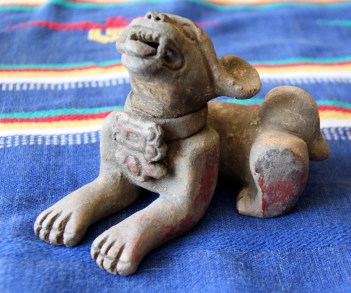
 Mono means Monkey in Spanish. Monkey is one of the day names in the Mixtec calendar. 
Monologue, then, is Monkey, talking, perhaps to himself.

“They broke our walls,” Mono whispered, “stone by stone.
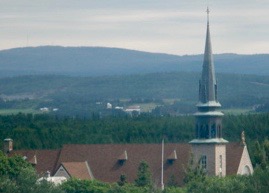
A new church they built, on the land they stole from us.
Red was its roof from a thunderstorm of blood.
The white bones of their lightning scattered us like hail.

They ripped out our tongues and commanded us to sing.
Carved mouths were ours, stuffed with grass.
Stone music forced its way through our broken teeth.

Few live now who can read the melodies of our silence.
We wait for some sage to measure our dance steps:
treading carefully, we walk on tiptoe.

A + cross  these stepping stones of time.”


Note: I am working on Sun and Moon. It will be ready for publication on Amazon and Kindle some time this week. Monkey Temple, Though Lovers Be Lost, Bistro, and Empress of Ireland are now available for review or purchase on Amazon and Kindle.

St. Christopher: Flash Fiction


F1040003.jpg

St. Christopher

“Well,” I said to Luis, “if you wade through that river and get yourself soaking wet when there’s a perfectly good bridge to walk on, you’re stupid. That’s all I can say.”
He didn’t reply and we both stood there, glaring at each other. Then I looked down at the cobbled road that led to the bridge. The stones, turned on their edges and woven into herring bone patterns, looked as though they had been there since the beginning of time. The bridge was clearly the work of the Romans rather than the Devil, the Devil’s Bridge, as the locals called it, built by the Devil himself and joining the two banks of a river that God had placed there to separate one side from the other.
“I’m going over the bridge,” I said.
“And I’m wading through the river, however deep it is.”
“It’s not that deep,” I replied. “It’s only up to the waists of the fishermen in their waders. You’re not taking that much of a risk.”
“It’s not a question of risk. It’s a question of honor and loss of honor.”
“What do you mean, loss of honor?”
“You know what I mean. I have lost my honor and somehow I must win it back.”
“By wading across a river, barefoot, with your clothes on, when there’s a perfectly acceptable bridge set here especially for pilgrims?”
“If necessary, yes; that’s what I must do.”
“Necessary?” I exclaimed. “There’s nothing necessary about it. You’re just being stubborn; and stupid.”
“I don’t think I’m being stupid.”
“I’m beginning to wonder if you are even thinking.”
Luis looked at me, hard, then started down the little path that led to the river.
“I give up,” I said. Then I turned away and walked to the bridge. I stopped when I was half way across and looked back. Luis had descended to the riverbank. He was talking with a young child who stood there, gazing at the moving water. Then I watched him as he picked up the child, placed him on his shoulders, and waded slowly into the river.
There was a sudden shout from one of the fishermen, and a washerwoman, washing her linen on the far side, to which Luis was headed, ran to where Luis was forcing his way slowly through the waters with the child on his shoulders.
“My son,” she cried out. “¡Hijo mío! Where is he taking you?”
“Everything’s fine,” Luis shouted back. “He just wants to visit his mother and I’m bringing him across.”
Just then, Luis stepped into a pothole in the river. He stumbled and the child almost fell from his shoulders. Luis staggered for a pace or two, then straightened up and continued across the river.
“A saint,” the child’s mother called out. “You stumbled yet did not fall: you must be a saint.”
“St. Christopher has come back to us,” another washerwomen crossed herself and the two of them knelt. I looked at Luis, wading through the river, and I knew for certain that if he wasn’t mad now, he soon would be. I watched as he reached the shore and handed the child over to its mother. She asked for his blessing, but he shook his head and refused to bless her saying that he was neither a priest nor a saint but just a poor sinner who could give a blessing to no one.
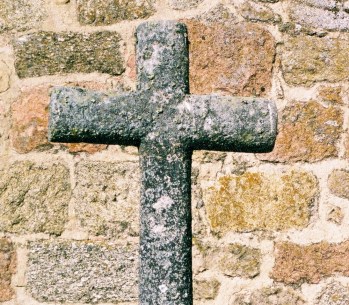
I walked down to the end of the bridge and waited for Luis to catch me up. Ahead of us, the cobbled road led to the church and to another cruz de harapos. We walked forward together, him with his wet clothes and his watery footprints, and me with my clothes all dry. When we got to the stone cross in front of the church, Luis stopped and gazed at it, raising his eyes up from the base and looking up towards the heavens. Then he moved forward, climbed onto the cross’s plinth, and stood there, just below the level of the stone arms. Three of the washerwomen had followed him. One was the mother of the child that Luis had carried across the river and her child was beside her.
Luis turned to face the cross. Then he raised his arms above his head, jumped upwards into the air, and clung on to the cross with both hands, his feet suspended about six inches above the ground.
“What do you think you’re doing?” I asked him.
“I’m hanging myself out to dry.”
“You can’t just hang there.”
“Why not? Jesus did.”
“You’re not Jesus.
“And the cross isn’t wooden and nobody has nailed me.”
“You’re going mad,” I told him.
He raised his eyes skywards muttering a prayer and refused to look down at me.
“Father,” he said. “Father: why hast Thou forsaken me?”
The three women stood at the foot of the cross, gazing at Luis who was hanging there, dripping his drops of water onto the stone.
“Send someone to fetch the local priest or the doctor,” I said to one of them. “This man’s gone mad.”

Empress: Graveyard on the Point

Empress 314.jpg

Graveyard on the Point:
A Survivor Remembers his Catechism
Ste. Luce-sur-mer

The survivor at the cross roads,
wreathed in his personal storm:

et discerne causam meam /
… and distinguish my cause

de gente non sancta… /
from the unholy nation.

Rising waves:
bells on buoys
peal out sea warnings.

Tonight there is a grief across the grève.

Sa griffe / his claw,
ma griffe / my claw
homophonic puns

scratching at reality’s surface,
hiding inner meanings,
leaving the depths unplumbed.

Did he really paint
the reality of the shipwreck,
this Magritte?

 Cette pipe, qui n’est pas une pipe! /
This pipe which isn’t a pipe!

Mi grito que no es un grito! /
My cry which isn’t a cry!

Cette vie qui n’est plus une vie!
This life which is no longer a life!

This littoral bay
no longer a literal bay.

ab homine iniquo et doloso erue me /
from the unjust and deceitful man deliver me.

Over bird frosted rocks,
a ring billed gull cries out whose name
on its early journey to greet pale stars?

 On the beach at the cross’s foot,
a grey robed pilgrim

stands in dusk’s failing light.

et introibo ad altare Dei:
ad Deum, qui laetificat juventutem meam
/

and I will go unto the altar of God:
to God, who giveth joy to my youth.

Mouettes, göelands muets:
sea gulls, silent sea gulls:
white arrows shot over sea wet sand.

He stands solemn before this graven stone
waiting to be blessed:

 sicut erat in principio, et nunc, et semper /
as it was in the beginning, is now, and ever shall be …

The eider duck sigh for their siblings,
tossed from the crèche and lost
in the long low swirl of the sea.

Empress: A Survivor Lights a Candle

Empress 233.jpg

A Survivor Lights a Candle
During the Latin Mass for the Dead
Before the Main Altar
at the Sanctuaire Sainte-Anne
Pointe-au-Père

I am afraid of fire:

 in principio erat verbum /
in the beginning was the word.

 I am afraid of the loud voice of the match
scratching its sudden flare,

narrowing my pupils,
enlarging the whites of my eyes:

 et lux in tenebris lucet /
and light shines in darkness.

Booming and blooming,
igniting the soul’s dark night.

Voice of fire:

et Deus erat verbum /
and the Word was God.

 Flourishing to nourishment,
flames whispering on the flood:

omnia per ipsum facta sunt /
all things were made by Him.

Wool and water,
this sodden safety blanket;
and what of the cold plush

of the pliant teddy bear,
the staring eyes of the doll:

et tenebrae eam non comprehenderunt /
and the darkness comprehended it not.

The lashes of their eyes
bound together with salt water,

they were doused in a silken mist:

hic venit in testimonium /
this served as a witness.

 Still the patterns pierce my sleep,
hauling me from my opaque dreams,

holding my wrists in this sailor’s double clasp:

 non erat ille lux /
he was not the light.

Oh! Curse these dumb waters rising!

“Not a hair on your head
shall be harmed!” he said,
hauling my sister up by her hair

only to find her staring eyes
belonging to the already dead:

et mundus eam non cognovit /
and the world knew her not.

Night waters rising.

The moon raising
its pale thin lantern glow:

et vidimus gloriam ejus /
and we saw His glory

 shining forth
upon the waters’
mirrored face.

Remembrance Day Flash Fiction


039

Remembrance Day
Bistro 20

Previously published on
http://commuterlit.com/2015/12/wednesday-remembrance-day/

            The old man watched a drop of red wine slide slowly down the side of the bottle. It was November 11, his birthday.

Seventy-three years ago, Father John had taken the boy’s ear lobe between thumb and forefinger and pinched the nail deep into the flesh until the blood ran.
“This afternoon you will go down to the bamboo grove and cut a cane. Bring that cane to me and I will bless it.”

That night, the boy woke up. Snuffles, snores, and an occasional sob broke the dormitory’s silence. The bamboo was a long, cold serpent drawn up in bed beside him.

The next day, he awoke to his seventh birthday.

Father John beckoned and the boy followed him to his cell and knelt with his hands stretched out like those of Christ on the Cross. The priest struck him with the bamboo cane six times on each hand.
“Your Savior, blessed be His name, suffered more, much more for you,” the priest sighed. “Examine your soul. Find fault with each flaw, for you are unworthy. Remember: the eye you see is not an eye because you see it,” Father John droned on. “It is an eye because it sees you. Christ sees you as you kneel there. He sees. He knows. He judges. Examine your soul with care and stay there until I return.” The priest raised his right hand and made the sign of the cross in the empty air.

The boy spent his birthday kneeling before the crucifix in prayer. He contemplated the wounds of Christ. He imagined each blow of the hammer and imagined the pain of cold nails biting into his warm flesh. He tasted bitter vinegar as it dripped off the sponge, gasped at the thrusting spear, felt the lash’s sting as it fell across his flesh. He became the flagellated Christ and knelt before the crucifix, staring at himself eyeball to eyeball in the same way he looked at himself in the morning mirror. The crucified Christ gazed back at him, his brother, his soul mate, his double.

After an hour, a red drop of paint slipped slowly from the nail hole in Christ’s right hand. The boy blinked. The red drop trembled then fell.
After two hours, Christ opened his eyes and smiled at the boy.
After three hours, salt-water formed at the corner of Christ’s eye. It glistened in a sunbeam that entered through the cell’s narrow window.
After four hours, tears began to flow down flesh and painted wooden face.
It was Remembrance Day, the boy’s birthday. He was seven years old.

Seventy-three years later, the old man sat at the table. He watched the red wine trickle down the bottle. He remembered it all and his tears flowed again.

Miracle: Flash Fiction.


F1030024 2.JPG

Miracle
Bistro 15

A tiny man in a dark brown robe bustled into the library.

“Brother Marcos: come quick. There’s a miracle. We’re witnessing a miracle.”

Brother Marcos raised his eyebrows and Robin looked horrified. Will didn’t know what to think.

“A miracle?” Brother Marcos asked. “What kind of miracle?”

“There are angels and visions. Oh, I can’t explain. It’s happening now. You must come and see. Oh, you must come and see.”

The tiny man scampered out of the library door and Robin and Will followed him.

“Ship of fools,” said Robin to nobody in particular. “We’re all sailing in a ship of fools.”

“Wait and see,” said Brother Marcos. “We must not pass judgment. Wait and see.”

The man in the brown robe led them to the main altar at the heart of the monastery where the lignum crucis stood on display.

A group of tourists clustered around a man on his knees in front of the true cross. A ray of sunlight pierced the stained glass window and picked out the kneeling figure whose arms spread out like an angel’s wings as he knelt there motionless.

It was LJ. His eyes were open and his chest hardly moved. Fragments of colored light from the stained glass window flowed over and around him and at times they gave the impression of flowing through him too. They gifted him with what, in the shifting light of the sun’s ray, seemed to be a halo round his head. Golden specks of dust sparkled in the sun’s bright rays and danced like little angels in the air.

Brother Marcos drew in a deep breath, knelt, and made the sign of the cross.

“Little angels, ascending and descending,” he mused out loud. “How many, I wonder, could dance on the head of a pin?”

“It would depend on the size of the pin,” said Robin. He pushed past the staring crowd. Some were on their knees, their rosary beads clacking through their fingers. Others stood and looked on in wonder at the light descending. Others crossed themselves and looked towards the altar where the lignum crucis was displayed, the time-blackened nail hole exposed in all its glory.

“Come along, now, LJ,” said Robin, touching him on the arm. “That’s enough of that. Get up off your knees now. We’re going.”

There was a low mumble of disapproval from the absorbed spectators.

“Don’t touch him,” said one.

“It’s a miracle,” said another.

Noli me tangere.” The voice, a deep voice, not at all the voice of LJ, rose seemingly from the kneeling man’s mouth.

The crowd sighed. Some drew closer, in seeming awe. Others drew back in fear.

“I didn’t know LJ spoke Latin,” Will said.

“He doesn’t,” Robin shook his head. “But he could have learned those words at any time while he was in school. Even I know them. It’s a neat trick with the voice, though.”

“It’s no trick,” Brother Marcos crossed himself. “We have witnessed other miracles in this very place, though none quite like this.”

“This is my beloved son in whom I am well pleased.” The voice spoke again. And immediately the crowd responded and with the exception of Robin and William those still standing dropped to their knees and joined in the prayers. More rosaries appeared.

“Let the night’s stone be rolled away. Let sunshine pierce the shadows. LJ, my son, pick up thy cross and follow me.”

Two things happened almost at once. First, the sunray that illuminated the scene flickered and vanished and then LJ toppled over and lay on his side.
 

F1030024 2.JPG