Bears

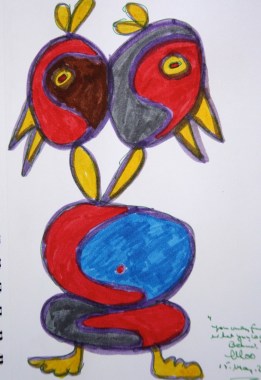
Empress 048

BEARS

Think of pink salmon caught in pools,
plucked from water, tossed to air,
the catch stacked rainbow‑fired.

Winter now:
unsnubbable, lumbering overcoats
closeted, laid to rest;
seeking power in hibernation
till sun from summit melts frosty dark:
fresh heartbeats forged in forest’s night.

Think alchemy:
prime matter moved safely in flask or jar.

Think circus stars:
The Great Bear leads the Lesser,
dancing to the trainer’s whip,
tumbling from their pedestals.

Secure behind bars,
think fallen stars.

Punctuation in Poetry

img_0177

Punctuation in Poetry

Gardeners

when three bearded men
unbury winter’s bones they pick
at old wood scars dead trees and
their limbs now lying there lifeless

they dig deep at flowerbeds
uprooting a riot of Japanese
Knot Weed untangling roots
all tangled and twisted with
Bees’ Balm and perennials
that stray across borders
unwelcome immigrants neither
barriers nor fences can possibly hold

they probe between flag-
stones where wintering birds
and squirrels and chipmunks
cracked the seeds and wild weeds
that grow there and flourish

but where would the land be
and what would it accomplish
without helping hands
and the power of strong fingers
and fresh eyes that spot those
intruders who diminish
the space where good flowers
grow strong with fresh herbs
chives and oregano basil
and parsley peppermint sweet
crushed beneath feet

Comment: I posted this poem yesterday. It’s another raw poem. On re-reading it, I found it confusing. To punctuate or not to punctuate, that was my question. I decided to rewrite it and use punctuation. Here’s the new version.

Gardeners

Three bearded boys unbury
winter’s bones. They pick
at old wood scars, dead trees and
their limbs now lying lifeless.

They dig deep at flowerbeds
uprooting a riot of Japanese
Knot Weed, untangling roots
all tangled and twisted:
Bees’ Balm, Cape Daisies,
and quick-growing weeds
that run across borders,
unwelcome migrants
that barriers can’t hold.

They flourish between flag-stones
where wintering birds,
squirrels, and chipmunks
cracked seeds from the feeders.

Where would the land be,
and what would it accomplish
without helping hands,
the power of strong fingers
that pluck out the intruders
that infringe on the spaces
where proper plants grow
unthreatened by weeds?

Second Comment: Both versions work, but in different ways. The first version is more spontaneous and less logical. It allows thought and image to freely flow, but there’s some repetition and a certain lack of clarity. It does allow the  reader to be creative and to seek for alternate meanings and choose the combinations that please the most. The second version is more logical and expresses a slightly different train of thought. Punctuation forces revision and a revision that punctuates demands good grammar, less freedom of speech. The result is a tighter, much closer expression. By extension, the need to punctuate also demands more thought, more concision. Needless words are eliminated. Better combinations are possible. In addition, I find the rhythm becomes more prominent, but less spontaneous. To punctuate or not to punctuate: only the poet can decide, but any comments will be most welcome.

.

Gardeners

IMG_0486.jpg

Gardeners

when three bearded men
unbury winter’s bones they pick
at old wood scars dead trees and
their limbs now lying there lifeless

they dig deep at flowerbeds
uprooting a riot of Japanese
Knot Weed untangling roots
all tangled and twisted with
Bees’ Balm and perennials
that stray across borders
unwelcome immigrants neither
barriers nor fences can possibly hold

they probe between flag-
stones where wintering birds
and squirrels and chipmunks
cracked the seeds and wild weeds
that grow there and flourish

but where would the land be
and what would it accomplish
without helping hands
and the power of strong fingers
and fresh eyes that spot those
intruders who diminish
the space where good flowers
grow strong with fresh herbs
chives and oregano basil
and parsley peppermint sweet
crushed beneath feet

Comment: This was the day for Thursday Thoughts, but I don’t have any, save for those in the poem. How does Mother nature manage without us? What is the difference between a weed and a flower? Why do the dandelions dance in my garden and why so many, fresh every spring? What happens when the gardeners no longer garden and nature takes over? Is the wilderness that arrives really a wilderness? The garden that grows, does it really need us? Do we own the land, or does the land own us? The same with development: do we shape the land or does the land shape us? Was the wilderness a wilderness before we arrived? I watch the deer drifting past the trees in the garden. They are so tolerant, so aware of my presence. “Beware of the possessive,” my teddy bear tells me. “I’m not your Teddy and you’re not my master. The world exists without you possessing it. It will continue without you. And yes, I can hear you: ‘my flowers, my garden, my bees and my deer, my house and my grounds, my groundhog and my Teddy.”‘ “My God,” says the Teddy Bear who sits on my bed and hears me snore and watches me dreaming … “Whatever are you thinking?”

Sun

Empress 070

Sun

The sun has decided to take a vacation.
He’s left us and gone down to Mexico
for a week or two. Right now I think
he’s in the main square in Oaxaca.

He’s wearing a flashy, floral shirt
and a panama hat and he’s sunning
himself in El Jardin as he sits in the shade
and sips his ice-cold Oaxacan beer.

This evening he will go to Monte Alban
to see himself set. Tomorrow, bright
and early, he’ll pop over the mountains
to Puerto Escondido where he’ll gild
sand castles and play games on the beach.

I know where he is, because he sent me
a postcard saying “Having a great time.
Wish you were here.” I miss him so much.
I really do hope he’ll come home soon.

Comment: Today is my father’s birthday. He would have been 107 years old. I was thinking of him this morning, how he loved the sunshine, the sea, and his glass of cold beer. He also liked to travel. I don’t think he ever went to Mexico, but he would have loved Oaxaca and the beaches at Huatulco and Puerto Escondido. He would have appreciated the old temple compound and palaces at Monte Alban.  I thought of calling this poem, this ‘very raw’ poem, Sun & Son, but it’s all about him really, the Sun as warmth and protector and father, and the Son as missing the Sun.

Battle Axe

img_0199

Battle Axe

Grim-faced, ageing,
wrinkles bone-deep
sculpting her skin
into unsightly waves,
a grimaced frown,
much practiced,
worn as a mask
to keep the world at bay.

Over her shoulder,
the mail-pouch slung,
brimful of letters,
bills, in all probability,
their content unknown
until the recipient’s
thumb or pocket knife
slits open the envelope
and reveals the secrets.

She carries more secrets.
They bob along in the streams
that flow beneath her skin
where joy and sorrow mingle.

Tomorrow, the surgeons
will perform their biopsy
and search out those secrets.
For now, she walks
with her eyes cast down,
unwilling  to meet
my all-seeing gaze.

Sandman

IMG_0131

Sandman

The sandman brings
sand to put in my sandwich.

He brings it from
the nearby beach.
It’s as fierce as
fine salt in life’s
dwindling hour glass,
thin-waisted sandpaper
thinning down our ways,
throwing sand in the clockwork
that ticks out our days.

Sand rasps between toes,
sticks fast to our feet,
grows castles on the beach
where no grass grows.

Seven, lucky seven,
those clouds close to heaven,
but beware the sandbox
if you count up to eight.

Walker

img_0380-2

Walker

It’s as good as a walker, this shopping cart.
I set my heart on finding one and when I do
I hang on to the handle and goad myself
onward, up the supermarket ramp.

I hate it when people to see me like this,
body and confidence broken by my fall.
For when I fall there’s no safety net,
no security, just an old man lying hurt.

A leaf on a tree, I shake in the breeze.
I pause for thought, catch my breath,
then struggle forward, caught like a high-
wire dancer in the spotlight, my heart in my

mouth, trying not to look down, or fall,
struggling on, fighting the good fight.

Hastings

IMG_0138.jpg

Hastings

A cloud on the horizon
no bigger than a small boy’s hand
turns into a sail and then
a sailing fleet,
an armada of hostility
sailing towards our shores.

Shield upon shield the shield wall
binds itself together,
becomes impregnable

Loud the clamor,
the raising of voices,
the heavens split asunder
by a sharp hail of arrows,
closer the enemy now,
and arrows become spears
their sharp heads
tumbling from the turbulent sky.

Fate hangs now on a single arrow
protruding from the royal eye.

Faith falters.
The shield wall, firm at first,
breaks now and the house carls,
one by one,
fall like corn
beneath sharpened blades,
to wither and die as all men die.

Help!


img_0372

Help!

The world turns full circle
and my mother is on the phone.
It’s four AM. “Help me!” she cries,
from the far side of the Atlantic.

Her ship is sinking fast and she’s
nine sheets to the wind.
“I’ll stick my head in the oven,”
she says, “and turn on the gas.”

What can I say? What can I do?
She makes so many threats.
She’s crying “Wolf!” and her words
now bounce off this duck’s back.

Yet still I wake at night to hear
her whispered words, and they still
chill with their razor’s edge of
“Help me! Help! Please help!”’