An acolyte in a charcoal suit runs by.
He neither stops nor speaks
but slips on slippery words
dripping from another monkey’s tongue.
This other monkey has eyes of asphalt,
a patented pewter soul,
ice water flowing in his veins.
“Hear not! See not! Speak not!” The hatch of his mind is battened tightly down.
Nothing gets out nor in.
The acolyte’s fingers grasp at a khaki folder,
his manifesto for success.
The other monkey stalks to his office
and turns on the radio.
His favorite music is the clink of mounting money.
Disturb him at your peril:
this monkey is very important,
and very, very busy.
First, he empties all the chocolate candies from the box.
Then he sorts them into little piles:
green with green, brown with brown, blue with blue, red with red.
Then, like the Good Shepherd counting His flock,
he counts them again and again,
to ensure that not one has gone astray.
Any reference to any real monkey, living or dead, is entirely coincidental. However, if you are a monkey and if the cap fits, please do not hesitate to wear it.
Reader and listener discretion is advised.
PS This manuscript was begun at midnight and completed just before mid-day on April 1, 2012.
Prologue
These Monkeys Bite
A large sign at the entrance to Bristol Zoo, off Clifton Downs, announces to visitors the zoo’s motto: “Ask the animals: they will teach you.” My visits to Bristol Zoo always lead me to the Monkey Temple. It is an old, ruined, Indian Temple, half-hidden in the trees and populated by a colony of monkeys. Sometimes, the monkeys are playing in the open, sometimes they aren’t. Patience is everything: sooner or later, the monkeys will appear, revealing themselves in all their splendor.
I do not like to call these refuges from modern city life zoos; rather, I think of them in terms of nature reserves, preservation centers, museums, art galleries with living portraits, areas where human beings can break from the city’s restlessness and come face to face with a tiny part of a lost natural world, a world which we are so busily destroying.
Are monkeys people, you ask? Of course they aren’t. But they do have human qualities and there is no better place to see these human qualities than in the Monkey Temple. Do animals accurately reflect human qualities? Of course they don’t. The monkeys in the Monkey Temple are the distorting mirrors of fair ground, circus, and exhibition where bodies are fattened and flattened, thinned and skinned, turned inside out into falsified figures, stick creations bent out of woolly wires designed for cleaning pipes.
Please be reassured: the poems in Monkey Temple do not refer to any specific monkey, living or dead. If you see an aspect of yourself, or myself, twisted beyond the norms of reality, do not fret: it is entirely accidental, taken from the monkeys themselves.
Remember: “Ask the animals: they will teach you.”
But, be warned: do not place your fingers near the cages — these monkeys bite.
Monkey Teaches Sunday School on Mondays (With apologies to Pavlov and his dogs)
Younger monkeys e-mail elder monkey
and expect an answer within two minutes.
Elder monkey drools and writes right back.
He is turned on by the bells
and whistles of his computer.
“Woof! Woof!”
His handlers hand him a biscuit.
Elder monkey has grown to appreciate
tension and abuse:
the systematic beatings,
the shit and foul words hurled at his head.
The working conditions are overcrowded.
Elder monkey is overworked.
Yet he has managed to survive,
to stay alive and fight
what he once believed was the good fight.
Now he no longer knows:
nor does he drool anymore
when bells and whistles sound
and his handlers bait him
with an occasional, half-price biscuit.
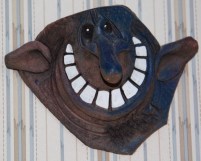
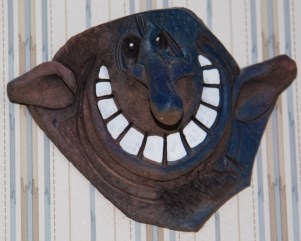
I will record and post the whole of Monkey Temple, poem by poem, with voice recordings. I’ll use two key trigger elements: first, the grinning monkey in the picture and second, the MT 1-1 designation, standing for Part 1 Poem 1 … this will continue 1-2, 1-3, 1-4 etc. If you are enjoying these poems and readings, keep your eyes open for those two triggers and catch your favorite monkey as he goes about his monkey business.
The monkeys appear, as if by magic.
They tumble out of windows and doorways.
They clamber through the holes in the temple’s ruined roof.
They are quiet at first.
They inspect their surroundings.
They ogle the crowd gathering for the afternoon show.
They watch the watchers watching them.
They pulsate, for no reason at all, they pulsate, then ululate.
They jump up and down and swing from the temple’s roof.
They pontificate, gesticulate, and regurgitate.
They sit and sift for fleas.
They defecate and urinate.
They masticate cautiously.
They castigate and fornicate.
They ruminate. They masturbate.
They rush to the top of the temple
and on the uplifted faces of the crowd they ejaculate.
Monkey Temple is the first poem of the book of the same name. It serves as a Prologue. Below is my oral presentation of this poem.
Some days, monkey winds himself up
like a clockwork mouse.
Other days he rolls over and over
with a key in his back like a clockwork cat.
Monkey is growing old and forgetful.
He forgets where he has hidden the key,
pats his pockets, and slows right down
before he eventually finds it
and winds himself up again.
One day, monkey leaves the key
between his shoulder blades
in the middle of his back.
All day long, the temple monkeys
play with the key, turning it round and round,
and winding monkey’s clockwork,
tighter and tighter, until suddenly
the mainspring breaks
and monkey slumps at the table
no energy, no strength,
no stars, no planets, no moon at night,
the sun broken fatally down,
the clockwork of his universe sapped,
and snapped.
This is the audio of the reading. Click on the audio, then click on the text and read while you listen. Or listen, then read. Or just listen. So many choices and so much fun.
Monkey’s Book Burning (Remembering Cervantes’s Scrutiny of the Library
and Ray Bradbury’s Fahrenheit 451)
Who burnt Monkey’s books?
Who took them from their shelves,
evicted them into the courtyard,
built them into book stacks, like hay,
then applied gasoline, and a lighted match?
Monkey watches in horror
as smoke and flame devour his beloveds.
He tries to approach, but the fire is too hot.
One book jumps out from the smoke, still smoldering,
and monkey snatches it and carries it away beneath his coat,
the fire burn branded into its cover,
the skin still sizzling on monkey’s hand.
How many books were burned that day?
How many monkeys now walk in the woods,
trying to re-create their lives,
circulating their memories by word of mouth?
Moth is to candle as book is to flame.
Monkey runs his hand in and out of the candle.
He recalls the bonfires in the streets.
He coughs through the throat burn of smoke.
He touches the blistered scars of flame.
I am continuing today with my experiments with voice recordings, something that interests me very much. As I said earlier, my voice changes with audience and mood, and early morning, in Island View, with the microphone and Princess Squiffy as an audience, and the window open so the cool morning air can circulate before the heat of the day, is not the best way to induce mood, well, not in this reader anyway.
When I made the recording, I was reading from my book Though Lovers Be Lost (available on Amazon) my head was slightly turned away from the laptop’s built-in speaker, and, as a result, the reading is not as loud as I would have liked. It is also a little bit fast. I don’t mind the speed of it: when I was younger I would read this poem in a single breath, all 90 seconds or so of it. Now I need many breaths to get though it successfully. Ah, a young man’s fancy turned to dust …
I will do a retake of the poem, not on my laptop, but on my IMac, and I will add that later, below the first recording which will appear just below this introduction. Then I will add the text. Yesterday I offered text, then reading. Today I offer the reading first. That allows the listener to listen first and then read the text OR to start the audio recording and then follow the text as it is being read. This is a Wednesday Workshop and this is all part of my workshop experiments in reading. Wonderful fun and highly recommended. Thank you for being here with me and remember, your comments are more than welcome, they convert a workshop from a soliloquy into a dialog.
Second recording to follow
To be Welsh on Sunday
To be Welsh on Sunday in a dry area of Wales is to wish, for the only time in your life, that you were English and civilized, and that you had a car or a bike and could drive or pedal to your heart’s desire, the county next door, wet on Sundays, where the pubs never shut and the bar is a paradise of elbows in your ribs and the dark liquids flow, not warm, not cold, just right, and family and friends are there beside you shoulder to shoulder, with the old ones sitting indoors by the fire in winter or outdoors in summer, at a picnic table under the trees or beneath an umbrella that says Seven Up and Pepsi (though nobody drinks them) and the umbrella is a sunshade on an evening like this when the sun is still high and the children tumble on the grass playing soccer and cricket and it’s “Watch your beer, Da!” as the gymnasts vault over the family dog till it hides beneath the table and snores and twitches until “Time, Gentlemen, please!” and the nightmare is upon us as the old school bell, ship’s bell, rings out its brass warning and people leave the Travellers’ Rest, the Ffynnon Wen, The Ty Coch, The Antelope, The Butcher’s, The Deri, The White Rose, The Con Club, the Plough and Harrow, The Flora, The Woodville, The Pant Mawr, The Cow and Snuffers — God bless them all, I knew them in my prime.
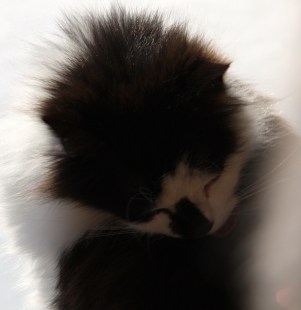
Photo Credit:Princess Squiffy, my favorite listener. She never complains, but she rarely stays awake.
I am the all-seeing eyes at the tip of Worm’s Head;
I am the teeth of the rocks at Rhossili;
I am the blackness in Pwll Ddu pool
when the sea-swells suck the stranger in and out,
sanding his bones.
Song pulled taut from a dark Welsh lung,
I am the memories of Silure and beast
mingled in a Gower Cave;
tamer of aurox,
hunter of deer,
caretaker of coracle,
fisher of salmon on the Abertawe tide,
I am the weaver of rhinoceros wool.
I am the minority,
persecuted for my faith,
for my language,
for my sex,
for the coal-dark of my thoughts.
I am the bard whose harp, strung like a bow,
will sing your death with music of arrows
from the wet Welsh woods.
I am the barb that sticks in your throat
from the dark worded ambush of my song.
Commentary:
Continuing with the audio experiments of the last couple of days, here is my voice recording of On Being Welsh. This poem can be found, along with several other Welsh poems, in Though Lovers Be Lost, available on Amazon.
Comments on the readings are very welcome. For my regular readers, if you have a favorite poem of mine that you would like to hear, just let me know and I will record it, specially for you!
I am indebted to my friend Jeremy Gilmer for this second reading of On Being Welsh. We will be collaborating on the creation of sound files and posting contrasting readings of various poems to see how different voices and rhythms change sound and meaning in poetry. Hopefully, this is the first in a longer series.





 rogermoorepoet