Tomb 104, Monte Albán: Sun & Moon

IMG_0181.jpg

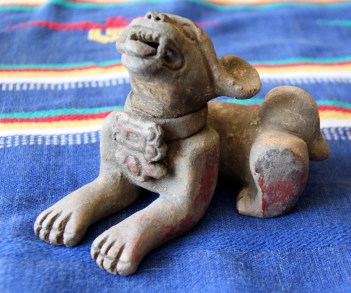
Tomb 104, Monte Albán

 Crocodile wraps bat in the carved
crocodile jaws that open the doors to hell.

Cocijo clutches Owl’s feathers.
He wears a feathered headdress
as he flies on Owl’s back.

 At the back of the tomb,

a darker world hides in the shadows
beyond the finger of our flashlight:
hidden galleries,
carved and painted bones.

 Our torch
plucks faces from the dark.

 Brought back to life by our unsteady light,
shadows walk grey bristles
across cheek and jaw.

We blink like owls as we ascend
from the underground darkness.

Up here, in the false world,
the one we know and love,
our hearts sing like wild birds,
caged between red ribs.

 Above us,
the pocked skull of the moon,
bares white rabbit’s teeth.

 Tochtli
knows that life’s only reality
lies in wait for us

underground.

Sun & Moon

IMG_0231 (2).jpg

Sun and Moon was published on Amazon and Kindle today. This is the second (revised) edition of Sun and Moon, the first edition having been published in 2000. Although this is the second edition, I have returned to and revised the original manuscript. It is clearer, stronger, and better than the first edition. Here is the description of the book as it appears on Amazon and Kindle.

“They tore down our walls,” Mono whispered, “stone by stone. A new church they built on the land they stole from us.” These opening lines begin the verbal adventure of Sun and Moon. Written in Oaxaca, Mexico, between 1995 and 1999, the poems tell some of the tales  of the voiceless, of the conquered, of the displaced, of the survivors, of the people who eat and sleep in the streets of Oaxaca, spinning their myths and legends and recalling their oral histories and memories. Sun and Moon traces the relationships between two civilizations, the indigenous and the conquerors, from the first contacts between Europeans and the people of the Oaxaca Valley up to the modern day interactions between locals and tourists. In these pages, some of the ancient ceremonies and beliefs, as described by indigenous people, are brought back to life in vivid images and colorful metaphors, so sharp, they can be grasped between the fingers and examined by the light of the sun by day and the moon by night. The multiple voices in the poems are those of human beings who, like the author, himself an émigré, find themselves in exile, lost, abandoned, and displaced. As the final character cries out in the final poem: “You do not worship at our sacred places … you don’t know even know the meaning of my name.”

Inquisitor: Sun & Moon

IMG_0184.jpg

Inquisitor

He told me to read,
and plucked my left eye from its orbit.
He slashed the glowing globe of the other.

 Knowledge leaked out:
loose threads dangling,
the reverse side of a tapestry.

 He told me to speak and squeezed
dry dust between my teeth.
I spouted a diet of Catechism and Confession.

He emptied my mind of poetry and history.
He destroyed the myths of my people.
He filled me with fantasies from a far off land.

I live in a desert where people die of thirst,
yet he talked to me of a man who walked on water.

 On all sides, as stubborn as stucco,
the prison walls listened, and learned.

 I counted the years with feeble scratches.

For an hour, each day, the sun shone on my face;
for an hour, each night, the moon kept me company.

Broken worlds lay shattered inside me.
Dust gathered in my people’s dictionary.
My heart was a weathered stone
withering within my chest.

 I longed for the witch doctor’s magic,
for the healing slash of wind and rain.

 The Inquisitor told me to write out our history:

I wrote
how his church
had come
to save us.

Note: I am still working on Sun and Moon. It will be ready for publication on Amazon and Kindle some time this week. Monkey Temple, Though Lovers Be Lost, Bistro, and Empress of Ireland are now available for review or purchase on Amazon and Kindle.

Monologue: Sun & Moon

IMG_0211.jpg

Monologue

 Mono means Monkey in Spanish. Monkey is one of the day names in the Mixtec calendar. 
Monologue, then, is Monkey, talking, perhaps to himself.

“They broke our walls,” Mono whispered, “stone by stone.
A new church they built, on the land they stole from us.
Red was its roof from a thunderstorm of blood.
The white bones of their lightning scattered us like hail.

They ripped out our tongues and commanded us to sing.
Carved mouths were ours, stuffed with grass.
Stone music forced its way through our broken teeth.

Few live now who can read the melodies of our silence.
We wait for some sage to measure our dance steps:
treading carefully, we walk on tiptoe.

A + cross  these stepping stones of time.”


Note: I am working on Sun and Moon. It will be ready for publication on Amazon and Kindle some time this week. Monkey Temple, Though Lovers Be Lost, Bistro, and Empress of Ireland are now available for review or purchase on Amazon and Kindle.

Re-reading the Codices Flash Fiction

IMG0061_1.jpg

Re-reading the Códices
Bistro 22

             The Mixtec Códices, indigenous screenfold books written on deer hide, 
are Pre-Columbian pictographs that record the history of the Mixtec peoples. 
There are no words: only brightly coloured scenes containing information about rituals, gods, heroes, and ceremonies. 
Only a few very precious documents
(Zouche-Nuttall, Vindobonensis, Borgia etc) survived the ravages of time
 and the continued purges of the Spanish priests. 
The following text, self-explanatory for the main part, verbalizes typical symbols from the códices. 
Clearly, such symbols, as the poems suggest, are ambiguous 
and open to radically different interpretations.

           “Two breasts: one green, one yellow, symbolic of the hill where the church stands; the church itself bi-colored, strong stone walls, a spire. A large red heart symbolic of the love we bear for you, our masters. Two feet walking the path of enlightenment you opened before us; two hands pointing the way. The feet below the heart; the hands above the heart, like wings; and the heart becomes the body of the new place you have built for us. And in the heart is our sacred symbol: the Earthquake, a sign of leadership and power used only by those of Royal Stature and the Noblest Blood. Attached to the heart is the Numeral One which means Lord of the Earthquake; for you are Number One in our Hearts. Attached to the heart is a speech scroll showing felicitous words of praise; below it is the sacred earthworm, and beneath that the serpent head of wisdom and the flint knife promising strength through sacrifice.

            But be wary: for our symbols are double-edged.

            The colors of the hill are divided, as the hill is divided, showing strife and division. The church is on top of the hill, for the symbol has conquered the people, and the people are starving, subject, and destroyed. The feet are pointing in opposite directions, for the people are stalled. They have no forward movement, nor will of their own. For they are conquered by the sword and not by love. And the hands are pointing in opposite directions; for the right hand knows not what the left hand is doing. And the hands are reversed showing anguish and distress. The sign of the heart is the sign of the disembodied heart, torn from the heaving chest of the vanquished and thrown to the dogs. The sign of the earthquake is also the sign of movement. And that movement is a bowel movement. And one movement in the middle of the sacrificed heart is the victor excreting on the vanquished and treating them with scorn and contempt. The scroll protrudes from the nether part and says that the victors are speaking words of excrement, that verbal diarrhea issues from their lips. And the serpent has no feathers; it cannot fly. It is as a snake treacherous and bitter, crawling on the ground. The head of the serpent is two tongued and tells of treachery and of deceit. The flint is attached to a heart; it speaks of the heart that is as hard as flint, knowing no mercy.

            And at the end that heart will receive no mercy in its turn.”

Obsidian’s Edge 29


IMG_0150.JPG

El sueño de la razón produce monstruos.
When reason sleeps, monsters are born.

Francisco de Goya.

5:00 AM

… bright flowers of penance purchased for a pittance finger knitted spider webs of silence spun into wrinkles between stars and evensong while an old film shadow boxes black and white photographs and a rowing boat lurches over the waves as if a soggy brown cardboard box had dropped down on a moonbeam to pluck the mote from a one-eyed jack-in-the-truck who surveyed his road map for the dead days lying in ambush next to the sudden bonfire that flared on Guy Fawkes night and ignited the world like a Jacky-jumper vaulting a Roman Candle as Catherine spun on her wheel and a sky full of stars wheeled round the North Pole and slid down the Big Dipper’s handle to launch a long white scar of lightning that scared night’s velvet mask and plucked a diamond feather from the peacock’s tail as it strutted through the garden of bifurcating paths where Borges left his summer footprints at low tide in the sandy grief of the autumn leaf that the red fox dripped and dropped as he fled in vain like blood sizzles drizzling from an open vein and observe I say the play of light as it glistens on the voices of young children reaching to pluck the church bells as if they were ripe fruit dangling before us in our dreams and the world is a handkerchief so small it is and now not so clean and so we dream these dreams and pluck this unripe apple from the eternal branch where it lay hidden kicking and struggling up like the float that bobbled then sank through deep water and memory bent itself into two like that fragile reed dead in the water lying as straight as a bowing string at a crazy angle   at the pillows edge where mouths flap open as shadows walk and talk and we slide back into sleep’s dark waters where there are no dreams and nothing from those dark depths is ever recalled …

IMG_0152.JPG


6:00 AM

a clicking of claws
needles knitting outwards
towards dawn’s guillotine

the alarm clock shuffles
its pack of sleeping hours

the church bell
lurches into action

IMG_0140 2.JPG

We have come full circle and the sequence of rewrites that I have dedicated to At the Edge of Obsidian / Obsidian’s Edge ends here, with the start of a new day in Oaxaca that will be very similar to the old day that has just passed us by. For those of you who wish to read the full sequence, in its correct order, it will appear (some time soon) under Obsidian’s Edge at the top of this page.

I would like to thank all those readers who have accompanied me on this journey. In addition, I would like to thank all of you who lent your voices to this sequence either below the line with your comments or, and I refer specifically to those who are close enough to know me in the flesh and blood of real life, with your verbal comments and telephone conversations.

I hope this will be the first of many journeys that we make together. My best wishes go out to you. I trust you will consider joining me in my next verbal adventure on this blog.

IMG_0149.JPG


Obsidian’s Edge 26

IMG_0188.jpg

El sueño de la razón produce monstruos.
When reason sleeps, monsters are born.
Francisco de Goya.

2:00 AM

… waves of people wandering the streets a hammer blow falling on an echoing anvil and the cracked church bell lurching into its hourly cry of grief dogs barking at the fleshy red crest some playful deity has placed on the heads of domestic fowls and other gallinaceous birds beaks digging for the dawn in parched earth with thin cracks spanning out from its egg shell crazy paving the yellow yolk of sunshine creeping out from cobbles and the Russian egg cup doll after doll unfolding as the hammer’s silver spoon descends on egg shells as thin as a shattered dream of moonlight raked from a pond with its life blood filling a crystalline goblet with a thick rich callous liquid as fierce and sweet as sunshine sacrificed on a branch as rain from the clouds speckles the tree with radiance an arco iris with its semi-circular scarf this deer head mocking pulling back velvet lips white teeth grinning through the wind screen’s shattered glass and man a string quartet of flesh and bone created from a ball of dough and baked in the oven in an earthenware dish with currants for eyes a raisin for a belly button lemon rind for a mouth orange peel for hair while white storks with swaddled babies are scared away by thrown stones and the man in the mirror his hand held up to trap the wind as a falling leaf settles in the secret web between index and thumb puzzles bind like a bird bound in a metal cage the sparrow’s mighty choir chirping at the roof of the circus tent and animals running wild all gone and the smooth grass brown with its withered distorting mirrors of stark staring eyes driving through black paintings of Satanic witches spooning soup between wrinkled lips dark open holes mouths and eyes gouged in slatted wooden faces and Anonymous Bosch’s bourgeois hell of furnaces and factories swarming with sparks of black imps falling from the heavenly meadow and the devil impaired on his black wooden horse …


Obsidian’s Edge 24

IMG_0259.JPG

12 AM
Envoi

1
Night’s incoming waves,
flickering candles,
yellow flames,
altar-white table cloth
with its cross of flowers;

evensong:
an ebb tide dangling its flotsam
at the end of a long white string.

Mala madre,
the spider plant,
an evil mother
abandoning
her unwanted children.

2

I clasp your hand in a confessional of dust:
your fingers knit themselves with mine.

Each wrinkle
on your hand
as fine as
a silk spun web.

IMG_0133.JPG

3

Yesterday

I tapped
with ardent spoon
on the graceless grapefruit’s
golden skull.

When we awake
I will boil us
each an egg.

Squeezed orange:
as warm as
this fierce embrace,
as sweet as
sunshine,
moonlight,
starlight;

silent bird:
midnight branch.

IMG_0263.JPG


Obsidian’s Edge 23

IMG_0240.JPG

11:00 PM
Calling it a day

1

This auriferous sky,
sewn with sharp sequins.

Is there a warp, I wonder,
a lurch towards meaning,
a leaning towards
sun or moon?

When they planted
our first footsteps
did those little prints
take root and grow
or did they wander,
restless,
across this planet?

A rampant foot stands firm
on the highest rampart:
instant gratification,
timeless possession,
each passing cloud.

2

A rocket streaks upwards.
Immediate
this release from the sender’s
earthbound misery
or is it merely
a message of anguish?

Who knocks
now at heaven’s gate?

The low moon glows:
lesser incandescence,
departed sun.

3

A satellite glides
its razor edge,
slicing distant pin
pricks of light.

The moon rides
her orange unicycle
across a thin black
line of hill.

Here on the azotea,
midnight slowly
covers the sparkling town
with a dark gray cape.

4

If their grief is our grief,
and all grief is one,
do we all then bleed in vain?

IMG_0067.JPG

Nochebuenas, tulipanes,
flowers of every crimson hue
pour blood from each
thorn-pierced wound.

5

This zapotec measuring cloth,
this mixtec weaving wool,
this trique with her knife:

who will sever the artery
that binds us to the loom
at Obsidian’s Edge?

Writing or Re-Writing? 6

IMG_0130


A Question of Thematic Unity

 The question for today concerns thematic unity: should one strive for thematic unity or should one present thematic contrasts? This question is provoked by today’s blog post, Obsidian’s Edge 22 10:00 PM, in which the narrator, sitting alone at the table in his apartment in Oaxaca is filled with memories of home, a home that is very different from the daily reality of life in Oaxaca.

The contrast with the sights and sounds of Oaxaca is obvious and immediate: outside in the street, a world of sunshine and shadow, darkness and fireworks, singing and dancing, people and poetry; yet within the room, alone, the narrator is challenged by that other world in which he is also immersed, the world of home and memories from home. This other world contrasts cold with warmth, the coast with the interior, memories of home with the immediate presence of Mexico.

I keep asking myself, would it be better to keep the thematic unity of Oaxaca, rather than to try and contrast the past with the present, thus creating a contrast between the distance there-sense and the immediate here-sense? The insertions try to emphasize the strangeness and immediacy of the new world (Oaxaca) that is in truth already so old. My worry is that I have not done so, certainly not in the way that I wanted to. As a result, I am worried that these “home visits” are intrusive and break the thematic unity that I would also like to establish.

The same question arises with earlier posts, Obsidian’s Edge 17 (Home Thoughts) and 16 (Siesta and Dream). These three poems (or sets of poems) break the thematic unity of the Oaxacan presence. They work as a contrast to that present, a reminder of the origins of the foreigner who observes and writes. But do they intrude, do they break the unity to such an extent that they stick out, a sore thumb hitching a ride to nowhere in particular?

My feeling right now after scanning the rewrite yet again is that they are intrusive and should be excluded from the final text. I have other poems and scenes from Mexico that would fit the Oaxacan themes much better. I give an example below. So, fellow followers and fellow bloggers: the rabbit is out of the trap and the greyhounds are primed and ready — I would appreciate your thoughts.

First: Today’s Post

10:00 PM
Alone at the Table
Memories of Home

1

Salt on the sea wind sifts raucous gulls in packs,
breeze beneath wings, searching for something
to scavenge. Seaweed. The tidemark filled with
longing. A grey sea crests and rises. Staring eyes:
stark simplicity of that seal’s head filling the bay.
Next day, his body stretched dead on the beach.

The river runs rocky beneath the covered bridge.
Campers have created first nation’s rock people,
heaping stone upon stone. At low tide, on the dried
river bed, there is no easy way to say no. White foam

horses in the farrier’s forge stamp and surge. A cold
wind blows at Cape Enrage. Wolfe Point sees late
gales transform the beach: the sandbar carved:
a Thanksgiving turkey, stripped to bare rib bone.

Dead birds sacrificed, so I can lie here in comfort:
my eiderdown is stuffed with dull dry winter coats.

2

Gold and silver, the last breath going out of him,
this warrior destined to dance before a cruel sun.

His ultimate spoken threads, so delicate, so thin,
they run, blood and water, through his pierced side,
sorrowful beneath the spectator’s stare. Ice cold,
this water on which he no longer dares nor cares

to walk. Rich silk: this tapestry woven with another
man’s words. Ghosts shunt back and forth across ice.
Late autumn mists confuse the paths, leading nowhere.

And now the alternate post on which I am still working.

10:00 PM
Alone at the Table
Memories

(Alternate Take)

1

Last year,
limed in a wedding
suit of white,
the grand tree of Tule
escaped from its compound.

Waving its branches wildly,
stumped down the road
to Teotitlán
in search of a bride.

2

It found instead,
on the Day of the Dead,
a carpet weaver
who interfaced its spirit
with fine lamb’s wool
shot with silk.

Next morning,
the tree came back,
its soul intact.

Now you can’t take photos:
the locals have imprisoned it
in a straitjacket of rusty iron railings.

3

The tree will not escape again.

It wanders round its pen,
hiding in corners,
never quite what you expect,
nor where you expect it to be.

Child prisoners,
escaped from their schools,
flash tin mirrors
at the underside of its branches.

Their dancing lights
set ancient spirits
free from their incarceration.

4

Serpiente lies along a lower limb,
waiting for some gossip to walk his way.

Mono swings from branch to branch
and is never still.

The quetzal bird preens
the emeralds of his feathers;
mirrors pursue him
with their liquid light.

5

Wandering eyes need time to rest.
They need time to discover
the old wrinkled man,
face like an ancient manuscript
all lines and creases,
his dark skin dried by the sun:
coarseness of furrowed bark.

Half buried in the trunk,
he nurses a fiery flame.

6

Convinced by the eloquence
of his hand-carved map,
I strive to follow
my troubled heart
struggling on its journey
across earth’s sea.

7

Conjured in the mirrors’
confusing crossfire,
blood flowers
dot the poinsettias
eyes and cross their Ts.

Sunshine engraves my name
on the sacrificial pelt
I bought at the abastos.

A blazing sun
dries the cries of shock
coursing through my victim eyes.