Battle Axe

img_0199

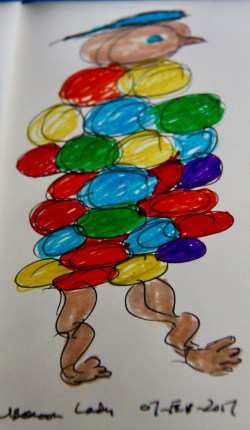
Battle Axe

Grim-faced, ageing,
wrinkles bone-deep
sculpting her skin
into unsightly waves,
a grimaced frown,
much practiced,
worn as a mask
to keep the world at bay.

Over her shoulder,
the mail-pouch slung,
brimful of letters,
bills, in all probability,
their content unknown
until the recipient’s
thumb or pocket knife
slits open the envelope
and reveals the secrets.

She carries more secrets.
They bob along in the streams
that flow beneath her skin
where joy and sorrow mingle.

Tomorrow, the surgeons
will perform their biopsy
and search out those secrets.
For now, she walks
with her eyes cast down,
unwilling  to meet
my all-seeing gaze.

Cramp

Chaos

Cramp
(Jackpine Sonnet)

Late last night, lying in bed,
cramp laid siege to my lower limbs.
I crawled out of that bed and stretched,
left leg, right leg, in the bathroom.

Aching still, the fear of more cramp
to come weighed heavy on my mind.

I didn’t want to wake my wife
with panic and alarums, so I slept
in the spare bed in the other room.

A great round moon sailed its pale-
faced boat on a sea of silent clouds.

I lay on the life raft of my bed
and prayed for cramp to stay away
and for the mattress to keep me afloat.

Crows

IMG_0146

Crows

 1

 “Your head’s bleeding.”
“I know.
“What did you do?”
“Nothing.”
“What do you mean, nothing? How did you get that cut on your head? Did you fall?”
“No.”
“What happened then?”
“I’d rather not talk about it.”
“You have to talk about it. Tell me, or I can’t help you.”
The old man looks at the social worker.
“It was my wife. She hit me with the frying pan.”
“Why?”
“She wanted bacon and eggs and I wouldn’t cook them. So she hit me.”
“What! And what did you do?”
“Nothing. I couldn’t hit her back.
“I should hope not. Where is she now?”
“In hospital.”
“What on earth …. why is she in hospital”
“I wouldn’t hit her. So she stuck her hand in the door jamb and closed the door on her fingers. There was blood everywhere. I called the ambulance and they came and took her in.”
“You didn’t go with her? To get your head seen to?”
“Obviously not.”
“Why not?”
“I knew you were coming. I couldn’t leave the house empty. It was funny though …”
“What was?”
“The crow. He must have heard her scream. He came and perched on that windowsill, right there, and just sat, and looked through the window as she lay on the floor. Then, when the ambulance came, he flapped his wings and flew away.”

2

He moves in closer then he tries to head butt me. I sense it coming, but I’m not quick enough to avoid the blow. It glances off the side of my head and I feel skin break, blood flow.
I step back.
He moves in again and this time throws a punch, a roundhouse swing with his right hand. I catch his wrist, pull him off balance, turn my body, spin on my heel, drag him across my outstretched leg: Tai Otoshi. He doesn’t know how to break fall, and I throw him down heavily, rather than lowering him. Then, I drop with him and, as his head rebounds off the floor, I slam my elbow into his nose and mouth.
He is now bleeding worse than me.
I leave him lying there.
As I walk away, two crows fly into a nearby tree and, heads cocked to one side, stare at him as he lies there.

3

My open-toed sandal catches on one of the nails that the ice forces up through the wood and I hit my head heavily on the back porch even before I realize I am falling.
I put my hand to my head and my fingers come back sticky and wet.
I lie there, stunned, groaning.
A crow flies in, perches in the nearest tree, and sits there, watching me. He caws. Two other crows join him. And then two more. A family of five. I watch them watching me.
Everything hurts. I try to roll over, but cannot.
The first crow flies towards the porch and lands on the balustrade where he sits, head cocked to one side, staring at me.
I slide slowly across the wood. The splinters are sharp. The nails stick up and catch in my clothes.
The crow on the balustrade caws and a second one flaps in and lands feet first, claws outstretched, to join him.
This spurs me into renewed action. I slither awkward across the boards, roll over on to my tummy by the picnic table, and force myself to do a push up. Then I grasp the seat of the picnic table and haul my aching body to the Hail Mary praying position.
I shriek, once, as my body returns to the almost vertical.
The crows flap their wings and fly away.

4

My father once told me how, during police training, a man burst into the classroom, grabbed the lecturer by the lapels of his coat, and tried to head butt him. The lecturer struggled with his assailant. Curses and blasphemies rose high as the two men rocked back and forth locked in combat.
“Stay there. Don’t move,” the lecturer screamed at the class. “I’ll handle this.”
The young recruits froze in their seats.
The intruder left as quickly as he came, cursing, and leaving the lecturer seething. The lecturer took a deep breath, regained his composure, and turned to the class.
“Write down what you have just seen,” he said. “I’ll need you all as witnesses. Use your own words. Don’t talk to anyone.”
There were thirty young recruits in the room and twenty-four different versions of the event.

In Medias Res

img_0177

In Medias Res
Wednesday Workshop
12 April 2017

In medias res is Latin for in the middle of things or in the middle of the story. It is a device from classical literature, going back to Homer, that allows the narrator to start the tale half way through, to return to the beginning to show what has happened leading up to the current situation, then to end the tale in suitable fashion with all the necessary details now in place.

In some ways it’s a bit like the arrival of a pizza from a new pizza home delivery service. You are hungry, you make the phone call, you order the pizza, and then you sit and you wait. The doorbell rings and the dog comes rushing out of nowhere and barks at the delivery man who stands there with his delivery bag in which the pizza nestles comforting and warm. You tell the dog to sit, you hand over the money, with a tip, of course, and the delivery man takes the pizza from the bag and pops it into your hands.

You close the door, walk back into the kitchen, and everyone is there, salivating waiting to see what you’ve bought. You know what kind of pizza it is, because you ordered it. But this is the secret of in medias res: the pizza is there but it’s still a mystery. You don’t really know what the pizza’s like. It may smell nice, it may look great when you open the box, but what’s in it, or rather on it; and how does it taste? These things are as yet unknowable. They are the mysteries that give in medias res its bite.

“Seek and you will find.” But what are you looking for?

You recognize the onions,; then there’s a meatball; ooh, look, some slices of salami and bacon; then there’s red peppers and green peppers; no anchovies (are you old enough to remember that song? RIP J Geils: I remember and still like your music); it’s a high rise pastry and there’s a cream cheese filling in the crust: delicious; oh yes, that subtle sweetness will come from the pieces of pineapple that decorate the pizza. Cheese: there’s plenty of that, three different types by the look of it and the tomato sauce is spicy and delicious.

When you take that first bite, the whole blend explodes in your mouth and the full delights of pizza burst upon you.

And that’s how I think of in medias res: no planning, washing and cutting the ingredients, no cooking, no placing in the oven, no wait as the house fills up with the smell of cooking pizza.

There’s just the pizza itself and the journey backwards to discover how it was made and what conjures up the magic of that first bite.

Beneath the surface of many people’s writing, lie lots mysterious ingredients. Sometimes, you can draw a few of them out and examine them as they flourish in the daylight. Often, they remain as mysteries, unconscious moments that float like lilies upon the surface of the story.

As I write, the sun is shining and the storm that visited us last week has all cleared away. There are deer prints by the bird feeder where the deer came last night and nuzzled for bird food.

The red spark of a squirrel sits by the feeders and four mourning doves crowd together on the balcony. I do not know where they came from and, like the deer, I do not know where they are going, although the deer tracks point to a probable destination.

In medias res: we all live there; we understand it, even if we don’t call t by its classy Latin name; we are intrigued by it; and it often lies at the center of our fascinating world.

Why?

IMG_0154

Why?

Curiouser and curiouser
the vanishing smile
on the ginger cat
and wild dog dingo
grinning like a coal-scuttle,
why, oh why?

Who put the cur in curious?
Why was the dog-watch curtailed?
Cynicism, some say, and why
do we kneel before him,
heads bowed, waiting
the thumbs up, thumbs down,
of placet, placetne,
why, oh why?

Comment: Raw poem. I dreamed it up last night, but it wasn’t like this when it started. Cur: means why or what for in Latin and curs were large, mongrel dogs, bred for herding cattle in the Middle Ages. Cynicsm: because the cynics were also called ‘dogs’ partly for their shamelessness and partly for the faithful way they guarded their philosophical tenets. In Mexico, the Dominicans were often portrayed with dogs at their sides. The explanation: domini / of the Lord, -can / dog; hence they were the faithful guard dogs of the Lord. Placet: it pleases in Latin; the thumbs up sign that allowed the defeated gladiator to live, not die. “In any event, the final decision of death or life belonged to the editor, who signalled his choice with a gesture described by Roman sources as pollice verso meaning ‘with a turned thumb’ a description too imprecise for reconstruction of the gesture or its symbolism” (Gladiator: Wikipedia).

The Brick

img_0372

The Brick

 The brick sits on the master’s desk.
The master enters the classroom,
sees the brick, picks it up,
and without even looking
hurls it out of the window.

It is a warm, spring day
and luckily the window is open.

The schoolboys watch the brick
as it tumbles in slow motion
end over end through the air.

It lands with a thump in the quad
right at the feet of another master.

This second master looks around
but there’s nobody in sight.

He shrugs his shoulders,
bends down, picks up the brick,
puts it in his briefcase,
and walks away.


The Sneeze

img_0394

The Sneeze

Uncontrolled,
uncontrollable,
it bursts forth,
unstoppable.

I was painting at the time,
an imitation of Munch:
all those sad-faced
citizens walking the street.

The sneeze caught them
in mid-stride.
The looked shocked
and bewildered:
green, slimy eyes,
white-flecked beards,
yellow cheeks and chins,
tiny red specks.

Who knows in what
hidden fold of the brain
are great ideas born?

I smudged and smeared,
worked snot into paint,
molded sticky chunks
with a palette knife,
sculpted those so-sad faces
into wily coyote smiles.

“Genius, pure genius,”
the art critic cries.
I get full marks
and
win first prize.

The Perfect Boiled Egg

img_0184

The Perfect Boiled Egg

two dozen
at the bottom of the pot
as hard as rocks

two dozen at the top
liquid beneath the stale bread
resurrected as toast
and used as blotting paper
to mop them up

and there
lurking somewhere
in the middle of the pot
hiding like the prize number
waiting for the winner
in a national lottery

the perfect boiled egg

Comment: School food was always a thing of wonder and I remember it only too well. If nothing else, the school sports gave me an appetite and the school food made me more or less omnivorous and gave me a cast-iron stomach. I can’t remember who said them first, but I always associate these words it with St. Trinian’s: “School fish: the piece of cod that passeth all understanding.” We sat at tables of eight and we could always find someone who would eat whatever we left … more about that (and school) later.

Blind

img_0394


Blind

Warmth in a color,
with heat visible to the touch
and shocking pink a shock
to seeking fingers,
not one that you and I,
gifted with sight,
would ever understand.

Blindfolded, they wheel me
round and round the garden
in my teddy bear reality.
Gravel scrunches beneath
the wheels and I am flooded
with the inability to see, to know,
to be sure of the shadows
that are no longer there.

The ones who push me
talk and tell but cannot show.
How could they hold a rainbow
before my eyes or let me hear
the northern lights crackle the sky,
their visible Niagara a curtain
of fairy lights dancing up and down?

And those glorious organ notes
quivering the body, angel voices rising,
falling, grasping at my eye-
lashes, peeling my eye-lids apart.

Song of songs and the singer
deaf to his own sublimity,
oh dealer of cards, fingerless
pianist, bold dancer prancing
on your amputated stumps.

Comment: Raw poem, written for Gwen Martin who opened my eyes to the fact that blind people can perceive color through their finger-tips.

The Return

Avila 2008 003

The Return

I opened the car door
and he ran across the parking lot
and jumped into the back seat.

“Where have you been?” I asked.
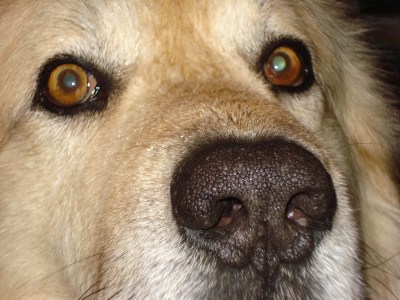
He thumped his great tail, sniffed,
and licked the hand I placed on his shadowy head.

As we drove back home, he thrust his head
between the seats and placed his paw upon my shoulder.
Then he licked my ear and the side of my face.

I pulled into the garage and let him out of the car.
He raced to the end of the drive, surveyed the neighborhood,
and drilled an invisible pee into the snow.

I whistled, and he ran back to the door,
whimpering and scratching, impatient.
I held the door open and he bounded in.
“You’re back home now,” I told him.

He ran to the cat’s bowl and lapped some water,
scoffed her kibble, and lay down in his usual place.

At night, he lies beside me in bed,
a fluffy spoon carved into my body’s curve.
In the morning he walks through the kitchen
and doesn’t make a sound.
The cat senses he’s there and bristles and hisses
at rainbow motes dancing in the sun.

He’s sitting beside me now,
head on my knee, as I type these words,
one-handed, because I’m scratching him
in his favorite spot behind the ear.