Looking Back

Empress 048

Looking Back

Looking back on a wonderful weekend, the WFNB WordSpring in Quispamsis, I remember the highlights.

  1. Picking up Kerry-Lee Powell and driving with her to Quispamsis. Never has the road seemed so short, and rarely has time passed so quickly. Whether it’s our shared Welsh roots or the course I took with her online at Toronto, we had so much to talk about.
  2. Arriving to find so many friends and all of them so willing to help with books and luggage and getting me to my room. Special mentions: Jeremy Gilmer‘s hug on arriving, Zev Bagel‘s offer to help with luggage, Chuck Bowie‘s warm presence and guiding hand, Cathy Fynn‘s hug and firm control of registration and checking in, and many others, some of whose names will appear bit by bit.
  3. Settling into the room was easy.  Then it was a case of preparing for the first workshop (The Sense of an Ending) that started at four and was due to run until five. I went early to the room and met the participants as they arrived. My first surprise: Barb Fullerton, another member of our online Toronto course, announced her presence with a warm smile and greeting. We had chatted online for eight weeks and now she was here at my workshop. Wonderful. Starting the spring conference with a workshop on endings seemed very inappropriate, until I remembered my T. S. Eliot: “In my beginning is my end …” The circularity of time and the intricate relationship of the end to the middle to the beginning … it made a great central theme for the workshop.
  4. The group was composed of many excellent writers and I was able to mention many of them by name. In addition to  some of those already highlighted above [Chuck, Jeremy, Kerry-LeeZev, Chuck] , Ana Watts, Jane Tims, Neil Sampson, and Terry Armstrong stood out and I urged people to circulate during the mobile, inter-active session, meet these writers, and talk to them about their undoubted finishing skills.
  5. Time passed too quickly and we found that an hour was not enough. No problem, I checked with Cathy and we kept going for another fifty minutes in a seamless transition of lengthened workouts.
  6. Friday night passed in a flurry of conversation in the hotel restaurant, coffee house, and bar. Chuck (the TWUC Atlantic Representative) introduced me to Marjorie Doyle, the Chair of TWUC and our guest speaker for the banquet, and we held a delightful, wide-ranging conversation on literary values and travels in Catalonia.
  7. Saturday morning saw the advent of my second workshop, this one entitled The Black Ink of Fear. This workshop was by request and I was more than a little afraid of how I would handle it. I circulated my own Fear Document  and invited people to read it. Victor, my Australian friend, found his sheet was upside down and amazed the room by standing on his head, to much applause, as he read it the right way up. This clearly broke the ice and we employed Chaos Theory to good effect by doing absolutely nothing in Chaotic Fashion and getting everywhere.
  8. Lunch was a delightful selection from Chef’s Table (Sussex) and Chuck Bowie played a major role in keeping me a seat (I arrived late) and getting me settled (thank you again, Chuck).
  9. Worn out after lunch, I missed the afternoon’s sessions and took to my bed in traditional Spanish fashion enjoying a well-earned, rather extended siesta from 2-5 pm.
  10. Supper was at 6:00 pm and I was truly honored when Jeremy Gilmer read my poem Inundation that I wrote on May 6, just when the St. John River flooding was at its worst downstream below Fredericton. We dedicated our thoughts and prayers to the people in Saint John and Quispamsis still affected by the now diminishing waters. It was a double honor when I was invited to say a traditional Welsh Grace, in Welsh, followed by an English translation: “Thanks be to the lord for good food and even better friends.”
  11. My weekend’s activities were not yet over and I received an award (3rd place in the David Adams Richards’ Prose Competition for my short story collection Devil’s Kitchen). I read in a thick Welsh accent a short piece of Flash Fiction from this collection, called Teeth. For some strange reason that I could not fathom, the room was highly amused by this true story of domestic bliss.
  12. Saturday night and we retired to the bar where a small group of us Marie, Louise, Angèle, John, Andrea, and I stayed up and sang to John’s marvelous harmonica and guitar music until one thirty am. Contrary to malicious rumors spread by unknown sources, not mentioned by name, we did not sing rugby songs, but a marvelous mix of Irish ballads, Newfoundland songs, Acadian and French chansons, and contemporary songs by internationally acclaimed singers, many of whom might not, midnight being long past, have recognized their own music.

Alas, all good things must come to an end. Later that Sunday morning, we made our sad farewells and Kerry-Lee and I headed back down the road to Fredericton where we arrived after what what seemed to be about five minutes driving (at well below the speed limit). I dropped Kerry-Lee off then stopped at the Happy Baker for cakes and croissants. These I presented to my beloved for Mother’s Day. We shared them over hot coffee … and that was that.

 

Thursday Thoughts: Fear

IMG_0147

Thursday Thoughts
10 May 2018
Fear

Tomorrow I drive to Quispamsis to give a writers’ workshop on Fear. How do I tell the participants that I am afraid? I am afraid of the journey there by road. I am afraid of stray moose and deer, fleeing from the flooding, and standing, frightened, by the roadside, ready to panic and run at the car. I am afraid of getting lost, of losing my way, of being stranded in unknown streets with no outlet, no exit, no easy way home.

How do I tell them I am afraid of them. I am afraid of their knowledge. Many of them will know more than me. They are all unknown quantities, blank faces at present, with tumble dryer minds full of churning ideas, ideas that I have never had nor met. I am frightened. I have it in my head to call in sick, to say I am no longer available, to say I cannot come to orchestrate the music that I myself composed.

Stage fright, I suppose, these pre-conference  nerves that battered me all last night with their owls’ wings, leaving me sleepless, turning and tossing, cringing at my own lack of everything that I will tell them they should have.

Fear: a black monster that hides beneath the bed. I dare not leave arm or hand above the blankets in case the monster emerges and bites off the hand that feeds it with more fears. Fear: the shadow in the corner, looming over the bed, shaking me by the shoulder as I lie there, tormented. Fear: the jaws that bite, the claws that snatch, the hand that holds me by the ear or the scruff of the neck and drags me back into a shadowy past where monsters dwell and flicker in the candlelight, growing larger as I walk down white-washed halls.

Enough, no more: I am just as afraid now as I was before. Sleepless tonight, too tired tomorrow to care, I will leave early, hope for the best, wind my way carefully through deer strewn roads and perilous paths. When I get lost, and I probably will, I will ask the way. And all the time I’ll sing my favorite travel song: ‘I know where I’m going’ … even if I don’t.

Wednesday Workshop: Recycling

IMG0075_1

Wednesday Workshop
09 May 2018

Recycling 1

“You never know when you might need it,” my

grandfather said, finger-nails cracking red-
waxed parcel string. Bright sealing wax rained down
on the tablecloth, covering it with hard,
scarlet chips, wax cracked, tight knots emerging.
One by one, my grandfather first loosened
them, then sought the string’s free end, following
it along its snaking way from knot to
knot. Like Theseus following his twine
through the labyrinth below the palace, my
grandfather mused, hesitated, followed
the clues given him by the knotter’s mind.
Set free from its parceled knots and lashings,
he looped the string around his fingers and
tied the twine into a tight bow that he
stowed away for future use. Reef knots, slip
knots, sheep-shanks, bowlines, bowlines-on-the-bight,
he showed me how to tie them all. He taught
me too how to never tie granny knots.
“Never cut string with a knife: untie knots,”
strict his advice and followed still today.

Recycling 2

finger-nails
cracking red-waxed
parcel string

sealing wax rained down
staining snow white tablecloth
wax cracked
hard scarlet flakes
tight knots emerging
loosened

now seek the string’s
free end
then follow it
the way it snakes
linking knot to knot

muse
hesitate
unknot
the mind of she who tied

set free these
parceled knots and lashings
loop string around fingers
tie tight the twine

a child’s bow
to be stored
for future use

Recycling
Haiku 1
[7/11/7]

string yields blood-bright scarlet wax
a thread to lead through the parcel’s labyrinth
open now the magic box

Recycling
Haiku 2
[5/7/5]

blood-bright scarlet wax
a thread through the labyrinth
open now the box

Commentary:
There are many ways to recycle. All are valid. Some are more valid than others.

Guelaguetza

IMG0072_1

Guelaguetza
Oaxaca, Mexico

Brass bands, marimbas, violin strings
stretched over turtle shell, conch,
mad march of goat-skinned men,
fierce-gazed, horned and ready,
mirror dance, sun sparking
flint flakes from glass buttons
highlighting feathered flounces
lifting to fancy’s flights …

… beggars hold out chronic hands,
snotty-nosed children baited to hook
your heart from your body,
your money from your purse,
pleading lips, desperate brown eyes
primed to conquer the conquistadors
that still stalk, haughty, the square
where tiny women dance
with angels and devils …

… a backstreet now, an alley,
three men in masks,
one with a gun,
two with knives,
probing for the tourist’s
wallet …

Recycling

Books

Recycling

“You never know when you might need it,” my
grandfather said, finger-nails cracking red-
waxed parcel string. Bright sealing wax rained down
on the tablecloth, covering it with hard,
scarlet chips. Wax cracked, tight knots emerged.
One by one, my grandfather first loosened
them, then sought the string’s free end, following
it along its snaking way from knot to
knot. Like Theseus following his twine
through the labyrinth below the palace, my
grandfather mused, hesitated, followed
the clues given him by the knotter’s mind.
Set free from its parceled knots and lashings,
he looped the string around his fingers and
tied the twine into a tight bow that he
stowed away for future use. Reef knots, slip
knots, sheep-shanks, bowlines, bowlines-on-the-bight,
he showed me how to tie them all. He taught
me too how to never tie granny knots.
“Never cut string with a knife: untie knots,”
strict his advice. I follow it today.

Commentary:
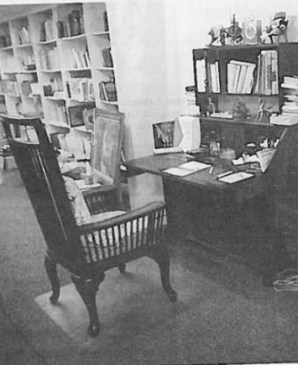
The photo shows my grandfather’s chair sitting before my basement desk where I write and store my books. I used to climb up the back of this chair when I was a tiny child, and blow on the bald spot on his head while he was asleep. Such memories nesting in the attic corner of the dormant mind. One day, I will write about that. Oh: I just did.

Darning Socks

F1030024 2

Darning Socks
(for Angela Wink)

My grandfather taught me how to darn socks.
I sat beside him by the fire and placed
a grey, wooden mushroom inside the sock,
stretching the sock wool to expose the hole.
He chose his colors with care, bright yellows,
oranges, reds, sky blues, anything that
stood out against the sock’s dark drabness. If
the socks were thin, he split new wool, pulling
it into individual strands that
he would draw through tongue and lips, wetting them
so they would thread with ease through the needle.
Curled wool threaded, I would cross-hatch the sock’s
hole, slowly forming a life raft that I’d
fill with colored wool. All my life, I have
darned socks, sewn buttons, mended my sweaters.
I always use bright colors, to my wife’s
dismay. Then, I know who did the darning,
and when. I still have my grandad’s First World
War sewing kit, all wrapped up in his signed
canvas wrap with his needles and some wool.
It’s lovely just to touch where his hands touched.
I still see dark blood traces where he pricked
his thumb, and where he sewed up wounded friends.

Commentary:

This poem comes from a comment, made by Angela Wink, on yesterday’s post. Such exchanges are precious and help create new memories. Thank you Angela.

Friday Fiction: Crave More

IMG_0125

Friday Fiction
04 May 2018
Crave More

Crave More: I hate those words. I always choose
a cart with the shop’s name on the handle.
I can handle that. I can’t stand a cart
that screams Crave More at me every time I
bend to place an item in the wire grid.
If stores were honest they would write Think More
and Crave Less
 on their shopping carts. I bet
that would cut into profits. Anyway,
there I was, in LaLaLand, leaning on
my cart, half asleep, when this ghost drifted
towards me. “Help me,” it said. “I’m hungry.
I need money for food.” I woke up from
my dream, looked at the ghost, tall, skeletal
thin, cavernous eyes and cheekbones sticking
out, gaps in the teeth, grey face drawn with shame.
“Sorry,” came automatically. Then I
too felt shame. I looked at him again. “I
only carry plastic.” The excuse limped
heavily across the air between us.
I saw something in his eyes, I knew not
what, and turned away. As I walked away,
I added one hundred pound of muscle
to the scarecrow frame. Took forty years off
his age. Filled his body with joy and pride,
not shame, and remembered how he played, hard
and fast, but true. I ran the card index
of former players that I had coached through
my mind. I knew their moves, and attributes,
the way they played the game, strengths, weaknesses …
I remembered him holding up the Cup.
But I couldn’t remember his name. I
pushed the cart all over the store in a
frantic search for him. At the ATM
I withdrew cash. I could hand it to him.
I could tell him he had dropped it. I went
through a thousand scenes. I could invite him
to the snack bar. I could tell him to buy
what he needed and follow me. Check out
time, I would add his purchases to my
bill. I looked everywhere. He was nowhere
to be seen. One opportunity. One
chance. That’s all we get. Miss it, and we blow
the game. Grasp it and we medal with gold.

Commentary:
I have been experimenting with iambic pentameter, counting words and syllables on my fingers, tapping rhythms on the table, driving Clare crazy, and disturbing the cat. I have also disturbed my usual way of writing, for better or for worse I am not yet sure. Yesterday’s entertainment was to rewrite my brief story, Crave More, as a poem in pseudo-iambic pentameter. The measures seem to function and the rhythm and word count move both within the line and in the melodic, rhythmic phrasings that move between lines in a constant enjambement.

So, by all means let me know what you think of this experiment.  Here’s the link to the short story, also called Crave More. I would love to receive your opinions on narrative pseudo-iambic pentameter.

Revised Version:

Encounter

I was in the Superstore, leaning on
my cart, half asleep, when this ghost drifted
towards me. “Help me,” it said. “I’m hungry.
I need money for food.” I woke up from
my dream, looked at the ghost, tall, skeletal
thin, cavernous eyes and cheekbones sticking
out, gaps in the teeth, grey face drawn with shame.
“Sorry,” came automatically. Then I
too felt shame. I looked at him again. “I
only carry plastic.” The excuse limped
heavily across the air between us.
I saw something in his eyes, I knew not
what, and turned away. As I walked away,
I added one hundred pound of muscle
to the scarecrow frame. Took forty years off
his age. Filled his body with joy and pride,
not shame, and remembered how he played, hard
and fast, but true. I ran the card index
of former players that I had coached through
my mind. I knew their moves, and attributes,
the way they played the game, strengths, weaknesses …
I remembered him holding up the Cup.
But I couldn’t remember his name. I
pushed the cart all over the store in a
frantic search for him. At the ATM
I withdrew cash. I could hand it to him.
I could tell him he had dropped it. I went
through a thousand scenes. I could invite him
to the snack bar. I could tell him to buy
what he needed and follow me. Check out
time, I would add his purchases to my
bill. I looked everywhere. He was nowhere
to be seen. One opportunity. One
chance. That’s all we get. Miss it, and we blow
the game. Grasp it and we medal with gold.

Comment to the Revision:

The first eight lines of the original poem set the scene. While I tried to use them to accentuate commercial exploitation of the customer’s potential for greed, Crave More, they are not essential to the story of the encounter. Meg noticed this and following her interaction I have revised the poem, eliminating those first eight lines.

This is an interesting and inter-active way to work. Thank you Meg!

Wednesday Workshop: The Poem Itself

Books

Wednesday Workshop
02 May 2018
The Poem Itself

One of the joys of downsizing one’s library is rediscovering old books, genuine treasures, that one wishes to read again. On my basement bookshelf I found an old copy of Stanley Burnshaw’s The Poem Itself (New York: Crowell, 1976). I thumbed quickly through it and found my old marginal notes on poems by Miguel de Unamuno and Antonio Machado. Reading the annotations to the poems I came across such literary and philosophical gems as these.

  • “Poetry gave (Unamuno) permanence to the temporary forms of the self” (p. 167).
  • “Unamuno’s God needs men to be sure of his own existence” (p. 171).
  • “The poetic element (for Machado) was not the word for its phonic value, nor color, nor line, nor a complex of sensations, but a deep palpitation of the spirit” (p. 172).
  • “In the life of every sensitive person there is much spiritual experience which cannot be given a name or a title” (p. 173).

These brief insights into the nature of poetry sent me back to the book’s first pages and I read with much joy and pleasure the opening essay entitled The Three Revolutions of Modern Poetry (pp. xvii-xliv).

The first revolution is that of Syntax (p. xxiii). Word order is changed substantially and words and thoughts are inverted. Sixteen lines of Mallarmé (p. xxiv) are composed of one sentence with five commas and a colon. There is no logical sequence of beginning, middle, and end as one thing runs into another and thoughts shape-shift and move. The structure becomes that of presences and dreams as Mallarmé writes to his new theory: “to paint, not the thing, but the emotion it produces” (p. xxv). Other analyses of syntactical distortion and fragmentation follow and Emily Dickinson’s Further in summer than the birds— leads into Cummings’ my father moved through dooms of love / through names of am through haves of give. When I link this most modern movement to Francisco de Quevedo’s ‘soy un fue, y un será, y un es cansado’ / I am a “was” and a “will be” and a  tired “is” … I realize yet again that all is not new in this modern world of ours. After all, Quevedo lived from 1580-1645, a modern poet indeed.

The second revolution is that of Prosody (p. xxvii). Rimbaud’s first poem in vers libre / free verse was written (probably in 1873) and published in 1886. Today, we are no longer shocked by the breaking down of the tyranny of verse. In fact, we are probably more shocked by people who use rhyming, metric poetry than by the many innovations in line length and word arrangement with which we are so steadily bombarded. That said, I still find some of Cumming’s innovations, Grasshopper / PPEGORHRASS for example (p.xxi) to be quite stunning and not always readily intelligible.

The third revolution is that of Referents, “the upheaval in poetic communication as a whole and specifically its referents” (p. xxxi). This is basically the writers of poetry turning to their private, interior worlds for inspiration. While poetry has always contained references to the self, modern poetry may be full of meaning for the writer, but that meaning doesn’t always extend to the reader. This is particularly true of automatic writing, surrealism, and the metaphoric poetry that floats, sometimes without factual substance, in the mind of reader and writer alike. Burnshaw isolates three moments in the development of this obscurity.

  • “a deliberate attempt to enrich the communicative content of language by expunging the unessential words” (p. xxxiii).
  • “to compress years of anguish, dreams, and projects into a sentence, a word” (p. xxxvii).
  • “the use of personal symbols and hence the creation of a private cosmology” (p. xxxviii).

These three elements contribute to the privacy and hermetic obscurity prevalent in certain poets. Le jeu ne vaut pas la chandelle / the game isn’t worth the candle … alas, while some difficult poems and poets are very worthwhile, some poetry is definitely not worth the valuable time wasted in trying to decipher it. That is my conclusion: nobody else’s.

This re-adventure back into modern poetry contributed to a delightful voyage through the verse of Baudelaire, Mallarmé, Nerval, Verlaine, Machado, and Unamuno (among others).  It is a voyage that I have started, but not yet finished. It is also a voyage that is generating new thoughts, fresh understanding, and a renewed desire to write. What more can a reader / writer desire than to be among friends, also sharing loneliness and despair and also held at bay by the living words of dead men, their voices and wisdom heard through ageing eyes that can still scan the printed page … vivo en conversación con los difuntos / y escucho con mis ojos a los Muertos // I live in conversation with the deceased / and listen with my eyes to the dead (in my friend Elias River’s translation) of Quevedo’s poem Retirado en la paz de estos desiertos.

Downsizing

img_0136

Downsizing

a double sword
this clearing out
of odds and ends

the library diminishing
book by book
so many memories
slipped between the covers
dust-bound now
yet springing so quickly
back to life

sorrowful not sweet
these multiple partings
from people I will never see again
save in my dreams

I think of book burnings
so many heroes
going up in flames
fire their beginnings
fire their ends

fire the means of forging
the Omega and Alpha
of the book world
that surrounds us

fire encircling us
death’s bone fires
consuming us
outside and in