Dog Daze

IMG_0040 (2)

Dog Daze

 the sad dog hounds me
sends me spinning
sets me back on my heels
makes me chase my tail
and snap at shadows
as they ghost
through my mind

memories deceive
desperate I lap
at licks of false hope
a shifting salt field
that increases my thirst

driving me on and on
deeper into ragged clouds
and the storm that lays waste
to the dog daze of my mind

Friday Fiction: Sentences

IMG_0010

Friday Fiction
27 April 2018
Sentences

“Use lots of verbs to catch the reader’s attention. Keep your sentences short.”

… people don’t like long sentences … life sentences … things like that … though death sentences may be short, ugly, and brief … unless there’s a power shortage when you’re sitting there all wired up … or they’ve watered down the drugs in the tube they attach to the needle they put in the shunt already plugged into your arm …

… you’ve read the news … seen the pictures … if you live close enough you may even have stood out in the street with a candle and your friends watching the power shortage hit downtown … district lights flickering off … road lights shutting down … big blankets of blackness … as they put all available electricity into the power circuits that lead to the electric chair …

… use short sentences … like the one they read to me when I was six … then they locked me away in a boarding school for twelve long years … until I was eighteen … I ran away … again and again … they beat me … again and again … short sentences … ‘hold out your hand’ … ‘pull down your pants’ … bend over that chair’ … six of the best … no verb in that one … yet the words still strike a note of fear into those who have been publicly humiliated and flogged in a boarding school dining room … in front of all the boarders … and the day boys as well … ‘don’t cry’ … ‘little baby’ … ‘mother’s pet’ … ‘mummy’s darling’ … blubbing like a baby … and this at six years old … or seven … or eight … lashed on hands or backside by a grown man wielding a bamboo cane …

“Keep those sentences short.”

“Bend over.”

“Place your hands against the wall.”

“Don’t cry like a baby.”

“Take it like a man.”

Thursday Thoughts: M. T. Head

IMG_0068

Thursday Thoughts
26 April, 2018
M. T. Head
 

I sat in the class, head in hands, avoiding eye contact. I hoped the teacher wouldn’t point me out, call on me, nominate me with a finger … to no avail … he called my name … “You have sixty seconds to speak about …” he paused, then produced the rabbit from the hat, “matches. Come along, stand up, you have sixty seconds, starting …” he watched the second hand go round on the classroom clock, then counted down: “5, 4, 3, 2, 1 …” waved his hand, and shouted: “Now!”

Matches: cricket matches, boxing matches, rugby matches, soccer matches, chess matches, matches to light the burners on the gas stove, the oven, to light the fire in the fire place … matches, matchsticks, Match Box toys, Dinky toys, toys for little boys, toys for big boys …

“Ten seconds have gone … you have fifty remaining.”

“When I think about matches, I think about …”

The first spring day in the bungalow, our summer home. The rooms are cold and damp after the winter and nobody has been here since last year. We lay a fire in the grate, but the wood is damp, as is the old newspaper we gather from our last visit. We search for sugar to aid the blaze that we hope to start, but the sugar bowl is empty. We go to the stove. Cold, winter ashes crowd the fire bowl. We scrape them together in a desperate search for charcoal remains …  but we find nothing. We move to the oil-fired lamps and oil stoves. Matches dragged across soggy sandpaper fail to spark.

“Come along, boy. Have you nothing to say? You have thirty seconds left.”

Silence fills the room. It is broken by the childhood sniggers and chuckles of long-forgotten friends. The unmentionable shuffles its outsize feet to shatter the silence. My cheeks grow red. I start, stammer, and stop.

We leave the bungalow. Go next door to where our neighbours winter over. We knock on the door. “Can you lend us a match?” we ask, holding out our hands. Mrs. Williams beams at us. “A match,” she says. “First time in after the winter?” We nod. “I thought so. Saw you arriving. Wondered why you hadn’t come earlier. The weather’s been nice. Here: I can do much better than a match.”  She moves over to the fireplace, picks up the little coal shovel, shovels up a generous portion of her fire, heaps on another lump, then two, of fresh coal, and “Here you are,” she says. “Just put it in the fireplace and add some wood and coal. You can start your first fire with this.” “Thank you, Mrs. Williams,” we say. “No problem,” she replies. “It’s good to see you back. It’s been lonely here this winter without you.”

“Time’s up,” the teacher says. “That’s sixty seconds of silence and you can hardly find a word to say on a simple subject. Are you stupid or what? You should be ashamed of yourself.”

My face turns red. I hang my head.

I feel ashamed.

I am seven years old.

Wednesday Workshop: Balancing the Books


15 May 2002 Pre-Rimouski 035

Wednesday Workshop
25 April 2018
Balancing the Books

Two days ago, I wrote the following lines to one of the writing groups of which I am a member.
“Today, 23 April 2018, is World Book Day. We not only celebrate the world of books, but also the death date of three great authors. Miguel de Cervantes, William Shakespeare, and the Inca Garcilasso de la Vega. Three great writers, two continents, two languages, three if you include the Quechua from which the Inca Garcilasso translated his Comentarios Reales. The Inca Garcilasso didn’t actually translate the Comentarios Reales, for the originals were part of an oral tradition in a culture that lacked handwriting. Hence they were never written down. His mother was an Incan Princess and his father a conquistador. His mother kept the Incan culture and memories alive and it was from the oral traditions of his family (one side of it) that the Comentarios Reales were born. It was recognized in its day as one of the greatest books to come from one of the first outstanding writers with indigenous roots. Hence his place on the pedestal alongside the other two greats. All three died on 23 April 1613, the same date, but not the same day. Two different calendars were present in Europe: the old Julian and the more modern Gregorian … same date, but thirteen days apart.”
I knew long ago that I did not have the strength and stamina to make a living as a professional writer. I knew too that I could not put my beloved and my family through the strain of maybe, or maybe not, surviving financially on a creative writer’s income. I wanted to be an artistic writer, a poet above all, art for art’s sake, not just a commercial writer, writing adverts for a living, or pandering to the lusts of the baying evening newspaper crowd.
In order to support and care for my family I had to make money and balance the books. Rather than writing full time, therefore, I chose a career in academia. My career as an academic led to 90 research articles, mainly in my specialized field of Golden Age Spanish Literature, 70 book reviews, the publication, in book form, of part of my doctoral thesis, and an online bibliography, prepared initially thanks to the loving care of my beloved, and now turned, thanks to the Harriet Irving Library at the University of New Brunswick, into a searchable data base.

In addition to my normal course load, I also committed to twenty-five years of unpaid, voluntary overload teaching. I did this in order to maintain a small, understaffed program in a tiny Maritime university. I also had a long-term coaching career (Rugby) at club, provincial, regional, and national levels, and a commitment, at various times, to various editorial positions in 14 local, regional, national and international journals. My creative writing career has understandably suffered because of this commitment to research, teaching, editing, and coaching. In spite of that, while researching and teaching full-time, I was still able, with the help of family and friends, to publish 10 poetry books, 11 poetry chapbooks, 12 short stories and 130 plus poems in 20 Canadian (and other) journals. There was very little money in any this, other than my salary as a tenured professor, and I know only too well that to have been a full time, creative writer and to have maintained a house and a family without recourse to a second career would have been impossible.
Now that I have retired from university teaching, I can finally engage full time in creative writing. In my part-time creative writing career, maintained while I worked in academia, I kept a journal and made sure I spent at least one hour a day writing creatively, even if I had to get up early to do so. This resulted in a couple of poetry books with small presses and later a series of self-published poetry books that doubled with various festivals and other writing sequences. My poetry books never sold well, and there is very little money in poetry anyway, so when I started self-publishing, I determined to give my books away to friends and well-wishers who were interested in what I was writing. In retirement, I discovered CreateSpace and I now have thirteen books up on Amazon and Kindle. However, I am a writer and an academic, not a salesman and a marketing manager. As a result, I haven’t marketed myself and no, I haven’t sold many books. Self-promotion does not appear to be my strong point.
Last year, as Canada reached it’s 150th birthday, a birthday that ignores the fact that the country has existed for much longer than 150 years and that our indigenous people have lived here for 10,000 years or more, without any spectacular celebrations, questions were asked to selected writers about our Canadian Culture. What do we love most about Canadian Culture, was one such question. I gave the following brief answer: “Canadian Culture allows a person like myself, born in Wales, and speaking English, French and Spanish, to live and write in Canada about Wales, England, France, Mexico, Spain, and my adopted homeland. However, the literary and cultural industry boasts of our international character while almost totally ignoring me and writers like me. Those who guard the gates of the literary world ignore the self-published (often referring to us as adherents to what they term the ‘vanity press’) and they constantly belittle and put down those who have not progressed in the ways that they, as literary gate-keepers, find acceptable.”
Do I care? Of course I care. That is why I am writing this and why I will continue to write. Will anyone read this and take any notice? I doubt it. Will anyone take any action as a result of this tiny pebble cast into a Great Canadian Lake? I really, really doubt it. I can see the shoulder shrugging now as the eye-brows raise themselves slightly and the reject piles beckon. Will literary Canada keep staring at its own belly button and congratulating itself on its wonderful cultural opportunities for self-expression in writing? I guess it will. Will things change for artists on the periphery, for struggling artists, for artists like myself who with great difficulty have fought throughout their lives to continue with their creative writing while balancing the family books? I doubt it very, very much indeed.
But I am here, as others are here. Together, we have a voice. I would like it to become a  very powerful voice. This voice has long been side-lined by the literary establishment and the institutions. But we are many. And I too have a dream: it is that one day, we independent publishers, we self-publishers, will raise up our voices, and one day we will be heard.

This Carving

IMG_5811_2

This carving may be gently touched

It doesn’t act like a bear.
Its head bears a Cocker Spaniel’s short, sharp stop.
Its jaws are wedged in a grin.
Its tongue hangs still.
No saliva drops from its chin.
Motionless eyes.
This carving’s tame.
Children may sit safely on its back,
may stroke the mighty muscles.
It’s perfectly safe.
Woodworm, like moth, have left holes in its back.
More: many a crack ensures its tameness.
Its shoulders hunch.
Sixteen wooden claws chisel the concrete museum floor.
It’s nearer ear is chipped like my grandmother’s tea-cup.
There’s lots of room for slips between cups and this bear’s lips.
I can sense death’s closeness.
Suddenly, I know you’re in there, Bear,
alive, alert, angry, hungry.
I feel you move:
cold sweat covers my false, carved skin.

Movie rights to a sonnet

Balloon lady

Movie rights to a sonnet

Meg Sorick wrote on my blog yesterday and suggested that poetry had flown out of our world.  Here are her words: “Poets used to be rock stars. And not that I feel like poetry has fallen from popularity, because Lord knows it’s all over the place in social media and the blogging world. But I cannot think of one famous contemporary poet. And I’m not talking about famous people who also write poetry. How did that happen?”

Meg’s is a very acute observation. My reply follows. I have changed it slightly from my reply on yesterday’s blog, expanding and annotating it.

“You raise a series of major questions, Meg, ones I have been thinking about for a long time. What is poetry? Has it vanished from our contemporary world? Is poetry as important as it was? If not, why not?”

I will begin with one of my favorite jokes. I made it as an author and a poet: ‘I cannot wait to be offered the movie rights for one of my sonnets.’ Movie rights to a sonnet: beautiful. I love it.

Baltasar Gracián, writing in Seventeenth Century Spain, penned the following: “Lo bueno, breve, dos veces bueno.” What is good and brief is twice as good.

I quote Baltasar Gracián for several reasons. Above all, what he wrote in the 1600’s is still true today. Perhaps, in this age of tweets, twitter, and sound bytes, it is more relevant than ever. Poetry: keep it short. Keep it brief. I would add one more piece of advice: make it memorable.

The rhetorical tools of poetry have never really changed. Reduced to their minima, they are metaphor, witticisms, snappy word plays, repetition, rhyme, rhythm, brevity, and cutting, memorable discourse.

Today, this is the language of advertisement, sound byte, twitter, tweets, labeling. Poetry hasn’t vanished: it has descended to its lowest common rhetorical denominators and today it serves a different purpose.

Trump, for example, is a magnificent poet. He relabels and reclassifies the world in oh-so-memorable epithets according to his own world-view and self-interpretation. As a destroyer and re-creator of language, he is magnificent. We may not like him. We may not always understand him, but we doubt and mock, to our peril, his poetic abilities and his abilities to create narrative and myth in sharp, memorable language.

Rap and hip-hop have also revitalized and politicized language. Poetry is not dead: it has taken to the street where it blends with twitter and tweet. Poetry is not dead: it is regenerating.

Poetry, in our contemporary world, has lost many things. Above all it has lost what the academic critics call The Grand Myth or the Grand Narrative. In The Great Code, Northrop Frye’s book on literature and the bible, the Canadian critic shows how English literature is dependent on the bible. The bible: a code, a poetic language spoken by all great poets. I would suggest that we have now lost that great code and we are no longer bound, in poetry at least, by biblical conventions.

We can say the same of other great codes, The Elizabethan World Picture, The Great Chain of Being, Ovid’s Metamorphoses, Courtly Love … codes come and go. They wander the hillsides like lost sheep. They migrate like people.

Migrate like people: a lucky phrase, plucked from the air, yet oh so true. Migrants, emigrants, immigrants: displaced people, we wander the physical world, each with our own set of cultural baggage. Dissatisfied people: we have left one place to travel to another and are unhappy in both. And remember, there are regional migrants, workplace migrants, weather migrants … wanderers all, they have no time to put down roots, to settle into a code of culture.

Ut populi, poesis / as people, so poetry: fragmented poetry, poetry linked to the intensely personal, poetry that reaches out to friend and family but does not extend to a universal code of language, culture, or being … in our current world, how could it?

We few, we happy few, we band of siblings, we cultured poets … we are the forgotten voices of the ivory tower, of an ivy-league academia. We have become immersed in the past, in our own navel-gazing, in the never-never land of things that probably never were and definitely will never again be.

Sitting at our computers, at our desks, at our kitchen tables, we will never connect with the rhythms of the street, of the soup kitchen, of poverty, of bag-ladies, of old men sitting outside the supermarket, their Tim Hortons cups in their hands, hoping for, begging for money. Migrants we may be, but migrating from where, to where, and why? Is my migration similar to your migration? I very much doubt it. Yet, in one way or another, each of us is a migrant. And all migrants pack their own bags carrying with them their memories, their myths, and all too often their native language.

You want poetry? Get out among the gente perduta, the lost people, the garbage cans, the back alleys, the panhandlers. Mix with the migrants. Stand for an hour at the traffic lights with your hand held out to stopped cars whose drivers roll up the windows, lock all the doors, hold their noses, and look the other way.

The nymphs and shepherds of our inner cities wear garbage bags to keep out the rain. They panhandle. They sleep at night in cardboard castles. They lodge in shop doorways. They sleep, poor shepherds and shepherdesses, on park benches. They shoot themselves full of dope with shared, blunt needles. They smoke dope. Drink alcohol from shared bottles. They fight so as not to share that one remaining bottle that they call their own.

Poetry is the voice of the deprived, of the indigenous, of the migrant, of the once-rich toppled from their jobs and left to drown in the gutter. Poetry is the voice of the left out, the abandoned, the depressed, the oppressed. It is the rust of the rust belt, the grind of locked gears, the language of muddled, mixed-up fears.

Poetry uses the same devices as it always did. As it always will. Like water, it flows. It seeks its own levels. It wears away stone. It rises to drown us. It carries our verbal arks, our cultural arks, our Noah’s arks, and it bears us, each and every one of us, into our dreams, out of our dreams, into our realities, into the worlds it creates for us, into the dreams it allows us to dream, into the realities of our everyday nightmares.

Poetry is the rediscovery of ourselves, our voices, our language. Poetry is what gives meaning to our lives, all of our lives. It is what makes us, even now, sit up, and listen, and learn, and live.

Violet

IMG_0004 (2)

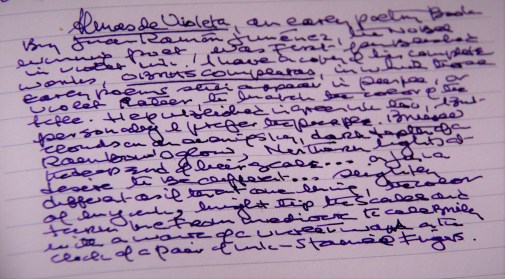
Almas de violeta, an early poetry book by Juan Ramón Jiménez, the Nobel winning poet, was first published in violet ink. I have a copy of his complete works, Obras completas, in which those early poems still appear in purple, or violet, rather, to match the color of the title. He published poems in green ink, too, but personally I prefer purple. Bruised clouds in an evening sky, dark depths of a rainbow’s glow, Northern Lights at the deep end of their descending scale … or is it just a desire to be different … slightly different, as if that one thing, the color of my ink, might tip the scales and turn me from mediocre to celebrity with a wave of a violet wand or the click of a pair of ink-stained fingers.

What else is there to do, other than meditate and walk your fingers across the keyboard, when rain mingles with snow and grey and white streaks fall at faster, slower rates to trace a network across window, trees, and garden? JRJ, Juan Ramón Jiménez, forgotten now by all but the scholars who read and teach him to the few ardent graduate students who clutter the ivy covered halls of academia and blow away the dry dust that settles on unused books when they languish on library shelves. Is that what will become of us, we poor poets of today? Are we to be reduced to the polvo seco de tesis doctoral / the dry dust of a doctoral thesis, as my good friend José María Valverde once wrote?

I guess the dry dust of a doctoral thesis is better than the silence of unturned pages, the empty sands of the voiceless desert, the dunes of forgetfulness shifting here and there along a sea-shore swept by shiftless winds. Forgetfulness: we must first be read … only then can we discarded and forgotten. And who will read us? Who will emerge from their twitter and their tweets to open a book and lift the written word from the page and carry it into their hearts so it can be placed on the soul’s altar and surrounded by incense and flowers?

Purple ink on a purple page, the violence of violet, life with it’s doldrums and purple patches, the cat curled up in its basket, one paw out to test the weather on this rainy, snowy day, when coffee appears at my elbow, as if by magic, and words seek sanctuary in a ritual flow of  song.

Thursday Thoughts: Cricket


IMG_0027

Thursday Thoughts
19 April 2018
Cricket

            Street cricket. Played on cracked tarmac. The wicket: three sticks whitewashed on to the high stone wall of our cul-de-sac street that backed on the railway yards. The wall the boundary. And the neighbor’s front yards. Six and out if you hooked and hit behind the wicket and over the railway wall. You also had to retrieve the ball yourself. Game stopped until you climbed the wall, looked down at the rail yards thirty feet below, and shouted until someone emerged from a workman’s hut to find the ball or throw it back.

            No worker … no ball … no game. Then you had to run out of your street, down the main road, up the hill for two streets, beg permission at the locked rail yard iron gates: “Please, mister, can I go get my ball?” Then run all the way back down the railway lines to where the waiting players hung over your own street wall, shouting and cheering. Search for the ball among shiny rails, shunting rails, rusty rails, dandelions, thistles, and nettles, avoiding rolling stock and the occasional shunting engine. Find the ball. Try unsuccessfully to throw it back over the wall to the waiting hands. Try again. No good. Wall too high. Carry ball back to iron gates. Thank gate man politely so you can come back next time. Return ball to game. Game continues, rain or shine. Unless it’s real rain. The Lissingdowne / Pissingdown type. If so, run for nearest house and shelter by fire in kitchen.

            Basic rules. Six and out if you hit it over the railway wall. Two runs and fetch the ball yourself if you hit it into the to bomb buildings at square leg, next to the railway wall. No fielders there. Banned territory. Still piled with grass-overgrown bombed bricks and debris. Fragile, crumbling walls still still liable to tumble. Cellars that might open up. Low walls that might collapse. Four and out in a neighbor’s front yard. Some were nice and didn’t mind. Watch out for the old witch with the garden gate. If you hit her window, even with a tennis ball, she’d be out quick as a flash, steal your ball, and wouldn’t give it back. Otherwise, it was single-batsmen. Run the runs and walk back from singles. One hand, one bounce. Tip and run once you’d scored twenty. One hand off the wall if you didn’t clear it for a six and out. Out if your fox terrier got the ball and ran round and round in circles with it in his mouth. Damn difficult to catch. Also his sharp, terrier teeth might puncture the ball. Damned dog. Lost ball and stopped match if the dog ran into the house and gave the ball to your gran who was saving it for tennis.

            Cricket, in those days, was civilization. It had survived the bombing raids that missed the railway yards and bombed the bomb buildings. It had survived the machine-gun fire from the fighter-bombers that had strafed the street leaving bullet-holes, still un-repaired, in walls and shattering the glass of now-mended windows. It gave us a sense of rule and law, for the rules were strict and nobody broke them and stealing runs in tip and run was legal and not a crime.

            Cricket: a small, bright window on the back-street where I lived, a window filled with happiness and light, even when it’s over the wall and six and out, or the dog runs away with the tennis ball, or the ball vanishes down a mysterious rabbit-hole in the bomb buildings and slides down to someone’s ruined cellar.

            Game’s over. The Tests Match is on. The one primitive, tiny black-and-white screen in the street lights up with flickering figures and we sit around on the floor watching real men playing the real game on a grassy field in a fairy-book world, a world that most of us back-street boys and girls will never know or see, but that comes over to us as a dream of reality on this old black-and-white tv.

Scrambled Eggs

img_0363

Scrambled Eggs

The door to her father’s house opened before Tiggy could raise the brass knocker.

“At last,” said her father. “You’re just in time to cook breakfast. Come in. Come in,” He stood aside to let her pass and she pecked a kiss at his cheek as she hurried by, overnight bag in the hand closer to him. Tiggy held her breath as she went. She knew the smell emanating from her father would be as ripe as it was during her last visit, if not worse.

“I’ll make you breakfast in a moment, dad. I’ll just take these upstairs first.”

When she came down, her post-drive ablutions completed, she went straight to the kitchen. Her father sat at the breakfast table, restless fingers playing the piano of the table top in arrhythmic Morse Code messages.

“At last,” her father muttered. “Where have you been?”

“Just tidying up, dad,” Tiggy smiled. “You know it’s a long drive.”

“I want scrambled eggs. On toast. Make them like your mother used to.”

Tiggy thought of the dry overcooked eggs her mother used to scrape out of the burnt-to-a-crisp saucepan and sighed. Her almost-liquid, cordon bleu divinity was the real thing. Scrambled eggs, indeed. And so much salt. More like bacalao, dried salt cod with a little bit of turmeric to make it look like scrambled egg.

Tiggy picked up a saucepan. Filthy. She went to the sink and started to scrub.

“You don’t need to do that,” her father said. “It’s clean.”

“It’ll be cleaner when I’ve finished, dad. Don’t you worry.”

“Here,” her father handed her some plates. “You night as well wash these as well. They were clean enough for your mother but they won’t be good enough for you.” Greasy films layered the plates where yesterday’s bacon had solidified. Hard lumps of egg stuck to the cracks that road-mapped the plates’ surface.

“I’ll look after it, dad. You sit down and rest. I’m home now.”

“At last,” Tiggy’s father grunted.

Tiggy took in her father’s face. He had put on weight and veins ran red and blue tattoos across the unshaven surface. He breathed with difficulty, but she knew he angered with ease.

Tiggy looked for the end of the roll of paper towels she had bought on her last visit. When she found it, she dried saucepan, plates, and cutlery, putting the saucepan on the stove and laying cutlery and plates neatly in a space she created on the cluttered table. Her father pushed his setting aside and struggled to his feet.

“Here, let me help you.”

“That’d be great, dad. You do the toast, I’ll get the eggs,” Tiggy walked to the fridge, searched in vain for some butter, and carefully selected three large brown eggs.

Her father followed her to the fridge.

“Here, use up this cracked one,” he handed her a brown egg with a large fissure that mapped a thin contour from big end to little end.

Tiggy reached for the egg. She grasped it and felt the cold icy creep of the army of white maggots that seethed along the line. She shuddered and the egg slipped from her fingers and dropped to the kitchen’s flagstone floor where it shattered. A rich, ripe stench arose and ghosted through the air to tickle Tiggy’s nostrils. Her stomach heaved.

Having washed her hands, she cracked each egg individually into a saucer, inspected it, then poured it into the saucepan. Next, she took a wooden spoon from the drawer and started to blend the eggs.

Meanwhile, her father sat back down at the table, toast forgotten, and recommenced his Morse Code messages.

Tiggy opened one cupboard, then another, in search of bread. Finally, she found the remains of a sliced loaf in a dark corner and brought it out into the light. The first slice she extracted from the bag was a painting from Picasso’s Blue Period, the second, a breeding ground for mold, but the third might be salvageable …

“Don’t worry,” her father said. “Just scrape the blue stuff off. It’ll be fine. I eat it all the time.”

“You can’t eat that,” Tiggy threw the bread in the garbage. “I’ll just serve you the eggs on the plate.”

When they were cooked to her father’s satisfaction, Tiggy scraped the dried-out eggs from now charred saucepan. They landed on her father’s plate with a harsh, unforgiving sound.

“Lovely,” he said, licking his lips. “Just like your mum’s.”

Friday Fiction: Teeth

img_0181

Friday Fiction
13 April 2018
Teeth

Lunchtime.

Tiggy opens a can of tom8to soup and heats it on the stove. She slices the remains of yesterday’s loaf of bread into one inch cubes and fries them in olive oil and garlic. Tom8to soup with croutons. Then she puts two slices of bread in the toaster. Her father will only eat toast soaked in butter and layered with Marmite when he eats tomahto soup.

“Lunch is ready,” she calls out.

The black American Cocker Spaniel, bought by Tiggy’s late mother, in a moment of madness, by telephone, unseen, camps in the kitchen. It nests at the far end of the table, by the stove, and defends its territory with warning growls and a snapping of yellowed teeth. Tiggy will not go near the dog.

“Lunch is ready,” Tiggy calls out, a little bit louder. Dog, as they call him, growls and clatters its teeth. It has hidden a treasure in the folds of its old, gray comfort blanket, and guards it with the fierce, loving worry of a dragon protecting its golden hoard.

Tiggy’s father enters the kitchen as she places the soup on the table.

“I’m not ready to eat. Put it back in the pot.”

“What’s wrong, dad? I thought you were hungry.”

“My teeth,” he mumbles through a mouthful of pink gums. “I can’t find my teeth.”

“Where on earth did you put them?”

“I don’t know. If I knew where I’d put them, I wouldn’t have lost them.”

Tiggy’s father circulates round the kitchen opening drawers, lifting saucepan lids, and shaking empty yogurt pots to see if they’ll rattle.

“I can’t find them anywhere. I can’t eat lunch without my teeth.”

“But it’s only soup, dad, tom8to soup.”

“I don’t like tom8to soup. Your mother always made tomahto soup. Why can’t you be more like your mother?”

“Sorry, dad. I’ll call it tomahto soup, if that will make you feel better. But it’s still made out of tom8toes.”

“Don’t be so sarcastic. Help me find my teeth,” Tiggy’s father stomps towards the stove and Dog growls fiercely from its blanket as it guards its treasure.

“Take that, you dirty dog,” Tiggy’s father lashes out at Dog with his stick and cracks it across the head.

“Dad, stop that. It’s not Dog’s fault.”

Dog howls and spits out what it is chewing.

“There they are,” Tiggy’s father bends down, picks up his teeth, still hairy from the blanket and bubbly from Dog’s saliva. He pops his teeth into his mouth.

“That’s better,” he says, “now I can enjoy my lunch.”