Though Lovers Be Lost 4-7 /7

Empress 070.jpg

“Though lovers be lost, love shall not;
and Death shall have no Dominion.”
Dylan Thomas 

Though Lovers Be Lost
4-7 /7

4

Who carved my future
in each sliver of bone?

A scratch of the iron pen
jerks the puppet’s limbs
into prophesied motion.

Who mapped in runes
the ruins of this heart?

Above me,
a rag tag patch of cloud
drifts here and there,
shifting constantly;

like this body of water,
this flesh and blood
ship in which I sail.

5

Eye of the peacock,
can you touch
what I see when
I close my eyelids
down for the night?

Black rock of the midnight
sun, rolled up the sky,
when will you release me
from my daily bondage?

 Last night, the planet
quivered beneath my body
and I felt each footfall
of a transient god.

6

Thunder knocks
on the door of my dream
and I am afraid.

I no longer know my way
through night’s dark wood.

Who bore her body
out in that rush of rain?

Could she still sense
the sigh of wet grass?

 Could she still hear
the damp leaves whisper?

7

A finger of fog
trickles
a forgotten face
down the window.

The power of water,
of fire, of frost;
of wind, rain, snow,
and ice.

Night’s incoming tide:
stark waters.

Rising.


Though Lovers Be Lost 1-3 /7

IMG_0133.jpg

“Though lovers be lost, love shall not;
and Death shall have no Dominion.”
Dylan Thomas 

Though Lovers Be Lost
1-3 /7

 1

Once,
you were a river,
flowing silver
beneath the moon.

 High tide
in the salt marsh:
your body filled
with shadow and light.

I dipped my hands
in dappled water.

2

Eagle with a shattered wing,
my heart batters
against bars of white bone.

Or am I a killdeer,
trailing broken-
winged promises
for a forgotten
god to snatch?

Gulls float downstream.
They ride a nightmare
of half-remembered ice.

Trapped in my cage of flame,
I turn my feathers to the sun.

 3

Awake,
I lie anchored by
what pale visions of moths
fluttering on the horizon?

A sail
flaps canvas wings
speeding me on my way
backwards into night.

 A feathered shadow
ghosts
fingers over my face.

 Night’s butterflies
stutter against
shuttered windows.

 Strange hands
reach out to grasp me
and once more I’m
afraid of the dark.


Suite Ste. Luce 11-14 /14


fundy 05 mist+wolfepipers 081.jpg

“Though lovers be lost, love shall not;
and Death shall have no Dominion.”
Dylan Thomas 

Suite Ste. Luce
11-14 / 14

11

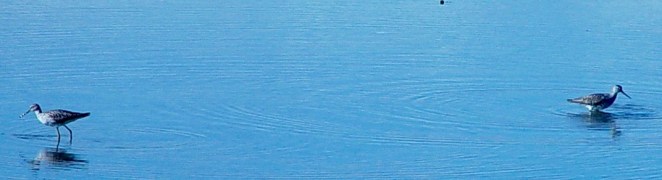
The beach compacts
smaller and smaller.

The tide jostles
sand pipers
into a dwindling world:

this shrinking pocket
handkerchief
of sand.

12

Happy the kite’s face
with its child
dangling far below.

Kite bounces up and down
on a tight-rope of air.

Below it, the child
walking the beach,
nose to the wind,
obedience on a leash.

The kite wags
its long, bright tail.

13

When the mist thickens,
it closes a window in the sky.

The church on the headland
steps plainly into sight,
and fades again.

The old man wraps himself
in a cloak of rain.

Suddenly, the sun
drapes itself,
a golden sou’wester,
over his head.

14

Summer lies abandoned
under rain-soaked umbrellas.

Red bucket, bright blue spade.

Childhood,
cast away:
a pair of sandals
on this cold, damp sand.

Suite Ste. Luce 5-10 /14

15 May 2002 Pre-Rimouski 277.jpg

“Though lovers be lost, love shall not;
and Death shall have no Dominion.”
Dylan Thomas 

Suite Ste. Luce
5-10 / 14

5

Early morning mist:

a shadow heron
clacks its beak
at a ring of mobbing gulls.

6

When the mist clears,
heron draws
his neck into a bow
and fires
the arrow of his beak
into a fish.

The gulls run wild,
clawing up the sky
on a ladder of sound.

7

Seagull:

a coat-hanger, hanging from
a blue sky-rail,

white wings braced
against the flow of air.

8

Herring gulls hovering,
white doves
round the old man’s head;

a halo
of clacking red-ringed beaks
livid against the sky.

Brazen voiced,
these peace doves,
mewling for their daily bread.

9

Black
cormorants pinning
their wings to dry
on the wind’s
rough cross-beams.

10

The dead crab,
alive an eye blink ago:

 body exit left
(with the black backed gull)

legs exeunt right
(with herring gull attendants).

Crowd scene:
a chorus
of crows-in-waiting.


Writer’s Block

IMG_0182.jpg

Writer’s Block

Every day, well, almost every day, I meet people who tell me that they cannot write anymore. They have abandoned their current project. They sit in their work space and stare at blank screens or empty walls. They have come face to face with the dreaded Writer’s Block.

While some consider Writer’s Block to be an actual illness, others flaunt it like a flag or a badge of honor:

“Don’t touch me — I’ve got Writer’s Block: I wouldn’t want you to catch it.”

“I’m having a bad week: I’ve got Writer’s Block.”

“Sorry, I can’t make the writer’s meeting, I’ve got Writer’s Block.”

According to Wikipedia, “Writer’s block is a condition, primarily associated with writing, in which an author loses the ability to produce new work or experiences a creative slowdown. The condition ranges in difficulty from coming up with original ideas to being unable to produce a work for years. Throughout history, writer’s block has been a documented problem.”

We have probably all experienced the sensation of being unable to write, unable to think, unable to continue. I have found that it happens frequently in examinations with young students whose minds suddenly go blank when faced by a white page and an awkward question. This form of Writer’s Block comes at the most unfortunate times. Students need to be switched on just when their minds switch off. And something similar happens to writers.

Examination Block can be overcome. In many cases careful preparation for an exam will reduce or eliminate examination block. These preparations may well include correct pre-examination note-taking and revision procedures, no last minute all-night study the night before the exam, a good night’s sleep, proper food, water, and appropriate physical exercises before the exam starts. All these things prepare both body and mind and free the student for that most important task: the struggle with the blank page and the awkward question.

Will a set of pre-writing preparations work for Writer’s Block?

In order to answer this question, I would rather take a different approach. Instead of seeing Writer’s Block as a physical / mental presence that stops us writing, why not look at it as an absence that can be overcome.

What can we call that absence? Personally, I look upon it as an absence of creativity. If the creativity isn’t there, then writing creatively won’t happen. So what do we do?

Let us define creativity. For me, creativity is the expression of the creative principle that dwells within all of us. It is there, within us. We may suppress it or we may let it be suppressed. We may ignore it or we may deny it: but it is still there. It is always there. Sometimes it is beaten out of us; or we think it is. But it is still there, beneath the surface, waiting to be called on. The Roman poets spoke of it as Deus est in nobis … the God that dwells within us.

Creativity, for me, is like a river that vanishes underground and then reappears: it will be back.

The most important thing in my opinion is what you do when you’re not writing, what you do when you’re faced with that wall of blackness, what you do when you stare at that blank screen and nothing makes your fingers dance on the key board.

Here’s what I do. I make up my mind not to force myself to be creative. Forget about writing. Do something else. Ignore all idea of Writer’s Block, or the End of the World, or the Imminent Disaster of not being able to write. It may take a mental effort, but forget about it.

Now do something else, something positive. Different people respond to different stimuli. Here’s what I do.

(1) I read books

I read other people in their creative moments. I love reading people who write in other languages that I speak and read, because my own mind tries to recreate their images, their stories. This re-creation is a form of creation in itself. New words, new ideas, new combinations, rise to the surface of the mind, like bubbles on a river.

(2) I color and draw

As any who have seen my drawings know, I cannot draw. However, I can take a line for a walk. And that’s what I do. Then I color the spaces I create. My friends thought I was wasting my time and I believed them until I read one of Matisse’s sayings: “My ambition: to liberate color, to make it serve both as form and content.” Voilà: I have my raison d’être. Nature abhors a vacuum. When you create a space, color and meaning rush in.

(3) I take photos

The capturing of a moment: a sunset, a new bird at the feeder, deer wandering through the garden, a black bear visiting, rain on a spider web, sunlight through a prism, a cat made out of cherry stones … the re-creation of the moment is the creation of the memory. More bubbles flow on the surface of the stream.

(4) I go for a walk, look at nature and the world around me, people too

It is incredibly important to do this. A visit to the local coffee shop, a walk around the super-market or corner store, a seat in the park on a sunny day … just be, watch, relax, look and listen, empty yourself, let the world flow back in … look at the ducks on the lake or the goldfish in the tank … more bubbles on the water, more ideas floating down the stream …

(5) I listen to music

De gustibus non disputandum … we can’t argue about taste. Where music goes, to each his or her own … the music I like fills my mind, relaxes me, flows out when it ends, takes my mind for a walk and leaves … a vacuum … into which dreams and colors, words and ideas, build like clouds …

(6) I cook

Cooking has always relaxed me. Sometimes the repeating of an old recipe helps clear my mind. Sometimes I have a need to invent something new. Hands and mind occupied, the secret, sacred underground river of creativity flows on …

(7) I sew

Last summer, an unexpected event led me to join a quilting group … oh what fun … a man quilting among a dozen women … I learned so many things … so many different ways of looking at the world … so many concepts that I would never have dreamed of on my own … Sewing runs in the family: I still have my grandfather’s sewing kit … darning and sewing needles that served him for two years before the mast … that darned his socks as he survived in the trenches of the First World War … it bears his name and I use it with pride … and what memories arise in my mind as I choose the needle … his needle … the one that will lead me into the next adventure, be it quilt, button or patch …

(8) I keep a journal

… and come hell or high water, I write in it every day and have done so since 1985. That’s 31 years during which I have scarcely missed a day. The writing maybe banal, it may be nothing but a note on the weather or a comment on a sporting event … but it’s there … a vital challenge to the idea that Writer’s Block can take me over and can win. This journal is 95% drivel … maybe more … but bobbing along the stream of words are ideas, verses, rhyme schemes, choruses, stories, flashes of inspiration, jokes, memories, magic moments, falling stars, … the secret is to catch these falling stars, to recognize these rough diamonds and to return to them and polish when the moment is ripe … and it will be, sooner or later … for bubbles are buoyant and will lift you to the stars.

(9) I believe

Through all this runs a thread of belief … belief that the black cloud of despair will not win. The Writer’s Block will go. Creativity will never be not lost. It is there, beneath the surface, always ready to be contacted, waiting to rise and take you over again. And all too soon and quite unexpectedly, one form of creativity slips into another and the creative writing (it never really went away because of the journal) comes back.

Writer’s Block: it does exist. It’s how we deal with it that’s important. Creativity rules: forget Writer’s Block and let creativity and the multiple ways back to creativity grow and flow. Sooner or later the clouds will lift, the sun will return, the block will unblock and the words will flow again.

Remember the words on the Roman sundial: Horas non numero nisi serenas … I count only the happy hours. And remember: the clouds will lift, the sun will return.

Trust me.

And believe.

Suite Ste. Luce 1-4 /14

Empress 068.jpg


“Though lovers be lost, love shall not;
and Death shall have no Dominion.”
Dylan Thomas 

Suite Ste. Luce
1-4 / 14

 1

Black backed gulls,
nature’s alarm clocks,
waking the seaside
with their glaucous rattle.

High tide? Low tide?
We have drifted on our life raft
far from the grasping hands
of city clocks.

Gulls breakfast on the beach.
Day’s rhythm all at sea.

 2

6 am? 7 am? 8 am?
What do they mean?

The planet’s slow revolution?
This sun arc sketched in its stretch of sky?

Salt spray combing seaside fingers
through a young girl’s hair.

A man in a red boat, fishing.

3

Bare toes grip
damp wrinkled sand.

 Worms have written
runes in their arcane
wriggling script.

What do they tell us,
these secret messages?

Sunburned now,
the bare beach itches:
like tanned leather,
like salt on a fish skin
nailed drying to a frame.

4

The salt air drives its freshness,
needles knitting through my chest.

Slowed heartbeat of the dormant beach,
the tide’s blood flowing,
in and out,
inflating, deflating
the beach’s sandy lung.


Re-reading the Codices Flash Fiction

IMG0061_1.jpg

Re-reading the Códices
Bistro 22

             The Mixtec Códices, indigenous screenfold books written on deer hide, 
are Pre-Columbian pictographs that record the history of the Mixtec peoples. 
There are no words: only brightly coloured scenes containing information about rituals, gods, heroes, and ceremonies. 
Only a few very precious documents
(Zouche-Nuttall, Vindobonensis, Borgia etc) survived the ravages of time
 and the continued purges of the Spanish priests. 
The following text, self-explanatory for the main part, verbalizes typical symbols from the códices. 
Clearly, such symbols, as the poems suggest, are ambiguous 
and open to radically different interpretations.

           “Two breasts: one green, one yellow, symbolic of the hill where the church stands; the church itself bi-colored, strong stone walls, a spire. A large red heart symbolic of the love we bear for you, our masters. Two feet walking the path of enlightenment you opened before us; two hands pointing the way. The feet below the heart; the hands above the heart, like wings; and the heart becomes the body of the new place you have built for us. And in the heart is our sacred symbol: the Earthquake, a sign of leadership and power used only by those of Royal Stature and the Noblest Blood. Attached to the heart is the Numeral One which means Lord of the Earthquake; for you are Number One in our Hearts. Attached to the heart is a speech scroll showing felicitous words of praise; below it is the sacred earthworm, and beneath that the serpent head of wisdom and the flint knife promising strength through sacrifice.

            But be wary: for our symbols are double-edged.

            The colors of the hill are divided, as the hill is divided, showing strife and division. The church is on top of the hill, for the symbol has conquered the people, and the people are starving, subject, and destroyed. The feet are pointing in opposite directions, for the people are stalled. They have no forward movement, nor will of their own. For they are conquered by the sword and not by love. And the hands are pointing in opposite directions; for the right hand knows not what the left hand is doing. And the hands are reversed showing anguish and distress. The sign of the heart is the sign of the disembodied heart, torn from the heaving chest of the vanquished and thrown to the dogs. The sign of the earthquake is also the sign of movement. And that movement is a bowel movement. And one movement in the middle of the sacrificed heart is the victor excreting on the vanquished and treating them with scorn and contempt. The scroll protrudes from the nether part and says that the victors are speaking words of excrement, that verbal diarrhea issues from their lips. And the serpent has no feathers; it cannot fly. It is as a snake treacherous and bitter, crawling on the ground. The head of the serpent is two tongued and tells of treachery and of deceit. The flint is attached to a heart; it speaks of the heart that is as hard as flint, knowing no mercy.

            And at the end that heart will receive no mercy in its turn.”

House of Dreams 4-6 /6

“Though lovers be lost, love shall not;
and Death shall have no Dominion.”
Dylan Thomas 

House of Dreams
4-6 /6

4

Pressed between
the pages of my dream:

a lingering scent;

the death of last
year’s delphiniums;

 the tall tree
toppled in the yard;

 a crab apple
breaking into flower;

a shard of grass
as brittle
as a bitter tongue
at winter’s
end.

5

A leaf lies down
in a broken
corner
and fills me
with sudden silence.

I revise
our scrimshaw history
carving fresh tales:
ivory runes on new
found bones.

6

A vixen
hunts for my heart.

She digs deep
at midnight

unearthing
the dry teeth
you buried
from my borrowed
head.

House of Dreams 1-3 /6

“Though lovers be lost, love shall not;
and Death shall have no Dominion.”
Dylan Thomas 

 House of Dreams 1-3 /6

1

The clematis unfolds
bruised purple on the porch.

Jazz piano:
beneath the black
and white hammers
of ivory keys,
old wounds crack open.

A flight of feathered notes:
this dead heart
sacrificed on the lawn.

I wash fresh stains
from my fingers
with the garden hose.

2

The evening stretches out
a shadow hand.

I feel my heart
squeezed like an orange
by long, dark fingers.

Somewhere,
the white throat
trills its guillotine
of vertical notes.

I flap my hands in the air.

They float there,
white butterflies,
amputated
in sunlight’s
net.

3

The light fails fast,
I hold up shorn stumps
flowers for the night
wind to heal.

The pale magnolia
bleeds into summer.

White petals
melt on the lawn:
early snow.

Sparrow sings
an afterlife
built of spring
branches.


Raptors Flash Fiction

IMG_0236.jpg

Raptors
Bistro 21

“Falcon, Richard?”
“Here, sir.”
“Finch, Thomas?” Mr. Shrike’s predatory eyes squinted out over half-rimmed glasses.
“Thomas Finch?”
“Not here, sir,” Dick Falcon answered.
“Why not? His trunk’s here.”
“Don’t know, sir.”
“Hawk, Peter?” Mr. Shrike continued.
“Here, sir.”

* * *
“Tom Finch not back?” Mr. Shrike perched by the fireplace with his conspicuous, upright stance. “Why not?” He addressed the staff room then spat in the fire.
“Tricky business,” Mr. Slaughter replied. “Important birthday, his mother said when she called. He’s at home but his trunk’s here. He’ll be back.”
“Pity,” Mr. Shrike winced. “That boy’s spineless. I’d like to…”
“Impale him on a thorn and hang him out to dry like the butcher you were in the war?” Mr. Slaughter peered down the long beak of his nose. “Not on school grounds, I hope,” he sniggered.

* * *
Tom and his mother lived with her parents. His birthday cake had thirteen candles that year. He blew them out and made a silent wish: “Let me be brave enough to do it.”

* * *
After tea, Tom’s mother sent him into the kitchen while she talked with her mum and dad.
“He’s got to go back to school,” Tom’s grandfather cleared his throat and spat in the fire. Tom’s mum recoiled at the stench of burning phlegm.
“He doesn’t want to go,” she murmured. “The boys bully him and the masters are worse.”
“Just like the army: he’ll get used to it. It’s me paying his fees; it’s my money you’re wasting when he’s not at school,” he spat again.

* * *
Tom leaned over the chipped porcelain sink in the kitchen. His fingers brushed against the damp red flannel and the soap dish. Then he touched the leather case of his grandfather’s cutthroat razor.
The folded razor lay cradled in his left hand. He nursed it, swaying back and forth on his feet. He found the groove and pulled the cold steel blade from its protective casing.
The razor formed a glittering right-angled claw. Then it became the sinister half-wing of a hawk that fluttered for a second, hovering above his wrist.
It pounced.
A fierce talon slashed into Tom’s wrist and a red river of pain sprang out. Tom fought the urge to scream as he stared at the flowing blood. The great claw of the triumphant hawk lay deep in his wrist. Strong wings flapped and bore him away.

* * *
“Falcon, Richard?”
“Here, sir.”
“Finch, Thomas?” Mr. Shrike’s strident voice pierced the classroom. “Thomas Finch?”
“Not here, sir,” Dick Falcon answered.
“Why not?” Mr. Shrike surveyed the class.
“Don’t know, sir. But he won’t be back.”
“How do you know that?”
“Saw his trunk being sent home, sir.”
“Finch, Thomas: absent,” Mr. Shrike looked down at his list and skewered the boy’s name with the absentee’s black cross. He smiled a cruel, calculated smile, and returned to his list.
“Hawk, Peter.”

* * *