Pilgrim

IMG0024_1.jpg

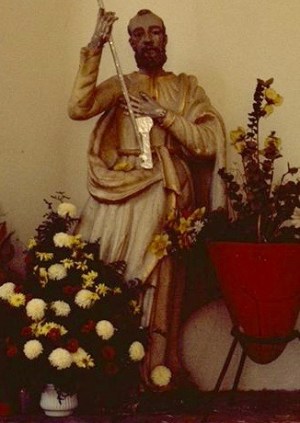
Pilgrim

Santiago de Compostela

She drew me out from inner darkness,
told me to rise and walk.
“But first,” she said, “your wounds.”

She washed them in laughter,
dried them with her smile.

I left that night
walking west beneath the stars
to where the red sun
dips beneath the horizon.
South I wended my way,
where winds are warmer.

Hope flowered anew each day.
Dew on the morning grass
gifted both food and water.
Birdsong raised its morning voice
to the creator and her creation.

Sunlight flooded my body.
It flowed out through my heart,
a beacon to light my way.

At night, when star song
brightened the owl’s path,
I saw my road
stretched high above me.

Pilgrim through once barren lands,
the light she lit for me
burns within me still.

 Rain, sleet, snow, ice, fire:
they’re all the same.
No lion shall me fright.
I’ll with a giant fight.

“Constant,” she said to me.
“Come wind, come weather.”

Christopher Columbus

IMG_0141 2.jpg

Christopher Columbus

leaves foot prints,
wake to his imagined ships,
dark, in the snow,
the unusual snow,
the snow they haven’t seen
in Granada city centre
for forty years.

It settles on roofs,
forms dark ridges
where the sun catches it
and turns it into
wet, dripping snow.

The Alhambra:
a wonderland of stiff,
white starched buildings,
stands out against
the mountain’s mass.

We click our cameras
and say “Just like home!”

We don’t realize
we’re repeating history
for it snowed then,
as it snows now
and Columbus
walked these streets
like any Canadian tourist,

short of breath,
short of cash,
the seams of his boots
letting in the cold,
wet snow,
you know how it is
on Yonge Street,
Main Street,
any street,
any town
in Canada.

And then the miracle:
he’s walking away,
leaving it all behind,
when the messenger
catches up to him and says:

“The war’s over:
there’s money now.
She says ‘Go for it!’
The ships you want,
the dream, the world,
they’re all yours now.”

Christopher Columbus
fell on his back,
flapped his arms,
and created winged shapes:
dream-angels,

white-sailed ships
sailing in the snow.

El Cristo de Carrizo

F1030024 2

El Cristo de Carrizo

For Tanya Cliff

“Contemplate this crucifixion.

Each time you sin
you plant a fresh
thorn in your savior’s
crown.

Each misdemeanor
spears the sacred side
or hammers a nail
in hand or foot.

Christ lives in you.
your daily misdeeds
nail him daily to the cross
he bears for you.

No death, for him,
no resurrection:
just an everlasting hanging
from these nails you daily drive.”

Cave Paintings: Altamira

IMG_0177 2.jpg

Cave Paintings
Altamira
(11,000 BCE)

Cold rock presses on shoulder and neck.
Sunshine dwindles until daylight is a distant star.
A great weight of earth weighs me down.

The tour guide strikes a crimson spark.
Firelight flickers, shadows dance, animals appear:
deer, elk, boar, buffalo.

Magic illusions
created from fat, charcoal, red ochre, ash …
how long have these huddled herds
grazed their way across these walls?

 My spirit sweats as elders anoint
my flesh with bear grease (for strength),
with greyhound hair (for speed),
with wolf blood (for tenacity on the trail).

They brush my eyes with eagle feathers.
Now I am a hunter.

I envision the animal my arrows will pierce.
My backbone arches like a bow.

 I shoot thought arrows:
my beloved dances her death dance on tip-toe.

Court Dwarfs: Velásquez

IMG_0188

Court Dwarfs

Calabacillas, the idot of Coria;
Francisco Lezano, the child of Vallecas;
don Diego de Acedo, the cousin;
and don Sebastián de Morra
in his red velvet coat:

a pride of lion-hearts,
these medieval jesters,
blown up
in some practical joke to
a full life size
that competes with their majesties
for our dialogue
with this time and place.

 Their captive souls
run the gauntlet
of their canvas jails.

Their eyes
recall those of Segismundo,
imprisoned in his tower,
drugged, then dragged
from darkness
to the palace’s brightness.

On his return to prison:
“Man’s greatest sin
is having been born,”
he cries.

Heir to a kingdom,
surviving in darkness,
rags and chains
binding his royal flesh:

 “Life is a dream,”
he sighs,
“and every dream,
a lie.”

Titles: Wednesday Workshop

img_0177


Titles
Wednesday’s Workshop
02 November 2016

I am currently thinking and re-thinking the titles to my books.

Clearly, the title is of the utmost importance. The title should draw the reader in while offering some information on the content. Alas, my earlier titles did not do this.

Monkey Temple, for example, really doesn’t say much about what the book contains. Nor does its subtitle: A narrative fable for modern times. Those who have read poems from the book or who have heard me read excerpts from it, know what it is about. However, deep down the title really says little about the life and times of Monkey, the protagonist who works and suffers in the corporate Monkey Temple.

In similar fashion, Though Lovers Be Lost is a wonderful title, taken from Dylan Thomas, and illustrating his theory that “though lovers be lost, love shall not, and death shall have no dominion.” If readers have these lines on the tip of their tongues, as most people from Wales do, then they will have a fair idea about the contents of the book. However, without that intimate knowledge of one of the great Welsh poets … many readers will be lost and the title will lack meaning, check my post on Intertextuality.

Bistro is a collection of flash fiction. I am not sure that the title suggests that instead of a standard and expected table of contents the book has a menu that refers to the 34 pieces of flash fiction are contained within its pages. The pieces are so varied, rather like a meal of sashimi or sushi, that it is difficult to describe the contents (or menu) in such a short thing as the title. Does the one word, Bistro, draw the reader in? The cover picture might and the combination of title and picture and cover may go further. However, I have my reservations.

Empress of Ireland, on the other hand, is a book of poems about a specific event: the sinking of the Empress of Ireland  in the St. Lawrence River in May, 1914. Here, title and event are closely linked and hopefully the title is rather more indicative of the contents. Even here, as in the cases of the books mentioned previously, a brief description of the book is necessary.

Sun and Moon is a great title, provided you have lived in Oaxaca, Mexico, and know that Sun and Moon are the official symbols of the state of Oaxaca. Without that knowledge, the sub-title, Poems from Oaxaca, Mexico, is essential. The cover photograph with the state symbol of Sun and Moon is intriguing, but it is still necessary to read the description to find out what the book is about. Are title and sub-title enough in themselves? I’m still not sure.

Obsidian’s Edge is a tricky title. I thought everybody knew that obsidian is the shiny black glassy stone produced in volcanic areas. Further, I thought most people knew that the edge of obsidian is used in weapons and knives that cut. By extension, obsidian knives were used by the Aztecs and others in their human sacrifices … so much knowledge that is clear to the writer but unclear to the reader who may not realize that we all live at Obsidian’s Edge with the sacrifice of our own lives hanging by a thin thread on a daily basis. Oh dear, I have been to workshops and readings recently where people knew nothing about obsidian and its properties … my title gives so little information.

Land of Rocks and Saints has yet to be revised and rewritten. Few English readers will associate it with the old Spanish saying, Ávila: tierra de cantos y santos / Avila, Land of Rocks and Saints. The tragedy of living a life in more than one language is that the cultural knowledge so easily understood in one does not necessarily transfer readily into a second or third language. Some of my readers write me to say that they Google all these terms and learn a tremendous amount from the books. Alas, I have to improve my titles. I need to sharpen them and use them to draw my future readers in.

Ávila: cantos y santos y ciudad de la santa, the Spanish translation of Land of Rocks and Saints that I have just put up on Amazon / Kindle, is a better title. Avila is both the province and the capital city of the province. The rocks and saints are clearly linked to the name and the city itself is the city of the saint, St. Teresa of Avila, of course. Hopefully, this title, in Spanish, will attract some Spanish readers. I can only hope.

The book on which I am currently working was originally called Iberian Interludes and had no sub-title. In my revision, I am selecting poems about Spain from various earlier collections and placing them together in one large compendium. I have selected poems from two collections Iberian Interludes and In the Art Gallery (oh dear, I never mentioned that it was the Prado and that all the paintings could be found there). To these I have added a selection of individual poems either published in reviews and literary magazines or taken from other collections.

I am still working on a title for this collection, hence today’s post. I have rejected Iberian Interludes as too vague (how many of my potential readers know that Spain is Iberia) and I am now looking at a bold assertion: Spain. If I do this, I will need a sub-title. The evolution of the subtitle looks like this: Bull’s Blood and Bottled Sunshine, ¡Olé!  >  Bull’s Blood and Bottled SunBottled Sun and Bull’s Blood. I wonder if Spain: Bottled Sun and Bull’s Blood will be catchy enough. Will it draw readers in and attract them? There’s still time for me to think and re-think and all observations will be gratefully accepted.

By all means, let me know what you think.

Butterflies

18 June 2002 butterflies in ditch 021.jpg

Butterflies

We raise our hands:
you sever them at the wrist.

We lift our arms:
you measure us for a cross.
Where do we turn?
Our fingers bleed from scratching
our skulls in bewilderment.
They catch on the thorns
you so thoughtfully provided.

Stigmata?
No, you haven’t nailed us yet.
Great barbed hooks penetrate our bellies,
inflaming our guts.

Like live bait,
threaded to tempt Leviathan,
we squirm.

Like butterflies
awaiting your chloroform jar,
we tremble

Your collector’s pin is poised:
that final thrust will skewer our flanks
and claim us under glass.

Eternally.

Velásquez’s Secret

IMG_0051.jpg

Velásquez’s Secret

Two large paintings
hang on the wall,
one in front of the other:
Las meninas.

I gaze at the serving maids,
the royal princess,
the court dwarf,
the sleeping dog.

The painter,
stranded behind his easel,
paintbrush waving,
stares back at me.

I turn around.
The second painting
is not a painting:
It’s a mirror.

There I am,
standing by the princess,
one of the family.
I move my hand
and wave at myself
across the centuries.

Like the four court dwarfs
staring out from their wooden
prisons on the walls in another room,
I emerge from obscurity
and join the élite:

the painter
waves his magic wand
and
Velásquez
paints me
as I stand beside
the king and queen.

Lorca

F1030024 2

Federico García Lorca

 Solidaridad screamed out from posters and stamps
that carried snapshots of the dead poet’s face.

We still haven’t found his body.
He said we never would.

They tortured him first,
taunted him for being homosexual:
trussed him up, laid him face down,
then shot him, for a joke, in the offending area.

It didn’t take him long to die.
When he did,
his body was dumped in some way out ossuary.

But first they carved the bullets out of his corpse,
three from around the anal tract,
keeping them as souvenirs.

 Later that night, Fascists, drunk,
laughed uproariously in their favorite bars.

They dropped the bullets into their wine
and drank to the re-establishment of law and order.

 Next day his friends were put to death.

Waverers were soon convinced by bullets
lodged at the base of another’s skull …

fine arguments …

Monkey Reviews Retirement
Monkey Reviews Retirement

IMG0056_1

“No more Latin, no more French, no more sitting on the old school bench.”

Monkey chants this famous ditty as he relaxes in the whirlpool bath, a glass of white wine on the tray before him and his faithful tablet sitting beside it.
“The olde order changeth …”  Monkey pauses and takes a sip of wine, “… lest one good custom should corrupt the world.”

“Welcome to heaven,”Monkey lies back in the jacuzzi and the beating waters whirl around him, sending him into a dream world.

No more committee meetings: The unter-monkeys sit in a circle, where all are equal but some are more equal than others.  They pass a lyre bird feather  round and round, weeping crocodile tears and lying through the tight monkey  grins of their alligator teeth.

No more writing reports: The dead text he revises is composed of misquotes, harsh judgements,  double-talk, and outrageous lies.

No more long-term contracts: “Will the defendant please rise. Sir: I sentence you to a term of two years’ detention at this institution, renewable for another two years. And, should you continue to to do well, and should you fail, over that four year probationary period, to fall by the wayside, or to do anything wrong, I sentence you to life imprisonment, till death do you and the institution part. Amen!!!”

No more promotion: Inmates with crowded heads and vacant faces, fools grinning at a universe of folly, paddled in piddle beside him.

No more cabin fever: Monkey has worked for forty years among foreigners and lunatics afraid of the rats who keep him company, devoured by his monkey lust to drive silver knives and forks through the watch springs of their inhuman, foreign hearts.

No more penis envy: They lounge in glass cubicles, checking each other out for size, weight, length, girth, with a roll of the eye, and a casual flicker of a forked lightning tongue.

No more water-fountain gossip: They prefer death by blow-gun, their poison dart injected through hollowed fangs or Chinese Water Torture, the slow drip after drip of poison inserted into ears and veins, a drop at a time, and slowly gathering … until their victim slows down, ceases to struggle, stands there, eyes open, unable to move, poisoned and paralyzed.

No more gala occasions: … gripping cup handles between finger and thumb, enormously pleased to be the center of attention, however clumsily they walk,  in their hired-for-the-occasion, ill-fitting,  black and white penguin suits.

No more macaronic Latin: Caesar adsum jam forte, Brutus aderat; Caesar sic in omnibus, Brutus sic in at!

No more thought police: The Thought Police try to make him change his mind. Others, in blind obedience to a thwarted, intolerant authority, first bully him, then beat him, then bite him till he’s dead.

No more Wittgenstein: Or is it just the act of perception, as Wittgenstein would have us believe, and nothing more, the money always spinning on its metal edge, never falling, the coin on its axis, a new day with its potential,  sunshine or shadow, thrown dice still skittering, a new world  imperceptibly poised in its own making?

No more Camus: “Il faut imaginer l’esclave heureux.”

No more Shakespearean tragedy: Down in the kitchen, the cooking staff are preparing the next nutrition break. As the cauldron boils and bubbles, three old monkey witches dance around the pot and polish that bright red poisoned apple.

No more annual reports: Monkey is not übermenschen, nor is he untermenschen, either. He thinks of himself as honorable mention, not a whole chapter in the book, but rather an interesting footnote to one of those less important pages that abound in local histories.

No more kowtowing to a vacant authority: “Yadda, yadda, yaddathree bags  full … and a fig for the frigging king beneath my frigging cloak.”

No more drugs: The bartender measures poison and monkey slips it skillfully into his veins.

No more avoiding direct questions: When asked where he grew up Monkey will now say “I don’t think I have.” When asked what he did for a living, Monkey will now say“I no longer know.”

There’s nothing more to say. The jacuzzi whirs on and on and Monkey continues his voyage serenaded by the buzzing of the bees as he walks past  the cigarette trees on his way to the soda water fountain.