Darning Socks

F1030024 2

Darning Socks
(for Angela Wink)

My grandfather taught me how to darn socks.
I sat beside him by the fire and placed
a grey, wooden mushroom inside the sock,
stretching the sock wool to expose the hole.
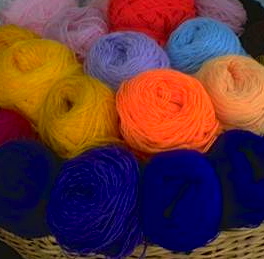
He chose his colors with care, bright yellows,
oranges, reds, sky blues, anything that
stood out against the sock’s dark drabness. If
the socks were thin, he split new wool, pulling
it into individual strands that
he would draw through tongue and lips, wetting them
so they would thread with ease through the needle.
Curled wool threaded, I would cross-hatch the sock’s
hole, slowly forming a life raft that I’d
fill with colored wool. All my life, I have
darned socks, sewn buttons, mended my sweaters.
I always use bright colors, to my wife’s
dismay. Then, I know who did the darning,
and when. I still have my grandad’s First World
War sewing kit, all wrapped up in his signed
canvas wrap with his needles and some wool.
It’s lovely just to touch where his hands touched.
I still see dark blood traces where he pricked
his thumb, and where he sewed up wounded friends.

Commentary:

This poem comes from a comment, made by Angela Wink, on yesterday’s post. Such exchanges are precious and help create new memories. Thank you Angela.

Friday Fiction: Crave More

IMG_0125

Friday Fiction
04 May 2018
Crave More

Crave More: I hate those words. I always choose
a cart with the shop’s name on the handle.
I can handle that. I can’t stand a cart
that screams Crave More at me every time I
bend to place an item in the wire grid.
If stores were honest they would write Think More
and Crave Less
 on their shopping carts. I bet
that would cut into profits. Anyway,
there I was, in LaLaLand, leaning on
my cart, half asleep, when this ghost drifted
towards me. “Help me,” it said. “I’m hungry.
I need money for food.” I woke up from
my dream, looked at the ghost, tall, skeletal
thin, cavernous eyes and cheekbones sticking
out, gaps in the teeth, grey face drawn with shame.
“Sorry,” came automatically. Then I
too felt shame. I looked at him again. “I
only carry plastic.” The excuse limped
heavily across the air between us.
I saw something in his eyes, I knew not
what, and turned away. As I walked away,
I added one hundred pound of muscle
to the scarecrow frame. Took forty years off
his age. Filled his body with joy and pride,
not shame, and remembered how he played, hard
and fast, but true. I ran the card index
of former players that I had coached through
my mind. I knew their moves, and attributes,
the way they played the game, strengths, weaknesses …
I remembered him holding up the Cup.
But I couldn’t remember his name. I
pushed the cart all over the store in a
frantic search for him. At the ATM
I withdrew cash. I could hand it to him.
I could tell him he had dropped it. I went
through a thousand scenes. I could invite him
to the snack bar. I could tell him to buy
what he needed and follow me. Check out
time, I would add his purchases to my
bill. I looked everywhere. He was nowhere
to be seen. One opportunity. One
chance. That’s all we get. Miss it, and we blow
the game. Grasp it and we medal with gold.

Commentary:
I have been experimenting with iambic pentameter, counting words and syllables on my fingers, tapping rhythms on the table, driving Clare crazy, and disturbing the cat. I have also disturbed my usual way of writing, for better or for worse I am not yet sure. Yesterday’s entertainment was to rewrite my brief story, Crave More, as a poem in pseudo-iambic pentameter. The measures seem to function and the rhythm and word count move both within the line and in the melodic, rhythmic phrasings that move between lines in a constant enjambement.

So, by all means let me know what you think of this experiment.  Here’s the link to the short story, also called Crave More. I would love to receive your opinions on narrative pseudo-iambic pentameter.

Revised Version:

Encounter

I was in the Superstore, leaning on
my cart, half asleep, when this ghost drifted
towards me. “Help me,” it said. “I’m hungry.
I need money for food.” I woke up from
my dream, looked at the ghost, tall, skeletal
thin, cavernous eyes and cheekbones sticking
out, gaps in the teeth, grey face drawn with shame.
“Sorry,” came automatically. Then I
too felt shame. I looked at him again. “I
only carry plastic.” The excuse limped
heavily across the air between us.
I saw something in his eyes, I knew not
what, and turned away. As I walked away,
I added one hundred pound of muscle
to the scarecrow frame. Took forty years off
his age. Filled his body with joy and pride,
not shame, and remembered how he played, hard
and fast, but true. I ran the card index
of former players that I had coached through
my mind. I knew their moves, and attributes,
the way they played the game, strengths, weaknesses …
I remembered him holding up the Cup.
But I couldn’t remember his name. I
pushed the cart all over the store in a
frantic search for him. At the ATM
I withdrew cash. I could hand it to him.
I could tell him he had dropped it. I went
through a thousand scenes. I could invite him
to the snack bar. I could tell him to buy
what he needed and follow me. Check out
time, I would add his purchases to my
bill. I looked everywhere. He was nowhere
to be seen. One opportunity. One
chance. That’s all we get. Miss it, and we blow
the game. Grasp it and we medal with gold.

Comment to the Revision:

The first eight lines of the original poem set the scene. While I tried to use them to accentuate commercial exploitation of the customer’s potential for greed, Crave More, they are not essential to the story of the encounter. Meg noticed this and following her interaction I have revised the poem, eliminating those first eight lines.

This is an interesting and inter-active way to work. Thank you Meg!

Thursday Thoughts: On Water

fundy 05 mist+wolfepipers 081

Thursday Thoughts
03 May 2018
On Water

In the seventy-fourth year of my life,
sitting on the car in Mactaquac Park,
waiting for my wife to walk down the slope
to where I’m writing, a warm wind today,
sunshine, the river still rising, more rain
called for tonight, another inch or more,
that’s twenty to thirty millimeters,
you can hear from here the restless waters
powering the dam’s dynamos, creating
great creamy waves to wash over coffee
colored waters fathered upriver with
their splintered debris wafted from waters
still gathering strength in the north where snow
melts steadily while the stormy sky builds
clouds, and weathermen forecast thunderstorms
yet to descend and overflow our streams:
sitting safely I fear for those downstream
who deal with flooded basements, water pumps,
animals in distress, destruction come,
no sanctuary save in flight, wood, mortar,
brick promising no safety, no respite
from rising waters and eternal rain.

Commentary:

In the great flood of 1973, we lived on the Woodstock Road in Fredericton. We watched the river waters rising. Luckily they stopped on the other side of the road from where we were living and didn’t cross the road. This year we live out of town on the other side of the hill away from the river. Each time we drive into town we see the river waters and measure how they rise. Our hearts go out to those folk who are forced to evacuate their homes. We find it hard to believe that the waters are now at the levels they reached in 1973 and may, in some places, exceed those levels by a meter or more.

Next weekend, Word Spring, the spring meeting of the Writers’ Federation of New Brunswick, is scheduled to take place in Quispamsis. Yesterday, the people of Quispamsis found themselves on flood alert and were told to prepare for instant evacuation. It rained last night and more rain is expected. While it may not rain here in Island View, the catchment area of the St. John River, the Rhine of North America, is enormous. Any rain falling in the north of the province may affect the river. The snow is still melting from the deep woods and clear cutting along the river banks has, according to some, affected the ground’s ability to retain water.

All in all, a difficult situation and one that is forecast to last for another week or ten days. More details can be found here:

http://www.cbc.ca/news/canada/new-brunswick/homes-cottages-flooded-1.4645225?cmp=news-digests-new-brunswick

Poetry


img_0189

Poetry

“Poetry gives permanence to the temporal forms of the self.”
Miguel de Unamuno.

That is what my writing is all about.
Those temporal forms, fluttering and changing.
Butterflies, they live for a day or two,
perch and flourish, spread their wings,
excel for a moment, catch our attention,
blown by a sudden gust, tear their wings on a thorn,
perish in the blink of an eye, cluster and gather,
reborn in dusty ditches, congregate on bees’ balm,
smother Cape daisies and black-eyed Susans,
shadows shimmering, butterflies by day,
fireflies lighting up the night, terrestrial stars
floating in their forest firmament, hackmatack,
black oak, bird’s eye maple, silver birch, fir,
impermanence surrounds us, dances beneath stars,
sings with robins, echoes the owl’s cry through woodlands,
poetry, the elemental soul, our words capturing nothing,
turning it into eternity, holding it for the briefest moment,
then letting it go. Island View: my dialog with time and place.

Downsizing

img_0136

Downsizing

a double sword
this clearing out
of odds and ends

the library diminishing
book by book
so many memories
slipped between the covers
dust-bound now
yet springing so quickly
back to life

sorrowful not sweet
these multiple partings
from people I will never see again
save in my dreams

I think of book burnings
so many heroes
going up in flames
fire their beginnings
fire their ends

fire the means of forging
the Omega and Alpha
of the book world
that surrounds us

fire encircling us
death’s bone fires
consuming us
outside and in

Broken Record

IMG_0192.JPG

Broken Record

I have worked on this poem for a long time now. I worry about it, gnaw at it like a dog gnaws at a bone or a cat plays with an insect trapped beneath its feet. Francisco Quevedo  (1580-1643) rewrote one of his poems (Miré los muros de la patria mía) six times between his first version (1603) and his last version (1643) two years before his death. Are we condemned to dance attendance on those poems that haunt us? I don’t really know. Here is the link to my first version of Broken Record. Is it the best one? The only one? The one I should keep? Here is my link to This Old Man. Is this a better version? Does the change of photo change the context of the poem?

Like Francisco de Quevedo and his long history of Miré los muros … I can no longer tell.  That said, here is the latest version of my poem. I hope you like it. Do some clicking (it’s also called research) and let me know what you think. I look forward to your comments.

Broken Record (?)

A vinyl disc going
round and round,
the diamond-tipped needle
stuck in a groove:
me and my broken-
record memories.

I stop old friends
in the supermarket
and, when I start to talk,

they stand there,
tapping their feet,
trapped in a doldrum
where no winds fill
their sails to move them on.

Caught in multiple mirrors
surrounding the barber’s chair,
my tongue is an open razor
constantly stropped.

I have turned into
a babbling book of hours,
life’s moribund albatross
necklaced,
a hot towel round
my reluctant throat.


Be Leaf

IMG_0135

Be Leaf

An autumn leaf,
brown crisp flaked from a tree,
floats breeze-blown
into my mind’s-eye corner
and settles down to sleep.

What joy to lie there
forgotten by the madcap
rush of televised folly,
false news filmed, fake news
hustled and bustled
by a burgeoning wind of change.

No science now, no truth,
no facts, no knowledge,
just news, fake news, false news,
the word pack shuffled and reshuffled,
each verbal insult dealt and redealt,
true falsehoods peddled
by tinker men and tailors who stitch
words to meanings,
while the real truth
lies dead and safely buried:

a leaf among leaves, lying forlorn,
forgotten beneath autumn trees.

Dog Daze

IMG_0040 (2)

Dog Daze

 the sad dog hounds me
sends me spinning
sets me back on my heels
makes me chase my tail
and snap at shadows
as they ghost
through my mind

memories deceive
desperate I lap
at licks of false hope
a shifting salt field
that increases my thirst

driving me on and on
deeper into ragged clouds
and the storm that lays waste
to the dog daze of my mind

Friday Fiction: Sentences

IMG_0010

Friday Fiction
27 April 2018
Sentences

“Use lots of verbs to catch the reader’s attention. Keep your sentences short.”

… people don’t like long sentences … life sentences … things like that … though death sentences may be short, ugly, and brief … unless there’s a power shortage when you’re sitting there all wired up … or they’ve watered down the drugs in the tube they attach to the needle they put in the shunt already plugged into your arm …

… you’ve read the news … seen the pictures … if you live close enough you may even have stood out in the street with a candle and your friends watching the power shortage hit downtown … district lights flickering off … road lights shutting down … big blankets of blackness … as they put all available electricity into the power circuits that lead to the electric chair …

… use short sentences … like the one they read to me when I was six … then they locked me away in a boarding school for twelve long years … until I was eighteen … I ran away … again and again … they beat me … again and again … short sentences … ‘hold out your hand’ … ‘pull down your pants’ … bend over that chair’ … six of the best … no verb in that one … yet the words still strike a note of fear into those who have been publicly humiliated and flogged in a boarding school dining room … in front of all the boarders … and the day boys as well … ‘don’t cry’ … ‘little baby’ … ‘mother’s pet’ … ‘mummy’s darling’ … blubbing like a baby … and this at six years old … or seven … or eight … lashed on hands or backside by a grown man wielding a bamboo cane …

“Keep those sentences short.”

“Bend over.”

“Place your hands against the wall.”

“Don’t cry like a baby.”

“Take it like a man.”

Thursday Thoughts: M. T. Head

IMG_0068

Thursday Thoughts
26 April, 2018
M. T. Head
 

I sat in the class, head in hands, avoiding eye contact. I hoped the teacher wouldn’t point me out, call on me, nominate me with a finger … to no avail … he called my name … “You have sixty seconds to speak about …” he paused, then produced the rabbit from the hat, “matches. Come along, stand up, you have sixty seconds, starting …” he watched the second hand go round on the classroom clock, then counted down: “5, 4, 3, 2, 1 …” waved his hand, and shouted: “Now!”

Matches: cricket matches, boxing matches, rugby matches, soccer matches, chess matches, matches to light the burners on the gas stove, the oven, to light the fire in the fire place … matches, matchsticks, Match Box toys, Dinky toys, toys for little boys, toys for big boys …

“Ten seconds have gone … you have fifty remaining.”

“When I think about matches, I think about …”

The first spring day in the bungalow, our summer home. The rooms are cold and damp after the winter and nobody has been here since last year. We lay a fire in the grate, but the wood is damp, as is the old newspaper we gather from our last visit. We search for sugar to aid the blaze that we hope to start, but the sugar bowl is empty. We go to the stove. Cold, winter ashes crowd the fire bowl. We scrape them together in a desperate search for charcoal remains …  but we find nothing. We move to the oil-fired lamps and oil stoves. Matches dragged across soggy sandpaper fail to spark.

“Come along, boy. Have you nothing to say? You have thirty seconds left.”

Silence fills the room. It is broken by the childhood sniggers and chuckles of long-forgotten friends. The unmentionable shuffles its outsize feet to shatter the silence. My cheeks grow red. I start, stammer, and stop.

We leave the bungalow. Go next door to where our neighbours winter over. We knock on the door. “Can you lend us a match?” we ask, holding out our hands. Mrs. Williams beams at us. “A match,” she says. “First time in after the winter?” We nod. “I thought so. Saw you arriving. Wondered why you hadn’t come earlier. The weather’s been nice. Here: I can do much better than a match.”  She moves over to the fireplace, picks up the little coal shovel, shovels up a generous portion of her fire, heaps on another lump, then two, of fresh coal, and “Here you are,” she says. “Just put it in the fireplace and add some wood and coal. You can start your first fire with this.” “Thank you, Mrs. Williams,” we say. “No problem,” she replies. “It’s good to see you back. It’s been lonely here this winter without you.”

“Time’s up,” the teacher says. “That’s sixty seconds of silence and you can hardly find a word to say on a simple subject. Are you stupid or what? You should be ashamed of yourself.”

My face turns red. I hang my head.

I feel ashamed.

I am seven years old.