Small Corner

IMG_0160.jpg

Kingsbrae 6.1
6 June 2017

Small Corner

 And this is the good thing,
to find your one small corner
and to have your one small candle,
then to light it, and leave it burning
its sharp bright hole in the night.

 Around you, the walls you constructed;
inside, the reduced space, the secret garden,
the Holy of Holies where roses grow
and no cold wind disturbs you.

 “Is it over here?” you ask: “Or over here?”

If you do not know, I cannot tell you.

But I will say this: turning a corner one day
you will suddenly know
that you have found a perfection
that you will seek again, in vain,
for the rest of your life.

Journal: I had the pleasure of reading this poem to the artists and committee of the KIRA program after the evening barbeque on Saturday, 3 June, 2017. It is indeed a Golden Oldie, but it summarizes with remarkable accuracy my own feelings about Kingsbrae and the surrounding area. There are places of peace within the world and, as our world becomes more crowded and our cities overflow with urgency, these peaceful places take on more and more importance. It is essential for us to escape the concrete and tarmac of the so-called civilization and to take refuge in nature. The cultivated garden has a long tradition going back to Medieval times, le jardin enclos and its sacred space, for example, and the monastery cloisters and their enclosed serenity,

Following in this tradition, Kingsbrae Gardens has established an oasis of cultivated peace within the larger peaceful space that is New Brunswick. We are indeed lucky to be permitted to enter these places, to renew our contact with nature in all its beauty and bounty, and to be able to refresh our spirits and drink deep of the peace that flows, and fills us, and blesses our endeavors.

The photo that accompanies this poem is of the crab apple trees in full blossom on the front lawn of the house in Island View where Clare and I have lived and worked together for a quarter of  century or more. This is the view from my writing room window. It is no wonder that poetry flows from this subtle spring beauty.

Bears

Empress 048

BEARS

Think of pink salmon caught in pools,
plucked from water, tossed to air,
the catch stacked rainbow‑fired.

Winter now:
unsnubbable, lumbering overcoats
closeted, laid to rest;
seeking power in hibernation
till sun from summit melts frosty dark:
fresh heartbeats forged in forest’s night.

Think alchemy:
prime matter moved safely in flask or jar.

Think circus stars:
The Great Bear leads the Lesser,
dancing to the trainer’s whip,
tumbling from their pedestals.

Secure behind bars,
think fallen stars.

Sandman

IMG_0131

Sandman

The sandman brings
sand to put in my sandwich.

He brings it from
the nearby beach.
It’s as fierce as
fine salt in life’s
dwindling hour glass,
thin-waisted sandpaper
thinning down our ways,
throwing sand in the clockwork
that ticks out our days.

Sand rasps between toes,
sticks fast to our feet,
grows castles on the beach
where no grass grows.

Seven, lucky seven,
those clouds close to heaven,
but beware the sandbox
if you count up to eight.

World Book Day

IMG_0131

World Book Day
23 April 2017

A word about World Book Day before it is over: April 23 is the death date of William Shakespeare, Miguel de Cervantes, and the Inca Garcilaso de la Vega. While the dates are the same, the days are not. Spain used the Gregorian Calendar, but England used the Julian calendar, with the result that Cervantes died on the same date as Shakespeare, but ten days before him.

The connection between these dates was made in Catalonia in 1925 and it was there that the death of Cervantes was celebrated. Don Quixote, after all, decided to travel to Barcelona, rather than Zaragoza, in the second part of Don Quixote (1615). The link to the Inca Garcilaso de la Vega (author of the Comentarios reales) linked two continents and three great, very original authors.  In 1995, UNESCO declared April 23 to be World Book and Copyright Day.

The conflict between the two calendars (Julian and Gregorian) also complicates the dates mentioned in the various ships engaged in the Spanish Armada that sailed for England in 1588. Battles took place on different day and different dates, according to the not always accurate logs of the two navies.

Two complicate things further, time at sea was very difficult to judge and candles, water clocks, sandglasses, and lanterns were all very unreliable and gave great differing times for the different actions that took place during the engagements.

In 1988, for the three hundredth anniversary of the event, instead of days and hours, the ships’ actions were logged into a computer along with the retro-calculated tidal tables. What emerged was a seaman’s account of time and tide in which actions were seen in the light of the actual sea environment. As a result, very different picture of that famous series of sea battles emerged.

Love Poem @ 70

img_0146-3

Love Poem @ 70

1
We walk on tiptoe round the garden,
peeling free the sunlight cloud by cloud.

Sometimes, the heart is a sacrifice of feathers,
bound with blood to an ornate altar.

Petrus:
this rock cold against my chest.
Piedra:
centuries of stone carvings
come alive in your face.

If our arms were to meet
around these columns
of sun-warmed flesh and stone,
what would become of us?

2
Beneath my skin, the woad
flows as blue as this evening sky.
Your skin is bronzed
in the warmth of my gaze.

Yellow light bends
low in the fields below us,
each darkening pool
a warrior fallen
beneath time’s scythe.

The moon paints a delicate circle.
Its great round eye opens out
above the rooftops,
a cathedral window
opening on the sky.

Tonight it bears
the wisp of an eye lid
carved from  cloud.

Your teeth are diadems of whiteness
aglow in your face.

We tie shadows to our heels
and dance in triumph
to the village music
sounding in street and square.

3
Daylight bends itself round rock
and turns into shadow.
We flourish in blocks of flickering flames.

Dreaming new selves from roots and branches,
we clasp each creation with greedy fingers.

Dark angel bodies with butterfly wings,
our shadows have eloped together.
They sit side by side holding hands
at a table in the central square.

4
Church bells gild the barrio’s rooftops.
Our fingers reach to the skies and hold back light.
We draw shadow blinds to shut out the sun.
Night fills us with stars and a sudden sadness.

We dream ourselves together in a silent movie,
closed flesh woven from cobwebs
lies open to a tongue-slash of madness.

The neighbor’s dog wakes up on the azotea.
He barks bright colors as dawn declares day
and windows and balconies welcome the sun.

Can anyone see the dew-fresh flowers
growing from our tangled limbs?

Your fingers sew a padlock on my lips:
We listen to the crackle of the rising sun.

Minus

IMG_0133 2.jpg

Minus

“The earth is geoidal, i.e. earth-shaped.”
These words, dictated to me by the geography
master when I was about fifteen years old,
taught me that teachers didn’t really know
all there was to know. Nor, indeed, did they
need to know everything. “I don’t know,
I’ll check and tell you later,” breaks the myth
of infallibility but sets up sympathetic links.

“What do groundhogs eat?” the little girl
asks her classroom teacher. “Spaghetti,”
comes back the instant answer from one
who doesn’t know that every day the child
watches the groundhog that lives in her yard
devour delicate New Brunswick violets.
“Spaghetti, with mushroom sauce, of course.”

Then one day comes the spelling test:
“How do you spell minus?”
M-I-N-O-S.”
“Wrong. Try again.”
M-I-N-A-S.”
“Wrong again.
You think you’re so clever.
Everybody knows it’s
M-I-N-U-S.
Don’t we class?”
The class breaks into shrieks and giggles.

Everyone knows how to spell minus:
even the one who has just read how Theseus
followed Ariadne’s thread to escape from
the Minotaur who roamed the Labyrinth
beneath the Cretan Palace of Knossos.

That one was present too, in her own mind,
at the Siege of Minas Tirith, when Gandalf
held five evil kings at bay and Aragorn fought
the nameless Dark Lord who dwelt beneath
the shadow in the land of M-O-R-D-O-R,
a Lord not so powerful M-I-N-U-S his ring.

Old Eight Hoots

IMG_0263

Old Eight Hoots

Winter has touched us
with this change of clocks
and darkness clutches now,
an hour or so too soon.

Old eight hoots watches:‑
he calls; I cough;
but he will not swoop.

He sits tight‑perched, out of sight;
chills me with his ghostly chorus,
hoo‑hooing me home.

Bright stars crackle the sky.
Frost crisps fallen leaves.
A mist weaves webs scarce‑seen.

And all around,
as cold ground creaks
its wordless tongue‑leafed language,
night‑shapes abound.

Pony

img_0291

Pony

for Jude
(and the WYPOD)

“A pony, a pony, my kingdom for…” Of course,
he didn’t want a pony. He was losing the battle
and the kingdom’s sceptre is not a baby’s rattle
to be tossed aside, even for the fastest horse.

Ponies and palfreys are not for kings. A princess
may ride a pony, and a side saddle, fit for a queen,
may grace a horse’s back, but a horse between
a princess’ legs is crass. How cramped the dress,

how wrinkled the nobleman’s brow seeing
his daughter, his wife, the female of the breed
straddling, legs apart, a broad-backed steed.

No: ponies are for Christmas, not for kings fleeing.
A horse, then, hung with bells, covered in red:
not with ribbons, but the old king, flayed and dead.

Dydd Dewi Sant Hapus.

14633208_10207317214799871_1242532105939959170_o

To be Welsh on Sunday


(This poem should be read out loud,
fast, and in a single breath!)

To be Welsh on Sunday in a dry area of Wales is to wish,
for the only time in your life, that you were English and civilized,
and that you had a car or a bike and could drive
or pedal to your heart’s desire, the county next door,
wet on Sundays, where the pubs never shut
and the bar is a paradise of elbows in your ribs
and the dark liquids flow, not warm, not cold, just right,
and family and friends are there beside you
shoulder to shoulder, with the old ones sitting
indoors by the fire in winter or outdoors in summer,
at a picnic table under the trees
or beneath an umbrella that says Seven Up and Pepsi
(though nobody drinks them) and the umbrella is a sunshade
on an evening like this when the sun is still high
and the children tumble on the grass playing
soccer and cricket and it’s “Watch your beer, Da!”
as the gymnasts vault over the family dog till it hides
beneath the table and snores and twitches until “Time,
Gentlemen, please!” and the nightmare is upon us
as the old school bell, ship’s bell, rings out its brass warning
and people leave the Travellers’ Rest, the Ffynnon Wen,
The Ty Coch, The Antelope, The Butcher’s, The Rhiwbina Deri,
The White Rose, The Con Club, the Plough and Harrow,
The Flora, The Woodville, The Pant Mawr, The Cow and Snuffers …

… God Bless them all, I knew them in my prime.

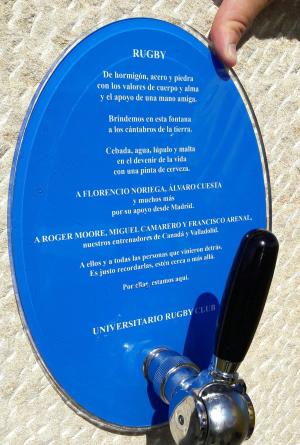
Comment: When I was living in Wales, back in the fifties and the early sixties, the country divided itself into counties that could drink alcohol on Sundays (wet Wales) and those that couldn’t (dry Wales). There were twelve counties in those days and people commuted from the dry to the wet, on Sundays, if they wanted to drink. Some took the wet / dry divide very seriously. Others didn’t. Where do I stand? I refuse, even now, to say. But check out, very carefully, the attached photo. Not every rugby coach has his name engraved on a beer spigot in a rugby club in Santander, Spain. Happy St. David’s Day, everyone. Dydd Dewi Sant Hapus.

Water 1

15 May 2002 Pre-Rimouski 277

Water

Water seeks its final solution as it slips from cupped hands.
Does it remember when the earth was without form
and darkness was upon the face of the deep?

The waters under heaven were gathered into one place
and the firmament appeared.
Light was divided from darkness
and with the beginning of light came The Word,
and words, and the world …

… the world of water in which I was carried
until the waters broke
and the life sustaining substance drained away
throwing me from dark to light.

The valley’s parched throat longs for water,
born free, yet everywhere imprisoned:
in chains, in bottles, in tins, in jars, in frozen cubes,
its captive essence staring out with grief filled eyes.

A young boy on a tricycle bears a dozen prison cells,
each with forty captives: forty fresh clean litres of water.
“¡Peragua!” he calls. “¡Super Agua!”

He holds out his hand for money
and invites me to pay a ransom,
to set these prisoners free.

Real water yearns to be released,
to be set free from its captivity,
to trickle out of the corner of your mouth,
to drip from your chin,
to seek sanctuary in the ground.

Real water slips through your hair
and leaves you squeaky clean.
It is a mirage of palm trees upon burning sand.

It is the hot sun dragging its blood red tongue across the sky
and panting for water like a great big thirsty dog.

Comment: Water: such a precious commodity, and more than a commodity, the very substance of life. Without it, we shrivel and die. Vegetation struggles to survive, the desert shifts its boundaries outwards, and a high tide of sand rises to engulf the cultivated land.

In Oaxaca, Mexico, the Atoyac, the Green River, often runs dry. When it does, women kneel on the sand and pebbles to dig holes into which the water seeps. They wait for the holes to fill and use little cups to pour that water into their buckets. These water holes are also used to wash their clothes and they hang them out on the riverbank bushes to dry beneath a burning sun.

Twice I have been in Oaxaca when the rains have not arrived. I have seen the reservoirs sink lower and lower as the sun laps up the precious liquid and no rain falls. Oaxaca, with or without rain, is a land of dry toilets, chemical toilets, chemicals to put in the tap water when you wash and peel fruit and vegetables. You drink only bottled water. It is sold to the households in forty litre bottles and hawked round the street by boys on tricycles who cry out their wares.

In Oaxaca, almost every house has its own supply of water. The flat roof, azotea, catches the rain when it falls and channels it into large internal cisternas that trap the water and keep it cool.  Water to waste is a luxury that few can afford and most water is recycled when possible in one way or another.

The rules are strict: drink nothing direct from the tap; do not clean your teeth in tap water;  beware of ice cream and ice cubes; drink only water delivered from trusted hands. In addition: eat food only from establishments with running water and a reputation for safety. Avoid street vendors, especially the little ladies in the street who cook over open fires and and change their babies’ nappies only to return to their cooking with unwashed hands … There are so many things you learn if you want to be safe and streetwise. Above all, close your nose to the delights of those wonderful street side cooking smells.