Backstreets

IMG_0009

Backstreets

You go from the beaches turn away from the waters
and walk with your warder through this catholic prison,
through the streets of this city where innocents die
and the guilty confess to pitiless crimes
in hide-bound confessionals of dark white-washed churches
that strut in the streets and the heart-breaking alleys
with washing at windows and black widows waving
as you consciously wander through past sins and problems
forgetting remembering the squares with their fountains
with their saints and their statues in cold heartless marble,
with swords without edges and tongues sharp as grass
that cuts you with silence as it slips through your fingers
whilst bitter and bleeding you wander through labyrinths
of meaningless shortcuts leading to churches
and stationary statues that threaten with footsteps
until you come out at last to the light and the sea 

Commentary:
Another Golden Oldie, this time from my poetry book Broken Ghosts, published by Goose Lane (Fredericton, 1986). It dates from time spent in Spain (1969-1971) and recalls walking in tiny seaside towns along the north coast (Cantabria) without being specific to any single place, although Castro Urdiales, Comillas, Laredo, Santander, and Zarauz all conjure up similar visions and memories. A single sentence, the poem can be read in one breathless breath.


Mist

fundy 05 mist+wolfepipers 081

Mist

Mist and I lose my bearings:
men become trees become men
and the clammy damp
waves through my bones.

Hollow sound of my feet
where wraith-like white
pools in the street.

I whistle:
and the moon gleams bright
with whitened teeth.

Comment:

So much mist in town yesterday, all along the river, and winding out from the river to the road. Beautiful, and so mysterious. Shapes shifting, looming out from the trees, then fading back in again. Cars, so difficult to see, and regular landmarks magicked into never-before-seen monoliths so I had to slow, and squint, and double-check all those well-known streets and directions. A baffling world, it was: in its magic, truly mystifying. 

This poem is from my first poetry collection, Last Year in Paradise (Fiddlehead Poetry Books, 1978). It was published by Fred Cogswell, a wonderful New Brunswick poet and editor who gave help and encouragement to so many young poets.

Monkey Teaches Sunday School


IMG_0040 (2)

Monkey Teaches Sunday School on Mondays
(With apologies to Pavlov and his dogs)

Younger monkeys e-mail elder monkey
and expect an answer within two minutes.
Elder monkey drools and writes right back.

He is turned on by the bells and
whistles of his computer.
“Woof! Woof!”
His handlers hand him a biscuit.

Elder monkey has grown to appreciate
tension and abuse:
the systematic beatings,
the shit and foul words hurled at his head.

The working conditions in his temple
kennel are overcrowded.
Elder monkey is overworked.

Yet he has managed to survive,
to stay alive and fight
what he once believed was the good fight.

Now he no longer knows:
nor does he drool anymore
when bells and whistles sound
and his handlers bait him with
an occasional, half-price biscuit.

Catching and Caging

IMG_0375 2

Catching, caging, and making them sing

We track them through their courting ceremonies

hunt them down by the noise they make

clutch them tight between anxious fingers

We weave glass jails

sentence them one by one to green imprisonment

At day’s end we ferry them to city apartments

incarcerate them like canaries in their cages

and wait for them to sing

At first they are silent in this strange environment

we feed them with bread dipped in brandy and wine

and sooner or later they sing in their captivity

Now they will not eat

they await the liquor that burns them

into fiery tongues of song

Our midnights are haunted by their spirituals


Thursday Thoughts

IMG_0027

Thursday Thoughts
22 March 2018

Washroom

Locate the nearest washroom …  I am growing old. Maybe I am the only one who needs the consolation of the proximity and known whereabouts of this item, but I am so much happier when I have located it and know where it is.  For me, it’s part of the pre-reading, ‘scouting out’ process that I wrote about yesterday.

The other thing I should have mentioned: work out for yourself a simple relaxation exercise that helps you to concentrate and brings your nerves back under control very quickly. Closing your eyes and breathing deep, one in, one out, does it for some. When uptight, I use a simple exercise from my early piano lessons. (1) Shrug your shoulders, relax your arms and let them hang down, then roll your shoulders, forwards and backwards; (2)  shake out your forearms and fingers; (3) close your eyes and breathe deep. This takes about five – ten seconds.

A personal anecdote: the first time I was due to read a paper at a major academic conference (in Laval University, Quebec) I was standing outside the lecture room listening to the chatter of a group of friends. I opened my mouth to join in and … squeak … no sound … speaker’s block … my voice had disappeared.

I eventually found a washroom,  did a series of  relaxing routines, including this one, sipped some water, and just like that, my voice came back. I returned to the conference and was able to read my paper, five minutes later, without further embarrassment.

Such narrow margins between success and failure.

Apologia

weir 2

Apologia pro vita mea
(for Ana)

          Late last night, I opened Alistair Macleod’s book The Lost Salt Gift of Blood and I re-read the first story. I was soon dabbing my eyes with a tissue and blowing my nose.

This morning, I want to destroy everything I have written. I know I don’t possess the verbal and emotional genius of the great writers and I sense that I cannot write like them. Graduate school taught me to be passive, not active, and to write impersonally, choking every emotion when I write. Academia also taught me how to kiss and how to run away with my thirty silver pence. “Never challenge the status quo,” my professors told me. “Learn the rules and disobey them at your peril.”

But here, in this private space where I create and re-create, there are no rules. The enemy is not clear any more and the fight is not one of black against white. It is rather a choice between diminishing shades of grey, and all cats are grey in the gathering dark that storms against my closing mind. Should I destroy all my writing? I won’t be the first to do so; nor would I be the last. And I won’t be the first or the last to destroy myself either. Intellectual, academic, and creative suicide: as total as the suicide of the flesh.

I carry on my back the names of those who have gone on before me as if they were a pile of heavy stones packed into a rucksack that I carry up a steep hill, day after day, only to find myself, next morning, starting at the bottom once again. But this is not the point: the point is that if I cannot write like the great writers, how can I write?

I think of Mikhail Bakhtin and his cronotopos, man’s dialog with his time and his place. I have no roots, no memories, and that is where my stories must start: in the loss of self, the loss of place, the loss of everything. I was uprooted at an early age, soon lost my foundations, and only survival mattered.

I look at the first page of one of my manuscripts. My writing manifesto is clear before me: “And this is how I remember my childhood,” I read. “Flashes of fragmented memory frozen like those black and white publicity photos I saw as a child in the local cinema. If I hold the scene long enough in my mind, it flourishes and the figures speak and come back to life.”

I am aware of the words of T. S. Eliot that “every attempt / is a wholly new start, and a different kind of failure / because one has only learnt to get the better of words / for the thing one no longer has to say, or the way in which / one is no longer disposed to say it” (East Coker).

Are these stories an exercise in creativity or are they a remembrance of things past? How accurate is memory? Do we recall things just as they happened? Or do we weave new fancies? In other words, are my inner photographs real photographs or have they already been tinted and tainted by the heavy hand of creativity and falseness?

The truth is that I can no longer tell fact from fiction. Perhaps it was all a dream, a nightmare, rather, something that I just imagined. And perhaps every word of it is true.

I no longer know.
Herring Bones

IMG_0177 2

Herring Bones

Last winter, a heavy snowfall
toppled the garden wall.
Bricks and mortar now litter
the grass in untidy piles.

I take my child by an arm
and a leg and swing her round,
faster and faster till, dizzy,
she calls ‘no more’,
and I let her go.

She can hardly stand,
staggers like her grandfather
who lurches around the garden
leaning on a walking stick.

 He jabs at the red-brick wall
he wants me to rebuild
and claws,
with twisted fingers,
at words,
bricks laid
like herring bones
and
caught in his throat.

Velásquez

IMG_0486

Portraits by Velásquez

 Velásquez sought asylum in Canada.
He set up his studio on the shore at Glace Bay.

He photographed short, stunted people
miners who worked underground
mining Cape Breton coal.

He waited while they shook or coughed,
had patience till they were still, then click.
When he had captured their spirits,
he blew up their photos to NHL size.

Slack jaws, puffy eyes:
“Man’s greatest sin
is having been born,”
one sighs.

Another seeks himself
through inner darkness.
He probes dark galleries
with Davy Lamps for eyes.
He finds no gold,
just seams of coal
that cling and clot his lungs.

Velásquez waits
for his cough to stop
and click he’s got him.
Sally Ann Second Hand clothes
lay siege to his tortured flesh.

“Life is a snap,”
Velásquez cries.
“And every photograph
a lie.”

Chalky

Avila 2007a 039


Chalky

 Dead accurate he was
with a piece of chalk,
hit you wherever you sat:

“Bonk!”
right between
the eyes.

 “Pay attention, boy.”
“I was paying attention, sir.”
“Then repeat what I just said.”

 And the boy repeated it,
word for word.

 “Sorry.
Here, have a peppermint.”
“No thank you, sir.”
“Guess and how, then.”

 He put his hand in his pocket
and pulled out a handful of coins.

Sooner or later
we all tried,
but nobody ever guessed
how much money
he held in his hand.

Yesterday

Ay Ay Ayeres

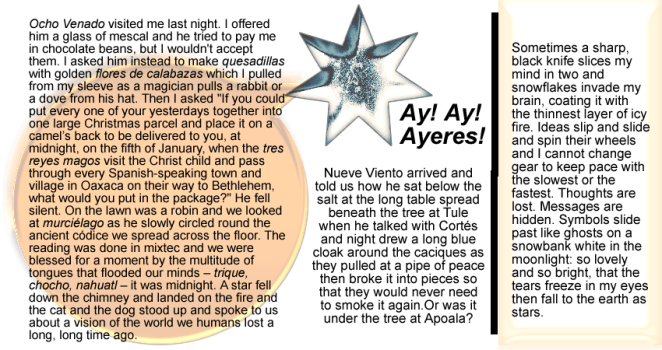
Digging around in the photo files that I transferred from my old computer to my Google drive, I discovered this golden oldie composed of my words and Clare’s images. What a revelation: I had completely forgotten that this group of work existed. I’ll dig them out ne by one and post them from time to time. Ayer is the Spanish for yesterday, hier in French. The title “Ay! Ay! Ayeres!” with its multiple plays All our yesterdays and its reference to the old song “Ay, ay, ay, canta no llores” draws together a series of memories, some in the past and some in the future. ‘How can we have a memory in the future?’ you ask. By recognizing a present moment, or one that lies just ahead in a future that ill become soon enough a present, as one that has already occurred in the past, thus confirming the circularity of our lives and the idea that all time is time present, one of T. S. Eliot’s recurring themes.

Ocho Venado: Eight Deer is a central figure (war leader) in the Zouche-Nuttal, a pre-Columbian Mixtec Codex. He is the war leader in the Conquests recorded in the codex (circa 1050-1100).
Quesadillas: Oaxacan tortillas filled with cheese and flores de Calabaza, gourd flowers.
Reyes Magos: the three wise men or kings who visited the Christ Child on January 6, the traditional Spanish Christmas.
Murcielago: the bat and a symbol of death in Oaxacan mythology.
Nueve Viento: Nine Wind descends from heaven to separate the sky from earth and its waters. Nine Wind at Tule meeting with Cortes is mythical not historical, though the meeting of Cortes with the Mixtec chiefs (caciques) did happen.
Apoala: The Mixtec nation was born form a cave (sometimes a tree) in Apoala, Oaxaca.
Spinning the wheels in the snow: a reference to Jean Chretien and one of his famous images.

The piece is written in a surrealist style that mixes historical fact with creative writing. The distant past is recalled (1050-1100), then the middle past (1525-1530), and finally the present appears. This mixing of time and place (Mexico and Canada) is also related to the surrealist movement. Surrealism creates a dream world in which images float and change shape within a time-space conundrum where dream is more real than reality and creates its own new meanings that are individual to each reader.

Any comments on this rediscovered piece will be warmly welcomed.