The Return

Avila 2008 003

The Return

I opened the car door
and he ran across the parking lot
and jumped into the back seat.

“Where have you been?” I asked.
He thumped his great tail, sniffed,
and licked the hand I placed on his shadowy head.

As we drove back home, he thrust his head
between the seats and placed his paw upon my shoulder.
Then he licked my ear and the side of my face.

I pulled into the garage and let him out of the car.
He raced to the end of the drive, surveyed the neighborhood,
and drilled an invisible pee into the snow.

I whistled, and he ran back to the door,
whimpering and scratching, impatient.
I held the door open and he bounded in.
“You’re back home now,” I told him.

He ran to the cat’s bowl and lapped some water,
scoffed her kibble, and lay down in his usual place.

At night, he lies beside me in bed,
a fluffy spoon carved into my body’s curve.
In the morning he walks through the kitchen
and doesn’t make a sound.
The cat senses he’s there and bristles and hisses
at rainbow motes dancing in the sun.

He’s sitting beside me now,
head on my knee, as I type these words,
one-handed, because I’m scratching him
in his favorite spot behind the ear.

Raccoon

IMG_0080.JPG

Raccoon

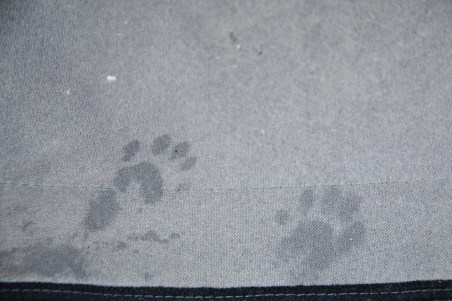
Two footprints on the dew damp chair
show that he has been here.

We know he visits at night.
The cat wakes up, jumps off the bed,
leaps to the window, and hisses.
Then she falls silent.

The raccoon steals food from the feeder
and shuffles the pottery shards
we leave out to gather water for the birds.

We never see him.
Sometimes we hear him grunt;
occasionally the wind chimes rattle furiously
as if caught by a giant gust..

We peer into the dark,
turn on the outside lights,
but his absence greets us
like a long lost friend.

Last night, nothing:
this morning, an empty feeder,
those footmark in the dew on the chair:
we know he was there.

Sun and Moon 2

IMG0023_1

Sun and Moon 2

Eagle paints my eyes with daylight.
He offers to fly me to the sky.
His feathers trap sunshine in his pinions.
Morning is a rebozo draped over his plumage.

“My mother is blind,” says Eagle.
“Her sight: cold ashes in the fireplace.
Stripped of her dreams,
she wanders in darkness.
You must give her
the fire from your eyes!”

Tiger offers to carry me to the sky.
Flame speckles his pelt.
His eyes are two scorched blocks of charcoal.
“I will break the bread of your bones,” says Tiger,
“and warm myself on the fire of your blood!”

Serpent offers to bear me to the sky.
His scales are shards of emerald and ruby.
His serpent’s blood runs cold through his veins.
He weighs me in the twin dice of his eyes.

“Where I lead you must follow,” Serpent says.
“There is no other price.”


Comment: Here as promised are the words to yesterday’s song as composed and sung by my good friend Cat Leblanc. This is the second stanza from the ten poem title sequence of Sun and Moon. Here is the link.

Pony

img_0291

Pony

for Jude
(and the WYPOD)

“A pony, a pony, my kingdom for…” Of course,
he didn’t want a pony. He was losing the battle
and the kingdom’s sceptre is not a baby’s rattle
to be tossed aside, even for the fastest horse.

Ponies and palfreys are not for kings. A princess
may ride a pony, and a side saddle, fit for a queen,
may grace a horse’s back, but a horse between
a princess’ legs is crass. How cramped the dress,

how wrinkled the nobleman’s brow seeing
his daughter, his wife, the female of the breed
straddling, legs apart, a broad-backed steed.

No: ponies are for Christmas, not for kings fleeing.
A horse, then, hung with bells, covered in red:
not with ribbons, but the old king, flayed and dead.

Brandy Cove

img_0186

Brandy Cove

for my cousin
Frances
who lives in
Australia

I remember helping our nana
climb the steep slope
from the beach to the headland.

“It’s easy, nana,” I said. “Look!”
I leaped from tussock to tussock,
up the path, each patch of grass
a stepping stone leading me upwards.

She stood there, below me,
breathing hard, her left hand
held against her chest,
just beneath her heart.

“I’m catching my breath,”
she said, panting.

I ran up and down, then held out
my hand to help her.

It was so long ago.
Who now will hold out
her hand to help me
as I too age and grow
slow?

In Praise of the WYPOD

img_0202-1

In Praise of the WYPOD
(Cheryl, Jude, Judy, Julie, Rachelle)
and
My Other Blogging Friends

How do I love you? Let me count the ways.
I love you when together we start to write
for although you’re always out of sight,
you’re never out of mind. So many days

we’ve spent sitting at keyboards, tapping
at computer keys. Is this the way to please
each other, a choosing of words, a squeeze
of meaning into a smaller space, overlapping

metaphors and images improved in ways
we never dreamed of on our own? Each
to his or her own, we say. Yet we reach
out to each other over time and space,

not joined at hip or lip, but with energy and zest,
sailing similar seas, and trying our very best.

Water 2

15 May 2002 Pre-Rimouski 277

Rain Stick

The bruja turns her rain stick upside down.
Rain drops patter one by one,
then fall , faster and faster
until her bamboo sky
fills with the welcome
sound of rushing water.

An autumnal whirl of sun-dried cactus
beats against its wooden prison walls.

As I look heavenwards,
clouds gather,
rain falls in a wisdom of pearls,
cast from dark skies.

The scales fall from my eyes
and land on the marimbas,
dry beneath the arches
where wild music sounds,
half-tame rhythms,
sympathetic music
like this rainstorm
released by the bruja’s
magic hand.

(bruja: witch, witch doctor)

Comment: Every afternoon, in the rainy season, as regular as clockwork, the clouds build up and by five o’clock, the rain comes tumbling down. Nothing can describe the welcome smell of cool rain on dry dust and hot sand, the sound of raindrops pittering through the trees to splash on dry leaves, or the hiss of water on hot cobbles.

When the rain doesn’t come, then the Oaxacans who believe in the ancient traditions resort to sympathetic magic. They ask the brujos for help and the witch doctors bring out their rain sticks. Sympathetic magic: the sound of the sun-dried  cactus thorns falling through the hollow rain stick imitates the sound of the rain falling on the rain forest leaves. The clouds gather in sympathy and, sooner or later, the skies fill up with clouds, and down comes the rain.


Water 1

15 May 2002 Pre-Rimouski 277

Water

Water seeks its final solution as it slips from cupped hands.
Does it remember when the earth was without form
and darkness was upon the face of the deep?

The waters under heaven were gathered into one place
and the firmament appeared.
Light was divided from darkness
and with the beginning of light came The Word,
and words, and the world …

… the world of water in which I was carried
until the waters broke
and the life sustaining substance drained away
throwing me from dark to light.

The valley’s parched throat longs for water,
born free, yet everywhere imprisoned:
in chains, in bottles, in tins, in jars, in frozen cubes,
its captive essence staring out with grief filled eyes.

A young boy on a tricycle bears a dozen prison cells,
each with forty captives: forty fresh clean litres of water.
“¡Peragua!” he calls. “¡Super Agua!”

He holds out his hand for money
and invites me to pay a ransom,
to set these prisoners free.

Real water yearns to be released,
to be set free from its captivity,
to trickle out of the corner of your mouth,
to drip from your chin,
to seek sanctuary in the ground.

Real water slips through your hair
and leaves you squeaky clean.
It is a mirage of palm trees upon burning sand.

It is the hot sun dragging its blood red tongue across the sky
and panting for water like a great big thirsty dog.

Comment: Water: such a precious commodity, and more than a commodity, the very substance of life. Without it, we shrivel and die. Vegetation struggles to survive, the desert shifts its boundaries outwards, and a high tide of sand rises to engulf the cultivated land.

In Oaxaca, Mexico, the Atoyac, the Green River, often runs dry. When it does, women kneel on the sand and pebbles to dig holes into which the water seeps. They wait for the holes to fill and use little cups to pour that water into their buckets. These water holes are also used to wash their clothes and they hang them out on the riverbank bushes to dry beneath a burning sun.

Twice I have been in Oaxaca when the rains have not arrived. I have seen the reservoirs sink lower and lower as the sun laps up the precious liquid and no rain falls. Oaxaca, with or without rain, is a land of dry toilets, chemical toilets, chemicals to put in the tap water when you wash and peel fruit and vegetables. You drink only bottled water. It is sold to the households in forty litre bottles and hawked round the street by boys on tricycles who cry out their wares.

In Oaxaca, almost every house has its own supply of water. The flat roof, azotea, catches the rain when it falls and channels it into large internal cisternas that trap the water and keep it cool.  Water to waste is a luxury that few can afford and most water is recycled when possible in one way or another.

The rules are strict: drink nothing direct from the tap; do not clean your teeth in tap water;  beware of ice cream and ice cubes; drink only water delivered from trusted hands. In addition: eat food only from establishments with running water and a reputation for safety. Avoid street vendors, especially the little ladies in the street who cook over open fires and and change their babies’ nappies only to return to their cooking with unwashed hands … There are so many things you learn if you want to be safe and streetwise. Above all, close your nose to the delights of those wonderful street side cooking smells.
 

Five deer!

IMG_0422.jpg


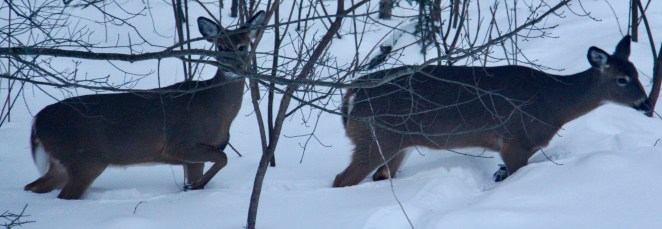
I glanced out of the bedroom window, and there they were. So silent. “Five deer,” I whispered to Clare.

IMG_0423.jpg

We watched as they moved through the trees at the garden’s foot. Step by step, silent, slow, ears pricked, cautious, the little ones up to their bellies in snow.

IMG_0428.jpg

They couldn’t see me as I took these pictures, but I am sure their sharp hearing caught the click of the camera. The one on the left is looking right at the spot where I am sitting.

IMG_0431.jpg

Sound and movement surround them: the clicking of branches, the whispering wind. They are so careful, so cautious, so suspicious. We look: but we can’t see anyone out there. Certainly we cannot hear the neighbors’ dogs.

IMG_0436.jpg

There must be something, there. They start to turn. Will they go back the way they have come?

IMG_0448.jpg

No: they continue to the road and we catch a last glimpse of them through thin branches as they prepare to cross the tarmac and vanish into the deeper woods beyond.

Poem from the Cree

IMG0061_1
Poem from the Cree

The Cree have retreated from the streets.
Their violinist has taken time out, leaving
his last notes dancing from a street lamp.
Only the Fire-Brave remains, inhaling thick
black oily smoke. He juggles twin balls of fire.

Bones gather together to gather dry dust. Hollow
metal buffalo: a cold wind blew and plucked out
his heart. Five climate controlled pedestrian
walkways cross the prairie, linking building
to building. A glass wheat field shimmers
and tinkles to the rhythm of air conditioning.

The black cow, cast iron hide set free from rust,
ruminates behind its plate glass window.
The night wind whisks white buffalo bones
pale across the sky. Oskana ka asasteki.

With these words, I will leave you, suddenly,
abruptly. A light going out. Now I am here.
Oskana ka asasteki. And now I too am gone.
Comment: Another Golden Oldie, re-discovered. I wrote this in Regina back in the nineties, last century, last millennium … how long ago is that? In our kitchen, an ear of wheat, purchased in the glass wheat field museum, still shelters in its gilded frame, a memento from that trip. So many memories, so many pictures, drifting … just drifting.