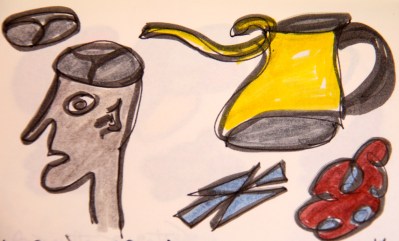
Raptors Flash Fiction

IMG_0236.jpg

Raptors
Bistro 21

“Falcon, Richard?”
“Here, sir.”
“Finch, Thomas?” Mr. Shrike’s predatory eyes squinted out over half-rimmed glasses.
“Thomas Finch?”
“Not here, sir,” Dick Falcon answered.
“Why not? His trunk’s here.”
“Don’t know, sir.”
“Hawk, Peter?” Mr. Shrike continued.
“Here, sir.”

* * *
“Tom Finch not back?” Mr. Shrike perched by the fireplace with his conspicuous, upright stance. “Why not?” He addressed the staff room then spat in the fire.
“Tricky business,” Mr. Slaughter replied. “Important birthday, his mother said when she called. He’s at home but his trunk’s here. He’ll be back.”
“Pity,” Mr. Shrike winced. “That boy’s spineless. I’d like to…”
“Impale him on a thorn and hang him out to dry like the butcher you were in the war?” Mr. Slaughter peered down the long beak of his nose. “Not on school grounds, I hope,” he sniggered.

* * *
Tom and his mother lived with her parents. His birthday cake had thirteen candles that year. He blew them out and made a silent wish: “Let me be brave enough to do it.”

* * *
After tea, Tom’s mother sent him into the kitchen while she talked with her mum and dad.
“He’s got to go back to school,” Tom’s grandfather cleared his throat and spat in the fire. Tom’s mum recoiled at the stench of burning phlegm.
“He doesn’t want to go,” she murmured. “The boys bully him and the masters are worse.”
“Just like the army: he’ll get used to it. It’s me paying his fees; it’s my money you’re wasting when he’s not at school,” he spat again.

* * *
Tom leaned over the chipped porcelain sink in the kitchen. His fingers brushed against the damp red flannel and the soap dish. Then he touched the leather case of his grandfather’s cutthroat razor.
The folded razor lay cradled in his left hand. He nursed it, swaying back and forth on his feet. He found the groove and pulled the cold steel blade from its protective casing.
The razor formed a glittering right-angled claw. Then it became the sinister half-wing of a hawk that fluttered for a second, hovering above his wrist.
It pounced.
A fierce talon slashed into Tom’s wrist and a red river of pain sprang out. Tom fought the urge to scream as he stared at the flowing blood. The great claw of the triumphant hawk lay deep in his wrist. Strong wings flapped and bore him away.

* * *
“Falcon, Richard?”
“Here, sir.”
“Finch, Thomas?” Mr. Shrike’s strident voice pierced the classroom. “Thomas Finch?”
“Not here, sir,” Dick Falcon answered.
“Why not?” Mr. Shrike surveyed the class.
“Don’t know, sir. But he won’t be back.”
“How do you know that?”
“Saw his trunk being sent home, sir.”
“Finch, Thomas: absent,” Mr. Shrike looked down at his list and skewered the boy’s name with the absentee’s black cross. He smiled a cruel, calculated smile, and returned to his list.
“Hawk, Peter.”

* * *

Remembrance Day Flash Fiction


039

Remembrance Day
Bistro 20

Previously published on
http://commuterlit.com/2015/12/wednesday-remembrance-day/

            The old man watched a drop of red wine slide slowly down the side of the bottle. It was November 11, his birthday.
…
Seventy-three years ago, Father John had taken the boy’s ear lobe between thumb and forefinger and pinched the nail deep into the flesh until the blood ran.
“This afternoon you will go down to the bamboo grove and cut a cane. Bring that cane to me and I will bless it.”
…
That night, the boy woke up. Snuffles, snores, and an occasional sob broke the dormitory’s silence. The bamboo was a long, cold serpent drawn up in bed beside him.
…
The next day, he awoke to his seventh birthday.
…
Father John beckoned and the boy followed him to his cell and knelt with his hands stretched out like those of Christ on the Cross. The priest struck him with the bamboo cane six times on each hand.
“Your Savior, blessed be His name, suffered more, much more for you,” the priest sighed. “Examine your soul. Find fault with each flaw, for you are unworthy. Remember: the eye you see is not an eye because you see it,” Father John droned on. “It is an eye because it sees you. Christ sees you as you kneel there. He sees. He knows. He judges. Examine your soul with care and stay there until I return.” The priest raised his right hand and made the sign of the cross in the empty air.
…
The boy spent his birthday kneeling before the crucifix in prayer. He contemplated the wounds of Christ. He imagined each blow of the hammer and imagined the pain of cold nails biting into his warm flesh. He tasted bitter vinegar as it dripped off the sponge, gasped at the thrusting spear, felt the lash’s sting as it fell across his flesh. He became the flagellated Christ and knelt before the crucifix, staring at himself eyeball to eyeball in the same way he looked at himself in the morning mirror. The crucified Christ gazed back at him, his brother, his soul mate, his double.
…
After an hour, a red drop of paint slipped slowly from the nail hole in Christ’s right hand. The boy blinked. The red drop trembled then fell.
After two hours, Christ opened his eyes and smiled at the boy.
After three hours, salt-water formed at the corner of Christ’s eye. It glistened in a sunbeam that entered through the cell’s narrow window.
After four hours, tears began to flow down flesh and painted wooden face.
It was Remembrance Day, the boy’s birthday. He was seven years old.
…
Seventy-three years later, the old man sat at the table. He watched the red wine trickle down the bottle. He remembered it all and his tears flowed again.
…

Recalcitrant Flash Fiction

IMG_0013

Recalcitrant
Bistro 19

            The annual Old Boys Reunion took place in the sixteenth-century cellar of a world famous winery that also ran a restaurant and banquet service for pecunious customers. A man in a penguin suit, with a foreign accent, and a suspicious looking bulge under his left armpit, ushered the recalcitrant towards a set of well-worn of steps.
            “You are arriving slightly on the late side, sir,” the penguin whispered, staring mockingly at the checkered, American-style sports jacket worn by the man he escorted. “And not dressed like the others. But not to be troubled, I myself will escort you down to the place of the guests.”
As he descended the steps that led down to the former wine cellars, the recalcitrant heard the well-remembered, high nasal bray as his former headmaster’s brass voice pierced the ruminations of the penguin-suited herd that, having sniffed the glorious nature of the gregarious watering-hole, was intent on reminiscing, drinking, and feeding.
“Wonderful place … so fortunate … to be here … thank you … ” the old man neighed.
It was indeed a wondrous place, a semi-whitewashed room, warm in the center where bees wax candles in gold candlesticks blazed on antique tables and cool by the one wall left untouched since that same sixteenth century. Here the damp gathered in great grey clots and the spider webs, also untouched, sparkled and glistened, like “the mythical lights of fairyland” as the winery brochure announced to the limited circle of the wealthy to whom it was circulated.
Empty kettle … the recalcitrant thought as he remembered his old headmaster and then they were, face to face, the head and his obstinately defiant and anti-authoritarian pupil, staring each other down.
“You!” It was an authoritarian call to battle. “I remember you. The boy who denied all authority.”
“Yes, me,” the recalcitrant, eyeball to eyeball with the old enemy rejoiced in his newfound glory. And here he was, back in the old country on a lecture tour of six major universities, one of them being in this city, a full professor now, with international honors, multiple publications, department chair in a well-known university, a household name in his subject, and all of this at forty-two years old. “Yes, me,” he repeated.
“You have done well for yourself,” the ageing donkey brayed.
The gunman in the penguin suit, sensing the tension, placed himself in the gunslinger’s position from which he could survey the whole room. He lovingly stroked the armpit bulge, eyes gleaming with hope.
“Tell me,” the head drew a handkerchief from his pocket and honked his nose into it like a storm-bound goose. “How did your career take off?”
“Well, in two stages,” the recalcitrant paused, partly for effect, partly to gather his thoughts. “Just like a rocket: stage one was when I left your school and stage two was when I left your country.”
The old donkey, blinked, threw back his head, trumpeted down his nose with intense nasal wrath, and turned away with a wave of his hand towards another latecomer who had just descended the stairs. “Ah, there you are Smithers,”the fog horn blared. “At last. Saved me you have. This man was just about to …”
The rest of the sentence was lost in the rush and a hubbub as a new series of delights arrived, tapas, hors d’oeuvres, little sticky creations on fiddly little sticks, they all circulated from hand to hand along with the exquisitely chilled champagne, the single malt whiskies, and the ultimate in estate wines.
Not a penguin spoke to the sports-coated recalcitrant. Nobody offered him a hand. Nobody shared a memory with him. As he arrived at each little group, the penguins gathered in a tight circle, turned their black backs to him, and shut him out. Throughout the feasting, he sensed the gimlet eyes of the gunman glued to a spot mid-way between his shoulder blades.
The recalcitrant didn’t partake of the food or the drink, he just watched. Then, after an hour or so, he turned and climbed the sixteenth-century stairs, the gunman in the penguin suit right behind him, and walked away into the freedom of starlight and the cool night air.
He never returned for another reunion.
He never received another invitation.

Decisions

DSC02057.JPG

Decisions

We make them all the time: what shirt to wear, jeans or dress pants, black of brown shoes, loafers or lace ups, sandals … socks or not … and then there’s breakfast … tea or coffee, cereal or toast, sugar or honey … most days, we don’t even realize we are making decisions. We certainly don’t need to write out a page of pros and cons in order to choose between coffee or tea …

Then there are the big decisions, like where to go next on this blog. I have been weighing up the pros and cons and I am finally getting close to a decision. My blogging possibilities include Literary Theory … Writing about Writing … How to Read … Revising Older Texts … Reading Don Quixote Online … Writing New Texts … Preparing Books for Publication Offline … These are much more difficult decisions but I must think about them and make them.

Literary Theory sounds good. But what do I know about it? Nothing but the dry academic literary theory of an abandoned academia that wasn’t really very interesting anyway. An occasional question arises in the blog world, one on which I feel competent to comment, and that for me, is the way I go with my literary theory: a quick response. All that academic literary theory is money in the savings bank that I can draw on if I, or anyone else, needs to access it. But to access it on a daily basis and pontificate my way to the limbo of a blogger’s boredom? I don’t think so!

Writing about Writing also sounds good, but in many ways it is a poor person’s literary theory, rather like literary theory without the long, obfuscating technical terms. Again, if the need is there, I can contribute; but it’s not the way I want to go, not here, not on this blog, not on this particular watch.

How to Read is a subject on which many books have been written and I recommend that all people not just read, but learn to read deeply and properly. In some cases, depending upon the quantity of material that crosses the computer screen (it used to be the desk), speed reading is essential and I recommend speed reading for everybody except poets and those who love poetry. To speed read a sonnet is not the way to go. I would love to sell the film rights to some of my sonnets, but apparently, that’s not the way to go either. Ah well, we can’t have everything …

Revising Older Texts is another excellent way to run a blog. The material is always there in one form (old) and the reworking of it into another form (new) is regular, instructive, and creative. I have done that on this blog with At the Edge of Obsidian > Obsidian’s Edge and loved both the process and the result. However, at least three of my commentators, Al Lane, Chuck Bowie and Kevin Stephens, suggested that the past is in the past and should remain there, while the future lies ahead of us and needs to be created. After much thought, I have come to the conclusion that Al and Chuck and Kevin are right. I will put older material up on the blog, but I will no longer review it for future re-publication, except in exceptional circumstances, and these are yet to be determined.

Reading Don Quixote Online has been in my wish bucket for a very long time. It is something that I would love to do one more time. I have already done online readings on several occasions. I have twice taught DQ in an online hybrid environment: hybrid — an online portion and an in-class face to face portion –. To return to DQ is, for me, to return to academia, an academia that I rejected several years ago. No: much as I would like to re-formulate this project and to lay out online my definitive This Is How To Read Don Quixote, I feel in so many ways, that this is not yet the time to do so. I want so much to turn back that particular clock, but I know how much work, reading, and commitment is needed and I am not yet ready. Perhaps, like the Flowers of Scotland, those days are past now and in the past they must remain. We’ll see. I checked my DQ notes last night … they are all there, ready and waiting … and I can set out on that adventure anytime … alas, through the mists of time, I can hear those bagpipes playing Will ye no come back again? I will, my friends, but not just yet.

Writing New Texts is fun. This is a new text and it is helping me to focus  on what I want and do not want to do. There is always room here for new texts. But new texts need revisiting and revising. Maybe some of my creative texts just aren’t ready for publication yet and yes, online writing is a form of publication. Thankfully I can revise these texts, and I may yet revise this one; indeed, I will probably come back both to this text and to these decisions. And maybe I won’t and that’s another decision for another day.

Preparing Books for Publication is where I am right now in my offline life and I think this is where I want to be online as well. I have two texts in preparation: Bistro (Flash Fiction) and Echoes of an Impromptu Metaphysics (poetry). I have thus far shared 17 pieces from Bistro on this blog. There are another 17 to go. Each time I prepare a piece of Flash Fiction for publication here, I re-read it, re-think, re-frame it, re-structure it, and re-write it. Those of you who know me offline are well aware of the nature of that re-processing. Sometimes the pieces are merely sharpened and polished; often they are totally re-written. And yes, when flaws are pointed out or doubts expressed, the texts are changed. I deeply value the comments of my below the line commentators. Echoes is the other text I need to re-write. I will share that online as well. The sharing will be difficult … Echoes is a difficult and very personal text … but it will be done.

Decisions have been taken and my thought process has been shared. There will be no turning back of the clock even though I am always looking over my shoulder. Here, then, are my decisions, but remember, they are always open to revision.

  1. I will re-publish on this blog Though Lovers Be Lost, one of my favorite poetry books. I will do this as and when necessary if I need more time between blogs with my re-writing.
  2. I will finish publishing the other stories from Bistro online on this blog as I prepare it for offline publication.
  3. I will start the re-write of Echoes online. I have been away from this book for about eight months now and re-reading it earlier today I saw how and where it could be improved.
  4. I will add in literary and philosophical commentaries when and where I see the need to do so. I consider this particular article to be a literary commentary with philosophical connotations, or is it the other way round? As an academic, I could prepare a treatise on the question; as a blogger, I can leave that question in the capable minds of those who read and follow this blog.

    Vale!
    Et vade mecum!

My Top Ten Books

IMG_0062.JPG

My Top Ten Books

For Tanya Cliff
https://postprodigal.com/2016/07/14/top-ten-books-that-changed-my-life/

It sounds so easy, doesn’t it, to choose your ten favorite books? But really: it isn’t.

Clare’s great aunt made the best sponge cakes and rock cakes I have ever tasted. Her formula? Not weights and measures but a simple scale: the egg on one side, the flour on the other — and balance them.

How do I weigh a book?

I think in terms of authors rather than their individual books. For example, on one side of the scale place Les Fleurs du Mal of Baudelaire and on the other, his Petits Poèmes en Prose. Literary and cultural history would opt for Les Fleurs du Mal, and quite rightly so. My own personal preference, and I love them both, is for Petits Poèmes en Prose. De gustibus non est disputando / there is no arguing over taste. My choice is for Baudelaire, the author, rather than for one of his works, selected above the other.

If I apply this theory to other authors, what happens to, for example, William Shakespeare? Must I choose MacBeth over Henry the Fifth,  King Lear over Julius Caesar or A Midsummer Night’s Dream over The Merchant of Venice? And what if I refuse to do so? I would much rather choose Shakespeare over any of his plays, the Complete Works, including the sonnets, over any single play. And why shouldn’t I?

By extension, should I choose Shakespeare over Lope de Vega? Corneille over Molière? Racine over Calderón de la Barca? Mira de Amescua over Jean Anouilh? Bernard Shaw over Samuel Becket or Beaumarchais or Ionesco? And look at how Euro-centric (English, French, and Spanish) I am, especially when I am not familiar with the great playwrights of other Western nations: the Russians, the Norwegians, the Germans … and yet they are all Europeans. Are there no other literary nations in the world? Of course there are, but I am not that familiar with their literature and culture, and there is only so much a reader can read in its original form.

So, blessed and privileged as I admit I am, I can read books in English, French, and Spanish … lucky for me. However, I admit to difficulties with books written in Portuguese, Italian, German, Catalan, and Galician. As for Chinese, Hindi, Japanese, Russian, Arabic … I can only offer my apologies, but for me, these are closed books and I can only reach them in the translations, however good, however bad, that are placed before me. This is true too of the Pre-Columbian Mexican codices, the Zouche-Nuttall, the Vindobonensis et. al. These are also books and they outline the peoples and cultures of Mexico as they were before the arrival and conquest orchestrated by Cortés. And let us not forget Bernal Díaz del Castillo, the man who, in later life, wrote the true history of  Cortés’s conquest. And speaking of conquests, how about Julius Caesar’s Bellum gallicum, his personal account, in the third person, of his conquest of Gaul? As a school boy, long ago, I struggled through it in Latin, but I enjoyed it later, in translation.

Translation: traductor / traidor, according to Cervantes, who was undoubtedly following someone else, means translation / betrayal … or does it? Translation: the reverse side of a tapestry (also Cervantes) from which we may through a glass, darkly, glimpse only shape and shadow while stumbling over all those knotted threads … so here’s another question:  why would we choose a translation, with all its flaws, over a work we can read and enjoy and hopefully understand in the original?

So far, I have mentioned mainly playwrights; Cervantes was a playwright and wrote a goodly number of plays (Ocho comedias y ocho entremeses). I should also mention novelists. Charles Dickens, for example; or Honoré de Balzac or Gustave Flaubert or Marcel Proust or Pío Baroja or Benito Pérez Galdós or Gabriel García Márquez or Carlos Fuentes or William Faulkner or Kurt Vonnegut or William Golding or Chuck Bowie or John Sutherland or Kevin Stephens … not to mention Charlotte Bronte … Emily Bronte … Jane Austen … Virginia Woolf … Should I then choose just ten novelists and forget the world’s playwrights? And how can I choose just one book from a single novelist’s vast production, think Trollope, think Balzac?

What about poetry? My ten favorite poems? My ten favorite books of poetry? My ten favorite poets? Perhaps the latter is more achievable. If that is so, I must then choose between Quevedo … Góngora … Antonio Machado … Juan Ramón Jiménez … José Hierro … Wilfred Owen … Dylan Thomas … Gerard Manley Hopkins … Baudelaire … Verlaine … Rimbaud … Prévert … R. S. Thomas … Federico García Lorca … Miguel Hernández … T. S. Eliot … Seamus Heaney … Pedro Salinas … José María Valverde … and how do I choose between the writers I know and love … Patrick Lane … Richard Lemm … Fred Cogswell … Norman Levine … Donna Morrissey … Susan Musgrave … Joan Clark … Erin Mouré … and the ones I work with on a regular basis … Jane Tims … Kathy Mac … Shari Andrews … Michael Pacey … allison Calvern … Ian LeTourneau … Judy Wearing … Rachelle Smith … Cheryl Archer … Judith Mackay … Julie Gordon … ten poets … ten books … ten poems … ten fingers … ten toes … ten commandments … only ten?

Hold on a second: I have forgotten St. John of the Cross / San Juan de la Cruz, one of the western world’s great mystics. I must also mention St. Teresa of Avila, a Doctor of the catholic church, and Fray Luis de León, and now I am about to enter a great cloud of unknowing in which mystics, some named, some unnamed, have blessed us with their life thoughts and works.

Things fall apart, the centre cannot hold … and I have also forgotten W. B. Yeats and James Joyce and I have failed to remember the Poema de Mío Cid and the anonymous epic poems and ballads of the European middle ages, some of which are so deliciously delightful. Alas, I will be forced to abandon so many of my teachers and my friends … ten books, ten speeches, ten lectures, ten words … my life in literature reduced to ten teaspoons of instant coffee, instant tea, instant knowledge.

“My friends, we will not go again
nor ape an ancient rage;
nor let the folly of our youth
become the shame of age.”

Oh yes, that’s G. K. Chesterton. I had forgotten him. When asked what book he would take with him to read in exile on a desert island, he replied: “Green’s Practical Manual of Ship Building and Ship Sailing.” Now that’s a book that should be in everybody’s top ten, especially with the seas rising and disaster lurking round every corner of the suspicious, weather-warmed mind.

However, as I look back on my reading life, believe it or not, some books do stand out. When I entered graduate school and realized the enormous amount of reading that was being thrust upon me, I took a speed reading course. Over the ten weeks of that course my reading speed rose sharply from about 200 words a minute to 800 words a minute. Without that one book, I would have been unable to read so many of the others. Where is it now? It is not on my shelves: ah yes, I gave it to my daughter when she went to law school.

The second special book is the Spanish text book that, in regularly updated versions, I relied on for teaching basic Spanish grammar throughout my academic career in Canada. Without that textbook and the employment it ensured me, I would not have been able to put my family’s bread on the table. I guess you might call it influential. Perhaps the third special book is my own doctoral thesis: that allowed me to gain academic employment and is so very, very special to me, but for all the wrong reasons.

Ladies and Gentlemen and Fellow Bloggers, here I am, marooned in Island View, with not an island in sight, and no reason, as yet, to build a librarian’s arc. I will now replace my selected books and authors back on the shelves from which, one by one, I have taken them down, dusted them off, and glanced through the pages. I admit my inadequacy. I cannot for the life of me choose ten books, let alone ten authors. I lay down my pen. I remove my fingers from the keyboard. I abandon my task. Soon I will leave the room with one of my favorite books in my hand. Will it be Jane Tims’s Within Easy Reach or Chuck Bowie’s Steal it all or John Sutherland’s master work, The Two-Shot Compendium. I think I’ll go with Two-Shot and re-read the first story, Two-Shots Lands in Trouble, as I sip my mid-morning coffee. Meanwhile, I will leave you with this thought from Guillaume Apollinaire.

Je voudrais dans ma maison
une femme ayant sa raison,
un chat passant parmi les livres,
et des amis en toute saison,
sans lesquels je ne peux pas vivre.

DSC02576.JPG

Bistro 9 Flash Fiction

Grave Expectations

For Tanya Cliff

https://postprodigal.com/2016/06/27/curdled-milk-in-burning-hands/

IMG_0051.jpg

“Good evening, ladies and gentlemen. Thank you for being here tonight”

Jerry took a sip of water from the glass on the lectern. The hand that held his speech shook and the sheets of paper whispered like reeds in the breeze. He cleared his throat.

“My eldest brother, Eric, is according to many, and judging from the prestigious teaching awards he has won, a fabulous teacher. Part of his skill has been to involve the learner in the act of learning to such an extent that the subject learned becomes part of the learner’s life-style. Teaching and learning then become an act of love in the course of which learners reshape and rethink themselves. This reshaping does not come in a narcissistic imitation of the teacher, but in an act of self-discovery which releases and hones latent talent.”

Jerry looked up from his pages and glanced around the room, trying to catch the eyes of as many as would look at him. Some stared at the remains of food on the table, others gazed up at the ceiling or shuffled their feet.

“My second brother, Phillip, is named after our grandfather who was an outstanding professional athlete.”

A murmur of interest slid around the room. Jerry watched as several heads nodded in appreciation.

“Phillip, my brother, was a reasonably good rugby player who turned into an exceptional coach. He coached at all levels: junior high school, high school, club, junior and senior provincial, regional, the national championships, and even internationally. His teams won regularly both in leagues and play-offs at the provincial and regional level. He was also an instructor of coaches and for nearly 20 years all the area rugby coaches at Levels I and II (National Coaching Certification Program) were taught and assessed by him. In addition, he worked in administration and was the president of the provincial rugby union for 6 years.”

A soft sigh greeted these words, the letting out of a gentle breath.

“I am the third brother, the academic, the one who won scholarships and was the first of our family to go to university.”

Jerry raised his voice at this last word and, owls on a branch, the guests at the nearest table nodded their heads.

“I am also the only one to go on to graduate school and earn an MA and a PhD. Throughout my academic career I received national and international recognition for academic publications and have been an editor, an associate editor, an assistant editor, an editorial assistant, a book review editor, and a proof reader. I currently sit on 2 editorial boards in Spain, 1 in the USA, 2 in Canada. This editing has gone hand in hand with research and publishing as anyone who has consulted my books, my online Bibliography and data base, or one of my 70+ peer-reviewed articles will know.”

Jerry took another sip of water. Two tables away, the guests sat with their eyes shut, meditating. At another table, a man with a long white beard that flowed over his chest breathed deeply, head down.

“My youngest brother, Peter, is quite possibly the best of us. He is the dreamer, the poet, the writer. He has won several writing awards and has written and published 8 poetry books, 9 poetry chapbooks, and 12 short stories. Lately, he has produced a score of films and videos. He loves working in multi-media and has built two web-pages packed with audio-visual displays in which photos and videos stand beside poems in a series of expressions which he calls video poems and photo poetry.”

Jerry turned the page. He sensed a bored restlessness in the audience’s slow adjusting of body angles, in their shuffling of feet.

“My parents would have enjoyed tonight’s celebratory dinner and tomorrow’s ceremony, but unfortunately, they cannot be here. They passed away some twenty years ago. My brothers would have loved to have been present, but alas, that too would be impossible. My older brother, Eric, was still-born. Phillip and Peter died at birth.”

Heads jerked up, glazed eyes brightened. The audience sniffed as they sensed a fresh wind carrying revelation and scandal.

“Although they died in the flesh, their spirits have never left me. Eric’s spirit represents my career as a teacher: I dedicate it to him.”

Some of the guests put palm to palm in light applause.

“Phillip’s spirit represents my adventures in sport and coaching: I dedicate them to him.”

Jerry emphasized the last word and the audience responded.

“My academic and research career, for better or for worse, is my own.”

The audience clapped and one man stood, only to be pulled down by the woman beside him who tugged at his sleeve.

“Peter’s spirit represents my creative side: I dedicate my creativity to him. I have thought about the lost potential of these three brothers of mine every day of my life. Their presence has never left me. It has been a privilege to incorporate their three different spirits, personalities, and work ethics into this unique life with which I have been blessed.”

Spoons tinkled against cups.

“I would like to thank you, the members of this university community, for permitting me to work here for so long.”

A murmur of appreciation rose from the audience and body positions were again re-adjusted.

“You have given me the space and freedom to express not one, but multiple personalities and talents: researcher and teacher, athlete and coach, academic and editor, and last, but by no means least, creative artist in image and word. I would also like to thank my nominator and the Board of Governors, who unanimously approved my nomination. I look forward to receiving the honorary status of Emeritus Professor which you will so kindly confer upon me tomorrow.”

The audience, sensing an ending, stamped their feet and tapped open palms on the tables.
“Well deserved.”
“Well done.”
“Hear, hear.”

“In honoring me, you honor my parents and my brothers, whose spirits continue to thrive and work within me. You also honor my wife and my daughter who have played such an important role in keeping me balanced, committed, healthy, positive, productive, and, in spite of the occasional insanity of the world around me, sane. Thank you all. And to all a goodnight.”

The audience struggled to its feet and former colleagues touched Jerry’s arm as he walked from the podium back to his table. He sat down and took a sip of water. As he glanced around him, he took in the mad babble of voices, the swirls of divergent conversations, and realized, sadly, that nobody had understood, really understood, a word that he had said.


M. T. Kettle

M. T. Kettle

I had a friend called M. T. Kettle
and he was one of those boys
who thought they were very,very clever
and always made a lot of noise.

Alas, he had an empty head
but the teachers set him right.
They drilled a hole in his empty head
and filled it with homework every night.

Each day in class when they tested him
hot tears fell from his eye.
It was such a shame
when they called out his name
to watch that young boy cry.

IMG_0051.jpg

In our school, education
was like filling M. T.’s head.
The masters took notebooks filled with ideas
from white males (mainly dead),
and told us stories of their own past glories,
We would have liked fresh thoughts instead.

IMG_0041.JPG

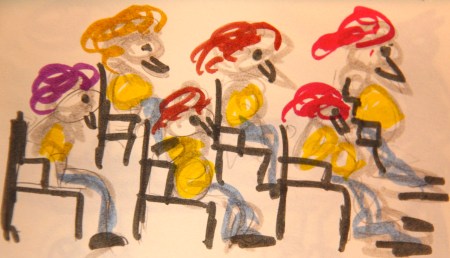
We sat in a classroom, row upon row,
our pencils in our hands,
and took dictation about every nation
that had passed through colonial hands.

IMG_0047.jpg

“Now knowledge, boys, is in your notes,”
that’s what one master said.
“I read them out, you write them down,
they never pass through anyone’s head.”