Wednesday Workshop: The Poem Itself

Books

Wednesday Workshop
02 May 2018
The Poem Itself

One of the joys of downsizing one’s library is rediscovering old books, genuine treasures, that one wishes to read again. On my basement bookshelf I found an old copy of Stanley Burnshaw’s The Poem Itself (New York: Crowell, 1976). I thumbed quickly through it and found my old marginal notes on poems by Miguel de Unamuno and Antonio Machado. Reading the annotations to the poems I came across such literary and philosophical gems as these.

  • “Poetry gave (Unamuno) permanence to the temporary forms of the self” (p. 167).
  • “Unamuno’s God needs men to be sure of his own existence” (p. 171).
  • “The poetic element (for Machado) was not the word for its phonic value, nor color, nor line, nor a complex of sensations, but a deep palpitation of the spirit” (p. 172).
  • “In the life of every sensitive person there is much spiritual experience which cannot be given a name or a title” (p. 173).

These brief insights into the nature of poetry sent me back to the book’s first pages and I read with much joy and pleasure the opening essay entitled The Three Revolutions of Modern Poetry (pp. xvii-xliv).

The first revolution is that of Syntax (p. xxiii). Word order is changed substantially and words and thoughts are inverted. Sixteen lines of Mallarmé (p. xxiv) are composed of one sentence with five commas and a colon. There is no logical sequence of beginning, middle, and end as one thing runs into another and thoughts shape-shift and move. The structure becomes that of presences and dreams as Mallarmé writes to his new theory: “to paint, not the thing, but the emotion it produces” (p. xxv). Other analyses of syntactical distortion and fragmentation follow and Emily Dickinson’s Further in summer than the birds— leads into Cummings’ my father moved through dooms of love / through names of am through haves of give. When I link this most modern movement to Francisco de Quevedo’s ‘soy un fue, y un será, y un es cansado’ / I am a “was” and a “will be” and a  tired “is” … I realize yet again that all is not new in this modern world of ours. After all, Quevedo lived from 1580-1645, a modern poet indeed.

The second revolution is that of Prosody (p. xxvii). Rimbaud’s first poem in vers libre / free verse was written (probably in 1873) and published in 1886. Today, we are no longer shocked by the breaking down of the tyranny of verse. In fact, we are probably more shocked by people who use rhyming, metric poetry than by the many innovations in line length and word arrangement with which we are so steadily bombarded. That said, I still find some of Cumming’s innovations, Grasshopper / PPEGORHRASS for example (p.xxi) to be quite stunning and not always readily intelligible.

The third revolution is that of Referents, “the upheaval in poetic communication as a whole and specifically its referents” (p. xxxi). This is basically the writers of poetry turning to their private, interior worlds for inspiration. While poetry has always contained references to the self, modern poetry may be full of meaning for the writer, but that meaning doesn’t always extend to the reader. This is particularly true of automatic writing, surrealism, and the metaphoric poetry that floats, sometimes without factual substance, in the mind of reader and writer alike. Burnshaw isolates three moments in the development of this obscurity.

  • “a deliberate attempt to enrich the communicative content of language by expunging the unessential words” (p. xxxiii).
  • “to compress years of anguish, dreams, and projects into a sentence, a word” (p. xxxvii).
  • “the use of personal symbols and hence the creation of a private cosmology” (p. xxxviii).

These three elements contribute to the privacy and hermetic obscurity prevalent in certain poets. Le jeu ne vaut pas la chandelle / the game isn’t worth the candle … alas, while some difficult poems and poets are very worthwhile, some poetry is definitely not worth the valuable time wasted in trying to decipher it. That is my conclusion: nobody else’s.

This re-adventure back into modern poetry contributed to a delightful voyage through the verse of Baudelaire, Mallarmé, Nerval, Verlaine, Machado, and Unamuno (among others).  It is a voyage that I have started, but not yet finished. It is also a voyage that is generating new thoughts, fresh understanding, and a renewed desire to write. What more can a reader / writer desire than to be among friends, also sharing loneliness and despair and also held at bay by the living words of dead men, their voices and wisdom heard through ageing eyes that can still scan the printed page … vivo en conversación con los difuntos / y escucho con mis ojos a los Muertos // I live in conversation with the deceased / and listen with my eyes to the dead (in my friend Elias River’s translation) of Quevedo’s poem Retirado en la paz de estos desiertos.
Broken Record

IMG_0192.JPG

Broken Record

I have worked on this poem for a long time now. I worry about it, gnaw at it like a dog gnaws at a bone or a cat plays with an insect trapped beneath its feet. Francisco Quevedo  (1580-1643) rewrote one of his poems (Miré los muros de la patria mía) six times between his first version (1603) and his last version (1643) two years before his death. Are we condemned to dance attendance on those poems that haunt us? I don’t really know. Here is the link to my first version of Broken Record. Is it the best one? The only one? The one I should keep? Here is my link to This Old Man. Is this a better version? Does the change of photo change the context of the poem?

Like Francisco de Quevedo and his long history of Miré los muros … I can no longer tell.  That said, here is the latest version of my poem. I hope you like it. Do some clicking (it’s also called research) and let me know what you think. I look forward to your comments.

Broken Record (?)

A vinyl disc going
round and round,
the diamond-tipped needle
stuck in a groove:
me and my broken-
record memories.

I stop old friends
in the supermarket
and, when I start to talk,

they stand there,
tapping their feet,
trapped in a doldrum
where no winds fill
their sails to move them on.

Caught in multiple mirrors
surrounding the barber’s chair,
my tongue is an open razor
constantly stropped.

I have turned into
a babbling book of hours,
life’s moribund albatross
necklaced,
a hot towel round
my reluctant throat.


Friday Fiction: Sentences

IMG_0010

Friday Fiction
27 April 2018
Sentences

“Use lots of verbs to catch the reader’s attention. Keep your sentences short.”

… people don’t like long sentences … life sentences … things like that … though death sentences may be short, ugly, and brief … unless there’s a power shortage when you’re sitting there all wired up … or they’ve watered down the drugs in the tube they attach to the needle they put in the shunt already plugged into your arm …

… you’ve read the news … seen the pictures … if you live close enough you may even have stood out in the street with a candle and your friends watching the power shortage hit downtown … district lights flickering off … road lights shutting down … big blankets of blackness … as they put all available electricity into the power circuits that lead to the electric chair …

… use short sentences … like the one they read to me when I was six … then they locked me away in a boarding school for twelve long years … until I was eighteen … I ran away … again and again … they beat me … again and again … short sentences … ‘hold out your hand’ … ‘pull down your pants’ … bend over that chair’ … six of the best … no verb in that one … yet the words still strike a note of fear into those who have been publicly humiliated and flogged in a boarding school dining room … in front of all the boarders … and the day boys as well … ‘don’t cry’ … ‘little baby’ … ‘mother’s pet’ … ‘mummy’s darling’ … blubbing like a baby … and this at six years old … or seven … or eight … lashed on hands or backside by a grown man wielding a bamboo cane …

“Keep those sentences short.”

“Bend over.”

“Place your hands against the wall.”

“Don’t cry like a baby.”

“Take it like a man.”

Thursday Thoughts: M. T. Head

IMG_0068

Thursday Thoughts
26 April, 2018
M. T. Head
 

I sat in the class, head in hands, avoiding eye contact. I hoped the teacher wouldn’t point me out, call on me, nominate me with a finger … to no avail … he called my name … “You have sixty seconds to speak about …” he paused, then produced the rabbit from the hat, “matches. Come along, stand up, you have sixty seconds, starting …” he watched the second hand go round on the classroom clock, then counted down: “5, 4, 3, 2, 1 …” waved his hand, and shouted: “Now!”

Matches: cricket matches, boxing matches, rugby matches, soccer matches, chess matches, matches to light the burners on the gas stove, the oven, to light the fire in the fire place … matches, matchsticks, Match Box toys, Dinky toys, toys for little boys, toys for big boys …

“Ten seconds have gone … you have fifty remaining.”

“When I think about matches, I think about …”

The first spring day in the bungalow, our summer home. The rooms are cold and damp after the winter and nobody has been here since last year. We lay a fire in the grate, but the wood is damp, as is the old newspaper we gather from our last visit. We search for sugar to aid the blaze that we hope to start, but the sugar bowl is empty. We go to the stove. Cold, winter ashes crowd the fire bowl. We scrape them together in a desperate search for charcoal remains …  but we find nothing. We move to the oil-fired lamps and oil stoves. Matches dragged across soggy sandpaper fail to spark.

“Come along, boy. Have you nothing to say? You have thirty seconds left.”

Silence fills the room. It is broken by the childhood sniggers and chuckles of long-forgotten friends. The unmentionable shuffles its outsize feet to shatter the silence. My cheeks grow red. I start, stammer, and stop.

We leave the bungalow. Go next door to where our neighbours winter over. We knock on the door. “Can you lend us a match?” we ask, holding out our hands. Mrs. Williams beams at us. “A match,” she says. “First time in after the winter?” We nod. “I thought so. Saw you arriving. Wondered why you hadn’t come earlier. The weather’s been nice. Here: I can do much better than a match.”  She moves over to the fireplace, picks up the little coal shovel, shovels up a generous portion of her fire, heaps on another lump, then two, of fresh coal, and “Here you are,” she says. “Just put it in the fireplace and add some wood and coal. You can start your first fire with this.” “Thank you, Mrs. Williams,” we say. “No problem,” she replies. “It’s good to see you back. It’s been lonely here this winter without you.”

“Time’s up,” the teacher says. “That’s sixty seconds of silence and you can hardly find a word to say on a simple subject. Are you stupid or what? You should be ashamed of yourself.”

My face turns red. I hang my head.

I feel ashamed.

I am seven years old.

Wednesday Workshop: Balancing the Books


15 May 2002 Pre-Rimouski 035

Wednesday Workshop
25 April 2018
Balancing the Books

Two days ago, I wrote the following lines to one of the writing groups of which I am a member.
“Today, 23 April 2018, is World Book Day. We not only celebrate the world of books, but also the death date of three great authors. Miguel de Cervantes, William Shakespeare, and the Inca Garcilasso de la Vega. Three great writers, two continents, two languages, three if you include the Quechua from which the Inca Garcilasso translated his Comentarios Reales. The Inca Garcilasso didn’t actually translate the Comentarios Reales, for the originals were part of an oral tradition in a culture that lacked handwriting. Hence they were never written down. His mother was an Incan Princess and his father a conquistador. His mother kept the Incan culture and memories alive and it was from the oral traditions of his family (one side of it) that the Comentarios Reales were born. It was recognized in its day as one of the greatest books to come from one of the first outstanding writers with indigenous roots. Hence his place on the pedestal alongside the other two greats. All three died on 23 April 1613, the same date, but not the same day. Two different calendars were present in Europe: the old Julian and the more modern Gregorian … same date, but thirteen days apart.”
I knew long ago that I did not have the strength and stamina to make a living as a professional writer. I knew too that I could not put my beloved and my family through the strain of maybe, or maybe not, surviving financially on a creative writer’s income. I wanted to be an artistic writer, a poet above all, art for art’s sake, not just a commercial writer, writing adverts for a living, or pandering to the lusts of the baying evening newspaper crowd.
In order to support and care for my family I had to make money and balance the books. Rather than writing full time, therefore, I chose a career in academia. My career as an academic led to 90 research articles, mainly in my specialized field of Golden Age Spanish Literature, 70 book reviews, the publication, in book form, of part of my doctoral thesis, and an online bibliography, prepared initially thanks to the loving care of my beloved, and now turned, thanks to the Harriet Irving Library at the University of New Brunswick, into a searchable data base.

In addition to my normal course load, I also committed to twenty-five years of unpaid, voluntary overload teaching. I did this in order to maintain a small, understaffed program in a tiny Maritime university. I also had a long-term coaching career (Rugby) at club, provincial, regional, and national levels, and a commitment, at various times, to various editorial positions in 14 local, regional, national and international journals. My creative writing career has understandably suffered because of this commitment to research, teaching, editing, and coaching. In spite of that, while researching and teaching full-time, I was still able, with the help of family and friends, to publish 10 poetry books, 11 poetry chapbooks, 12 short stories and 130 plus poems in 20 Canadian (and other) journals. There was very little money in any this, other than my salary as a tenured professor, and I know only too well that to have been a full time, creative writer and to have maintained a house and a family without recourse to a second career would have been impossible.
Now that I have retired from university teaching, I can finally engage full time in creative writing. In my part-time creative writing career, maintained while I worked in academia, I kept a journal and made sure I spent at least one hour a day writing creatively, even if I had to get up early to do so. This resulted in a couple of poetry books with small presses and later a series of self-published poetry books that doubled with various festivals and other writing sequences. My poetry books never sold well, and there is very little money in poetry anyway, so when I started self-publishing, I determined to give my books away to friends and well-wishers who were interested in what I was writing. In retirement, I discovered CreateSpace and I now have thirteen books up on Amazon and Kindle. However, I am a writer and an academic, not a salesman and a marketing manager. As a result, I haven’t marketed myself and no, I haven’t sold many books. Self-promotion does not appear to be my strong point.
Last year, as Canada reached it’s 150th birthday, a birthday that ignores the fact that the country has existed for much longer than 150 years and that our indigenous people have lived here for 10,000 years or more, without any spectacular celebrations, questions were asked to selected writers about our Canadian Culture. What do we love most about Canadian Culture, was one such question. I gave the following brief answer: “Canadian Culture allows a person like myself, born in Wales, and speaking English, French and Spanish, to live and write in Canada about Wales, England, France, Mexico, Spain, and my adopted homeland. However, the literary and cultural industry boasts of our international character while almost totally ignoring me and writers like me. Those who guard the gates of the literary world ignore the self-published (often referring to us as adherents to what they term the ‘vanity press’) and they constantly belittle and put down those who have not progressed in the ways that they, as literary gate-keepers, find acceptable.”
Do I care? Of course I care. That is why I am writing this and why I will continue to write. Will anyone read this and take any notice? I doubt it. Will anyone take any action as a result of this tiny pebble cast into a Great Canadian Lake? I really, really doubt it. I can see the shoulder shrugging now as the eye-brows raise themselves slightly and the reject piles beckon. Will literary Canada keep staring at its own belly button and congratulating itself on its wonderful cultural opportunities for self-expression in writing? I guess it will. Will things change for artists on the periphery, for struggling artists, for artists like myself who with great difficulty have fought throughout their lives to continue with their creative writing while balancing the family books? I doubt it very, very much indeed.
But I am here, as others are here. Together, we have a voice. I would like it to become a  very powerful voice. This voice has long been side-lined by the literary establishment and the institutions. But we are many. And I too have a dream: it is that one day, we independent publishers, we self-publishers, will raise up our voices, and one day we will be heard.

Wednesday Workshop: Reading

IMG_0167

Wednesday Workshop
11 April 2018
Reading for Writers

Miguel de Cervantes once wrote that he was so fond of reading he would pick up even the scraps of paper he found in the street to read them if anything was written on them. This is well-known. What is less known is that Don Quixote, his immortal novel (DQI, 1605, DQII, 1615) is a masterpiece, not only of writing, but also of reading.

From the initial sortie, a prose transcription of an earlier short play, to the Scrutiny of the Library, Cervantes demonstrates right from the start his awareness of current trends in poetry, theatre and prose. In addition, he shows (especially DQI, chapter 47) his acquaintance with contemporary literary theory, as E. C. Riley has so ably established in Cervantes’s Theory of the Novel.

Cervantes begins with the traditional Renaissance novel (DQI, 1605) in which he experiments with plays and poetry turned into prose, oral and written histories, pseudo-autobiographical episodes, the picaresque novel, the pastoral novel, the Italianate Novel, the picaresque novel (briefly), his own versions of the realistic Spanish short story, and then, after a ten year gap during which he receives all kinds of reader feedback, he invents (DQII, 1615), the self-referring modern novel. DQII refers back to DQI as if it were true history. Don Quixote on his ravels meets with people who recognize him, for they have read his story and know all about him. The fictitious character establishes himself as an almost flesh-and-blood living person.

What can we, as writers, learn from this? Above all, we must learn to read copiously, not just once in a while, but all the time. Not only must we read, but we must learn how to read. Yes, we can read for knowledge and information; yes, we can read for pleasure and enjoyment; yes, we can read to lose ourselves and wash away the cares of the world. However, as writers we must learn to read in a different fashion. We must read in search of the narrative structures that inspire other good writers. We must read in search of the iterative thematic imagery that binds a text with meaningful, repeated images. We must read in search of the poetry that sates the soul’s constant thirst for beauty. We must read in search of the dialog that cuts to the bone and reveals the hidden character of the protagonists. We must read in search of the layering that allows us to give extra meaning at all levels of the narrative. We must read in search of the secret that allows us to trim all unnecessary material in order that our stories may be spare and sparse with not an extra word or thought.

Reading: I have just finished taking an eight-week online course with the School of Creative Writing at the University of Toronto. In the course of those eight weeks, I read the following books.

  1. 3 short stories a week, recommended by the instructor, the wonderful novelist Kerry Lee Powell, to illustrate each week’s lesson. [24 stories]
  2. 14 first drafts, one from each of the magnificent students in the course (I had the honor of being the fifteenth student). [38 stories]
  3. 14 revised stories. [52 stories]
  4. 14 first drafts of a second story. The course asked for two stories to be written by each participant over the duration of the course. [66 stories]
  5. 14 revised drafts of this second story. [80 stories]
  6. My own voluntary reading included Raymond Carver’s What we talk about when we talk about love (17 stories), Cathedral (12 stories), and my own short story collection, Bistro (35 very short stories). Recognizing the errors, weaknesses, and inaccuracies in my own collection reduced me to tears. [144 stories]

I have spent eight wonderful weeks exploring creativity and the art of short story writing.  Am I a better writer for all that work? Undoubtedly. I can see and think much more clearly and I am beginning to gain a better understanding of how short narratives work. I am a better writer, but I am not yet a good one. There is still a long way to go.

I am retired. A long, cold, icy New Brunswick winter has kept me in the house, close to the fire. I have been gifted the time and mental energy to make the most of this course I have taken. I attended the University of Toronto, as a graduate student, back in the sixties. I was amazed at the quantity of work handed out by the professors in the School of Graduate Studies. My first decision, made very early on in my graduate career, was to take a speed reading course. Accelerating my reading speed and capacity for understanding was the only way I would be able to compete. I am still a fast reader, though not as fast as I was. This speed reading has left me time for long thought and slow writing.

Over the last eight weeks, in addition to the reading, as described above, I have written five new short stories, including two for the course. I have also revised and re-written a series of short stories for my next collection. As a good friend keeps telling me, we are not writers, we are re-writers. After eight very intense weeks, the acts of re-writing, re-reading, re-vising, and re-editing have become much, much easier.

Carpe diem, seize the day: pick up a book and start reading. Pick up your pen and start writing. No excuses. Participaction: don’t think about it, do it.

Lessons

dsc03693

Lessons

“The earth is geoidal, i.e. earth-shaped.”

These words, dictated to me when I was
fifteen, taught me that teachers
didn’t know all there was to know.

Nor, indeed, did they need to know everything.
“I don’t know, I’ll check,” breaks the infallibility
myth but establishes sympathetic links.

“What do groundhogs eat?”
“Spaghetti,” says the grade two teacher
to my eight year old daughter who has
watched our groundhog devour
New Brunswick violets in our garden,
“with mushroom sauce, of course.”

Commentary:
Another Golden Oldie from Broken Ghosts (Goose Lane, 1986). As a teacher, I have always tried to be honest, admitting a lack of knowledge when it was necessary to do so. Sometimes this meant delaying the answer for a day or two while I researched it.  The automatic and instant access to information via the advanced cell phone and tablet was not ubiquitous when I was teaching, though occasionally we did use the in-class and lap-top computers for immediate online searches. This was, in my opinion,  so much better than the dishonest fudging of knowledge or the careless throwaway answer, sometimes accompanied by ridicule of the questioner, that can blight a young child’s thirst for knowledge and education. Many of us learn by first asking questions and then by striving to find answers to them. The blunt answer that turns the child’s face away from knowledge and shuts down any line of inquiry is a large step down the track of intellectual bullying that leads to knowledge frustration and a future failure to respond, even in the face of later encouragement.

Why? Y is a crooked letter. Why? Wye is a river. But why? Wye is a river flowing between England and Wales. But why? Because. Please tell me why? Oh shut up. Why? Because I’ll hit you if you don’t. Why? Whack. There. I warned you.

Thursday Thoughts: Downsizing


IMG_0188

Thursday Thoughts
05 April 2018
Downsizing

“The time has come,” the Walrus said,
“To talk of many things:
of shoes, and ships, and sealing wax,
of cabbages and kings,
and if the sea is boiling hot,
and whether books have wings.”

Downsizing: such a sad time. Over the last few weeks we have slowly and steadily packed seventeen boxes with a part of our precious book collection. We are giving it to the Harriet Irving Library at the University of New Brunswick, our local provincial university. The collection contains several specialist areas including Mexico, the State of Oaxaca, and five pre-Columbian Mixtec codices, the 1492-1992, quincentennial facsimile editions. Today the Mexico collection, minus the codices (which we will deliver later, by hand), departed.

Their departure has left an emptiness on our shelves and a sadness in our hearts. Old friends, they are. We sought for them in Oaxaca, chasing through old books stores, market places, state institutions, and the houses of friends. The result: a steady accumulation of literary gems. Clare, in particular, took a delight in the codices, learning first to read them, then to analyze them. Much of the Mexican collection centres on how to interpret these precious documents, one of which still bears the burn marks where a wise priest drew the manuscript codex from the Inquisitional flames and saved it for posterity.

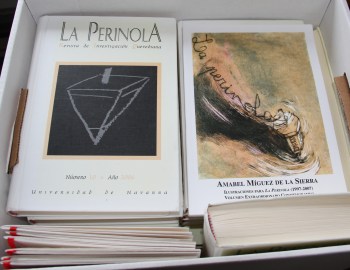
When the Mexican collection settled down in the boxes, a little space remained and we filled one box with the first set of books from our Quevedo collection. This was La Perinola, the Revista de Investigación Quevediana. I lay awake most of the night agonizing on whether or not I should let this review series go. Then, at 4:00 am, I got up, put on my dressing gown, went downstairs and photographed the Perinola, in all its glory. When this was done. I returned to bed and was finally able to fall asleep.

IMG_0192

The Perinola meant (and still means) so much to me. I still remember the thrill of being asked to sit upon the consejo honorífico, the only Canadian scholar, and one of only two Anglophones to be so honoured, my external reader being the other. To read my name next to that of the external examiner for my doctoral thesis on the love-poetry of Francisco de Quevedo (University of Toronto, 1975) was, and still is, an extraordinary honour. I still get butterflies when I see my name attached to this review. The butterflies settled, bit by bit, as I realized that I could preserve my personal memories with a photo while donating the series to the greater glory of Quevedo Studies in the wider world of Hispanic Academia.

IMG_0187

Wednesday Workshop: Attending a Reading

weir 2

Wednesday Workhop
Wednesday, 04 April 2018
Attending a Reading

            Number one piece of advice: don’t arrive late. I thought last night’s reading at the Oromocto Public Library began at 7:00 pm. I used Google maps to locate the library and I left plenty of time to get to there early. The Oromocto Public Library is just off the main road, tucked sideways on, so you are driving past it before you see it. I didn’t see it.

            I drove to the first roundabout, went straight through that, looked again: no library where the library ought to be. So I drove to the second roundabout. Still no library, and now I was running out of road space and the highway beckoned. So, I went right around the second roundabout, scanning both sides of  the road for the library as I drove. Still no library. I returned to the first roundabout, went right around it, drove back to the second roundabout … I was becoming fixated on driving in circles … then back to the first again.

            Just past the first roundabout, I spotted a gas station. I pulled over to ask the way to the library and there it was, just in front of me, right beside the gas station, facing the new Japanese restaurant, and sideways on to the road. There was one parking spot left and I took it.

            When I got inside, the library was very silent. I asked directions to the reading room and was directed to the back of the building. The reader stood before the audience, with the podium at his back, and was already talking. It was 6:50 pm. “Wow,” I thought. “He must have started early.”

            I have known Chuck Bowie, the invited reader, for several years and we share the same writer’s group, a group which he organized. He invited me to join it and we meet regularly (there are seven of us), once a week, on Tuesdays. Regularly: this is Canada … regularly, when it isn’t snowing, when there’s no icy rain, when the temperature is above -30C, when the wind doesn’t threaten to blow the car off the road … regularly, you know what I mean. There are usually three or four of us at each meeting.

            “There’s Roger,” Chuck announced my presence as soon as he saw me.  The audience turned round and several people whom I knew gave me a smile and a wave. There were no vacant chairs. A lady at the back gave me hers and went to fetch another one for herself. I found out later that she was the organizer and I thanked her profusely for her generosity.

            Chuck, as I found out later, had started at 6:30 and was well into his stride. He mixed anecdotes from his stories with advice about writing. As I was settling, he was explaining how much research he had done into wine and wine growing for the winery scenes in his four Donovan novels (the series is called Donovan: Thief for Hire). I love wine and I have visited several excellent vineyards in Rueda and La Seca (Spain). Chuck’s deep knowledge of the vines impressed me. “Roots,” he told us, “sometimes going down twenty-one to twenty-four feet.”

            I thought of the Spanish wines with their denominations of Old Vines, Reserva, Gran Reserva as Chuck dragged me from the outside world to the inside world of the winery laboratory where the crime had taken place. Then he read an excerpt from his novel, four or five pages that illustrated the use to which he had put his knowledge of the vines (Book Four of the series, Body on the Underwater Road).

            Chuck then talked about writing from memory (Rumania) and emphasized that memory alone was not enough. Memory gives atmosphere but accurate details come from many places, including the ubiquitous, omnipresent, and virtually omniscient Google search. Thus, as he explained, cum grano salis, the churches in Rumania are circular, constructed that way “so the devil may not corner you.”

            From memory and Rumania, he moved to Manchester Gangs in the 1980’s (Book Three: Steal It All), a simple anecdote about how the neighborhood protection racket protected the local families who in turn protected the criminals, while all crime was committed outside the area. Chuck’s ability to turn a table-top conversation into the idea for a story, or in this case, a full novel, is exemplary. How many creative seeds are scattered on stony ground, never to come to full fruition?

            Violence can play a meaningful role in the crime thriller but it has to be meaningful, and it must be accurate. Chuck spent some time explaining how he had researched guns and armaments so that the right weapons would always be carried by the right people and used in correct fashion at the right time. He talked a little about entry and exit wounds and I had visions of Rumpole, in the Penge Bungalow Murders, stabbing a ketchup filled sponge in the kitchen of his suburban home on The Gloucester Road, to see how the stains spattered, much to the disgust of She-who-must-be-obeyed.

            Chuck’s next book, the fourth in the Donovan series, Donovan: Thief for Hire, is called Body on the Underwater Road. Much of this story takes place in St. Andrews, New Brunswick, and Chuck explained how he had scouted out the local area and, in particular, the ‘underwater road’ from the mainland to Minister’s Island. The Fundy Tides, the highest in the world, cause the roadway to disappear at high tide, thus making the island inaccessible for long stretches of time. It also makes the underwater road a natural fishing weir for dead bodies. This research work involved live interviews with the local RCMP and others on the movement of bodies in the Fundy Tides, where would they end up if they were inserted into the water at place A, B, or C. That sort of thing.

            Chuck ended with a request for questions and the audience announced their own engagement by asking questions on how to develop characters, how to name characters, how to thread narrative arcs, and on how much rewriting is necessary if an arc goes wrong. The answer: “Lots. Sometimes you need to abandon the arc completely; other times, you must rewrite it from top to tail. But cave scriptor / writer beware: if you make a change on page 272, make sure that it checks out all he way backwards, page by page, back to the book’s beginning on page 1.”

            The use of humor within a thriller series serves to illustrate the layers of complexity that the characters manifest. The insertion of this element serves notice that genre writers who are serious about their craft write with the intention of elevating words, their sense, and their impact on the discerning reader. It also serves to layer the novel with additional meaning. Such layers of complexity spark joy in the writer.

            An interesting evening, then. With some old friendships renewed and some words of wisdom cast before an appreciative audience by the Atlantic Provinces Director of The Writers’ Union of Canada and local Fredericton author, Chuck Bowie.  I attach his web page. Do some research: check it out.  http://www.chuckbowie.ca

Painting credit: Roger Moore. Fundy Weir Poles (acrylic), St. Andrews, NB.

Book Burnings

Skeleton

The Island View Book Burnings 

“Nobody gives a f*ck about your f*ckin’ books,” Jess said, as Jim spoke about the joys of his collection and what he intended to do with it. “Believe me, nobody wants those f*ckin’ books.”

Jim didn’t believe her at the time. But she was right.

Once upon a time, Jim had three great web pages. They took years to build and to consolidate. They also enjoyed great popularity and had many visitors. The first was taken down by the people who ran the website, they never told him why. The second became obsolete, almost overnight. Jim couldn’t add to it, and one day, it just wasn’t there anymore. The third one disappeared. Jim lost his voice, his photos, his videos, his feeds, his work and his identity. Planned obsolescence: the touch of a button, a click on the delete key, and great chunks of identities vanished forever. What is it with this world?

The Angel of Death came and knocked on Jim’s door. “All you have I own,” he said. “All this will come to me.”

“Then you can have it now,” Jim replied. Next day, he lay the foundations for a fire in his backyard.

I am ready, Jim thought, I’ll build a bonfire, sit on top like Guy Fawkes, and I’ll burn myself, like a Buddhist Monk, along with all my soon-to-be orphaned and hence unwanted books.

First came Jim’s papers: 53 banker’s boxes of documents, records, and papers he had taken for recycling. Ten seventy-five liter bags of intimate letters, signed papers, early handwritten versions of poems and stories he had fed into the shredder and left out for the garbage men. Nineteen boxes of books he had delivered to the charities who collect such things.

Books: they had fornicated in the dark and overflowed Jim’s shelves with their off-spring. A thousand Jim had given away. Three thousand remained. Jim thought the process was too slow. At the first sign of rain, when the woods were less dry, and would not flame at the slightest spark, Jim decided he would burn them all.

Bureaucrats: they deleted the country’s scholars, they eliminated all the scholarship that did not tally with their crippled and crippling minds, they refused to sanction what their oh-so-limited intelligence couldn’t understand … soon, Jim would wave his magician’s wand and he and his life work would disappear in a single act of academic and cultural suicide.

Jim had already shredded his manuscript copy of Flores de poetas ilustres (1603). Nobody spoke Spanish. Nobody could read the hand-writing. The Flores of 1609 swiftly followed. Jim had copies of five of the six known manuscript versions of the Heráclito Cristiano. Who wanted to read such things? Jim decided to commit them all to the flames along with his autograph copy of the Naples manuscript, the one written by an amanuensis (and who the hell in these days knows what an amanuensis is?) and corrected by the original poet, Quevedo, whose name nobody can now pronounce.

Jim’s sorry to say that these pieces will mirror the fate of the Evora manuscript and those autograph manuscripts from the Biblioteca de Menéndez y Pelayo in Santander that have already gone.

Jim also has copies of all the early manuscripts of Quevedo’s novel, the Buscón, and they too are destined for the flames. Who cares? If people cannot pronounce the author’s name, how can they read the manuscripts of what is probably Quevedo’s greatest work? Written in 1601, published illegally by a bookseller in 1629, targeted by the Spanish Inquisition, his authorship at first denied, then defended by the author … Jim has copies of all that correspondence between poet and priest and Inquisitor, but who now cares? It can all go.

Facsimiles, too, will flare into flame. Who cares? Who now knows what a facsimile is? The ancients buried their warriors with grave gifts of horses and armor, jewels and food … photocopies, facsimiles, microfiches, microfilms, they will all go with Jim to the fire. Jim shall sate the Angel of Death with everything he owns, unless that being stays Jim’s hand or carries him away before he can light the match.

I will grieve.

Does anyone else give a damn?