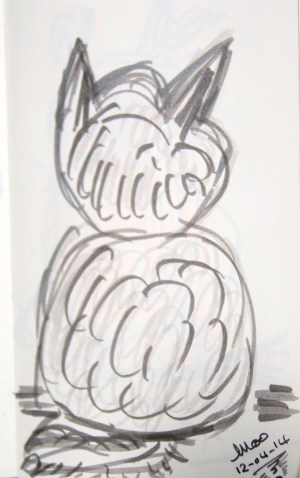
Secret Garden 4

IMG_0137.jpg

Secret Garden 4
Pause for Thought

My love, are you my muse?
Or do I write to amuse myself?
I don’t know any more.

I only know for sure
that every second is precious
here in our secret garden
where we cultivate these creative
moments when the world stands
still and our breathing makes
light of the void within us.

Right side, left side: who cares
what’s dominant when our bodies
are tuned like strings on a lute
and you blend with that blood-
red body space beneath my ribs
until my heart beats to your rhythms,
Princess of Paradise, fair of face.

We must never permit these memories
to fade. All too soon chaos will serve us
its tainted apple, tunneled by surging
worms, dark-serpent heralds fore-
telling death’s angel, the night to come,
and the cold of our ultimate separation.


Secret Garden 2

fundy-05-mistwolfepipers-081

Secret Garden 2

Five a.m.: The moon on the back porch
shines with  light as bright as day. It’s cold,
much too cold for August. Orion is back. To the left,
in the East, he has hoisted himself over the horizon.
Winter can’t be far behind.  Upstairs, in bed, I can
hear you twisting and turning, looking for me in your
sleep. I am not there. The garden is magic beneath
the moon-shadow playing on flower and plant. Withered,
it is all dried up from summer’s heat. A false light
casts moving shadows as whispers of clouds murmur
close to the moon’s ear. Orion heralds the bitterness
to come. The long bright winter nights, aurora borealis,
more than a dream, a vision dancing in brittle
air that crackles and snaps in changing sheets of color.
I know you are there, upstairs, waiting for me,
hoping I will sneak quietly back to bed,
waiting for my footstep on the stair.
What will you do when I am no longer there?

Predicting My Death 2

fundy-05-mistwolfepipers-081

Three Poems Predicting My Death before Yours

2

There never was anybody else but you. Too late now when
you’ve discovered this to tell you that there probably
never will be anyone else. Middle age: I look back on all
the things we’ve done together. Shall I count the ways?

No: I’ll make a list. So often we’ve sat together at the table
planning the next set of duties that will keep us occupied
by driving us apart. But of all the people in the world
you’re the only one who doesn’t need a list of what we’ve done

or haven’t done. Goodrich Castle, last year in England,
was your discovery. We went there together at your instigation.
A part of you that will always be me, that first discovery
of ruins, new to us, growing from red bed-rock. I thought I had

seen everything worth seeing till I looked on Goodrich,
explored its towers, its labyrinth of connecting rooms.
Civil War tore down the curtain walls, fired the stables,
driving the horses wild with fear. Sometimes, at night,

I can feel that fear pumping through my veins. Knowing
I will die before you, knowing I will leave you alone
to defend yourself between curtained walls, isolated,
besieged by the same memories that mill in my mind.

Predicting My Death 1

fundy-05-mistwolfepipers-081

Three Poems Predicting My Death before Yours

1

I cannot always talk to you. There are so many barriers.
The hoovering, the cleaning, cooking the daily meals.
When we go to bed, you are tired, I’ve had too much to drink.
We know our routine answers off by heart. There’s never any time

for each other. House work, gymnastics, paying the bills,
even housekeeping on the computer: they all take time.
Time, time: so little of it left. I can feel death’s seeds
rooting in heart and chest. Premonitions: so little time.

Comment:

Rummaging in the dusty memories that line my bookshelves, I rediscovered a sequence of love poems I wrote for Clare, 25 years ago, in 1991. This is the second in the sequence. A Golden Oldie, it grips today even more than it did back then. I am growing old. The insurance company’s statistics tell me that soon, all too soon, I will join those statistics and become another black number on a white page. According to those statistics, Clare will survive me, but we don’t know by how much.

How do we prepare ourselves for such things? Our society, a society that sees violent death every day on the road, on the street, on television, backs away from death. We don’t face it, not in the same way they do in Oaxaca, for example, where it is celebrated once a year on the Day of the Dead. Homes are lit up. The dead ones favorite food is prepared. Little altars are illuminated by candles. Photos appear. Do the dead return to their homes to join in the celebrations? Sometimes, I guess they do. Certainly the would be made welcome if they did.

Perhaps Francisco de Quevedo, the seventeenth-century Spanish poet who was the subject of my doctoral thesis, was right. “The day I was born, I took my first step on the road to death.” He writes too of “this death that I carry within me, that has walked beside me all my life.” “If death is a law, and not just a punishment,” he writes, “then we must accept it and obey its call.” I guess it’s easier, if you are a Stoic or a Neo-Stoic, to face up to such things.

I once asked my grandfather, a man who survived the trenches of the First World War, if he was worried about dying. He looked at me in silence for a long time. I was very young and we were sitting in the sunshine on the bench by the old Swansea Hospital where he went daily to gossip with his friends. “Roger,” he said. “We are all going to die. We will die if we worry about it. We will die if we don’t. So why worry?”

I certainly don’t want to go. I didn’t want to go twenty-five years ago and I really don’t want to go right now. I have decided to take my grandfather’s advice. I’m not going to worry and I am going to continue to enjoy myself for as long as possible because: “For there are many fine things to be heard and good things to be seen / before we go to Paradise, by way of Kensal Green.”


Gorilla Drives the Zoo Bus

img0046_1

Gorilla Drives the Zoo Bus

Gorilla drives the same zoo bus all day, every day,
same starting time, same finishing time, same route, same stops,
different passengers, but all passenger equally faceless.
Gorilla doesn’t want to know their names.

“Please tender the exact fare!”

Not a penny less, not a penny more, and he polices every penny.
Bus conductor and master of every passenger’s destiny,
he opens and shuts the door, letting passengers on and off the bus,
but only at official stops.

Every passenger has a ticket,
and Gorilla punches every ticket with a neat, round hole.
He never makes mistakes.
He grinds, like God’s own mills, exceedingly small.

He has spent all his life in uniform.
He has a belt and braces to hold his trousers up.
He’s always prepared for the worst.

Ten, fifteen, twenty years:
an anonymous wife; anonymous little babies;
at shift’s end, a pension, and another bus.

St. Peter’s at the wheel.
He doesn’t want to know where gorilla wants to go:
he wants to know where he’s been.

Commentary:

This poem follows on from my statement in Structure in the Short Story that “my greatest fear then becomes the gate-keepers, those anonymous figures who sit on shadowy selection committees, place ticks in appropriate boxes, and judge the quality of writing by consensus in committee.”

A long time ago, on holiday in Cardiff, the capital of Wales, we caught the bus from where we lived into the city center. I made a mistake in the name of the stop to which we wanted to travel and the bus driver insisted we got off at the place I had named. He would not let us travel to the stop a little further on to which we wanted to go. It was raining hard and so I told him that, rather than get wet, we would pay the difference in fare, but he said he had no change and insisted we get off the bus. I didn’t have any change either and had only a five pound note, so I gave him that and after a few curses and meaningful looks, he pocketed the money (more than three times the original fare), allowed us to stay on the bus, and took us to our true destination.

I have often thought about the “anonymous, shadowy people” who rule a tiny kingdom and insist, sometimes with the utmost vigor, that everything should be done exactly they way they want it done. There is no room in their lives for creativity, for adventure, for generosity, for a different way of life. More to the point, they seem (many of them, but not all) to enjoy bullying the people over whose lives they have for control for such a small amount of time. Some school teachers I have known fall into this category: utterly miserable people whose sole joy consisted in indoctrinating and dominating their young charges.

I think of them as the gate-keepers. They hold the key to a very small gate through which we all must pass, but their motto is a famous one “no pasarán” — you shall not pass.

Balancing the Books

DSC03693.JPG


Balancing the Books

I knew that I did not have the strength and stamina to make a living as a writer. I knew too that I could not put my beloved and my family through the strain of maybe, or maybe not, making it as a creative writer. And I wanted to be an artistic writer, a poet above all, not just a commercial writer, writing adverts for a living, or pandering to the lusts of a baying multitude.

So: the most difficult thing for me would be look after my family and balance the books. Rather than writing full time, I chose a career in academia. My career as an academic led to 90 research articles in my various fields, 70 book reviews, the publication, in book form, of part of my doctoral thesis, and an online bibliography, now turned into a searchable data base. Add in unpaid, voluntary overload teaching to maintain a small program in a small university, overseas travel programs for students, a relatively successful coaching career at club, provincial, regional, and national levels, and a commitment to various editorial positions, in 14 local, regional, national and international journals, and my creative writing career has understandably suffered. In spite of that, I published 10 poetry books, 11 poetry chapbooks, 12 short stories and 130 plus poems in 20 Canadian (and other) journals, and won several writing awards. Indeed, to have been a full time creative writer and to have maintained a house and a family and a second career would, in my opinion, have been impossible.

Now that I have retired from university teaching, I can finally write full time. In my part-time creative writing career, maintained while I worked in academia, I kept a journal and made sure I spent at least one hour a day writing creatively, even if I had to get up early to do so. This resulted in a couple of poetry books with small presses and later a series of self-published poetry books that doubled with various festivals and other writing sequences. My poetry books did not sell well, and there is very little money in poetry anyway, so I started to give the books away to friends and well-wishers who were interested in what I was writing.

In retirement, I discovered CreateSpace and I now have eight books up on Amazon and Kindle. I am working on my ninth. What do I love best about Canadian Culture and Creativity? That it allows a person like myself, born in Wales, and speaking English, French and Spanish, to live and write in Canada about Wales, England, France, Mexico, Spain, and my adopted homeland. However, the literary and cultural industry boasts of our international character while totally ignoring me and writers like me. We ignore the self-published (calling them adherents to the vanity press) and we put down those who have not progressed in the ways that the literary societies accept.

Do I care? Of course I care. That is why I am writing this and why I will continue to write. Will anyone read this and take any notice? I doubt it. Will anyone take any action as a result of this tiny pebble cast into a Great Canadian Lake? I really, really doubt it. I can see the shoulder shrugging now as the eye-brows raise themselves slightly and the reject pile beckons. Will literary Canada keep staring at its own belly button and congratulating itself on its wonderful cultural opportunities for self-expression in writing? I guess it will. Will things change for artists on the periphery, for struggling artists, for artists like myself who with great difficulty have fought throughout their lives to balance the books? I doubt it very, very much indeed.

But I am here, as others are here. We have a voice. A very powerful voice. A voice that has been side-lined by the establishment and the institutions. But we are many. Very many. And one day, we will be heard.

A brief commentary:

The Writers’ Union of Canada (TWUC) invited its members to contribute a piece on their Canadian Writing Experience to Canadian Heritage, a group interested in gathering comments by Canadian Writers about their experiences. I thought about it for a while, penned this piece, and submitted it for their consideration. I was very pleased to have it accepted and it has attracted some attention.


First Snow

IMG_0033.jpg

First Snow

Lying in bed
on a snowy morning
with the first flakes
fast falling,
can you follow
the rag-tag-and-bobtail
drift of snow thoughts?

Filled with sparrow, siskin,
chickadee and finch,
the now leafless tree
stands outlined in the yard:
black skeleton,
white wind-drift.

A scarecrow
with many arms,
it braces against
these feathered weights
that settle
like colored snow.

Warning: raw poem.

I rarely let any of my writing out while it is still raw. These words will undoubtedly change, the snow will settle, the birds will fly away, a crow and a blue jay will startle the smaller species, the sun may come out, the wind may get up, and so may I. In addition, the poem, like the birds in the tree may or may not survive. The tree itself chose to surrender to a family of yellow-bellied sap-suckers and they changed into a chess board of small square holes that leaked the tree’s life blood throughout the summer. Perhaps the tree won’t survive. Well, I know it won’t survive for ever, but perhaps its life will be even shorter, curtailed by those ravenous little beaks.

Whatever: I have taken a risk by sharing early, and we will see how you, my readers and fellow bloggers, rise to the bait. Perhaps you will encourage me to place more early verse online. Perhaps not. Hopefully, you’ll click and make some comments: we’ll soon see.

Baby Angel

IMG_0012.jpg

Baby Angel

yesterday a baby angel
lay dead beside the road
the trees
caught their breath

the air stood still
a red fox
tore from the woods
a runaway leaf
so quick so silent
a shadow across the road
melting away to hide in the forest

I can still see the occupants of the stricken car
standing with their cell phones in their hands
punching urgent numbers

the mother deer’s dead eyes
gazed at them from inside the windshield
shock had rounded the driver’s snow white
lips into an O for Operator

Questions

img_0141-2

Questions

I hear her voice, delicate, distant and I run to the sound, jump on the table, and sit in my usual spot just beside her play thing, but she isn’t there. He’s there, damn it, talking away on that little black thing with buttons. I can see him, smell him. I hate him, his other sex perfumes, his heavy-footed shuffle, his loud voice, his walking-sticks. I run when he approaches, run and hide myself away, making myself small, fitting under furniture where he can’t get at me, trying new places, new spaces …

Downstairs in the basement is good. He has problems with the stairs – shuffle, shuffle, clump, clump – and I get plenty of warning. Not that he ever comes downstairs to the basement. There’s nothing down here for him and I can sit here and snooze and dream and wait for my darling to come back. She will come back. I know she’ll come back. I know she’ll never abandon me, like she’s abandoned him. I am faithful, I can wait.

Besides which, I am training him. It takes time, but he’s beginning to understand that he must do things my way now. I chat him up for food and whisk myself around his legs and down comes the kibble, like manna from heaven. He often spills the food, so I get extra bits, nipping in quickly while he searches for a broom or a dustpan, or that noisy sucking thing I hate so much. That’s not just him, I run when she uses it too: it hurts my ears. And my feelings: I think they’re shooing me away because they don’t want me near. Not that I want to be near him, oh no.

I stay away from the upstairs and the bedroom while he’s here alone. Sometimes we meet on the stairs when I have completed my ablutions, but I give a little shimmy and scoot and leave him star-struck and stranded. He’s just not quick enough. He’s not cruel, mind. He doesn’t kick me or hit me with his stick or anything like that. I just don’t like men. I remember that other man, the one that beat me before she came to the place with all the other cats and cages and took me home. I think all men are like that first man, if you give them the chance, and I’m not giving this one a chance, not until I’ve trained him properly. And he isn’t trained yet. I wonder how long I’ve got?

There he is, hanging on to that little black thing, and when he stops talking, I can hear her beloved voice. It’s distant and a little bit tinny, with a sort of echo, and there are other sounds in the background that I can’t quite make out, but it’s her, I’d know her anywhere, and I whimper and scratch, and he puts down a hand in my direction, but he doesn’t tempt me, and then he holds that black thing down and she calls me by my favorite names and I sit there, silent, and gaze into space, remembering her touch, her gaze, her hand upon my neck, my back … no, I won’t let him that near me, not yet.

Yesterday, he sat at her place by the table and turned the picture machine on. Then shadows appeared and her voice came out of the machine. The shadows moved and played and people chatted back and forth and I didn’t understand it, I just didn’t understand. My whiskers stiffened and I sat there and bristled. The machine was warm and I snuggled up to it, behind the flat piece, where I could listen but he couldn’t quite touch me, even though he stretched out his hand. And she called my name, again and again, but I didn’t move, I just sat there and sat there, waiting.

Then I came to the front of the machine where the shadows danced and her voice was stronger. A shadow, I couldn’t make it out, then her voice again, my whiskers stiffened, I leant forward and sniffed, but no smell, it was her voice, and the shadow shifted the way she does, but they had no smell, and scentless, I could not really sense her, I bristled and she called me, called me by my favorite names, and mewed, I mewed back.

But I couldn’t smell her, and there was no sense of touch … is this the hell all pussy cats will suffer … shadows on a screen, a haunting voice, memories shifting and dancing, no touch, no hugs, no sense of smell … and nothing solid … just shadows and absence … and a sense of chill … forever and forever?

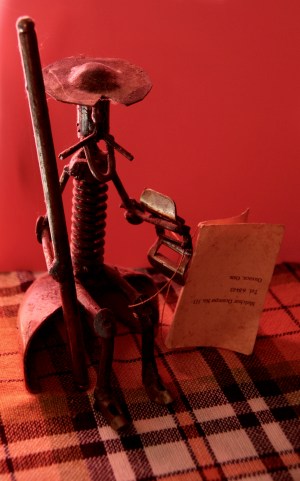
Maritormes

IMG_0281.jpg

Merry Tormes

Men of La Mancha

“Carters and peasants
found me soft to the touch.

I’ve had my fill of everything,
save money, youth, power, fame …
yet pleasure brings its own reward.

I never treasured money
more than the sweet caress,
flesh on treasured flesh.

Better a trellised bed
with horsehair blankets
than that bed of sour, dry earth
where I will one day lie.

Come:
let us strike a bargain,
for when midnight strikes
there’s no one prettier than I
for that is the hour of my greatest
power.

Lead me then to where
I can get your full attention.

But keep me far from madmen
who call me outlandish names:
virgin, maiden, sweet and chaste …

 … all foreign to my every intention.”