Last Dance FFF


img_0200

Last Dance
Fast Fiction Friday

                   The vocalist has rhythm but, unlike her audience, she doesn’t have cancer. She has come here tonight with her band to the hospice to entertain those who do. The band donates their time. They don’t do this for money. Nobody does.

The vocalist looks round the almost empty room. She has been here before and knows that when she starts to sing, many more patients, attracted by the music, will come drifting in. She introduces the trio that accompanies her to the few who have arrived and the evening’s entertainment begins.

The music circulates round the hospice, and the inmates, secluded in their rooms, tap out the rhythm of the first song. They leave their rooms and descend the stairs. The low lights give the patients courage and they trickle shyly into the dining room, now turned into a dance floor. As they enter, they see some of the bravest patients out on the dance floor, moving in time to the music. The late-comers stand straighter, adjust their headscarves, lean less on their sticks, and forget for a moment their suffering. They settle in chairs towards the back of the room and leave the front rows empty. Then they exchange glances and nods of encouragement. Many of the men stand at the rear, leaning on the chair backs of the women who are seated in front of them.

Some dance, but not everyone does. Some join in the chorus, humming or mouthing the words. One takes a pair of plastic spoons from his pocket and follows the rhythm. Two ladies hold hands and encourage each other onto the dance floor where they join the growing numbers who are moving around. Those who are not yet brave enough to step out, clap loudly and one or two cheer.

The music volume increases and laughter and merriment grow. More and more patients join the dancers on the floor. The lights are lowered even further and people who scarcely knew each other a week or two ago now dance in close friendship.

As they move beneath dim lights, the dancers half-close their eyes and enter a dreamland of sound and music. Here the women’s hair grows lush and long again. The men stand straighter, throw away their sticks, and rely on their partners to keep them upright. One man touches the place where his partner’s amputated breast should be. She recoils immediately, but he holds her close, whispers in her ear, brushes her cheek with his lips, and gradually she relaxes. As the evening comes to an end and the lights dim further, the dancers move closer together dreaming on and on in time to the music.

When the vocalist announces that this will be the last dance, the music stops for a moment and the hospice’s oldest inhabitant, an elderly lady, cancer-stricken, hauls herself to her feet and walks to the center of the dance floor. When she gets there, she holds out her hands before her and nods at the vocalist. The other dancers make space for her and the last dance begins.

This elderly lady dances alone, clinging to the empty air as if she were dancing with a well-remembered partner. A muted spotlight highlights her as she moves. It could be midnight, in some sacred grove where shadows shift, and moonlight makes its own sweet music, and her, the spirit of the wood, moving in tune to a rhythm that promises, in spite of everything, joy and ever-lasting love.


Gower

IMG_0196.jpg

To Be Welsh in Gower

To be Welsh in Gower is to spell it funny
and pronounce it worse: Gŵyr.

It’s to know how to say Pwll Ddu.

It’s meeting the cows in the lane to Brandy Cove
and knowing them all by name and reputation,
which one kicks, which one gores,
when to walk in the middle of the lane,
and when to jump for the safety of the hedge.

It’s to know the difference between the twin farmers
Upper Jones and Lower Jones.

It’s to recognize their sheepdogs, Floss and Jess,
and to call them with their different whistles.

It’s knowing the time of day by sun and shadow.

It’s knowing the tide is in or out
by the salt smell in the air
without ever needing to see the sea;

and now, in this far off land,
it’s hearing your stomach growl
for caws wedi pobi, crempog or teisen lap
whilst memory’s fish-hook tugs at your heart

like your father tugged at salmon bass,
fishing from the sand-pebbled beach
at Rhossili, Pennard, or Three Cliffs.

Wales

IMG_0182.jpg

Wales

Wales is whales to my daughter
who has only been there once on holiday,
very young, to see her grandparents,
a grim old man and a wrinkled woman.

They wrapped her in a shawl and hugged her
till she cried herself to sleep
suffocating in a straitjacket of warm Welsh wool.

So how do I explain the sheep?

They are everywhere, I say, on lawns, in gardens.

I once knew a man
whose every prize tulip was devoured by a sheep,
a single sheep who sneaked into the garden
the day he left the gate ajar.

They get everywhere, I say, everywhere.

Why, I remember five sheep
riding in a coal truck leering like tourists
travelling God knows where
bleating fiercely as they went by.

In Wales, I say, sheep are magic.

When you travel to London on the train,
just before you leave Wales
at Severn Tunnel Junction,
you must lean out the window and say
“Good morning, Mister Sheep!”

And if he looks up,
your every wish will be granted.

And look at that poster on the wall:
a hillside of white on green,
and every sheep as still as a stone,
and each white stone a roche moutonnée.

Last Day

IMG_0167 2

LAST DAY

Cardboard boxes stand stacked against the wall.
The basement is already empty.
There is no spare time.

We must clean and polish and make things shipshape.
The latest owners will be soon here
claiming their keys and their rights of entry.

Empty bottles of old memories stand disordered:
quarrels, wild words, making friends again;
my mother’s body slumped at the bottom of the stairs,
or lying senseless in front of the television;
her bloodless face pale above the stretcher
as they carry her away.
We launch a last desperate hunt through the empty house.

How many memories must we leave behind
with that one last look through the closing door?

How much of our former lives can we capture?

NOTE:
Another Golden Oldie from the last century, the last millennium. This one appeared in The Antigonish Review. I dedicate it to all those who are about to sell their houses and move, and particularly to my friends David and Ana.


Capella dos Ossos

IMG_0137.jpg

CAPELLA DOS OSSOS
(Chapel of Bones, Evora )

They drew blood from the bull’s body, stretching him,
broken, over golden sand: a playground for the gods.
His one horn, splintered, plowed into the arena,
his other horn pointed skywards: a finger of wrath.

Cannibal red and carnival yellow, his blood and urine
spilled for the drunken pleasure for which we had paid.
We had also paid for bands and martial music; a Mexican
wave swept rhythmically over the bullring to enliven us.

Later that day we gave warm coins to the tour guide.
She counted the whites of our astonished eyes and divided
the total by two as we stepped from the air-conditioned bus.

The chapel’s slaughterhouse stench overcame us.
Bone after human bone thrust out from the ossuary walls:
a generation of tarnished hands held out to greet us.

Note:
This poem is a golden oldie, published way back when, not only in the last century, but in the last millennium, courtesy of the Nashwaak Review. Sometimes, it’s fun to explore that past and see where it led us. This is from my Milton Acorn, almost about to rhyme, Jackpine Sonnet mode. The poem does have 14 lines.

People Poems 1

IMG_0202 (1).jpg

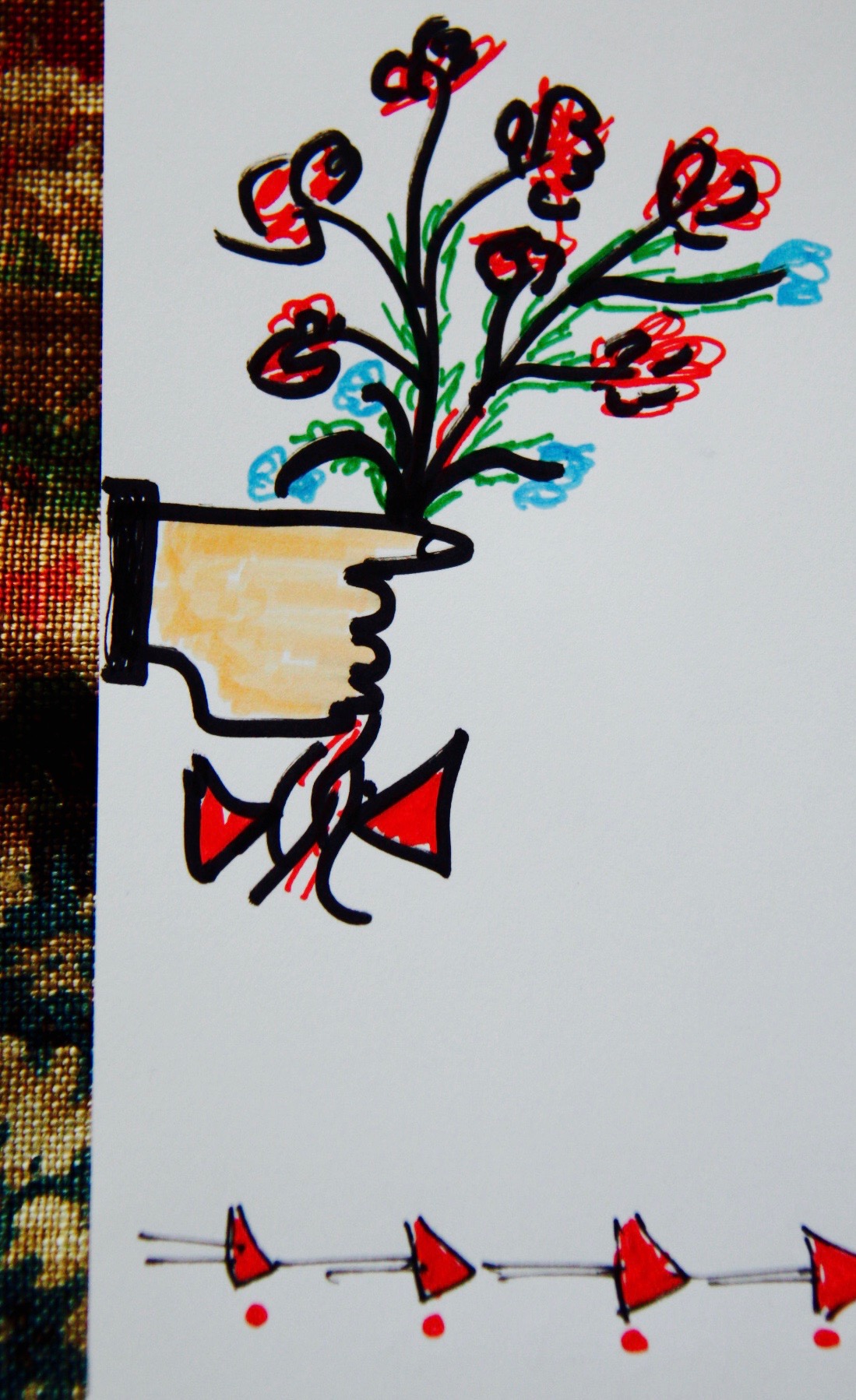
People Poems are dedicated to people who, for one reason or another, have distinguished themselves in my life. The first poem, People Poem 1, is dedicated to Meg Sorick who is the very first person, ever, in history, to purchase one of my books, Sun and Moon, online from Amazon. To be Welsh on Sunday pays  tribute to Meg’s adventures with Michelada, among other things! Congratulations, Meg! Many thanks, and I do hope you enjoy your new book. Meanwhile, please accept this poem and this bouquet of e-flowers as my tribute and acknowledgement of my debt to you.

To be Welsh on Sunday

(This poem should be read out loud, fast, and in a single breath!)

To be Welsh on Sunday in a dry area of Wales is to wish,
for the only time in your life, that you were English and civilized,
and that you had a car or a bike and could drive
or pedal to your heart’s desire, the county next door,
wet on Sundays, where the pubs never shut
and the bar is a paradise of elbows in your ribs
and the dark liquids flow, not warm, not cold, just right,
and family and friends are there beside you
shoulder to shoulder, with the old ones sitting
indoors by the fire in winter or outdoors in summer,
at a picnic table under the trees
or beneath an umbrella that says Seven Up and Pepsi
(though nobody drinks them) and the umbrella is a sunshade
on an evening like this when the sun is still high
and the children tumble on the grass playing
soccer and cricket and it’s “Watch your beer, Da!”
as the gymnasts vault over the family dog till it hides
beneath the table and snores and twitches until “Time,
Gentlemen, please!” and the nightmare is upon us
as the old school bell, ship’s bell, rings out its brass warning
and people leave the Travellers’ Rest, the Ffynnon Wen,
The Ty Coch, The Antelope, The Butcher’s, The Rhiwbina Deri,
The White Rose, The Con Club, the Plough and Harrow,
The Flora, The Woodville, The Pant Mawr, The Cow and Snuffers
— God Bless them all, I knew them in my prime.

The Thin Man

IMG_0183.jpg

The Thin Man

The thin man
looks out of his window
and watches the leaves
as they twist and fall
like they did last autumn.

Golden carpets
spread across the grass
while under the lindens
the slender hands of children
crush flowers into perfume
and interlace bright
threads into tapestries
woven with light.

Will the thin man
give up his secret?

It cannot be clutched
by the camera’s artificial eye,
by the painter’s red squirrel brush,
nor by the tail of the dog fox
held over bandaged eyes.

Cows in the thin man’s
fields are scrawny.

They once walked
wary of the thin man
with his fistful of stones,
his pointed stick,
his sharp knife
and his slant-eyed dogs
that showed off
the basket weave of their ribs
with a rash of gravelly nipples
rippling against the skin
when they ran
snapping and slashing
with ivory fangs
at the frightened cattle.

Now the thin man is dying.
His cattle graze in peace.
His spirit wants to slide
through a gap in the cactus fence
and wander celestial pastures.

“I will light a fire,”
the witch doctor says.

He begins with the glow-
worm of a match.

That small flame smolders
as he breathes life into
shavings and dry bark.

Stars reach out
with tender hands.

A new spark walks
among the constellations.

The goats on the roof
grow grey with age.

Beside them,
a dappled donkey brays
as the thin man’s spirit
sets out on its journey to the stars.

A herd of seven goats, the Pleiades
rise above the sacrificial mound.

The witch doctor’s heart
shrinks to the size of an orange pip
when he cradles the thin man’s
body in his arms.

On the horizon,
Tochtli
gnaws at the moon’s
white skull.

Murciélago

exits his cave with evening
wrapped beneath his wings.

Tezcatlipoca
holds a stone
knife in his iron hand.

The thin man
dreams of Santo Domingo
where the golden tree
bends like a rainbow,

exposing its roots
as the end draws near.

Old Man from Tlacochahuaya

IMG_0202 (1).jpg

Old Man from Tlacochahuaya

His skin
is heavy and thick:
the leathery pelt
of a working animal.

His bare feet
poke from the scratchy
leather of rough-hewn,
home-made sandals
carved from auto tires.

His toenails are iron claws
gripping the earth:
a climber’s spikes.

When I examine them
they seem cut off from the man
as if they protruded
from a bestial hoof.

I imagine him horned,
tailed, and bearded,
leaping in a bright red
devil’s suit
through black smoke
and orange flames.

Water is the bond
that binds the earth’s poor,
so I offer him
water from my bottle.

Then I see him sparkle
and his eyes are as clear
as the water he drinks
from the bottle I gift him.

Brothers across
artificial frontiers
we shake hands,
and now we are one.

Watered,
he is my friend,
my true amigo.

“Where are you going next?” I ask.

“Nowhere,”
he shrugs.

“I am just happy to be here,
squatting in this line of shade
that protects me from the fierce
knife-blade of the sun.”

Inquisitor: Sun & Moon

IMG_0184.jpg

Inquisitor

He told me to read,
and plucked my left eye from its orbit.
He slashed the glowing globe of the other.

 Knowledge leaked out:
loose threads dangling,
the reverse side of a tapestry.

 He told me to speak and squeezed
dry dust between my teeth.
I spouted a diet of Catechism and Confession.

He emptied my mind of poetry and history.
He destroyed the myths of my people.
He filled me with fantasies from a far off land.

I live in a desert where people die of thirst,
yet he talked to me of a man who walked on water.

 On all sides, as stubborn as stucco,
the prison walls listened, and learned.

 I counted the years with feeble scratches.

For an hour, each day, the sun shone on my face;
for an hour, each night, the moon kept me company.

Broken worlds lay shattered inside me.
Dust gathered in my people’s dictionary.
My heart was a weathered stone
withering within my chest.

 I longed for the witch doctor’s magic,
for the healing slash of wind and rain.

 The Inquisitor told me to write out our history:

I wrote
how his church
had come
to save us.

Note: I am still working on Sun and Moon. It will be ready for publication on Amazon and Kindle some time this week. Monkey Temple, Though Lovers Be Lost, Bistro, and Empress of Ireland are now available for review or purchase on Amazon and Kindle.

Casa Rosa: Flash Fiction

IMG_0193 (1).jpg

Casa Rosa
            Rosa placed four glasses on the bar, poured three fingers of Cuban rum into each glass, produced as if by magic from under the old wooden bar two old‑fashioned bottles of Coke, and threw one ice-cube into each glass. She filled the glasses with a foaming, bubbling liquid that didn’t quite spill over the edge.
“Aren’t you going to join us for a drink while we wait?” Danny asked Rosa.
In reply, Rosa poured a large glass of dark rum, scowled ferociously, and chugged it. We gazed in wonder as it vanished silently down the dark tunnel of her throat. Rosa held out her hand and Danny placed a one hundred dollar bill in it. Rosa poured herself another drink.
“I thought they shut you down last week,” Larry took a careful sip from his glass. He preferred wine really, New Zealand Pinot Grigio for preference, and this in Spain where the white wine flows like water and drowns you in an instant.
Rosa downed another glass of rum and looked at the boys over the rim of the glass. They were so young and innocent. In what might be generously called the imitation of a knowing wink, she covered a porcine eye with a flabby eyelid.
“Only one policeman,” Rosa winked again. “Very young, he was, quite pretty really, and in civilian clothes. I might have fancied him myself, a long time ago,” she paused, poured herself some more rum and drank it. “‘Special duty,’ he said, and showed me his ID.”
“What did you do?” Larry sounded interested. He might have been taking notes for his next book.
“I invited him to sample my newest acquisition,” Rosa tightened her lips in what might pass for a smile. “You can all sample him yourselves later, if you want. He’s quite attractive.”
Danny proposed a toast to the latest acquisition, the savior of the human race. He hummed as he sipped cautiously at his Cuba Libre. Danny and Larry clinked glasses with Rosa and I allowed my glass to join them.
We sat for a moment in silence, our elbows rising and falling as we sipped, or pretended to sip, our drinks while waiting for permission to ascend the stairs.
Rosa waddled over to the wall and fiddled with the dimmer switch. The room became even darker and a red light flashed on and off as a soft and suggestive wailing noise came from the jukebox. “Better have some music,” she said. “I’ve got a feeling you might be in for a long wait.”
Danny looked around. The door and the open street were to his left. People walked constantly past the entrance, glanced in, and saw us boys sitting there, waiting.
Larry sat motionless, staring straight ahead, looking for inspiration. He inspected his feet. They were resting, about a foot above the ground, on a dull, brass foot rail that ran the length of the bar. Down there, on the floor, lay paper serviettes, cigarette butts, shells from peanuts, heads of shrimp, crusts of bread, all the debris of men who spend Sunday in a certain type of bar and throw what’s left of their meal on the floor at their feet.                   Suddenly, Larry raised his feet from the bar and cursed.
In the space between the foot rail and the bar, where his feet had been resting, a large cat, foaming and spitting, ran towards him. Behind it, red eyes glowing, white teeth snapping at the end of the cat’s tail, was the largest rat Larry had ever seen. It was at least twice the size of the cat.
“Jesus Christ,” he cried.
The cat pursued by the rat raced beneath the arch of Larry’s lifted legs and vanished into the street.
Rosa didn’t blink.
“Chinese ship in town, from Shanghai,” she said. “Lots of big rats around. What you expect?”
Loud cries from the exterior marked the animals’ exit. Two loud pistol shots followed almost immediately and a very young man ran into the bar. It was Luis. He wore the uniform of the local police and held a still-smoking gun in one hand with his police identity card in the other.
“You’re all under arrest,” he screamed.
“Don’t be so silly, Luis,” Rosa smiled at him. “She’s upstairs, waiting for you. I knew you’d be here early tonight. Look, if it will make you more comfortable, I’ll close the bar.”
The young man put away his badge and nodded.
“Get them out of here, Rosa,” he said, dismissing us with a gesture of his hand. “Back door. And tell them never to say a word. Or else …” He waved his gun towards us, blew the smoke from the end of the barrel as if he were John Wayne in a cowboy movie, then tucked the pistol back into its holster.
Rosa nodded and waddled to the front door, turning off the lights as she went.
Danny, Larry, and I looked at Luis, nodded agreement, pressed our index fingers to our sealed lips, ran out the back door, and vanished into the night.