On the outside

IMG_0192

On the Outside Looking In …

I walked home on my own. As usual. I’d hated the church Christmas party with all its trumped-up noise, childish games, and artificial gaiety.
The priest, formidable yet effeminate in his long black skirted robe, had made us sit in a circle on the floor, legs crossed. He stood inside that circle and placed a bar of chocolate on the wooden boards. Then he walked around the group and whispered a word in each boy’s ear.
“You must wait until you hear your secret word,” he explained. “Then one of you, when I speak that word, whoever it happens to be, may have the chocolate bar,” he stared at us, large, yellowed, horsey teeth, no hair, eyes golden, fierce, like an eagle’s, beneath bushy eye-brows. “When you hear your secret name, you must run and grab the chocolate bar. Understood?”
I had come to the party on my own as both my parents worked. The mums and dads who had brought their offspring to the party leaned forward in keen anticipation. The boys all nodded.
“Are you ready?” The priest watched us as we nodded and then he shouted “Alligator!”
Nobody moved.
“Elephant!” The boys shuffled forward, like inch worms, hands twitching, fingers flexing and grasping.
“Tiger!” A sigh emerged from multiple mouths. Some of the boys licked their lips.
“Lion!” One boy moved, but the priest shooed him away. “Sit down. That wasn’t your word.”
“M-m-mouse!” The boys heaved, a sea-wave about to crest and break.
“I do love this game,” said the priest to the parents. “And so do the boys, don’t you boys?”
“Yes, father …” came the chorus.
“Monkey!” All the boys, except one, leapt into springy action. They dived, crawled, leaped to their feet, ran … a surging heap of boys writhed on the floor as the chocolate bar was torn apart and the long-awaited fights ensued.
All the boys moved, except me. I just sat there.
“I said ‘Monkey,’” the priest frowned at me. “That’s your word. When I say ‘Monkey’, you join in with the other boys and fight for the chocolate bar.”
I shook my head.
“Have some Christmas fun. Join in the game.”
I again shook my head.
“Why not?”
“It’s not right. You’re just mocking us.  I want to go home,” I stood up and walked out of the church hall. I turned at the door and saw the priest glaring at me while a mound of boys continued to scrummage on the floor.
As I walked home, it started to snow. Not the pure white fluffy snow of a Merry Christmas Card, but the dodgy, slippery mixture of rain, snow, and ice pellets that turned the streets of my little seaside town into an ice rink. I turned up the collar of my coat, bowed my head, and stuffed my hands into my pockets. Two houses before my own, I stopped.
A neighbor’s house. With a window lit up in the gathering dark. I drew closer, pressed my nose against the window and looked in. A Christmas tree, decorated with lights, candles, more decorations, a fire burning on the hearth, two cats curled up warm before the fire, presents beneath the tree, stockings hanging from the mantelpiece. For a moment, my heart unfroze and I felt the spirit of Christmas. Then I thought of my own house. Cold and drafty. No lights, no decorations. No fire. The snowball snuggled back into my chest and refused to melt.
When I got home, our house stood chill and empty. My parents were out at work and the fire had died. Nothing was ready for Christmas. I sat at the kitchen table, took out my colouring book and began to draw.
When my mother came home, I showed her my drawing.
“Very nice,” she said, barely glancing at it.
“But mum, you haven’t really looked.”
She stared at the picture again. This time, she saw the Christmas tree and the lights, the cats and the candles, the decorations and the presents.
But she never noticed the little boy standing outside the house in the falling sleet, peering in through the window.

Westbury White Horse

Chaos

Westbury White Horse

Winter in Somerset. No trains from Frome.
They sit in the engine sheds, boilers frozen.

Clare drives me to Westbury, in Wiltshire,
the neighboring county. She leaves me there

and I stand on a platform as white with snow
as Westbury White Horse towering above.

People arrive, flapping their arms, stamping
their feet, walking around trying to stay warm.

Finally, to shouts, cheers, and laughter, a train
arrives, its boiler successfully thawed. People

rush forward, open doors, claim their seats.
It’s a corridor, not a compartment train.

“Is this the eight-fifteen to Temple Meads?”
I ask the porter. “Nope,” he says. “That’ll

be arriving later.” “When?” “About ten
or eleven, I expect.” “What train is this?”

“Ah, now this is the six-thirty to Bristol.
Running about two hours late. Better be quick.

The guard’s waving his flag. She’s about to leave.”
I open a door, climb on the train.  All

the seats are taken. I stand in the corridor,
shivering, all the way to Temple Meads.

Bilingualism

IMG_1092 (2).JPG

Bilingualism

I went on a French immersion course last week. The instructor asked each one of us to address the class for ten minutes in French. When my turn came, I stood up and announced that I didn’t know what to say.

The instructor then suggested I tell the class about my dreams. What do you dream of? I said that I didn’t have any dreams, I just had nightmares, not rêves but cauchemars, you know, nightmares. She asked me to describe my nightmares and I said I couldn’t. So, she repeated, describe your dreams. I don’t have any. Do you dream about your mother? Yes, I said, but I don’t call them rêves / dreams I call them night-mères / cauche-mères, sometimes couche-mères. Couche-mères, the instructor repeated the word.

The look she gave me: finger-nails scraping down a chalkboard. She turned her headlights on me and I sat there, frozen in the twin beams emanating from her eyes. Yes, night-mères, I repeated, because I set myself goals, not just dreams, achievable goals, and then I have night-mères, inspired by my mother, who says I will never achieve any of my dreams, because they are not her dreams, the ones she has for me, and they are the only ones that count.

You are here to speak in French, the instructor said, and you must speak French for another five minutes. So I told the class about the seals in the Parc du Bic in Quebec. The seals are like a plague, I said, like mosquitoes, only bigger and nastier, quite vicious, in fact. So the people who made Off to keep the mosquitoes away designed a new chemical spray that would keep the seals away. Now the French for seals is phoques, and since this is mainly a problem in Quebec, at the Parc du Bic, and not elsewhere, they called their product, you guessed it, PhoqueOff.

It’s quite simple to use, I said. It’s a spray, not an ointment, and you point the spray in the general direction of the seals. Then you squeeze the button and loudly say “PhoqueOff” at which point all the seals slide off their rocks with a little splash and vanish into the sea, leaving you alone on the beach.  I have tried it myself, I tell them, and I know it works so I highly recommend it to anyone who is plagued by seals.

I still don’t know why she threw me out of the class.

On Learning Welsh

IMG_1238 (2).JPG

On Learning Welsh
            Here I sit, an old man now, in front of my computer, learning at last my mother tongue, Welsh. English is the language of the invaders, the mine-owners, the men who own the steel works and foundries, and who rule this land with a fist of coal inside an iron glove. Welsh is the tongue of farmers and fishermen, of the villagers who live on the hills and tend the sheep and plant potatoes in tiny small holdings where only the fittest children survive.
My mother’s father was the last of us to speak Welsh. It was banned in our house because it was bad for the kids. In a working-class household, Welsh, be it language or accent, was a barrier to success. And success came from imitating your English betters, and climbing upwards, like a vine, or Jack on his beanstalk, until you achieved the impossible and talked and looked and dressed like them.
Sitting here, I have discovered the beauty of simple words, not so much their meaning as their sound, the way they flow, the poetry of remembered rhythms:
Cwmrhydyceirw, the Valley of the Leaping Stag, though legend has it that ceirw was really cwrw, and cwrw is beer, and its real name was the Valley of the Brown Stream Frothing like Beer.
Words have their own music, even if you cannot pronounce them properly: Mae hi’n bwrw glaw nawr yn Abertawe / it’s raining now in Swansea. Mae’r tywydd yn waeth heddiw / the weather’s worse today. Bydd hi’n dwym ddydd Llun / it will be warm on Monday. Why, oh why, in Wales, do we always talk about the weather?
Place names also have their own magic: Llantrisant, Llandaff, Dinas Powis, Gelligaer, Abertawe, Cas Newydd, Pen-y-bont … Meaning changes when you switch from one language to another:  gwyraig ty / a housewife, gwr ty / a househusband, a concept of equality that has ruled Welsh lives since Julius Caesar invaded Albion, coming from Gaul with his legions in 55 BC.
            Un deg chwech, dau deg saith, tri deg wyth, naw deg naw … The photographer asks me to speak in English, then in French, then in Spanish, then in Latin, and lastly in Welsh. He checks the memory card in his camera and looks puzzled.
“You put on a new face each time you speak a different language,” he tells me. “Look, this is when you spoke French.” He shows me the photo and yes, I look happy.
“And this is when you spoke Latin.” He holds out the camera and I see myself on the screen. I look ever so grim. English, French, Spanish, Latin, Spanish, and Welsh: all different and each language is a new a map carved into my face.  Am I a clown, then, a comedian, a chameleon to wear so many masks and to slip so easily from one to another? Which, then, is my language and where is the Old Red Sandstone from Wales into which I can carve my memories and my dreams? More important, which of those many tongues will shape my story as I sculpt each letter of my tale?

DIY Fridge Magnets


IMG_1197 (2)

DIY Fridge Magnets

Tired of your old fridge magnets? Worn out by dire warnings, by political slogans, by advertisements from unwanted people for even less wanted things? Join the club! I set it up yesterday: The DIY Fridge Magnet Recycling Club.

IMG_1203 (2).JPG

Take that old magnetic advertisement for ‘who-knows-what’. If you don’t like the original photo, strip it off, some peel away with great ease. Others can be coloured over. In harder circumstances, you must stick  new painting surface over the old one. I use Crazy Glue for this quite simply because, yes, I know it’s a craze idea, and yes, crazy ideas not only work, they make and save money. When you have your new surface, paint away. I have used acrylic paints but I now use marker pens. Who cares? I’m crazy anyway. Who needs selfies? Here’s a self portrait, as stuck on my fridge. Crazy eh? Now you know exactly what I mean.

IMG_1202 (3)

Don’t hold your breath

IMG_0718 (2).JPG

Don’t Hold your Breath 

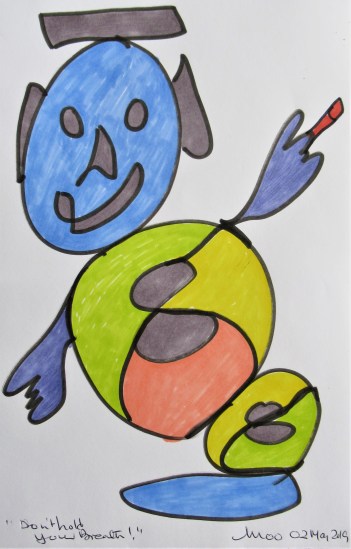
    Two small gnomes camped last night, one in each of my lungs. All night long they played their squeeze-box, wheeze-box concertinas, never quite in unison. Sometimes they stamped their feet and my body rattled with their dance. Their wild night music caught in my throat and I coughed unmusical songs that spluttered and choked, while I lay awake counting sheep and window panes and struggling with my future and my past.

    An east wind rattled my window whistling a sad song as it herded flocks of stars from one constellation to another. Wind and stars followed the westering moon’s slim finger nail as it scratched at the sky. The planets danced to the rhythms of the accordion music playing in my chest, and the sky’s planetarium folded and unfolded its poker hands of silent cards marked with my fate.

    Black jack, bright jack, one-eyed jack: what do I care when fate’s cards tumble onto the table and I count their spots. Forty card baraja, fifty-two card standard, Tarot, or any of the many others, what do we believe and why? I pluck runes from a velvet bag and shuffle and cut multi-colored cards. I survey the skies, cast dice and I Ching pennies … The fault is not in our stars, but in ourselves, that we are underlings, I mutter, not believing a word of what I say.

    I look in the mirror and see myself as I am. Grey, ageing, diminished, withering … yet proud of who I am and where I’ve been. Upright, in spite of all my failures. Proud because of all the small things that I have achieved. Who am I? What have I done? Where am I going? The eternal questions thrust at the shadows in my silvered morning mirror. Silent, it grins grimly back.


F-F-F-Forgetting

IMG_0486

F-F-F-Forgetting

    The apps and programs that no longer work. The computer files you can no longer access. The photos that vanish leaving a blank space in the album.
Now your memory goes on the blink and you forget faces and voices, friends, phone numbers, addresses, street names, the houses where people live, when to turn, where the best parking spots are, how far you can walk, where you were really going, and what you were sent out to buy.
Snow banks don’t help: that banked-up whiteness, that sticking out of the car’s snout into traffic, that stretch of your neck peering round corners. How many number plates have vanished into those white mists? How many cars? How many phone numbers have you forgotten?
You have forgotten the birthdays of your closest family and friends. When was your father born? When did he die? When and where did you bury him? Did you actually scatter his ashes or did someone else do it for you? When was your cousin born? When did he die? How close were you at the beginning, in the middle, and at the end? What color were his eyes, his hair? Did he even have any, hair, I mean of course?
What happened to that carton of eggs you abandoned in the store? Do you remember buying it, let alone leaving it there? How about your brothers, their faces, the sound of their voices? Did your own voice change when you emigrated?
Have those who live in Australia forgotten that they are Welsh? Do they speak like Australians, now, or do they still have those rich Welsh voices and rhythms that nobody in Wales ever wanted because they made us stand out when we moved, unwanted, to England? How many times have we, the Welsh, heard those threatening words: why don’t you go back home to Wales. Countless times, no doubt. In fact you have forgotten how many and you have forgotten so much.
Do you remember the parking spot in which you left your car? Do you recall your number plate or what model your car is, or what color?
“What day is it today,” you ask, for the second or third time. “I’m sure I know you,” you say to a friend who stops to talk to you in the shopping mall, “but I’m sorry, I can’t remember where we met and I can’t remember your name.”

IMG_0452

Cell Phone

IMG_0135

Cell Phone

    Fingers slip across the telephone key board, pressing  wrong numbers or punching them in in the wrong order. Strange voices reply from the other end. This morning a woman spoke to me in a language I didn’t understand, Then a man came on the line and yelled at me in broken English to “Go away! Go away! Leave alone!” I imagined him tearing the telephone from his wife and berating her for answering this call from a total stranger.

    Often, I am too clever for my own good. I think I recall the right number for a friend, but when I punch it in, I find I have reversed two of the figures. I imagine other people doing that when they call me: “Sorry,” I say. “I think you have the wrong number.” “Is that 472 …?” they query. I say that it isn’t and they say sorry and end the call. Then they call me straight back and get the same answer.

    I hate running through my list of callers to get to the name that I want to call. But that’s what I have to do most days now. At least I don’t run into so many wrong numbers.

    And as for answering the phone … well … I am tired of robot calls, especially around election time. I am fed up with telephone surveys. I am driven crazy by heavily accented, high-pitched voices that call me from overseas, in the middle of the night or wake me early in the morning to tell me that my computer needs repair. “Suh, suh, we have discovered a werry nasty wirus [sic, or should that be sick] on your computer. Give me all your passwords and let me in to your computer and I will repair it instantly.”

    I have had calls from the telly-phony tax men who tell me the RCMP are about to knock on my door and arrest me if I don’t immediately give them my VISA Card number, passwords, and send them, right now, the $7,200 I owe them in taxes. I have grown to loathe the harbor boat hooter that announces I have won a cruise from Florida to Mexico on a super cruise ship …. probably a rusty tug boat that will take me twice around the harbor, be declared un-seaworthy, and leave me stranded, miles from anywhere, and paying a fortune to get myself home … and all I have to do, they say, is … I put the phone down. Click!

    I think it’s the marketing surveys that really get my goat though. I am no expert, but I have read up on surveys and designed some myself. What I love-hate about telephone surveys is the lack of real choice, the forced direction in which they push you, the pre-determined result on which the designers are fixated. I know it’s a waste of time, but I occasionally indulge: “On a scale of 1-5, where 5 is good and 1 is poor, how would you rate …” I explain that the question and the ratings do not work, but they are adamant that I must answer from 1-5. Yes, they understand that it can’t really be done, but yes, it must be done, because that’s what they are paid to ask me to do.  Click!

    O tempora o mores … the Latin phrase translates literally as Oh the times! Oh the customs! but more accurately as Oh what times! Oh what customs! or yet again, Alas the times, and the manners (Wikipedia). No wonder they call it a cell phone: all too often I feel I am a prisoner in the cell of the telephone system, incarcerated in my love-hate relationship with the cell.

Butterfingers

IMG_0730 (2)

Butterfingers

My fingers turn to butter, but they taste of nicotine, garlic, and soap when I bite my nails. These butterfingers encourage cups to slip, saucers to fly off, run out of energy, stall, and crash to the kitchen floor where they lie in broken pieces, resting in peace, waiting to be picked up, one by one, and buried in the waste bin.

Arthritic fingers, grown clumsy now, struggle with bottle tops and glass containers screwed up so tight they refuse to open, even when soaked under the hot tap. I stick those jars in door jambs, lid first, closing the door with one hand, and twisting the jar with the other. Sometimes it slips and crashes to the floor, often with a portion of the contents spilling out.

I hate layer after layer of plastic wrapping. Flagrant in its defiance, it wages its guerrilla war against these ageing, uncoordinated fingers. I am often forced to use a knife, but a knife can slip or twist so easily. Occasionally, blunt, it will not even penetrate indomitable, multi-folded Saran wrap. So many slips between plate, teeth, and lips. Multiple precious items drop to the floor.

I cannot always bend to pick them up, and I cannot easily grasp them, not even with my new mechanical claw.

Free

IMG_0624 (3).JPG

Free
Flash Fiction

            I am as free as my father was free. He was free to walk on his walker, as far as he could go down the street. Free to walk in the wind and the rain. Free to sit on his neighbor’s wall when his legs and back got tired. Free to sit there, although it was raining, until he had recovered his strength and energy. Free to get soaked so badly that he caught a cold. And the cold was free to turn into bronchitis and the bronchitis was free to turn into pneumonia and the pneumonia was free to perform its assassin’s work as it tried to kill him. But my father was still free and strong enough to call the doctor and the doctor was free enough to call at the house and visit my father and write him a prescription for an anti-biotic that would free his body from the pneumonia that was free to leave when its time was up and it felt ready to go. Pneumonia, the old man’s friend, they used to call it, sitting there, in my father’s lungs, muttering away to him, day after day, louder at night, and my father slowly getting stronger and the pneumonia growing weaker until one day it left and freed my father from his immediate ills. Then my father was free to get up or to stay in bed. Being a free man, he chose to stay in bed all day and to listen to the radio and to read a book and when he got bored with reading he just lay there and counted the lines on the wall “one, two, three…” and “one hundred and seventy five” he told me one day when I was free to visit him, “though I have lost count once or twice and have had to start again from the very beginning. And the sun gets up at 7:03, and strikes the third line at 7:53 … and goes around the wall 33 lines a minute; and leaves that third line from the right at a 3:15 …” And there he stayed, day after day. But he was free. And sometimes the home help came and sometimes she didn’t, for she too was as free as the birds in the garden. And sometimes she remembered to buy him some food and sometimes she didn’t. And she was free to come and go, free to remember or forget. And my father was free to mumble or complain or grumble, though he rarely did. And he was free to eat, so long as there was food in the house. But I went there I often saw that the cupboard was bare and my father had neither milk, nor eggs, nor bread nor cereal, nor tea nor butter. And all those people, those acquaintances, those friends, they too were as free as the sea-gulls in the sky. But to find the time to set my father free from the hunger and thirst he seemed predestined to freely suffer, they were never free enough for that, not even at Christmas.
Neither was I.