Sun and Moon 1

IMG0023_1


Sun and Moon 1

Last week an old man squeezed the moon;
tonight, she’s a shrunken orange in the sky.

“Tell me, Moon:
when all the stars have been caught in my net,
what will I harvest?”

Silence descends a ladder of moonlight
bearing an offering of gift-wrapped stars.

“Wise Old Woman who lives in the sky:
what man tore your bones apart
and gave me your face?”

Dead leaves rush out through my eyes.
My hands stretch out before my face
and I wash them in moonlight.

“One day, I’ll climb to your silver palace
and steal all your secrets.”

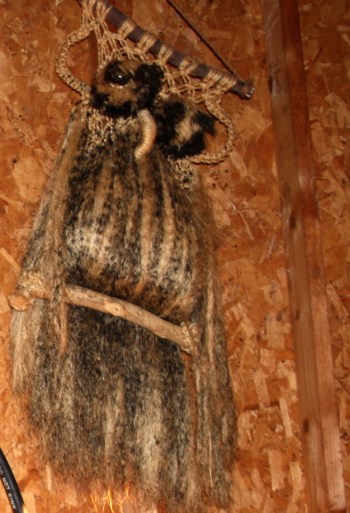
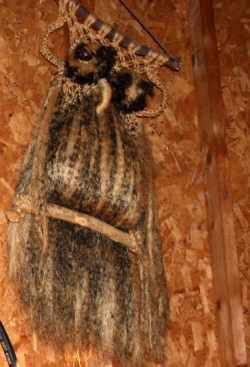
Comment: Sun and Moon 2 (as sung by Cat Leblanc) is introduced and complemented by Sun and Moon 1. These are the first two poems in the ten poem title sequence of Sun and Moon. The eagle costumes, shown in the photo, belong to the original dance sequence from Sun and Moon as performed on Monte Albán.

Sun and Moon 2

IMG0023_1

Sun and Moon 2

Eagle paints my eyes with daylight.
He offers to fly me to the sky.
His feathers trap sunshine in his pinions.
Morning is a rebozo draped over his plumage.

“My mother is blind,” says Eagle.
“Her sight: cold ashes in the fireplace.
Stripped of her dreams,
she wanders in darkness.
You must give her
the fire from your eyes!”

Tiger offers to carry me to the sky.
Flame speckles his pelt.
His eyes are two scorched blocks of charcoal.
“I will break the bread of your bones,” says Tiger,
“and warm myself on the fire of your blood!”

Serpent offers to bear me to the sky.
His scales are shards of emerald and ruby.
His serpent’s blood runs cold through his veins.
He weighs me in the twin dice of his eyes.

“Where I lead you must follow,” Serpent says.
“There is no other price.”


Comment: Here as promised are the words to yesterday’s song as composed and sung by my good friend Cat Leblanc. This is the second stanza from the ten poem title sequence of Sun and Moon. Here is the link.

Old Eight Hoots

IMG_0263

Old Eight Hoots

Winter has touched us
with this change of clocks
and darkness clutches now,
an hour or so too soon.

Old eight hoots watches:‑
he calls; I cough;
but he will not swoop.

He sits tight‑perched, out of sight;
chills me with his ghostly chorus,
hoo‑hooing me home.

Bright stars crackle the sky.
Frost crisps fallen leaves.
A mist weaves webs scarce‑seen.

And all around,
as cold ground creaks
its wordless tongue‑leafed language,
night‑shapes abound.

Robin Red Nest


img_0185

Robin Red Nest

That little red nest,
my heart,
hearth and home
to a galaxy of gods
who nest there,
year after year,
migratory spirits
blessing me with
hope renewed
in their spring
nest’s tangle:
feather and twig.

Old now,
you thump to different rhythms
not to mention
the schisms sprung from my body.

Age winds you up like a watch spring
stretching my lifeline egg-shell thin.

When the wind of change
blows me away,
what will replace you
and your offer of sanctuary
to those you daily nourish?

So sad I will be
to abandon you,
your visions unfulfilled
as winter winds unravel you
twig by twig

until nothing remains
but the bare
white-boned cradle
in which I carried you
so lovingly.

Wind

 IMG_0372.jpg

Wind

Wind gusts so strong:
bird feeders rattle
and the house shakes.

Winter withdraws
its savings
from the snow banks
and invests in
dervish drifts.

Laundered money
weaves lace curtains,
snow white,
across the yard.

Wind blows hard,
turns birds into
feathered snowballs
flung towards
frosted windows
and frail walls.

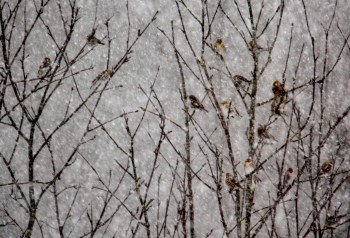
A red poll flock,
hoary and a century strong,
blows in,
blows out,
frightened by the wind’s
great lusty shout.


Ice Storm

img_0033

Ice Storm

This month and my life
are nearly done.

Sun strengthens in the sky
but birds ice up
in spite of feathers,
fluffed like eider downs.

Man alone,
within warm walls,
can bravely laugh
at winter’s squalls.

But oh, if the power fails,
if wires are tumbled
by winter’s gusting gales,
man’s heart no longer
fills with ease.

He sits at home
in the cold and dark
while all around him,
ice covers the land
and even fire dogs
freeze.

Sushi

IMG_0263

Sushi

Blank walls,
white sheets
on plastic couches,
anonymous faces
naming me
by my first name,
as if they knew me,
as if they were friends.

Moments of silence.

Eyebrows raised,
as if a question
of life and death
could be framed
that way.

“Here are your choices …”

laid out like a menu
in a take out
restaurant.

I don’t speak Japanese.
The occasional photo.
The scrabbled script.
The impossible translation.

The unknown items
you choose
from the specialist’s menu
will label you for life …

… if you survive.

People of the Mist 8

img_0146-2

7:35 AM

… the sound of dry cactus trickling through a rain stick imitating rain  as it falls from the clouds to strike the forest leaves … rain … steady and  heavy … from purple clouds … water fills the scorpion’s underground nest … Alacrán emerges and  knocks at the dreamer’s door … go away, says the dreamer … tail in air Alacrán minces down the balcony and onto the staircase … now his carcase dries on a stone in the sun … when the rain ends, black ants emerge to pick at Alacrán’s drowned body … they carry him in bite size chunks … up the thin crack in the apartment wall … back to their nests … life goes on … many are called … many are chosen to be victims or assassins … who knows who will be chosen … and for which role …

“Heal yourself,” cried the sánate bird, drawing his knife blade over the sun-warmed stone outside Tim’s window. The trees in the courtyard filled up with sparks of colour as their leaves lapped at his balcony. A butterfly, yellow and black, shook delicate wings, and dangled, at the end of his floral string. Soon the bird of paradise would close its eyes and go back to sleep. High in the sky, strung out like a line of washing in the early morning air, the temples of Monte Albán basked beneath the sun as they dreamed of their former glory. Cloud shadows walked across Tim’s wall. Tourists on an endless train from there to here to nowhere in particular, white clouds stared at Tim from a pastel sky.

Tim loved the sparrows. If he left the apartment door open, they would cease their squabbling and fly down to his balcony from the red-tiled roof of his neighbour’s house. Fearless, they would step through the opening to see if he would throw them some crumbs from his table. Sometimes, they would fly right in, perch next to him on the table, and pierce him with their inscrutable gaze.

… Ah, would some power the giftie gie us, to see ourselves as these sparrows see us, Tim used to think, for sparrows dwell among the blessed and it is written that not a single one shall fall …

The sánate kept winding up the day with the whistle of his call and dogs barked on the azoteas and in the streets. A warm wind walked through the open door, ruffled Tim’s hair, and climbed out through the kitchen window with a last wave of the palm leaves. This was now his life: to sit here before an open book while black ants crawled their predatory letters across the page and tulips and carnations performed a slow dance in time with the sun’s rotation. Tropical fruit sulked in a basket on the table. The great wheel of the sun had risen over the rooftops and sparrows hopped, dogs barked, and the sánate dragged once more the long thin knife of his tinker’s cry across the sharpener’s grindstone as a rooster crowed his thick rich morning cocoa rico.

… the breakfast orange lies racked on the plate …  juices flow like blood … a blood orange … rising like the sun from night’s mist … and now the orange … lifeless … a pale yellow robe spent and exhausted … fading in the sunlight … the wasted disc of a worn-out decadent moon … a lantern with its wasted light cast across a tabloid sky … a still life this orange … its life blood a sacrifice … thick rich golden liquid … as fierce and sweet as sunshine on a branch … 

Tim blinked, went into the kitchen, and looked for the mescal, but it had all gone. The absence of the yellow worm’s slithering crunch beneath his teeth was the ultimate sacrifice. He stood in the doorway, shivered in the sunshine, and mourned one more among his many losses.


People of the Mist 7

img_0146-2

7:30 AM

Tim opened the gate and walked into the courtyard of his apartment building. A bird of paradise fluttered before him, its crested head suspended in mid-air. Earth-bound, it nested in a basket in the grapefruit tree. Mario, the handyman, and Marisa, the widow who did the laundry and cleaned the rooms, gestured as they argued.

Marisa had just caught an enormous chapulín. She grasped the grasshopper by its hind legs and held down its freckled, leaf-colored wings so it couldn’t fly.

“It poured with rain last night,” Marisa said. “I saw him here, in the courtyard. I caught him before he dry his wings and fly,” Marisa held out her captive for Tim to see. The chapulín had long grey-green antennae and the serious anthropomorphic face of a junior priest or a staid young scholar who would one day hold sway over a classroom filled with little children. Its wings vibrated as they changed colour adapting to light and shade.

“I’m going to call him Charlie Chapulín,” Marisa smiled at her own joke.

“Give him to me. I want to hold him,” Mario lifted the grasshopper from Marisa’s hand and trapped it in a cage made from his fingers. “I have kidnapped your Charlie Chapulín,” he said in a threatening tone. “But you can ransom him for a kiss,” Mario closed his eyes, puckered up his lips, and Marisa slapped him in playful fashion across the face.

“Thief,” she said. “It’s my chapulín.” She put her hand on the grasshopper that Mario now held and Tim wondered if he was going to witness the Judgement of Solomon.

“It will be our chapulín,” Tim declared, “un chapulín de equipo, a Team Tim grasshopper, first captured by Marisa, then recaptured by Mario, then accepted into the team by me: a veritable dream team chapulín.”

“El Brujo would tell you to set it free, Mario,”Marisa smiled.

“Don’t say things like that, Marisa,” Mario frowned, drawing his thick, black eyebrows in together to form a crow’s wing.

“El Brujo?” Tim snapped to attention. “What do you know of him? Tell me, please.”

“Say nothing, Marisa,” Mario urged her. “You know we don’t speak of that man, not in the presence of strangers.”

“But I’m not a stranger,” Tim protested.

“Maybe not a total stranger, no,” Mario conceded. “But you are a foreigner, and it is dangerous to speak to foreigners about our holy men.”

“Dangerous? Holy? In what way? Tell me.”

“We have already said too much,” Mario beckoned to Marisa. “Come, Marisa, we have work to do.”

“At least let the chapulín go,” Tim said. “It was born free. Give it back its freedom.”

“Born free, like those captive kings who now dance in stone prisons on Monte Albán,” said Mario, unwilling to relinquish his prize.

“Yes, Mario; born free, just like them,” Marisa smiled. “And one day their prison walls will be broken and they too will be free, as will we all.”

“Enough,” Mario opened the prison bars of his fingers and the chapulín flew.

“Ah well,” Tim said. “It’s time for my breakfast.”

“Your breakfast has just flown,” Mario flashed his white teeth and the gold filling sparkled.

“Mario, you are a brute,” said Marisa as Tim walked to the bottom of the stairs and climbed up to his apartment. “He wasn’t going to eat him.”

“I don’t trust foreigners,” Mario glared at Tim’s back and made a rude gesture with small and index finger. “He would have fried him in olive oil and eaten him with garlic.”

“Mario: stop that,” Marisa gave him a push. “Remember: it’s a pig day. You mustn’t be rude to foreigners on a pig day, especially those who live in the compound.”

Mario shrugged.


Tomorrow

DSC02478.jpg

Tomorrow

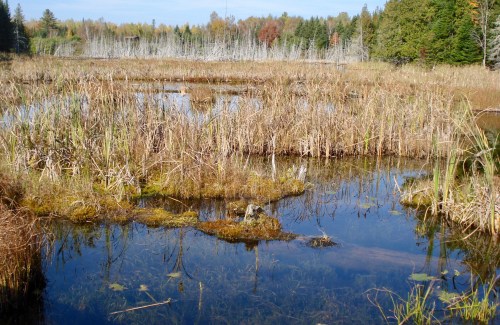
Tomorrow, early, my love, you’ll fly away. Today, all tense and stressed, your foot in the stirrup, as Cervantes would say, the anxiety of the journey on your back, you walk around the Beaver Pond where red and yellow leaves abound. I know you are hoping to see, once more before you leave, the Great Blue Heron that was here last week. Some ducks remain. I can see them standing on the water, flapping their wings, inflaming the wind, keeping themselves warm, not looking as if they really want to fly.

Alas, there are no beavers now. An abandoned lodge, the grass on its roof turning brown and dry,  lofts white sticks into the sky, but the waterways are clogging and the beaver have gone. Drowned tree trunks, beaver-gnawed and languishing, grow tiny clumps of grass and weed. Sometimes, they join together and form a miniature island that will grow at last into a grassland. The deserted lodge reminds me of our home, soon to be abandoned by the life and soul that animates it and keeps it alive. It will be sad and lonely living there without you. I know I will have the cat for company, but that’s not the same. I think I’m in charge of her, but I wonder sometimes if you’re leaving her in charge of me.

A thin grey woven webbing garlands one moribund tree. I don’t like tent worms or their equivalents. Every year we face a different invasion of this worm or that and the trees stand shocked by crawling creatures that infest their branches and build their silk cities up into the sky. I hate it when those dangling inhabitants, escaping from their cocoons, swing from low branches and twine silk threads around my face. Give me any day a fresh green frond caught by the morning sun in early spring, or else bright autumn leaves so soon to fall.

I love American Goldfinches when they sing that last departing song. I love most of all the occasional visitors that wing up north on the wings of a summer storm. Do you recall the Indigo Bunting that perched in the Mountain Ash just outside our kitchen window? He had the look of a lost bird and his call was more a cry of help than a birdsong. You took such lovely photos of him as he sat there, looking this way, that way, anyway for the way he needed to go home … and those two cardinals, orange the one, bright red the other, standing beneath the feeder, so bright against the early snow.

The hunting hawks give everyone a fright. They perch on top of a power line pole then step off into space to alight, claws first, on some poor songbird trilling away, quite free from fear, his unfinished symphony of song. Claws first? I gaze again at the photo you took of the Sharp-shinned Hawk that settled on our porch that day it rained. Claws? The massive yellow talons are high grade weapons fit for any war. I pity the poor bird clasped in those claws and brought to earth or lifted high into the sky, a feast for the marauder.

It’s getting late, my love. You walk towards me out of the woods like some lost spirit returning to this earthly world from some spiritual sanctuary. The season is ending. Thanksgiving is close. It will soon be time for you to pack your bags and go. Three silent wishes for you my love: enjoy yourself; don’t forget me … and don’t stay away too long.

Comment:
This piece goes back to the Fall of 2016. Clare and I visited the Beaver Pond at Mactaquac the day before she left for Ottawa. I sat at a picnic table and watched her as she walked through the woods and around the pond. ‘Parting is such sweet sorrow’: she didn’t want to leave me and I didn’t want her to go, yet we both knew how important it was for her to visit our grandchild for Thanksgiving. Time apart is good: it makes us realize how much we miss each other. For me, above all, it is a reminder of everything that gets done around the home without my ever noticing the care and love that is poured into each moment of every day. Having to provide that care and love for myself is an object lesson that makes me so thankful for the seemingly simple blessings Clare has brought to me throughout our married life …

Indigo Bunting, for Meg:

For you, Meg: photos, by Clare, of our second Indigo Bunting.

IMG_0206.jpg

He’s rather handsome. We usually get them in from the States following a strong south wind or  a summer storm.

IMG_0207.jpg

Great Blue Heron, for Tanya:

He was right over the garden: beautiful. We don’t often see them up here as we are on the far side of the hill from the river. Must have been raiding a neighbor’s goldfish pond.


IMG_0231.jpg