You get to build your perfect space for reading and writing. What’s it like?

Daily writing prompt
You get to build your perfect space for reading and writing. What’s it like?

You get to build your perfect space for reading and writing. What’s it like?

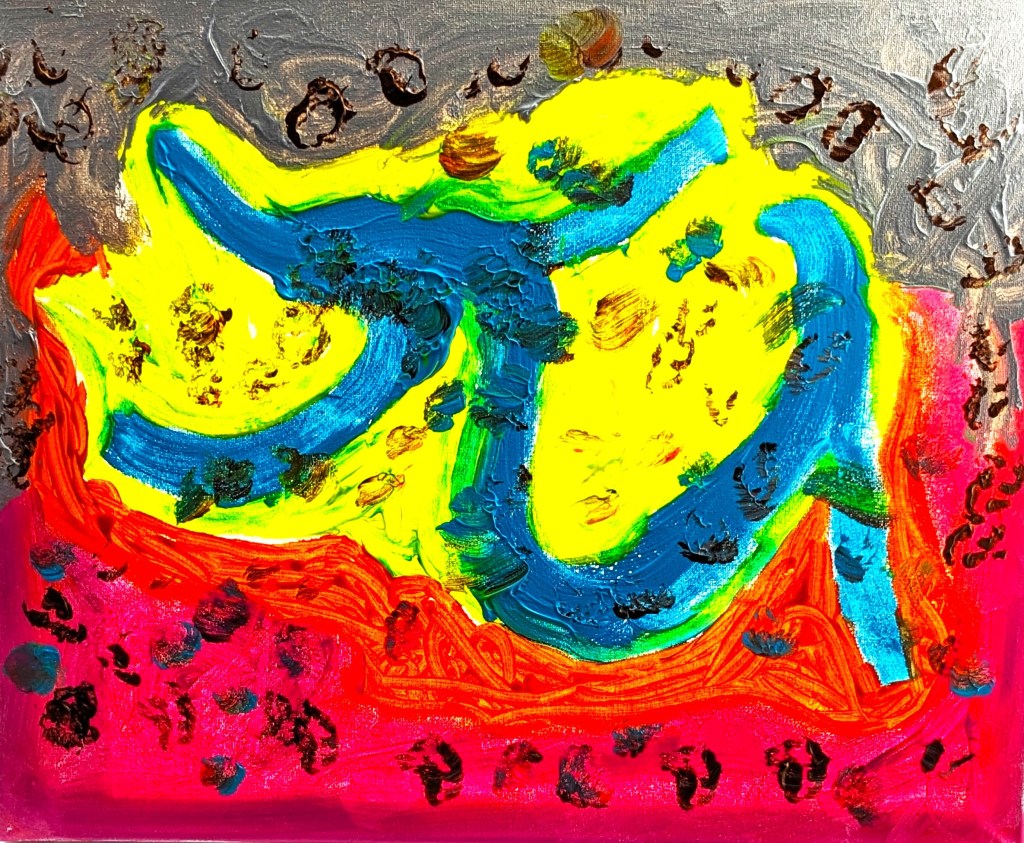
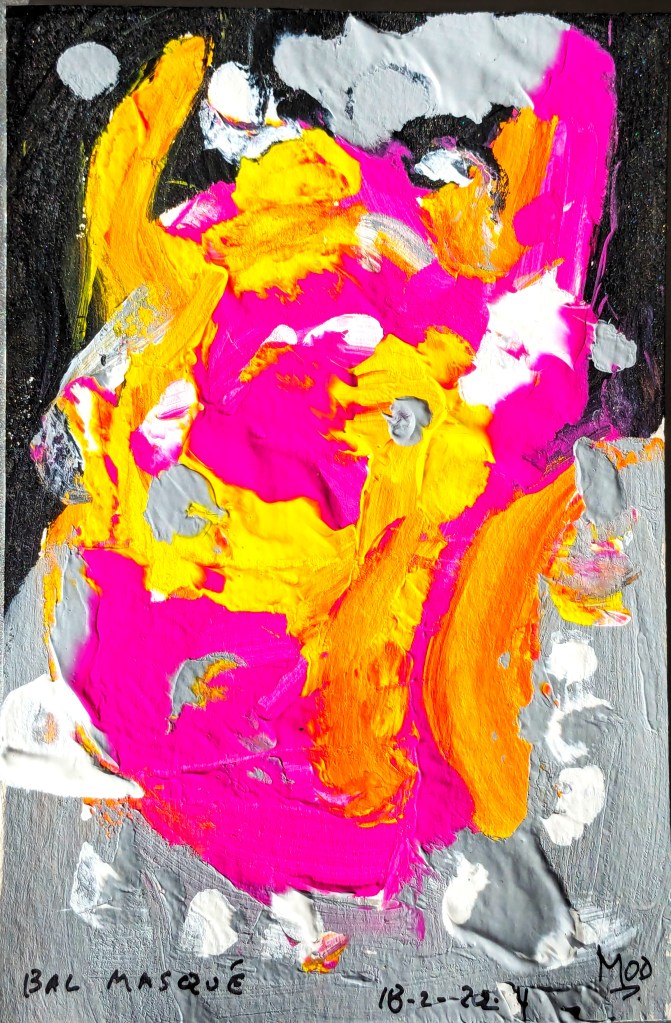
After an outpouring of poetry, during the recent three day – 72 hours – power loss, I have run out of words. Having had nothing to do but write, I now have everything to do, except write. So, I did some painting instead. This one is called Emotions in Motion. It is a picture of the inside of my head.

The inside of my head (pictured above) is the perfect space for both reading and writing. It is an especially good place when illuminated by candlelight as the flickering flames help the emotions to get into motion, if you see what I mean. And you probably don’t, because you have never entered a perfect writing, reading, and painting place, like mine.

Anyone can have a desk, with a window, looking out onto a garden. There may even be wonderful landscapes with fantastic sunrises and surprising weather events. But no space is perfect, save for that one perfect space (as depicted above). I can just imagine my friend Vincent (Van Gogh) doing aerial cartwheels with his paintbrush in his hand as he perambulates around his Starry Night, another perfect space in which to paint and read and write.

I painted Emotions in Motion during the aftermath of the three day power out[r]age when all sorts of thoughts and licorice all-sorts were floating around in there. You can probably taste a couple of the flavo[u]rs when you look at the picture. Never mind. Words will return – or not – in which case I’ll let the blobs of paint speak for me. And you can read my fortune in Vincent’s stars – or not, as the case may – or may not – be.

Share what you know about the year you were born.

Daily writing prompt
Share what you know about the year you were born.

Share what you know about the year you were born.

How much does anyone know about the year when they were born? When do childhood memories begin? What do we really know about those early days, those first surroundings, the family, the friends? I only know what I have been told – and not all of it is pleasant. Here for example is the song my grandfather used to sing to me when I was a very young child.

“I’ll never forget the day, the day that you were born.
They took you to your father and he looked at you with scorn.
Said he, ‘if that’s his face, the best thing you can do,
is stick a tail the other end and take him to the zoo.'”

I don’t remember what I looked like, acted like, or sounded like. I don’t remember much at all. But I have never forgotten that song with its innate cruelty. Oh yes, people laughed and pointed. Maybe you did too. But is it really funny? And what if your only childhood memory is a sense of being unwanted, rejected, left on the shelf, sent to the zoo… ? “Little boys should be seen and not heard.” Another piece of wisdom from the ancients.

Mind you, I have heard stories, and written them. Here’s one.

The Stork

My story almost didn’t begin in Number One, the first house that I recall from Gower, Wales. My mother gave life to me, a very long time ago, in the middle of a frost-bound winter in that land now distant in time and space. Yet begin it did just as the clock struck eight, that Sunday evening, in January, mis Iawnor. I know this is meant to be my story but the beginnings are swathed in a misty past that tells of a lack of awareness, a search for the meaning of shape, color, and form, the realization, however slow, of the need for language, words, a map, a direction, a slow growth of the seed from baby hood to boyhood, to manhood, and beyond.
 My parents told me I was flown in by a meandering stork that just happened to pass by our house at eight o’clock that night. I don’t remember much about the flight, although I have always dreamed of tumbling through that sky-blue air, only to be trapped at the last moment, my hips and legs caught in a vice that squeezed and squeezed until I could no longer breathe. This nightmare haunted me for years. All through my childhood, I climbed through ever narrowing tunnels and caves until I was trapped, struggling, suffocating, trying to get out. Many times, I would wake myself up with my own panicked screams. The twin holes in my temples, marks made by the doctor’s forceps, remind me to this day of the last stages of that journey.

Our dog, a black Labrador called Paddy, after St. Patrick, of course, and all the Paddies who worked the Paddy fields in Ireland and Wales, had been exiled to a neighbor’s house until after … after what? After the delivery? Were they afraid the dog might frighten away the stork? Who knows what they thought back then? In Galicia they still throw stones at storks to keep them from bringing babies to houses. It’s cheaper than contraception, which is illegal there anyway. When the clock struck eight, Paddy, curious and maybe jealous, turned herself into a stone, threw herself through the neighbour’s front bay window, and rushed home barking. The stork, scared by the noise, dropped me, plop, right down the chimney, and when the doctor held me upside down by the heels and slapped me, I started to scream.
How do I know all this? I don’t. I merely repeat what I’ve been told. Simpletons at heart, poets and babies believe so many things, myths and legends, fairy tales, tall stories, the stories of storks … can you tell talk from mutter, or Stork* from Butter as the TV ads used to ask? I know I can’t. But this is my tale to tell, even though I don’t know how it began (Alpha) nor how it will end (Omega). So many mysteries hide behind thick curtains of mist that conceal both the future and the dimly remembered past, a past that we often reconstruct while calling it ‘memory’.

*Stork: a brand of margarine that the tv ads said “tasted just like butter”. Hence: “Can you tell Stork from butter?”

Change

1

Change

Waters rise, tides get higher,
streams wash roads away.
grey, rainy skies, day after day.

Temperatures drop down at night.
Water turns to ice. Northern Lights
burn bright, set the sky alight.

I forget my gloves. Fingers, cold,
fumble at buttons, and my zip
is not the easy zip of old.

My life cries out for change,
but change is out of reach.
I change the things I can arrange.

Some days I’m weary and sore.
Most days I can do no more.

2

Change

Waters rise, tides get higher,
streams wash roads away.
Grey, rainy skies, day after day.

Temperatures drop down at night.
Water turns to ice. Northern Lights
burn bright, setting the sky alight.

I forget my gloves. Fingers, cold,
fumble at buttons, and my zip
is not the easy zipper of old.

Some days I’m weary and sore.
Most days I can do no more.

My life cries out for change,
but most changes are out of reach.
I change the things I can arrange.

Comment:

I decided to change my format today and go back to the left margin alignment, rather than the central alignment that I usually use for poetry. Your comments on the adjustment would be welcome. I have included both formats so you can see how the poem flows in each one. As for this poem – a rhyming sonnet, wow!

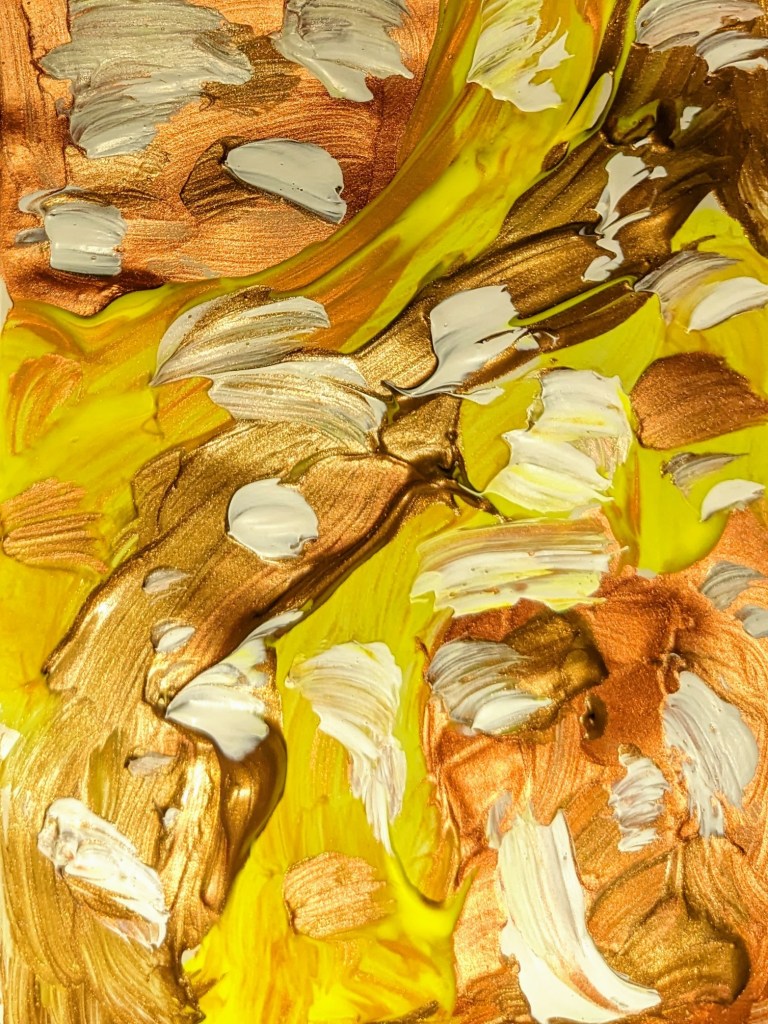
Moo’s painting, executed late last night, is his way of showing how rage can suddenly build and, like a runaway river, suddenly and unstoppably break out. It is extraordinary how his paintings so often mirror my moods and word flows.

Do you have a favorite place you have visited? Where is it?

Daily writing prompt
Do you have a favorite place you have visited? Where is it?

Do you have a favorite place you have visited? Where is it?

Just one place? So difficult to choose. I have been very lucky in my travels. I haven’t gone far, but I have tried to go deep, returning to the same places again and again. One place I often visited was St. Luce-sur-Mer in Quebec. It is a wonderful little town on the banks of the St. Lawrence River. The sunsets are sheer marvels and the views of the Northern Lights across the bay are just outstanding. Site of the wreck of the Empress of Ireland, it is filled with mystery and memories, as is the nearby Rimouski. Ste. Luce sur Mer would be my third choice.

Oaxaca, Mexico, would be my second choice. The city itself, capital of the state, is packed with history. I taught there for a couple of weeks (maximum six) every year from 1995-2001 and every time I returned I found something different and more mysterious. The dancing and music in the capital, the cascades of fireworks flowing down the facade of a church, the Christmas Cribs that grew day by day as people added to them, the incredible food, and above all the people – dancing in the Zocalo on Sundays to the music of the State Orchestra, crowding the markets with color, and the markets themselves, the scents of peppers, coffee, chocolate – to visit Oaxaca, in those days, was to visit the heart of Mexico. Imagine sitting beneath the tree that Hernan Cortes had sat beneath when he visited Oaxaca just after the Conquest of Mexico City – Tenochtitlan – and talked to the Mixtecs and Zapotecs of the Oaxaca Valley. And the codices – wonderful – I cannot say enough in praise of Oaxaca.

My number one choice: Avila. The lead photo shows the Toros de Guisando. Pre-dating Christianity, these four stone bulls – verracos – were often used as boundary markers by the Vettones who lived there before the Romans. One of these four bulls bears, carved into its side, the marks of one of the Roman Legions that passed this way. The countryside around Avila has to be seen to be believed. The walled city itself is a wonderland – three kilometres of walls, 9 gateways, a Cathedral that shows an enterprising mixture of styles, museums, libraries, squares, and a welcoming people who make you one of the family. I visited here for four summers, 2005-2008, staying for between 6 and 8 weeks on each visit, and always residing in the same place, El Rincon, close by the Mercado Chico.

The Seeker

The Seeker

Weaver of words, I wander my weary way
across a field of snow, careful as I go
not to slip and fall into the depths that wait below.

I know them of old, those man-trap mine-shafts
where darkness dwells, hand in hand with despair.
I know only too well the weight of coal dust,
fine and thin, polluting lungs with unfiltered air.

How long will I have the courage and strength
to survive so deep beneath the surface
and to explore those depths at greater length?

Who would now, willingly, plunge, or dig
and delve so deep into the mines underground?
Ony the searcher, the seeker who knows that
in dark pits wondrous gems can still be found.

Comment:
I don’t really know why, but my thoughts are now appearing (more or less) in rhyme and often in sonnets. Well, Milton Acorn’s Jack Pine Sonnets, straggly and wild, like the Jack Pines of Canada’s East Coast. Sometimes I think that this is a new format for me. And then I realize it’s where I started so long ago – a rhyming poet. “In my beginning is my end.” I have indeed returned to my roots. But now they are Jack Pine roots, well settled here in this wonderful Maritime Province of New Brunswick, amid Jack Pine, rock, and winter snow.

Doubts

Doubts

At midnight,
when that dark owl calls,
I sip a bitter wine.

The thoughts I think
are not my thoughts,
how could they ever
be mine?

And yet they are
the thoughts I think,
and round and round
they twine.

They wrap me in
a thousand threads
and none of them
are mine.

Whose are they then,
these thoughts I think?
They do not come from me.

And yet they make me
double think
this person that is me,
and who I am,
and what I am,
and where I’m going to be.

Comment:
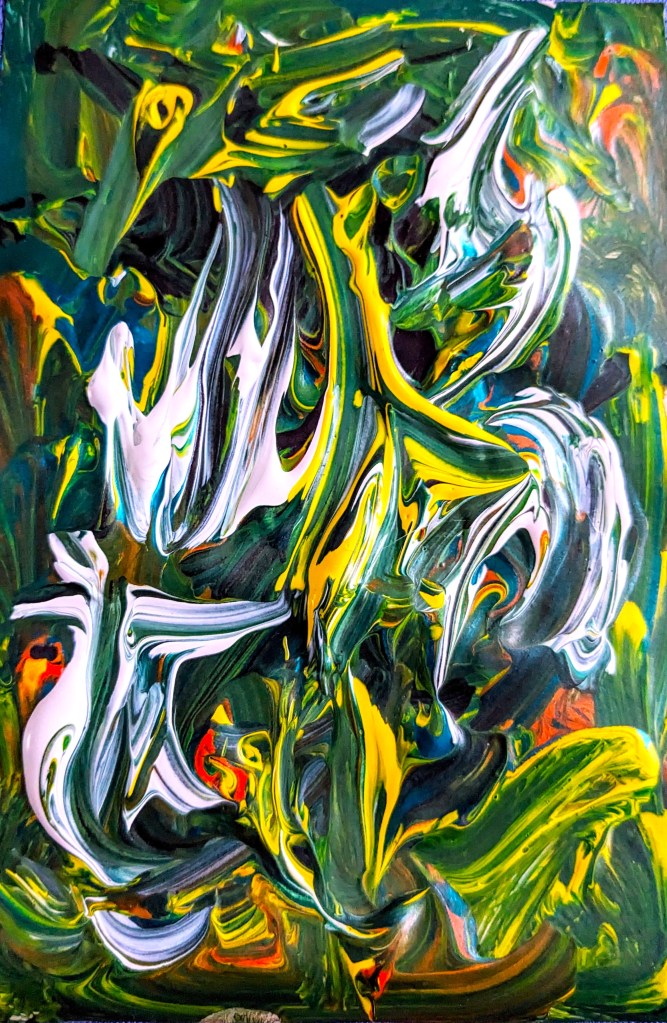
I guess that’s what happens when you finish your bottled sunshine (sol embotellado) before going to bed. The painting and the poem match up nicely though, ribbons of dark thought streaming through an empty head. Guessing and double-guessing, thinking and double-thinking, doubting and finding yourself inside that great cloud of unknowing in which you rarely know where you are going. Still, if you don’t know where you are going, any road will take you there. Pen-y-Bont, anyone? Or Abertawe, Cas Newydd, Llandeilo, Caerfili, Rhiwbina, Treorci, Trebanog

Old Wounds

Old Wounds


“The slow wound
deepens with the years
and brings no healing.”

The Minister. R. S. Thomas

How deep time’s wounds
have cut and carved,
not just in flesh and bone,
but in the embers
of that slow-burn fire
 they call the heart.

Memory and mind
have also played their part.

Some days, those wounds
don’t ache at all.

But there’s no real healing,
and a moment of madness,
a knife-edged finger nail,
careless, in the dark,
opens them up again
to bleed afresh
and remind us
of the frailty of the flesh.

Comment:
The opening quote, from the Welsh poet, R. S. Thomas, made me aware of so many sad things that have happened in my life. Usually they lie dormant, asleep like an ancient volcano. Occasionally they erupt, and memory’s hot lava breaks through to the surface and spills like blood. Hard as I may try to control those moments, they are, in essence, uncontrollable. The scars itch. I scratch them with sharp finger-nails, and the old wounds open and bleed again.

Magnolia

Magnolia

She stands there, at the garden gate, waiting for me.
I can see the scene, the flower beds, the magnolia
bleeding, in Wales, its soft, spring snow of ivory pearls.

Some fall on her head, crowning her with a beauty
more precious than frankincense or myrrh. Petals
also perch their pure, ermine cape on her shoulders.

She walks towards me, eyes shining, arms open.
Then, the vision fades and she drifts away, leaving me
alone, my face bathed in the tears of her passing.

For pass each other by, we did. Ships in the night,
trains rushing through a tunnel of darkness, bathed,
for an instant, in the constellation of a station’s light.

Now, when I try to go back and to recreate that scene,
I find an empty garden, fallen leaves, and winter’s cold.

Comment:
I have been struck recently by the number of published articles that speak of post-Covid loneliness and the difficulties of re-establishing old friendships that fell by the wayside, let alone establishing new ones. It seems to get harder and harder, as we age, to leave our post-Covid isolation, to get out of our new comfort zones – sometimes so limited and limiting – and to make new friends. As we age, our minds go backwards and we return to earlier days and happier memories. Yet all too often those memories are tinged with the sepia sadness of old photos, from a non-digital age, faded and stained.

Bay of Santander – 1963

Bay of Santander
1963

I stood there
on the sea wall
calling out to the dark
“Help!” “Save me!”

Moon hid her face
behind veiled clouds.
All hope denied
I called out to the tide,

outgoing, to take me
with it, out to sea,
past the island
and the lighthouse,

out to where the waves,
stronger than anything
I ever knew, would thrust
strong fingers under my arms

and lift me up,
then drag me down,
so I could finally rest
in peace, and drown.

Comment:
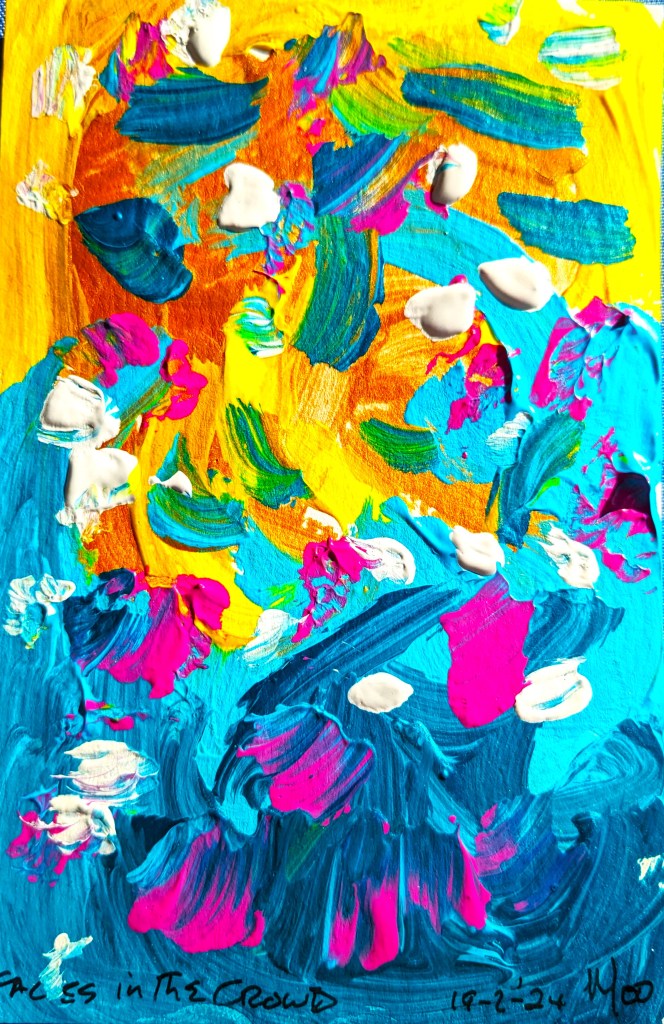
This painting is called Picking at Scars. Some scars run so deep that they are always there. When they itch, you scratch them, and they bleed afresh. The scar of loneliness is one such scar. Alone, in a foreign land, learning their language, the culture, their customs, feeling not just unaccepted, but unacceptable, and the moon at night shining on a land, a bay, a city, to which you know, deep in your heart, you will never belong. That loneliness walks with me still and, sixty years later, it still leaves me desolate.