Monkey and the Bean Counter

IMG_0026

Monkey and the Bean Counter

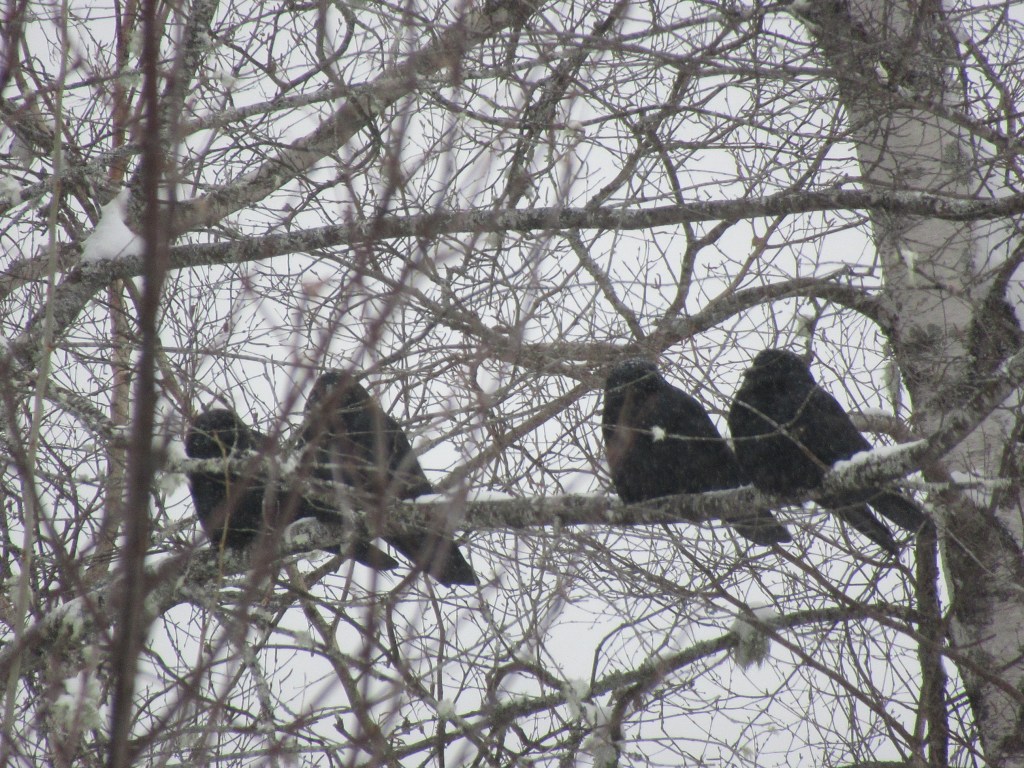
An acolyte in a charcoal suit runs by.
He neither stops nor speaks
but slips on slippery words
dripping from another monkey’s tongue.

This other monkey has eyes of asphalt,
a patented pewter soul,
ice water flowing in his veins.
“Hear no evil! See no evil! Speak no evil!”

The hatch of his mind is battened tightly down.
Nothing gets out nor in.
The acolyte’s fingers grasp at a khaki folder,
his manifesto for success.

Senior monkey stalks to his office
and turns on the radio.
His favorite music:
the clink of mounting money.

Disturb him at your peril:
this monkey is very important,
and very, very busy.
He’s also clever:
a real smarty.

First, he empties all the chocolate candies from the box
then he sorts them into little piles:
green with green, brown with brown,
blue with blue, red with red.

Then, like the Good Shepherd checking His flock,
he counts them again and again,
to ensure that none have been stolen
and not one has gone astray.

Comment: Another Golden Oldie, this time from Monkey Temple. I have updated it slightly so it won’t be exactly the same as it is in the printed text. Senior Monkey has, of course, built a bigger box into which he can place all his chocolate candies and tuck them away for ever and ever. I guess if he were a bull and not a monkey, he would have tucked them away for heifer and heifer. Such is the sad state of reality in the Monkey Temple. But if monkey were a bull, he would be living in the cow shed, not the Monkey Temple. Oh dear, oh dear: and oh what a tangled web we weave when first we practice to deceive with fiction, flash fiction, creative non-fiction, and all the other sugar and spice which goes into the spinning of spider-webs and fairy tales. Speaking of which, did I ever tell you the story of the… well, maybe next time. So tune in again tomorrow. Same thyme, same plaice, and I’ll sing you a song of the fish in the sea… and a fishy tail that will be.

Building Bigger Boxes

IMG_1292 (2).JPG

Building Bigger Boxes

Some of the worst educators I have been unfortunate enough to work with over my undergraduate and graduate years have come up with cliché after cliché in an effort to the sway students into believing that they really are getting an excellent education. One such phrase is the infamous: “We are teaching you to think outside the box.” So, what is their definition of ‘the box‘? Alas, I do not know. They deal in clichés and, by definition, a cliché is a  phrase that both parties (teachers and taught) accept as being meaningful, even though it is often without meaning. It is also a conversation closer, as in ‘it is what it is’. It’s hard to argue with that or to reason your way around it. ‘But it doesn’t have to be!’ rarely cuts the mustard aka mouse-turd.

So, if these teachers are teaching their students how to think outside the box, how are they managing to do so? Why by building bigger boxes inside which each student can be safely taught to think, without asking questions, and without looking for independent answers.

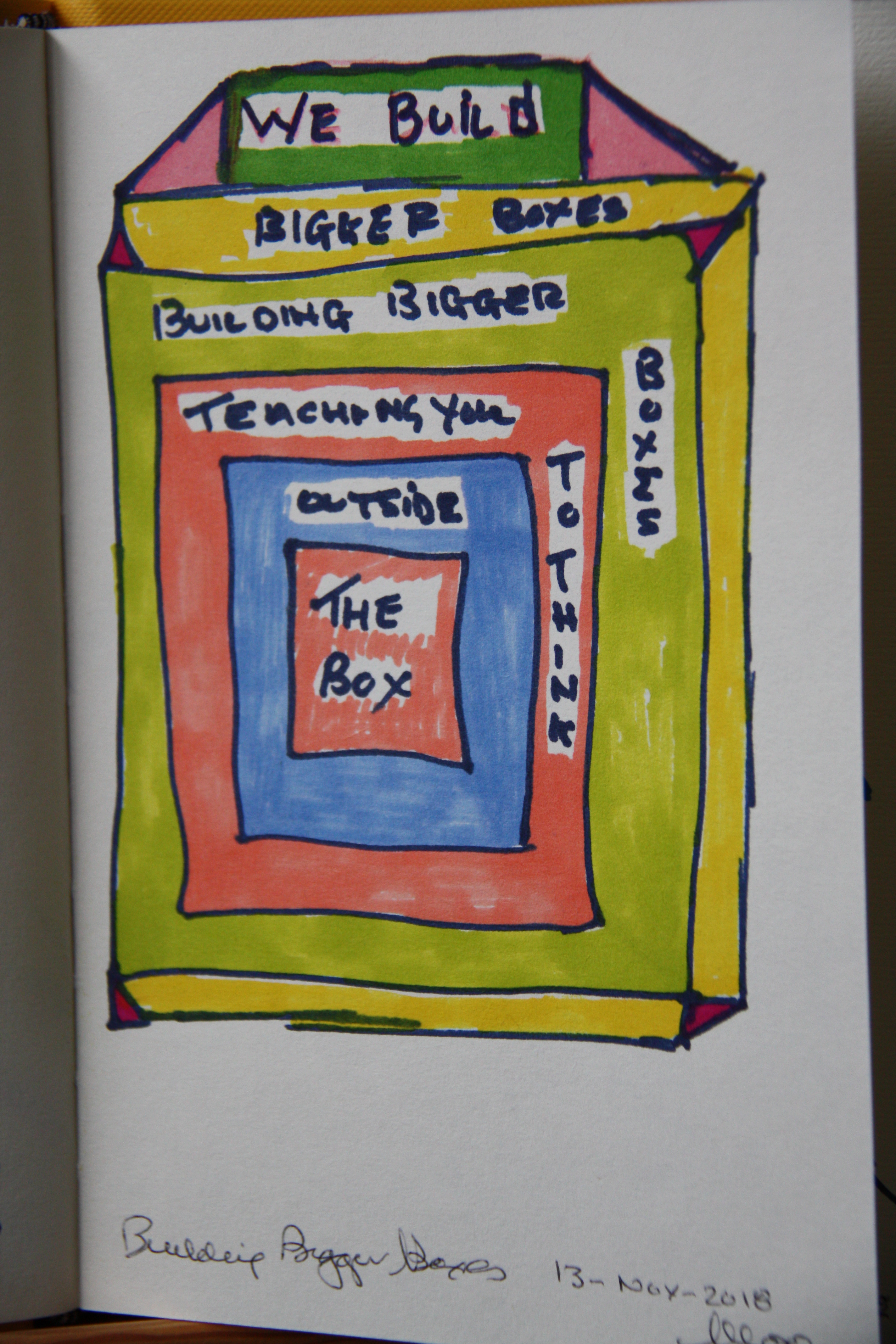
Today’s cartoon has two titles: (1) Brave hearts  escaping, finding meaning outside the bigger boxes and (2) can the true heart escape its coffin in a bigger box? I love the boxes within boxes and the drawers within each boxed segment into which the young, developing mind can be stuffed and crammed. How do we release those hearts? How do we develop those minds? Certainly not by confining them in bigger boxes. In the battle for hearts and minds, how do we set our students free?

It must be done on the student’s terms, each student, one by one, in co-operation with intelligent, meaningful teachers who step away from cliché and commonplace to enter the learner’s world and to themselves learn how to contact each learner at a mental, spiritual, and intellectual level. Only then will teacher and taught be able to speak of true intellectual freedom. Until that happens, be very careful when your child comes home and announces that today, of all days, that child has been taught to think outside the box. “Verily, I say unto you, open the cage door. Let in the sunshine and the light. Set those children free.” But remember, it must be on a  case by case basis, with each individual weighed, assessed, understood, and released to find their own individual way of earning the things they specifically need to know. In true education, one size really doesn’t fit all.

Comment: Another Golden Oldie that suddenly surfaced and, on emerging from the depths, reminded me of another of my callings: that of a teacher of philosophy and a teacher with a philosophy. Retired now, I can no longer help young minds to create and shape themselves. This is doubly true with Covid-19 haunting us, waving at us from the shop-windows, supermarket aisles, and street corners, flapping its wings and trying to fly into our bodies. And remember to distinguish between clichés and things that are not clichés, like ‘Wear a mask’, ‘wash your hands’ (twenty seconds, with soap), and ‘keep a safe social distance’. Do this all the time and hopefully you will avoid thinking inside the bigger box of a six foot pine Covid-19 coffin.

My Father

The Jaguar Symbol of Monte Alban, Oaxaca, Mexico.

I saw my father yesterday evening. I walked through the zócalo, opened the main cathedral doors and walked in. The doors closed behind me. I looked towards the main altar and there my father stood, motionless. The evening light shone through the engraved glass panels and illuminated him as if he were some long passed saint come back to visit me. We stared at each other, but I couldn’t open my mouth to speak. The hairs on my neck stood on end and my hands shook. When I forced my mouth open, words stuck in my throat. He wore his best grey suit over a light blue shirt and a dark blue, hand woven tie: the outfit in which I had buried him.

               Three old women, dressed in black, broke the spell. One stood in front of me and wouldn’t let me approach my father. She held a large bag of knitting in her hands and the wool spilled everywhere as she pushed me away. The second threatened me with a pair of scissors that she held in her left hand and thrust towards my face. The third smacked a tailor’s measuring rod against my father’s head.  He nodded, smiled sadly, and they all turned their backs on me and hurried away out of the cathedral and into the square.

               Just for a moment, I stood there in silence. Then I pulled the doors open and ran in pursuit of my father. The setting sun filled the square with shadows that whispered and moved this way and that, as if a whole village had come down from the hills to walk beneath the trees and dance in the rays of the dying sun. I stood on the cathedral steps and called out my father’s name, but I could see no sign of him among the cut and thrust of the shadowy crowd.

               I ran out into that crowd and pushed at insubstantial people who stood firm one moment and then melted away the next like clouds or thick mist. I came to a side street and saw real people, flesh and blood beings, a group of villagers gathered behind their band. I stopped and as I did the village elder put a live match to the taper of the rocket that he clutched between his thumb and forefinger. The taper caught on fire and the rocket soared upwards with a searing whoosh. The village band marched forward and started to play a traditional dance as the rocket clawed its way into the sky to explode with a loud knock on the door of the gods.

               Tired of grasping at shadows and afraid of this living phalanx of men that marched towards me I went back to the cathedral and knelt at the altar of La Virgen de la Soledad, the patron saint of Oaxaca. Real wax candles stood before her altar, not tiny electric lights, and I inserted five pesos in the slot, took a taper, and lit a fresh candle from an ageing one that had started to sputter. I knelt and, for the first time in years, I prayed. I prayed for the soul I had saved from extinction by lighting my candle from another’s flame. I prayed for my father and my mother and, above all, I prayed for myself.

               On the way home to my second-floor apartment where I live alone, I bought two litres of mescal, one to send me to sleep, and the other so I would survive the next morning.

Comment: A Golden Oldie that I had forgotten about. I found it among the drafts of earlier work. Monte Alban is also known as Dani Ba in the indigenous language of the region. Click on the link for more on Monte Alban. And click on this link for another piece on my father and Oaxaca. It’s a funny thing about Golden Oldies: sometimes they stick with us and are ‘unforgettable’, but sometimes they were better off left in the pile that gathers dust, like a forgotten book on a forgotten shelf. Speaking of which, have I told you about the time when …

Milton Acorn and the Jack Pine

Milton Acorn and the Jack Pine

            I met Milton Acorn in the photocopying room of the university in which I taught. I didn’t know who he was, but I soon found out.
            “Oy! You,” he waved his strong, carpenter’s hands, and stabbed me with a gnarled index finger.
            “Are you Milton Acorn,” I asked. “The poet?”
            “Yup. Make this machine work.”
            “I’m meant to be taking you to lunch.”
            “Got this job to do first,” he pointed at the machine. “Turn it on.”
            I typed in my code and the copier leapt into life.
            “Now go away. I need to be alone.”

            A few minutes later, I returned to find him lying on the photocopier, eyes shut, face pressed against the glass. Lights flashed, the copier whirred, and a copy of his face emerged. He descended from the machine and added his face to the pile of photocopies that lay at his feet.
            “Tape,” he said. “I need tape,” he again stabbed me with his finger and held out his hand.
            “I’ll go and get some.”
            I went to my secretary’s office.
            “What the heck is he doing in there?” she asked.
            “I haven’t got a clue. But now he wants some Scotch tape,” I held out my hand and she handed me a roll of tape “Thanks,” I said.

            I gave Milton the tape and watched as he taped the copies together. He had photocopied his whole body, arms, legs, back sides, feet.
            “Me,” he said happily. “That’s me,”
            Triumphant, he showed me his work: a self-portrait, shadowy and cloudy, still warm, with him all whiskered and worn, smelling still of photocopying ink, unique, unmistakable, uncouth, unseemly, but the real Milton Acorn, a jack pine sonnet self-grown in his own poetic image.

Jack Pine and Stars

Jack Pine and Stars

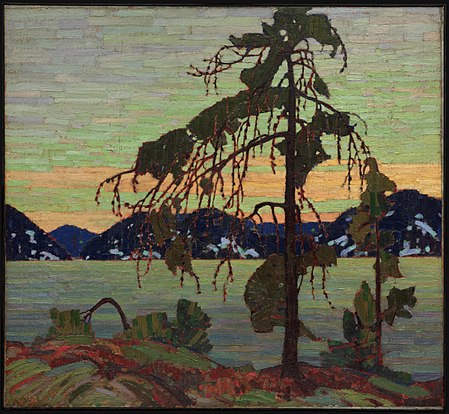
            Sitting on the porch at Tara Manor, measuring the evening shadows as they lengthen and thicken, I study the jack pine’s wild, extravagant growth, the way it reaches out to reject the commonplace of ‘tree’, as Milton Acorn rejected the commonplace of ‘poet’.
            The jack pine grows in radical disorder, sprouting here, there, anywhere the sea wind blows and its capricious nature dictates. Each limb of the jack pine bears a thin layer of salt, borne in from Passamaquoddy Bay by thin fingers of air that sow salt on branches and needles. Broken branches, untidy crows’ nests limb-tangled like grim, bedraggled hair sprout out from on high. Lower down the tree extends a branch, held out towards me like a helping hand.
            Charcoal shadows fill in the gaps between darkening trees. Shy deer emerge, step by cautious step, drifting their sylvan ghosts, delicate, across footpath and lawn. Wrapped in a scarf of peace, I forget the city’s hustle and bustle. Stars poke peepholes in the dark. I try to name each constellation, as it traces its new-to-me path across the indifferent evening sky.
            I look around: more jack pines, no two the same. How could they be? There’ll never be another poet like Milton, another book like his Jack Pine Sonnets, no tale like his own tale told in his own inimitable way.

Once Upon a Time

Once upon a time …

            Once upon a time, there was a man who carried a large round rock upon his back. It was huge and heavy, like the globe that Atlas carried. One day he felt tired, laid that rock upon the beach at Bocabec, waded out into the Bay of Passamaquoddy, and was never seen again. He left the rock there for my friend to find. My friend called it Magic Rock, but what he did with it and thought about it is his tale to tell, not mine. I must tell another story.
            Once upon a time, St. Patrick arrived in Ireland. He celebrated Easter on the hill above Tara, the royal palace of the ancient Irish kings. Then he walked down the hill to their palace and tried to convert them to Christianity. But that is another story, and it is not mine to tell, even though the name of Tara was given to the red and white house of another friend of mine, red and white, like the dogs and cattle of Ireland. But that’s not my story.
            Once upon a time, a rich and powerful man came to St Andrews and built a summer home on the hill above the bay. Later, another friend of mine purchased it, painted it red and white, and turned it into a wonderful home for guests and visitors. I wanted to tell her story, but it’s hers to tell, not mine. I can only tell my own story.
            Once upon a time, my friend who lives on the shore at Holt’s Point, walked on the beach outside his house and found an enormous, metal ball, weighing almost two hundred kilos. It was almost as big as Magic Rock. It lay there, on the shore waiting for some one to find it. My friend went home, drove back to the beach in his truck, winched the ball onto the flatbed, and brought it home. What he did with it is not my tale to tell. I must tell my own story.
            So, what is my story? What tales do I have the right to tell and how shall I begin my tale? Well, once upon a time, in Ty Coch, a red brick house on the Gower Peninsula, in Wales, a little boy was born … and that is my story … but I will not tell it here and now.  Instead, I’ll tell you another tale. But you will have to wait until tomorrow.

Birch

Birch

A birch tree lies on my power lines,
and I am powerless.

No phone, no radio, no tv,
and all because of a snow-laden tree.
Why did this happen to me?

“It’s a day, man, a day.
It’s nothing but a day.”

“Imagine,” says my wife,
“being without power all your life.”

I clench my fist and pump the air.
Nobody sees me. There’s no one to care.

A ghost’s voice echoes in my head:
“Stop moaning, bro, at least you ain’t dead.”

Sun, wind, melting snow.
The lame tree rising, slow.

At last the wires are free.
Power is back again.
I breathe more easily.