Carlos Carty

IMG_0134 (2)


Journal: Carlos Carty addressed the group of resident artists tonight. Carlos is from Lima, Peru, but he has lived for the past few years in Brazil. He told us how, at the age of 15, he had discovered music while still in school. It was, he said, love at first sight. However, musical instruments were expensive and not easy to obtain, so he learned to play rhythms and music on throwaway things, empty boxes, plastic and glass bottles, material that could be re-cycled. He was self-taught and has had few lessons. However, his explorations have led him to the Pan Flute, the Andean flute, the Chinese (or sideways) flute, and to many of the myriad flute-like instruments that are played in the Andes in general and in Peru in particular.

Carlos is interested in all types of music and would love to be a full-time musician, dedicated exclusively to his music. However, he has a family to look after and music alone will not keep food on the table. This was a problem shared by all the artists in residence. He then told us of some of his difficulties. He also told of his preference for his own people’s traditional music. This music existed before the Incan Empire and long before the arrival of the Spanish conquistadores who laid his land and his people to waste. Part of Carlos’s musical experiments have centered on restoring a melodic happiness to a Peruvian traditional music that is, by nature, sad. Add to this his ability to create music from all types of recyclable material, and you will see Carlos as an innovator. His own compositions demonstrate this innovative spirit and he happily blends any and all types of music to the traditional music as he searches for new ways in which to express himself, his moods, and his emotions.

With regards to KIRA and the Kingsbrae experience, Carlos stated that six months ago, while thinking about his application to KIRA, he realized how important it was to write down his ideas and focus on the elements that made him the musician that he is. From these cogitations arose his ideas on the eclectic nature of music and the necessity to recycle not just music, but the means by which music is made. Music, for Carlos, comes as an imitation of nature. It is the sound of water, of rocks knocking against each other. It is the sound of the wind through grass and reeds, the beating of wood on stone. He also spoke of the various waves of immigrants who came into Peru. The African slaves, in their moments of leisure, expressed themselves in sound, sounds made from the very materials with which they were laboring. This too became a part of Peruvian music.

One of the reasons why Carlos loves the flute is that it is one of the world’s most ancient instruments coming after the percussion of wood on rock and taut animal skin or shells. Flutes go back many thousands of years, to ancient Greece, among other places, and they are the world’s original instruments and bind all cultures together via the international language of music.

Many questions followed Carlos’s presentation. Most of them centered on a clarification of one thing or another. However, thanks to Anne Wright, a very productive theme was introduced: the relationship between North American aboriginal music (especially the first nations peoples of Canada) and the traditional music of other aboriginal American people. This theme merged into the question of identity, loss of identity, and the attempt to recover that lost identity, especially in the current age when so many differences are so easily erased. Language, culture, identity, music … they are all tied closely together. Carlos is an excellent ambassador and has the personality to explore and develop such links as these. Perhaps there will be further room to develop these contacts at a later date.
 

Seagull

IMG0005_1

Kingsbrae 12.4
12 June 2017

Seagull

Seagull on the wind
wing tip tilted
for maximum lift

Wheeling up and away
the gull-wing sway of him
climbing his celestial staircase
in a rush of blue air

Light his flight steps
danced to wind music
played over beach and wave

Watch him wave good-bye
with a waggle of his wings
and a well-judged flick
his sea gull tail painting
neat brush strokes

Comment: Looking through my notebook, I saw the original of this poem, scribbled while I sat in the car, waiting for my friend. I re-read it and admired its simplicity. So I copied it here. The earlier poem I wrote, with the same title, Seagull, is more worked and much more elaborate. You can find it here. I would be interested to know which of the two versions you prefer. A second question: can they both stand as separate poems, even though they overlap in their inspiration and imagery? Let me know what you think.

img_0201


Kingsbrae 12.3
12 June 2017

Fire Hazard

Sad the sacked shack
fire-blackened its bones
still standing its carapace
a reminder
Carpe Diem
of what can happen
when the wilderness breaks in
and shatters our illusions

From flames’ first flicker
tongues of fire lapping
painted wood
raised the alarm
but late too late the firemen

How many houses die this way
how many homes get carried away
in a moment’s flicker of flame
occupants hands burned
nameless their faces forgotten
and
over one and over all
this hot south wind
reeling us in
instigating
instant regret
and
terminal madness

Whitecaps


15 May 2002 Pre-Rimouski 277

Kingsbrae 12.2
12 June 2017

Whitecaps

… white-capped the waves,
pushed inland by a strong,
warmth-bearing wind, and hazy
the crazy paving sky, with its
cloud figments floating,
lazy, the heat, with summer’s
heavy hand now sudden upon
sea and land, wave upon wave,
this heat wave, holding us now,
as wind-tied, the tide, strives to flee
but cannot free itself from wind
-grip, and bit between teeth, white
horses cap the waves, leave seaweed
stranded high and dry in fierce sun
-glow, Irish Moss and Madcap Dulce,
their iodine tang fulfilled on chance
winds that blow us willy-nilly, this way,
that way, any way the wind blows …

Dawn

IMG_0018

Kingsbrae 12.1
12 June 2017

Dawn

… early morning sunshine
creepy-crawly spider leg rays
climbing over window and wall
my bed-nest alive to light
not night’s star twinkle
but the sun’s egg breaking
its golden yolk
gilding sheet and pillow
billowing day dreams
through my still sleepy head …

… the word feast festering
gathering its inner glimpses
interior life of wind and wave
the elements laid out before us
our banquet of festivities
white the table cloth
golden the woodwork’s glow
mind and matter polished
and the sun show shimmering
its morning glory on garden and porch …

Giving Back

IMG_0167

Kingsbrae 11.4
11 June 2017

Giving Back

In the beginning was the wind,
and the wind created waves,
whitecaps on wild waters
with sunlight dancing a tiptoe
hornpipe, heel and toe, landwards
towards the headland where the
lighthouse grows from rough and
ready rock, its light cast on water
and returned fourfold in the yellow
moon path, step after stepping stone,
golden from sea to gardens with
their marigold path leading to
house and home and the banquet
spread before them, so solemn the altar,
this day of all days, when we celebrate
our lost and loved ones with bread
cast, like light, out upon the waters
and tenfold always our love returned.

Sea Gull

IMG0007_1

Kingsbrae 11.3
11 June 2017

Seagull

… slipping sideways on the wind,
wing tip tilted for maximum lift,
wheeling up and away, magnificent
his movement, the gull-wing sway
as he climbs his celestial staircase,
that blue vault, high in the sky,
upwards, in a rush of indigo air
brushing his black back, fine
his feathers and broad and firm,
cousin to the distant dinosaurs,
those hollow bird bones, built
to bear their enormous bulk,
yet light his flight steps, this cloud
ballerina, treading on tipped wings,
dancing to sky music, white
bones herded by the wind, crisp
their notes, across cerulean pastures,
the wind whistle sharp over bay
and beach, oh watch the gull go
with a waggle of his wings,
a butt of his red-ringed beak
and his bird-tail tagging …

Fête / Fate

img_0181

Fête / Fate

Clowns are clowning,
playing up to the crowds.
The stilt walker in his top hat
climbs up to the clouds.
The man on the unicycle
tips his hat, winks his eye
at all the little girls
as they pass him by,
one on a white horse,
one with a teddy bear,
and one who’s invisible
and is no longer there.

 The tight-tope walker
walks his plank
trying not to fall
on wondering,
upturned faces
and open eyes
that watch it all.

The seals do their sea-side thing,
balls balanced on their noses,
tossing beach balls upwards
to the little girl who poses,
then juggles them so cleverly
while the clowns start to sing.

The magician conjures rabbits
and covers them with flowers.
Everyone is happy, though they’ve
been sitting still for hours.

On the trapeze, a little slip:
the artiste falls through the air.
She doesn’t have a safety net.
The silent crowds just stare
at her body twitching there:
yellow sawdust, golden hair.

Comment: This poem was written in Kingsbrae, but I don’t think it will be part of the Kingsbrae Sequence. I wrote it this morning after reading in the online Guardian about the developments circling around Brexit in the wake of the recent UK election and Naomi Klein’s article, also in the Guardian, on The Shock Doctrine. Life is indeed like a circus, as the old song says, but we’re in grave danger of falling off the trapeze.

Dawn

IMG_0021


Kingsbrae 11.1
11 June 2017

Dawn

Early morning sunshine
creepy-crawly its spider
-limb rays, as it climbs
over window and wall

My bed nest alive to light
not moonlight nor
night’s star twinkle but
the sun’s egg breaking
its golden yolk gilding
sheet and pillow as day
-dreams cast flickering
shadows black and white
on the cave wall screens
lining my still sleepy head

Painting

untitled


Kingsbrae 10.4
10 June 2017

Painting
for
Geoff Slater

I took a line for a walk.
It was
as disobedient as
an untrained puppy on a leash,
as crazy as a kite
in a wind-filled sky,
as joyful as
a schoolboy when they cancel school,
as easy as
pie when the R is squared.

The dog walks round in circles,
gets my legs caught in his leash.
The kite, all twisted strings,
comes tumbling down a ladder of sky.
The apple pie is a pulled-up sheet,
folded double, and I am a child again,
trapped in my boarding school bed.

“Color me now,” my painting cries
and I fill the spaces between the lines:
blue for happiness, blue for hope;
yellow for the lion mane of the sun;
red for the redbreast;
brown for the worm;
and green for schoolboy freedom
at the end of term.

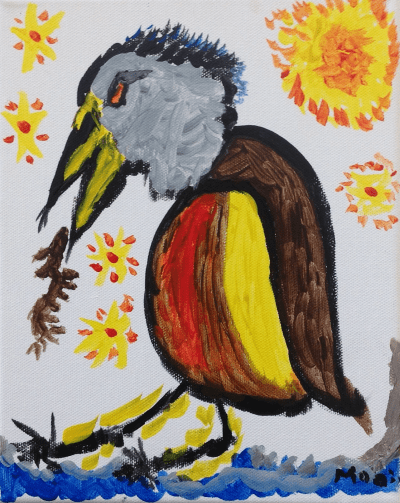
Journal: I had the great pleasure of working with Geoff Slater this afternoon. He sat me down at his painting table, alongside all the children, and gave me a palette, brushes, water, cleaning paper, and a rainbow of paint. Then he placed an easel and a canvas before me and put an apron on me to protect me from the paint. “Go for it,” he said. I looked at a field of white … and I remembered … “Drawing is taking a line for a walk” … so I drew a line, first a beak, and then a head and an eye, then I added wings, and legs … it was wonderful. The children were laughing with me and I was slapping the paint around with great delight. “Let me see, let me see,” they cried. And then, when they saw it: “What is it?” It was even more fun when I started to fill the spaces between the lines. This is, or was, the first time I have ever placed paint upon a canvas. In my old age, I have started to paint. “Is it a worm or a fish?” they asked. “Is the bird going to eat it?” “Is the bird spitting it out?” Such curiosity … and even I didn’t know the answers. “What’s the bird’s name?” asked one little girl. “Eagle-eye,” said the other. “And the worm’s called Squirmy,” added a third. “Are they talking?” another chimed in. “Yes,” I said. “I think they’re friends and they’re having a chat.” What fun. We left the painting out in the sun to dry … and now I don’t know where it’s gone. Let me know if you see it, anyone.