My Father

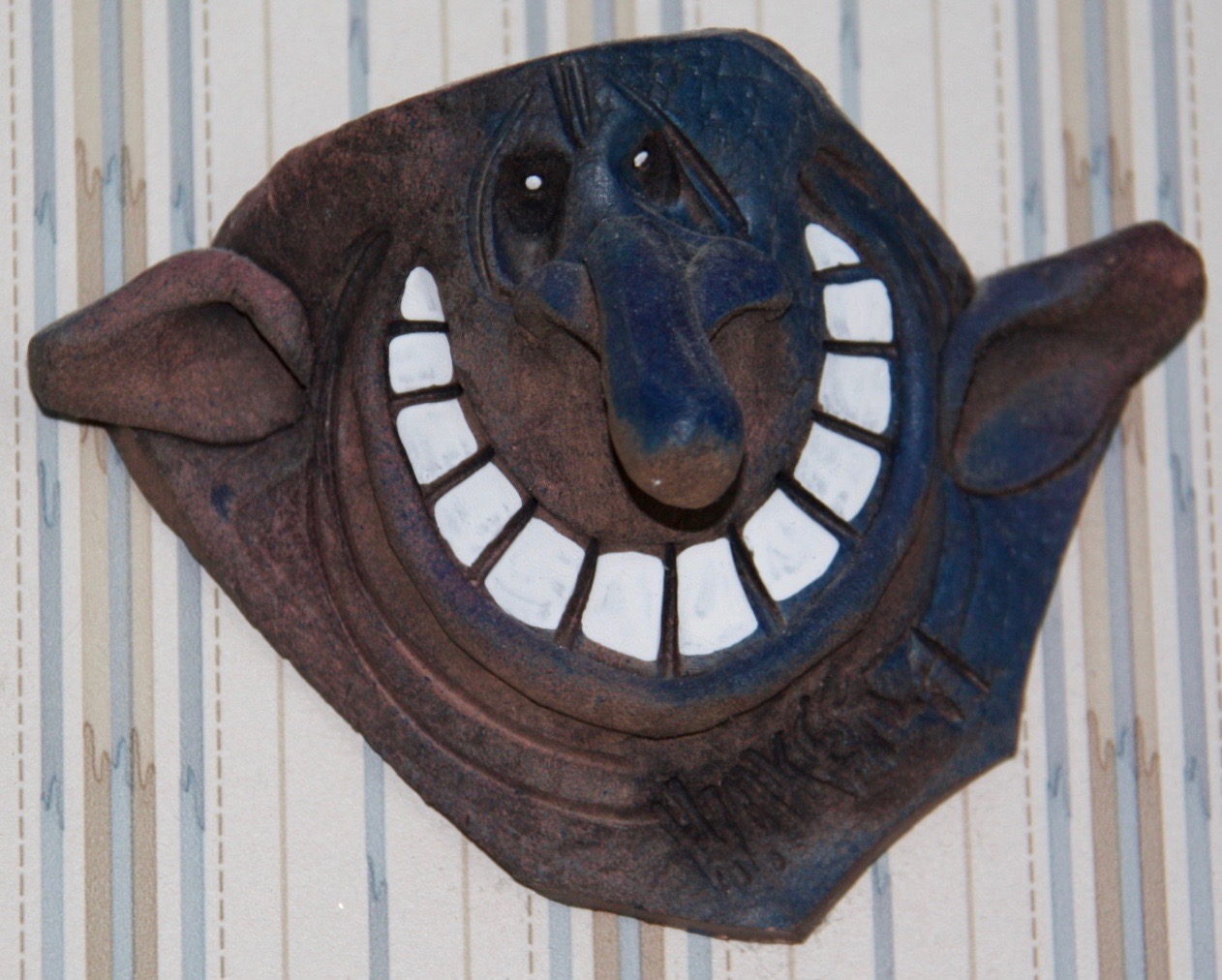
The Jaguar Symbol of Monte Alban, Oaxaca, Mexico.

I saw my father yesterday evening. I walked through the zócalo, opened the main cathedral doors and walked in. The doors closed behind me. I looked towards the main altar and there my father stood, motionless. The evening light shone through the engraved glass panels and illuminated him as if he were some long passed saint come back to visit me. We stared at each other, but I couldn’t open my mouth to speak. The hairs on my neck stood on end and my hands shook. When I forced my mouth open, words stuck in my throat. He wore his best grey suit over a light blue shirt and a dark blue, hand woven tie: the outfit in which I had buried him.

               Three old women, dressed in black, broke the spell. One stood in front of me and wouldn’t let me approach my father. She held a large bag of knitting in her hands and the wool spilled everywhere as she pushed me away. The second threatened me with a pair of scissors that she held in her left hand and thrust towards my face. The third smacked a tailor’s measuring rod against my father’s head.  He nodded, smiled sadly, and they all turned their backs on me and hurried away out of the cathedral and into the square.

               Just for a moment, I stood there in silence. Then I pulled the doors open and ran in pursuit of my father. The setting sun filled the square with shadows that whispered and moved this way and that, as if a whole village had come down from the hills to walk beneath the trees and dance in the rays of the dying sun. I stood on the cathedral steps and called out my father’s name, but I could see no sign of him among the cut and thrust of the shadowy crowd.

               I ran out into that crowd and pushed at insubstantial people who stood firm one moment and then melted away the next like clouds or thick mist. I came to a side street and saw real people, flesh and blood beings, a group of villagers gathered behind their band. I stopped and as I did the village elder put a live match to the taper of the rocket that he clutched between his thumb and forefinger. The taper caught on fire and the rocket soared upwards with a searing whoosh. The village band marched forward and started to play a traditional dance as the rocket clawed its way into the sky to explode with a loud knock on the door of the gods.

               Tired of grasping at shadows and afraid of this living phalanx of men that marched towards me I went back to the cathedral and knelt at the altar of La Virgen de la Soledad, the patron saint of Oaxaca. Real wax candles stood before her altar, not tiny electric lights, and I inserted five pesos in the slot, took a taper, and lit a fresh candle from an ageing one that had started to sputter. I knelt and, for the first time in years, I prayed. I prayed for the soul I had saved from extinction by lighting my candle from another’s flame. I prayed for my father and my mother and, above all, I prayed for myself.

               On the way home to my second-floor apartment where I live alone, I bought two litres of mescal, one to send me to sleep, and the other so I would survive the next morning.

Comment: A Golden Oldie that I had forgotten about. I found it among the drafts of earlier work. Monte Alban is also known as Dani Ba in the indigenous language of the region. Click on the link for more on Monte Alban. And click on this link for another piece on my father and Oaxaca. It’s a funny thing about Golden Oldies: sometimes they stick with us and are ‘unforgettable’, but sometimes they were better off left in the pile that gathers dust, like a forgotten book on a forgotten shelf. Speaking of which, have I told you about the time when …

Milton Acorn and the Jack Pine

Milton Acorn and the Jack Pine

            I met Milton Acorn in the photocopying room of the university in which I taught. I didn’t know who he was, but I soon found out.
            “Oy! You,” he waved his strong, carpenter’s hands, and stabbed me with a gnarled index finger.
            “Are you Milton Acorn,” I asked. “The poet?”
            “Yup. Make this machine work.”
            “I’m meant to be taking you to lunch.”
            “Got this job to do first,” he pointed at the machine. “Turn it on.”
            I typed in my code and the copier leapt into life.
            “Now go away. I need to be alone.”

            A few minutes later, I returned to find him lying on the photocopier, eyes shut, face pressed against the glass. Lights flashed, the copier whirred, and a copy of his face emerged. He descended from the machine and added his face to the pile of photocopies that lay at his feet.
            “Tape,” he said. “I need tape,” he again stabbed me with his finger and held out his hand.
            “I’ll go and get some.”
            I went to my secretary’s office.
            “What the heck is he doing in there?” she asked.
            “I haven’t got a clue. But now he wants some Scotch tape,” I held out my hand and she handed me a roll of tape “Thanks,” I said.

            I gave Milton the tape and watched as he taped the copies together. He had photocopied his whole body, arms, legs, back sides, feet.
            “Me,” he said happily. “That’s me,”
            Triumphant, he showed me his work: a self-portrait, shadowy and cloudy, still warm, with him all whiskered and worn, smelling still of photocopying ink, unique, unmistakable, uncouth, unseemly, but the real Milton Acorn, a jack pine sonnet self-grown in his own poetic image.

Once Upon a Time

Once upon a time …

            Once upon a time, there was a man who carried a large round rock upon his back. It was huge and heavy, like the globe that Atlas carried. One day he felt tired, laid that rock upon the beach at Bocabec, waded out into the Bay of Passamaquoddy, and was never seen again. He left the rock there for my friend to find. My friend called it Magic Rock, but what he did with it and thought about it is his tale to tell, not mine. I must tell another story.
            Once upon a time, St. Patrick arrived in Ireland. He celebrated Easter on the hill above Tara, the royal palace of the ancient Irish kings. Then he walked down the hill to their palace and tried to convert them to Christianity. But that is another story, and it is not mine to tell, even though the name of Tara was given to the red and white house of another friend of mine, red and white, like the dogs and cattle of Ireland. But that’s not my story.
            Once upon a time, a rich and powerful man came to St Andrews and built a summer home on the hill above the bay. Later, another friend of mine purchased it, painted it red and white, and turned it into a wonderful home for guests and visitors. I wanted to tell her story, but it’s hers to tell, not mine. I can only tell my own story.
            Once upon a time, my friend who lives on the shore at Holt’s Point, walked on the beach outside his house and found an enormous, metal ball, weighing almost two hundred kilos. It was almost as big as Magic Rock. It lay there, on the shore waiting for some one to find it. My friend went home, drove back to the beach in his truck, winched the ball onto the flatbed, and brought it home. What he did with it is not my tale to tell. I must tell my own story.
            So, what is my story? What tales do I have the right to tell and how shall I begin my tale? Well, once upon a time, in Ty Coch, a red brick house on the Gower Peninsula, in Wales, a little boy was born … and that is my story … but I will not tell it here and now.  Instead, I’ll tell you another tale. But you will have to wait until tomorrow.

Blueberry and the Night Bumps

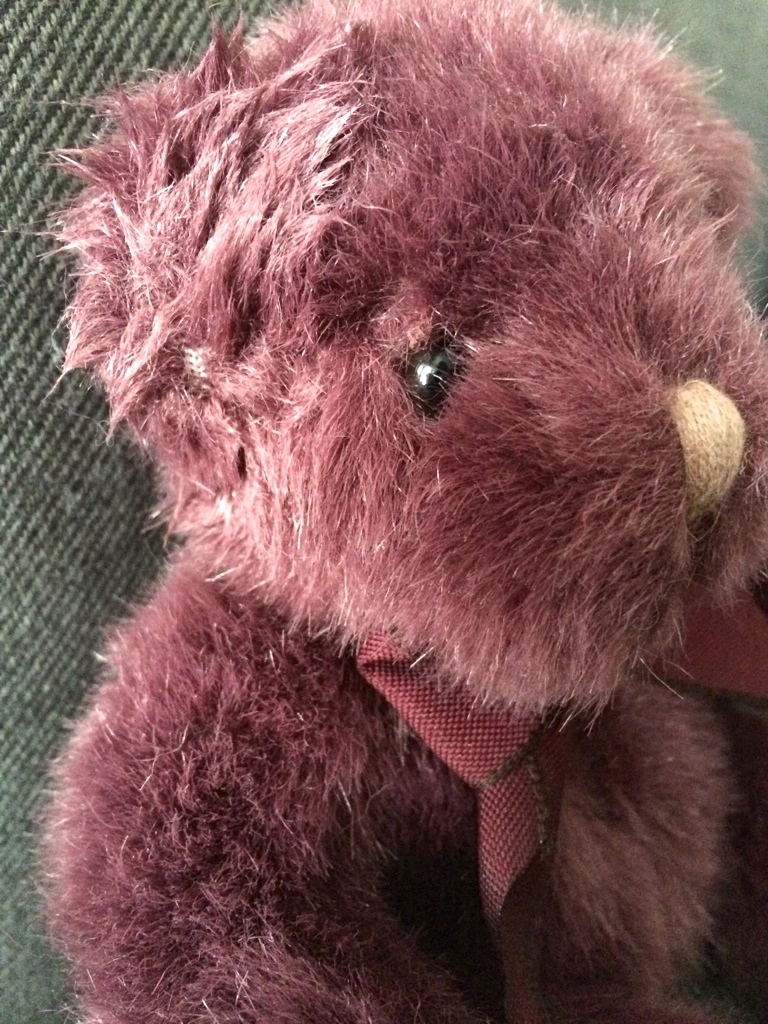
This isn’t Blueberry.
It’s Purple Martyn the Purple Peril.
Never mind. He looks sad.
Perhaps he’s feeling blue.

Blueberry and the Night Bumps

Blueberry is a nocturnal teddy bear. At night he stands by the side of my bed and protects me all night long. Before I get into bed, I take Blueberry from the dresser and place him beside my bed. Only when he is there, on guard, do I get into bed tuck myself in.

“Goodnight, Blueberry,” I say to him, but he never replies. He has a job to do. As I drop off to sleep, he comes alive. Some nights I pretend to fall asleep. When I start to fake snore, Blueberry begins to walk around the bedroom.

He walks to the door and makes sure it is properly shut. Then he looks under the chairs and behind the dresser. Next, he opens the closet door, looks in, and checks that no Night-Bumps are hiding in there waiting to go BUMP in the night.

I am afraid of those Night-Bumps. One night, when Blueberry wasn’t there, a Night-Bump came and sat on my head and went bump-bump-bump all night long. I couldn’t get any sleep. Next morning, my head ached and I didn’t want to eat my breakfast. Nasty Night-Bumps.

The last thing Blueberry does is to check beneath the bed. Sometimes he crawls right underneath it. One night, I woke up to hear an awful noise, squeaking and screaming and a gnashing of teeth. Then silence fell.

Blueberry emerged from beneath the bed holding something that once had wriggled but that would never wriggle again. He walked to the waste-paper basket in the corner, took out and old sheet of paper, wrapped his little bundle in it, dropped it into the basket, then came over to see me.

“That’s the last Night-Bump,” he said. “It struggled wildly, but I got it before it could go bump. You can go back to sleep now. No Night-Bump will go bump in here again. They are all too afraid of me to come back. And don’t worry: if there’s anything else comes in, I’ll get it.”

“Oh Blueberry,” I said, and reached out to hug him.

“Can’t do it,” he sat down and showed me the soles of his feet, one by one. LOVE YOU: these words decorate Blueberry’s two back paws, with one word sewn into each. Usually, I can only read the message by day, when Blueberry sits down and rests.

LOVE YOU stood out as he sat down and raised his legs to show me his message. Then he got back up.

“No hugs. I’m on duty. No nightmares. No worries. Sweet Dreams. And back to sleep you go now.”

And I did.

Next morning, I picked Blueberry up, gave him a big hug, and set him down on the dresser, feet up. LOVE YOU, his feet said.

“Love you too, Blueberry,” I said. And then I added: “Everybody needs a Blueberry.”

I swear Blueberry nodded his head.

Teddy and the Angels

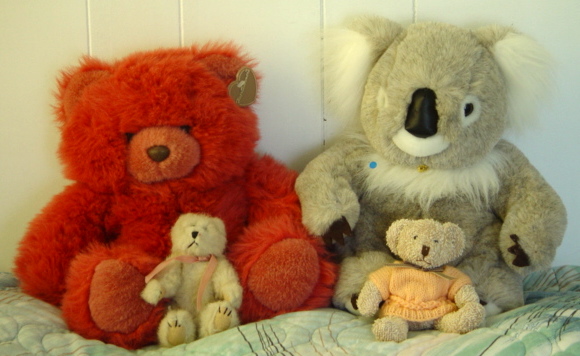
Rosie, Teddy (BR, LR) Basil, and Orange (FR, LR). They are on holiday in Ste. Luce-sur-mer. Blueberry gets car sick and refused to travel.

Teddy and the Angels

Warm in Bed. Cozy. I roll over and the flashlight clipped to my Teddy Bear’s ear drives its hard, metal lump into my face.
            “Are you awake?” Teddy’s soft voice lilts across the pillow.
            “I am now.”
            “Look!” Teddy points with his little leather paw. “The moon: it’s climbing the fir tree.”
            Sure enough, a thin fingernail of gold is perched on a branch. It hides its face among the fir’s darkness and vanishes for a moment.
            “The maple tree has a garland of tiny Christmas lights,” says Teddy, pointing again.
            “Those aren’t Christmas lights, they’re stars.”
            “Spoilsport. Look, that one’s moving. I think it’s an angel.”
            “What time is it, Teddy?”
            “I don’t know.”
            “Here, lend me your flashlight.” I pull him towards me, switch on the torch, and focus its light on my wristwatch.  “4:55 AM. That’s the early morning flight from Toronto. It’s a plane.”
            “I’d much rather it was an angel.”
            “Me too.”
            “Can we pretend it’s an angel?”
            “Of course we can. But it’s gone now.”
            “Perhaps angels don’t live long when they come to earth.”
            “I think they live for ever. Especially if we believe in them.”
            “Do you believe in angels?”
            “I was taught to believe in my guardian angel.”
“What’s a guardian angel?”
“He’s the one who looks after you when you sleep at night.”
“But you don’t need a guardian angel. You’ve got me.”
“But you’re a teddy bear, not a guardian bear.”
“That’s true, but you’ve got Blueberry. He’s your guardian bear. Look at him standing there, on guard, all night long to protect you from the Night-Bumps.”
“Ah yes, good old Blueberry. I’ve got a busy day today. I need some more sleep.”
            “Okay. Blue berry and I will watch over you. I’ll watch over you. I’ll let you know if any more angels climb the tree.”
            “That would be nice. Now I’m going back to sleep.”
            “Good night. Or should that be ‘good morning’.”
            Some days, when I wake up, I think I have dreamed all of this. Other days, I believe in talking teddy bears and angels. Today, I’m not so sure.

Fish Nets

Fish weirs in Fundy
Poles in Passamaquoddy
anonymous local artist

              … and speaking of fish, there are the fish nets on their poles stretched from horizon to horizon, at low tide, and the fishermen in their waders walk out to the nets where the mud is squishy from the sewage system which dumps all the sewage in Swansea bay, but the tide was younger then, and stronger, and there weren’t so many people, so the beach was always swept clean in those days by the tide, and the sewage was always swept out to sea … and the fish were nice and fat and healthy and you could buy a couple of whiting or flounders, dirt cheap, and bring them home, if you asked nicely, and plaice and sole, well, they’re all flat-fish, really, and our cousins from London could never tell the difference between them, but we can, and I’d tell you, but it’s so long ago, that I’ve almost forgotten, and it’s partly size and partly colour, and partly spots, and I forget so many things now …  but I don’t forget the sea as it licks at your toes, and you standing there, early in the summer, as white as an ice cream, and the sea climbs up to your ankles, and then your knees, but on Swansea Sands, at the Slip, or at Brynmill, you have to walk miles and miles before it reaches your waist … especially when it’s out and low … but you have to be careful for there can be deep holes and the mud can be slippery … though nobody ever falls down, oh, we were so much cleverer when I was young, … but there are rumours of quick sands out there at low tide, out beyond the fish nets … out where the banana boats ride … out where the bright lights are seen at midnight … the flashes and flares … the mysteries of the unidentified flying objects, saucers and the like, that visit us in Swansea, to learn to speak Welsh, or so the locals say, so that later they may n=mingle among us, and eventually take us over … once upon a time, when I was young, and the world was all new-born, that was not a conspiracy theory … and it was not fake news … maybe that’s why we moved to Cardiff …

Rats

Rats

Black clouds build over the Bristol Channel, threatening to cross the Severn from Ilfracombe to Brandy Cove and climb inland to rattle our windows and bounce rain off our corrugated roof.
            We run out to the lane, looking for the dog, calling his name. Hoping to get him in before he gets soaked. The rubbish dump outside the gate sits on a concrete stand and dominates the lane. Tall and stinky, the red-brick structure rustles with scavenging, skirmishing rats. Pinned to the dump, a hand-written notice: “Please do not light this dump.” We smile as we read it. Our neighbours will put a match to this dump, one dry night, on the way back from the pub.
            Kim, Nana’s Wire-haired Fox Terrier, spends his days at the dump in an effort to achieve his life’s desire: the elimination of every worrying, scurrying rat that ever inhabited the planet. When he tires of killing rats, he will bring their bodies home to the bungalow. Sometimes he lays them in rows outside the backdoor: rats, mice, field mice, voles. Sometimes he brings them inside and places them on the concrete base beneath the old cast-iron stove. Every day Kim sacrifices to my grandmother, his Gower Goddess, and lays the victims out on her altar.
            The rain is close. We run back down the lane to avoid the storm that is now upon us. Violent and short-lived, like so many summer storms in Wales, raindrops will thump against windows and roof. Lightning will flash, thunder roll its celestial drums, and the wind will whip its lash round the chimney. We sit at the table and sip hot cocoa. No sign of the dog.
            Later, when the storm has passed, we wander up to the lane, avoiding the deeper runnels of muddy water, and stepping from high point to stony high point. We scurry hurriedly past the dump and listen to the rats. They will survive for another night. Nobody will be able to light the dump after rain like that. Back in the field, we fill up the water can, take a handle each, and carry the precious liquid back to Gran.
            We walk to the back door. Our neighbor is standing there, crying.
            “I didn’t see him,” she stammers. “He ran out from the dump as I drove round the corner,” she points to Kim, laid out on the back step, his broken body wet and bloody, the last rat he would ever catch still clasped tightly in his jaws.

Brân

IMG_1063 (2)

Brân

Golden in the starlight, moon carved mountains and valleys, taut the skin, treacherous to the touch.  Heavy he is, glowing. He and his children. We carry them to the dark beneath the trees. Locate the secret, sacred place. Dig deep, bury him with the hoard.
We all know the place. Have measured it with footsteps. None will reveal it. Not under torture. Rather our lives than darkness eternal.
My mother limps beside me. Back-bent and broken. A crone in the moonlight. She’s been here before. Much too often. That’s how she bore me. Caught by the heathen. Captured and taken and twenty times taken.
Me, the blond son. Son of sea-raiders. Not black like my brothers. But never forsaken.
Head of the household, her man rejected her. Called for the Druids with mistletoe and magic, herbs and fragrance, scourging their medicine.
She would not drink them. Said she would keep me. Her biggest baby. Blond. To take vengeance.
Behind us, the villa in flames, there in the distance. Smoke rises heavenwards. Blots out the stars. “We should have fought,” my brothers say. “You would be dead,” my mother replies.
Brân, the white crow. King Arthur revenant. I fly the land, my brothers behind me. Black-haired, black-feathered. Strong as the crow flies. We travel at night. Fast now and furious.
My long bow penetrates. Shatters oak shields. Kills at a distance. None can withstand it. Daylight finds us grouped in the forest. Close to the place where the dragon lies buried. Close to my mother, the place where she sleeps.
Oh yes, they hunt us. But they don’t dare find us. Swift is their fate if they come close. Frightened they are, feared by the finding, wordless and dumb at the swift ending.

Comment: It’s an ill-wind, they say, blows nobody any good. So, ipso facto, some good must come from even the worst of things. Maybe, like Charles Dickens, I should write: ‘These were the worst of times, these were the best of times.’ The worst, because we have been under lock down, first voluntary, then involuntary, and now voluntary again, for 83 days. The worst, because we know that many people are dying and that many, many more are suffering. The worst, because we see some people, who think they are above the law, flouting the law and getting away with it while putting other innocent people at risk. The best, because we have seen extraordinary sacrifices made by the humblest people, many of whom, shop clerks, garbage collectors, street cleaners, bus drivers, taxi drivers, nurses, care-workers, house cleaners, were seen, if they were seen at all, as cheap labor to be exploited. However, thanks to CV, we now see them for what they are: the keys to making our lives and our economies function. The best, because where precautions have been taken the death toll has dropped and so have the infections. The best, because once again, we are free to move around so much more. However, many of us, after so long, no longer want to.

For me, safely distanced among the trees in my ivory tower, these have also been the best of times. I have made many new friends online. I have restructured the ordering of my acquaintances. I have gone into my computer files and found things that I cannot even remember having written. One such is Brân, the white crow, who is said to be King Arthur, still alive, and flying everywhere, ready to protect his from the evils that beset them. I do not know when I wrote this piece. Nor do I remember where the ideas came from. In what secret fold of the mind were they born? I do not know. But I do know that I have seventeen manuscripts, many of them rediscovered during this Dickensian ‘best of times / worst of times’, and all of them awaiting publication. This one is from a 67 page manuscript called A Cambrian Chronicle. 67 pages … and I don’t remember writing any of them.

Invisible Scars


SD 16

Invisible Scars

            Our minds absorb words as blotting-paper soaks up ink. Phrases carve beehives deep in our inner circuits. No te preocupes / don’t worry. Yet tone and carry are different in each language and the comfort-blanket serenity of no te preocupes does not translate.
Nor do the catcalls from the soccer, aimed equally at opponent and referee, and tumbling raucous from the stands where people sit. Shrill whistles sound in the bull ring: a matador who seems afraid to approach this particular bull for reasons only known to him, yet his shakiness visible to all who watch and understand what they are seeing.
The Cordobés answers the telephone he places on the bull’s nose, yet fails to approach between the horns and his sword rebounds off bull bone: pincha hueso. Each one wounds, the last one kills. El Viti, stately, graceful, an elderly churchman proud of his vocation and always willing to perform to perfection the weekly ceremony of the sacrifice. The boos when the bull enters the ring, stumbles, and comes up lame and limping. The cheers that accompany the arrival of the seventh bull. The refusal to eat meat that has been slaughtered in the bullring, even though it is advertised outside the butcher’s: tenemos solomillo de toro de lidia / we have tenderloin steaks from fighting bulls. Bulls who have led the best of lives, fed on the tenderest pastures by flowing streams. Bulls grown for slaughter and public sacrifice.
Guernica. The bull fight in the sand-filled square. Except it wasn’t a fight, it was more a circus. The slippery pig. The hens and chickens. The rabbits and hares. All the animals running scared. The animals released, one by one, and the spectators jumping into the ring, really a square, one by one, and chasing down the animals, taking them home for dinner, if they could catch them.
Then the bigger beasts. The mule, ferocious, jumping into the air, kicking four tormentors, one with each leg, and biting a fifth with his teeth. No fearful, clucking chicken this, nor the cow who came after with her padded horns. Participants moved more carefully now. She watched them from her querencia the place where she chose to fight to the death. She knelt, scraped off the rubber balls that covered her horns. Re-armed, she charged and the crowd scattered, all but one young kid, caught, fallen to the ground, the cow standing over him, ready to gore again.
Sixteen years old, an outsider, I jumped with others over the barrier, twisted this away and that, thumped the cow’s side, smelled her fury, her fear, the whole soured being that emanated from her. Together, we hustled her, bustled her, dragged her kicking, butting, from the ring, backwards, pulled by the tail.
Visible scars of damaged animals. Scars of the participants. That young man who broke his leg. That old man, inebriated, stuffed with food and drink, who loosened his belt to move more freely. We watched as his pants slipped from his waist to fall around his knees and trap him, just as the cow charged. He survived but will bear the scars forever, some visible, many not.
Long summer days, on the Sardinero, the Segunda Playa, playing soccer. Different rules, different skills, different swear words: I carry a dictionary tucked into my bathing trunks and refuse to play while I look up the words spat at me by my opponent. Good heavens, I think, is that anatomically possible? The ball bounces away on the hard, sand ridges. I chase it and steadily dehydrate under the hot sun. A sea-salt wind desiccates my body. My mouth fills with salt water when I swim out to retrieve the ball from the sparkling sea. My tongue sticks to the inside of my mouth. When I spit, I spit dry and everyone laughs. Now I am totally dry, shiver, and no longer sweat. Now I am no longer my self, but I’ll never be one of them.