Spring Birds

Each day sees another spark of brightness in the grass, in the trees, or at the feeder. Where, I wonder, have they been? In whose back yard did they winter?  Some, stray thoughts perched for a moment on a branch in the mind, fluttered last fall in the falling snow and melted away. Others, I know, stayed here with us and we fed them throughout the short cold days.

IMG_0017.jpg

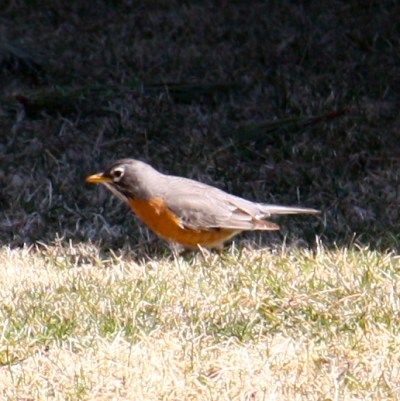
The robins, even though they are not my English robins, are my favorites, perhaps because they remind me of my childhood home. Less bold than those of my youth, they fly when we draw near and do not sit on the spade handle watching for worms as we turn the early earth and shake the garden back to life.
IMG_0033.jpg

Sentry duty: and they march up and down the lawn pacing their quicksteps, then standing to attention. They strut their stuff, turn their heads, listen, and look like guardsmen on parade outside our pastoral palace.

IMG_0014.JPG

With the guardsmen come the workmen, the busy birds, the ones who tap on the trees in search of insects or to set the juices running. Shy, they turn away and hide behind the trunk. But if we are quick, we can catch them, heads turned, when absorbed in their work, they forget to fear us.
IMG_0063.JPG

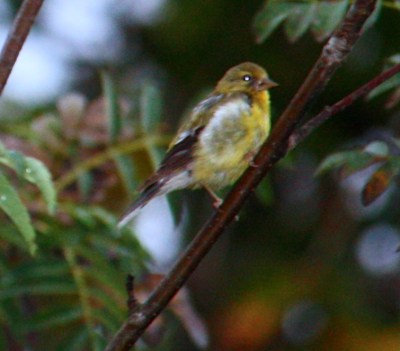
And the song-birds, shiest of all, often heard, their melodies, but their quicksilver spirits seldom seen except by chance and the artist’s luck and speed of finger. But listen: other songs throb their melodies on the wind and most days now we wake to music. A calling in the trees in the evening’s glow also tells us the world has turned once more and the birds, the glorious birds, the dwindling flocks of endangered birds, less this year than last year or the year before, are back. We must welcome them and cheer them while they are still with us.  Neither we nor they may  endure much more.


Black Angel

039.JPG

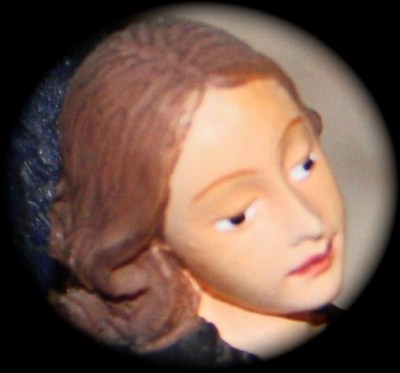
I first saw the Black Angel in Aldebarán’s cultural store in Ávila (2006). She sat there, in the shop window, along with several other angels, and I worshiped her from the distance of the street. Her image was taken from an original painting from Rogier van der Weyden (1399/1400-1464). This was turned into a 3-D image and then converted into the statue I saw in the shop window.

I brought the statue back to Island View, placed it on the shelf above the fireplace, where it still rests, and wrote several poems on the theme of Angels. I gathered them together in a chapbook entitled All About Angels that I self-published in Fredericton in 2009. The chapbook was dedicated to Clare’s great-aunt, D. E. Witcombe who departed this world on October 15, 2008.

All About Angels was also based on a book of a similar title, Sobre los Ángeles, written by Rafael Albertí, one of the poets of Spain’s Generation of 1927. I avoided the ambiguity of the Spanish title — Sobre (in Spanish) can mean Above or Beyond as well as About — by limiting my own title to All About Angels.

For Carl Jung, angels are the messengers sent to inform people of the state of their world. For me, they are also the wild creatures that inhabit the world around me and often take the form of birds and other spiritual creatures. They can be best seen in those moments of solitude when we are most open to the natural world around us. Then, and sometimes only then, we can hear the urgent messages they bring.


Black Angel

You cannot hide
when the black angel comes
and knocks on your door.

“Wait a minute,” you say,
“While I change my clothes
and comb my hair.”

But she is there before you,
in the clothes closet,
pulling your arm.
You move to the bathroom
to brush your teeth.

“Now,” says the angel.
Your eyes mist over.

You know you are there,
but you can no longer see
your reflection in the mirror.

Angel Choir

(on seeing the Northern Lights at Ste. Luce-sur-mer)

listen to the choristers with their red and green voices
light’s counterpoint flowering across this unexpected son et lumière
we tremble with the sky fire’s crackle and roar

once upon another time twinned in our heavenly prisons
we surely flew to those great heights and hovered in wonderment
now our earthbound feet are rooted to the concrete
if only our hearts could sprout new wings and soar upwards together

the moon’s phosphorescent wake swims shimmering before us
the lighthouse’s fingers tingle up and down our spines
our bodies flow fire and blood till we crave light and yet more light
yet when the lights go out we are left in darkness

close up.jpg

 Croaking Angels

Their tunes are one note symphonies,
croaks of joy
moving their fellows to ecstasy,
exhorting them to share
the splendors of ditch life,
in a springtime bonding
that will loft them to the skies.

There’s an ancient magic in this calling:
love and laughter,
moonlight and water,
all the joyous things
one links with spring.

Moonlight swings its cheerful love lamp.
New leaves and buds are also known to sing.

Patience

IMG_0228

   ‘Paciencia y barajar,” / Patience and shuffle the cards Miguel de Cervantes wrote, a long time ago, in the early seventeenth century. I think of it as watching and waiting. We must learn to observe, to stand still and watch the world around us. Who knows what lies there, just beneath the surface, waiting for us to find it?
We know our work is lonely and we thrive in the loneliness of the blank page, the blank screen. We stare at the water’s surface and wait and watch and then we shuffle the cards, the keys, the letters on the page, and something emerges. What will it be?

IMG_0233

   Carpe diem / seize the day: with the moment seized, we have time now to think, to polish, to work at it until it is ready. And yes, there is pride in that amber eye, pride and a sense of satisfaction.
We know our work is never done. We worry at it, work around it, gnaw it as a dog gnaws at a bone. Little children gathered round our grandma’s stove as the cookies cook we ask impatiently “are they ready now?”
Impatience is our enemy. We must wait in silence: wait and watch. Sooner or later that silver flash of inspiration will light up whatever page we happen to be decorating.


Tuesday’s Child

IMG_0220

Tuesday’s Child

Thursday’s Child has far to go …
so too does Tuesday’s child,
especially this one, when he sets out
on a Tuesday on a long journey.

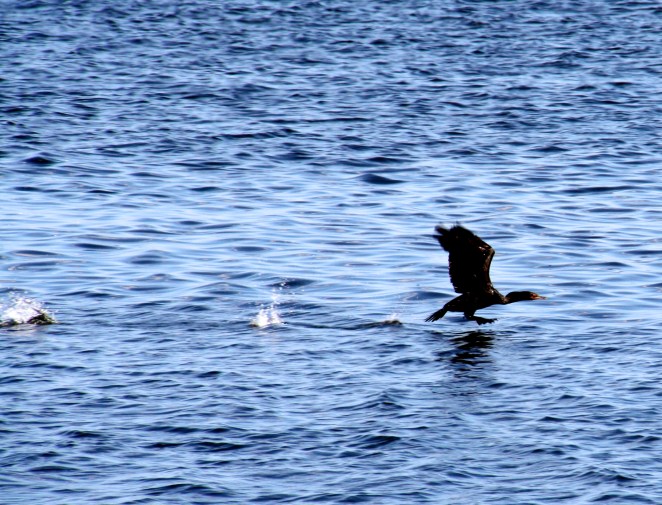
Just by chance, I caught this cormorant.
“Behind you, quick,” said Clare.
I turned and ‘Click!’

Such a miracle:
the first steps of flight
taken over water.
That first step heavy,
the second one lighter,
and the third one
scarcely a paint brush
pocking the waves.

The need for Tuesday’s Child
to take flight lies deep within me.
Fleeing from what?
Running towards what?
Who knows?

All I know is that the future
lies to the right of this photo
and the past lies to the left,
and I don’t know
what either might contain.

But I do remember the words
of Antonio Machado:

‘Caminante, no hay camino,
sólo hay estela sobre la mar.’
traveler, there is no road,
just a wake across life’s sea.

We may not know what lies ahead
but, like a ship at sea,
we leave white water behind us
and that wake tells us
where we have been
and what we have done.