Friday Fiction: Teeth

img_0181

Friday Fiction
13 April 2018
Teeth

Lunchtime.

Tiggy opens a can of tom8to soup and heats it on the stove. She slices the remains of yesterday’s loaf of bread into one inch cubes and fries them in olive oil and garlic. Tom8to soup with croutons. Then she puts two slices of bread in the toaster. Her father will only eat toast soaked in butter and layered with Marmite when he eats tomahto soup.

“Lunch is ready,” she calls out.

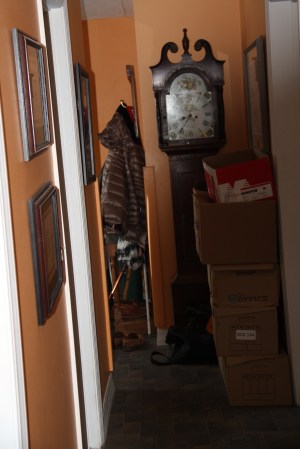
The black American Cocker Spaniel, bought by Tiggy’s late mother, in a moment of madness, by telephone, unseen, camps in the kitchen. It nests at the far end of the table, by the stove, and defends its territory with warning growls and a snapping of yellowed teeth. Tiggy will not go near the dog.

“Lunch is ready,” Tiggy calls out, a little bit louder. Dog, as they call him, growls and clatters its teeth. It has hidden a treasure in the folds of its old, gray comfort blanket, and guards it with the fierce, loving worry of a dragon protecting its golden hoard.

Tiggy’s father enters the kitchen as she places the soup on the table.

“I’m not ready to eat. Put it back in the pot.”

“What’s wrong, dad? I thought you were hungry.”

“My teeth,” he mumbles through a mouthful of pink gums. “I can’t find my teeth.”

“Where on earth did you put them?”

“I don’t know. If I knew where I’d put them, I wouldn’t have lost them.”

Tiggy’s father circulates round the kitchen opening drawers, lifting saucepan lids, and shaking empty yogurt pots to see if they’ll rattle.

“I can’t find them anywhere. I can’t eat lunch without my teeth.”

“But it’s only soup, dad, tom8to soup.”

“I don’t like tom8to soup. Your mother always made tomahto soup. Why can’t you be more like your mother?”

“Sorry, dad. I’ll call it tomahto soup, if that will make you feel better. But it’s still made out of tom8toes.”

“Don’t be so sarcastic. Help me find my teeth,” Tiggy’s father stomps towards the stove and Dog growls fiercely from its blanket as it guards its treasure.

“Take that, you dirty dog,” Tiggy’s father lashes out at Dog with his stick and cracks it across the head.

“Dad, stop that. It’s not Dog’s fault.”

Dog howls and spits out what it is chewing.

“There they are,” Tiggy’s father bends down, picks up his teeth, still hairy from the blanket and bubbly from Dog’s saliva. He pops his teeth into his mouth.

“That’s better,” he says, “now I can enjoy my lunch.”

Thursday Thoughts: Secrets

IMG_0027

Thursday Thoughts
Secrets
12 April 2018

Thursday Thoughts: there are none. This morning, I read the online newspapers, I played a game of chess against the computer, I played two games of solitaire, also online, I checked my dwindling financial resources, and then I sat down to write.

The piece that I wrote was so personal, so deep, so full of darkness, that I will keep it under cover, hidden from the light of day. Writing that expresses the authenticity of being, indeed: but when that being is weak and full of fear, how can that writing be exposed?

A flower in the desert, blooming unseen? An exposé of that which is better kept unexposed? I think of the multiplicity of ghosts best kept safe, old bones in Mother Hubbard’s Cupboard.

‘He who fights and runs away, lives to fight another day.’ My grandfather explained to me that this was how he had survived the trenches in WWI. His medals in the cupboard upstairs, his oak leaves for bravery, belie the stories he spun when I was a child.

Yet today, this Thursday, discretion is the better part of valor. I am the guardian of my family’s secrets. Some of them will be kept. Many of them must be kept. That is my thought (and my decision) for today.

Wednesday Workshop: Reading

IMG_0167

Wednesday Workshop
11 April 2018
Reading for Writers

Miguel de Cervantes once wrote that he was so fond of reading he would pick up even the scraps of paper he found in the street to read them if anything was written on them. This is well-known. What is less known is that Don Quixote, his immortal novel (DQI, 1605, DQII, 1615) is a masterpiece, not only of writing, but also of reading.

From the initial sortie, a prose transcription of an earlier short play, to the Scrutiny of the Library, Cervantes demonstrates right from the start his awareness of current trends in poetry, theatre and prose. In addition, he shows (especially DQI, chapter 47) his acquaintance with contemporary literary theory, as E. C. Riley has so ably established in Cervantes’s Theory of the Novel.

Cervantes begins with the traditional Renaissance novel (DQI, 1605) in which he experiments with plays and poetry turned into prose, oral and written histories, pseudo-autobiographical episodes, the picaresque novel, the pastoral novel, the Italianate Novel, the picaresque novel (briefly), his own versions of the realistic Spanish short story, and then, after a ten year gap during which he receives all kinds of reader feedback, he invents (DQII, 1615), the self-referring modern novel. DQII refers back to DQI as if it were true history. Don Quixote on his ravels meets with people who recognize him, for they have read his story and know all about him. The fictitious character establishes himself as an almost flesh-and-blood living person.

What can we, as writers, learn from this? Above all, we must learn to read copiously, not just once in a while, but all the time. Not only must we read, but we must learn how to read. Yes, we can read for knowledge and information; yes, we can read for pleasure and enjoyment; yes, we can read to lose ourselves and wash away the cares of the world. However, as writers we must learn to read in a different fashion. We must read in search of the narrative structures that inspire other good writers. We must read in search of the iterative thematic imagery that binds a text with meaningful, repeated images. We must read in search of the poetry that sates the soul’s constant thirst for beauty. We must read in search of the dialog that cuts to the bone and reveals the hidden character of the protagonists. We must read in search of the layering that allows us to give extra meaning at all levels of the narrative. We must read in search of the secret that allows us to trim all unnecessary material in order that our stories may be spare and sparse with not an extra word or thought.

Reading: I have just finished taking an eight-week online course with the School of Creative Writing at the University of Toronto. In the course of those eight weeks, I read the following books.

  1. 3 short stories a week, recommended by the instructor, the wonderful novelist Kerry Lee Powell, to illustrate each week’s lesson. [24 stories]
  2. 14 first drafts, one from each of the magnificent students in the course (I had the honor of being the fifteenth student). [38 stories]
  3. 14 revised stories. [52 stories]
  4. 14 first drafts of a second story. The course asked for two stories to be written by each participant over the duration of the course. [66 stories]
  5. 14 revised drafts of this second story. [80 stories]
  6. My own voluntary reading included Raymond Carver’s What we talk about when we talk about love (17 stories), Cathedral (12 stories), and my own short story collection, Bistro (35 very short stories). Recognizing the errors, weaknesses, and inaccuracies in my own collection reduced me to tears. [144 stories]

I have spent eight wonderful weeks exploring creativity and the art of short story writing.  Am I a better writer for all that work? Undoubtedly. I can see and think much more clearly and I am beginning to gain a better understanding of how short narratives work. I am a better writer, but I am not yet a good one. There is still a long way to go.

I am retired. A long, cold, icy New Brunswick winter has kept me in the house, close to the fire. I have been gifted the time and mental energy to make the most of this course I have taken. I attended the University of Toronto, as a graduate student, back in the sixties. I was amazed at the quantity of work handed out by the professors in the School of Graduate Studies. My first decision, made very early on in my graduate career, was to take a speed reading course. Accelerating my reading speed and capacity for understanding was the only way I would be able to compete. I am still a fast reader, though not as fast as I was. This speed reading has left me time for long thought and slow writing.

Over the last eight weeks, in addition to the reading, as described above, I have written five new short stories, including two for the course. I have also revised and re-written a series of short stories for my next collection. As a good friend keeps telling me, we are not writers, we are re-writers. After eight very intense weeks, the acts of re-writing, re-reading, re-vising, and re-editing have become much, much easier.

Carpe diem, seize the day: pick up a book and start reading. Pick up your pen and start writing. No excuses. Participaction: don’t think about it, do it.

Lessons

dsc03693

Lessons

“The earth is geoidal, i.e. earth-shaped.”

These words, dictated to me when I was
fifteen, taught me that teachers
didn’t know all there was to know.

Nor, indeed, did they need to know everything.
“I don’t know, I’ll check,” breaks the infallibility
myth but establishes sympathetic links.

“What do groundhogs eat?”
“Spaghetti,” says the grade two teacher
to my eight year old daughter who has
watched our groundhog devour
New Brunswick violets in our garden,
“with mushroom sauce, of course.”

Commentary:
Another Golden Oldie from Broken Ghosts (Goose Lane, 1986). As a teacher, I have always tried to be honest, admitting a lack of knowledge when it was necessary to do so. Sometimes this meant delaying the answer for a day or two while I researched it.  The automatic and instant access to information via the advanced cell phone and tablet was not ubiquitous when I was teaching, though occasionally we did use the in-class and lap-top computers for immediate online searches. This was, in my opinion,  so much better than the dishonest fudging of knowledge or the careless throwaway answer, sometimes accompanied by ridicule of the questioner, that can blight a young child’s thirst for knowledge and education. Many of us learn by first asking questions and then by striving to find answers to them. The blunt answer that turns the child’s face away from knowledge and shuts down any line of inquiry is a large step down the track of intellectual bullying that leads to knowledge frustration and a future failure to respond, even in the face of later encouragement.

Why? Y is a crooked letter. Why? Wye is a river. But why? Wye is a river flowing between England and Wales. But why? Because. Please tell me why? Oh shut up. Why? Because I’ll hit you if you don’t. Why? Whack. There. I warned you.

Friday Fiction: Big Blue Sea

IMG_0024

Friday Fiction
6 April 2018

Big Blue Sea

bad story I shout … because anger is stronger than fear … and I can’t analyse this story … I can’t look at it objectively … lucidity fails me … because I’ve been there … and because this story takes me back … returns me to that dark tunnel of the machine’s mouth … back to those flashing lights … back to the clacking teeth of the surgical saws … back to my own biopsies … those invasive surgeries … so deliberately concealed … so little understood … back to the memories of my mother … lying there … silent … needles taped to her arms … motionless but moving … ceiling lights casting orange shadows over African violet bruises on her arms … I communed with her in silence … my spirit seeking her spirit … in a wordless dance of two spheres … bonded by a common gravity yet circling suns … each in a different universe … spheres that would never again meet … not in this life … not in this dance … a beach … she was … with the tide running out … abandoned … empty … and nobody told me … nobody … said … a … word … as I sat there … and now … as I sit here … I find … I cannot write a word …

 … yet when I dream … I revisit these scenes … or do they drop round to visit me … returning like dream-ships in the night … white sails flashing beneath the moon … pale figures restless on spider-fine cordage … and the sequence a black-and-white conjunction of something just beyond my fingers … shy sparrows that I reach out for … yet cannot quite grasp … nor can my night mind exceed them …an Easter flower on a white-clothed altar … flickering candles snuffed out between finger and thumb … dark ghosts of spirits spiraling … surreal images dredged up from the unconscious and paraded at the tide-mark edge of the semi-conscious mind … only to be flayed by the rays of the rising sun and scattered into a million diamond drops that cling to the eye-lashes … and I remember looking at the pastel-paint walls of her hospital room … or looking out at the place I parked the car … beneath her hospital window … and a black dog played in the car park … ran round in circles … chasing its tail … as my dreams chase their tails and weave their willow-wand images in and out of my Mind’s flawed flower basket … weird this fishing weir … these circled sticks netting dreams on the open sea … as a dream-catcher traps them at the window and holds them … stopping them from coming in … and they perch like chirping sparrows in search of breadcrumbs … welcome on the window-sill … singing their mourning chorus … and no … I will not mourn … I cannot mourn her passing … for she is long gone now … I watch the last bus … the last train … pulling out of the station … and me in my dreams abandoned on the platform … and the train pulling away … like a sailing ship … bearing her to her final holiday … a cruise across the big blue sea …

Thursday Thoughts: Downsizing


IMG_0188

Thursday Thoughts
05 April 2018
Downsizing

“The time has come,” the Walrus said,
“To talk of many things:
of shoes, and ships, and sealing wax,
of cabbages and kings,
and if the sea is boiling hot,
and whether books have wings.”

Downsizing: such a sad time. Over the last few weeks we have slowly and steadily packed seventeen boxes with a part of our precious book collection. We are giving it to the Harriet Irving Library at the University of New Brunswick, our local provincial university. The collection contains several specialist areas including Mexico, the State of Oaxaca, and five pre-Columbian Mixtec codices, the 1492-1992, quincentennial facsimile editions. Today the Mexico collection, minus the codices (which we will deliver later, by hand), departed.

Their departure has left an emptiness on our shelves and a sadness in our hearts. Old friends, they are. We sought for them in Oaxaca, chasing through old books stores, market places, state institutions, and the houses of friends. The result: a steady accumulation of literary gems. Clare, in particular, took a delight in the codices, learning first to read them, then to analyze them. Much of the Mexican collection centres on how to interpret these precious documents, one of which still bears the burn marks where a wise priest drew the manuscript codex from the Inquisitional flames and saved it for posterity.

When the Mexican collection settled down in the boxes, a little space remained and we filled one box with the first set of books from our Quevedo collection. This was La Perinola, the Revista de Investigación Quevediana. I lay awake most of the night agonizing on whether or not I should let this review series go. Then, at 4:00 am, I got up, put on my dressing gown, went downstairs and photographed the Perinola, in all its glory. When this was done. I returned to bed and was finally able to fall asleep.

IMG_0192

The Perinola meant (and still means) so much to me. I still remember the thrill of being asked to sit upon the consejo honorífico, the only Canadian scholar, and one of only two Anglophones to be so honoured, my external reader being the other. To read my name next to that of the external examiner for my doctoral thesis on the love-poetry of Francisco de Quevedo (University of Toronto, 1975) was, and still is, an extraordinary honour. I still get butterflies when I see my name attached to this review. The butterflies settled, bit by bit, as I realized that I could preserve my personal memories with a photo while donating the series to the greater glory of Quevedo Studies in the wider world of Hispanic Academia.

IMG_0187

Wednesday Workshop: Attending a Reading

weir 2

Wednesday Workhop
Wednesday, 04 April 2018
Attending a Reading

            Number one piece of advice: don’t arrive late. I thought last night’s reading at the Oromocto Public Library began at 7:00 pm. I used Google maps to locate the library and I left plenty of time to get to there early. The Oromocto Public Library is just off the main road, tucked sideways on, so you are driving past it before you see it. I didn’t see it.

            I drove to the first roundabout, went straight through that, looked again: no library where the library ought to be. So I drove to the second roundabout. Still no library, and now I was running out of road space and the highway beckoned. So, I went right around the second roundabout, scanning both sides of  the road for the library as I drove. Still no library. I returned to the first roundabout, went right around it, drove back to the second roundabout … I was becoming fixated on driving in circles … then back to the first again.

            Just past the first roundabout, I spotted a gas station. I pulled over to ask the way to the library and there it was, just in front of me, right beside the gas station, facing the new Japanese restaurant, and sideways on to the road. There was one parking spot left and I took it.

            When I got inside, the library was very silent. I asked directions to the reading room and was directed to the back of the building. The reader stood before the audience, with the podium at his back, and was already talking. It was 6:50 pm. “Wow,” I thought. “He must have started early.”

            I have known Chuck Bowie, the invited reader, for several years and we share the same writer’s group, a group which he organized. He invited me to join it and we meet regularly (there are seven of us), once a week, on Tuesdays. Regularly: this is Canada … regularly, when it isn’t snowing, when there’s no icy rain, when the temperature is above -30C, when the wind doesn’t threaten to blow the car off the road … regularly, you know what I mean. There are usually three or four of us at each meeting.

            “There’s Roger,” Chuck announced my presence as soon as he saw me.  The audience turned round and several people whom I knew gave me a smile and a wave. There were no vacant chairs. A lady at the back gave me hers and went to fetch another one for herself. I found out later that she was the organizer and I thanked her profusely for her generosity.

            Chuck, as I found out later, had started at 6:30 and was well into his stride. He mixed anecdotes from his stories with advice about writing. As I was settling, he was explaining how much research he had done into wine and wine growing for the winery scenes in his four Donovan novels (the series is called Donovan: Thief for Hire). I love wine and I have visited several excellent vineyards in Rueda and La Seca (Spain). Chuck’s deep knowledge of the vines impressed me. “Roots,” he told us, “sometimes going down twenty-one to twenty-four feet.”

            I thought of the Spanish wines with their denominations of Old Vines, Reserva, Gran Reserva as Chuck dragged me from the outside world to the inside world of the winery laboratory where the crime had taken place. Then he read an excerpt from his novel, four or five pages that illustrated the use to which he had put his knowledge of the vines (Book Four of the series, Body on the Underwater Road).

            Chuck then talked about writing from memory (Rumania) and emphasized that memory alone was not enough. Memory gives atmosphere but accurate details come from many places, including the ubiquitous, omnipresent, and virtually omniscient Google search. Thus, as he explained, cum grano salis, the churches in Rumania are circular, constructed that way “so the devil may not corner you.”

            From memory and Rumania, he moved to Manchester Gangs in the 1980’s (Book Three: Steal It All), a simple anecdote about how the neighborhood protection racket protected the local families who in turn protected the criminals, while all crime was committed outside the area. Chuck’s ability to turn a table-top conversation into the idea for a story, or in this case, a full novel, is exemplary. How many creative seeds are scattered on stony ground, never to come to full fruition?

            Violence can play a meaningful role in the crime thriller but it has to be meaningful, and it must be accurate. Chuck spent some time explaining how he had researched guns and armaments so that the right weapons would always be carried by the right people and used in correct fashion at the right time. He talked a little about entry and exit wounds and I had visions of Rumpole, in the Penge Bungalow Murders, stabbing a ketchup filled sponge in the kitchen of his suburban home on The Gloucester Road, to see how the stains spattered, much to the disgust of She-who-must-be-obeyed.

            Chuck’s next book, the fourth in the Donovan series, Donovan: Thief for Hire, is called Body on the Underwater Road. Much of this story takes place in St. Andrews, New Brunswick, and Chuck explained how he had scouted out the local area and, in particular, the ‘underwater road’ from the mainland to Minister’s Island. The Fundy Tides, the highest in the world, cause the roadway to disappear at high tide, thus making the island inaccessible for long stretches of time. It also makes the underwater road a natural fishing weir for dead bodies. This research work involved live interviews with the local RCMP and others on the movement of bodies in the Fundy Tides, where would they end up if they were inserted into the water at place A, B, or C. That sort of thing.

            Chuck ended with a request for questions and the audience announced their own engagement by asking questions on how to develop characters, how to name characters, how to thread narrative arcs, and on how much rewriting is necessary if an arc goes wrong. The answer: “Lots. Sometimes you need to abandon the arc completely; other times, you must rewrite it from top to tail. But cave scriptor / writer beware: if you make a change on page 272, make sure that it checks out all he way backwards, page by page, back to the book’s beginning on page 1.”

            The use of humor within a thriller series serves to illustrate the layers of complexity that the characters manifest. The insertion of this element serves notice that genre writers who are serious about their craft write with the intention of elevating words, their sense, and their impact on the discerning reader. It also serves to layer the novel with additional meaning. Such layers of complexity spark joy in the writer.

            An interesting evening, then. With some old friendships renewed and some words of wisdom cast before an appreciative audience by the Atlantic Provinces Director of The Writers’ Union of Canada and local Fredericton author, Chuck Bowie.  I attach his web page. Do some research: check it out.  http://www.chuckbowie.ca

Painting credit: Roger Moore. Fundy Weir Poles (acrylic), St. Andrews, NB.

Butterflies

img_0189

Butterflies

We raise our hands: you sever them at the wrist.
We spread out our arms: you measure us for a cross.
Where do we turn? Our fingers bleed from scratching
our skulls in bewilderment. They catch on the thorns
you so thoughtfully provided. Stigmata? No, you haven’t
nailed us yet. Great barbed hooks penetrate our bellies,
inflaming our guts. Like live bait, threaded to tempt Leviathan,
we squirm. Like butterflies prepared for your chloroform jar,
we tremble. Your collector’s pin is poised: we await the final thrust
that will skewer our bodies and frame us under glass for ever.

Commentary:
Another Golden Oldie, also from Broken Ghosts (Goose Lane, 1986). I have changed the line lengths slightly, from the original. I also altered one word in the last line. I often read this poem round about Good Friday. It presents me with the threatening menace of an end to everything we know and love, eternal butterflies, framed forever, without the joy of resurrection.

Backstreets

IMG_0009

Backstreets

You go from the beaches turn away from the waters
and walk with your warder through this catholic prison,
through the streets of this city where innocents die
and the guilty confess to pitiless crimes
in hide-bound confessionals of dark white-washed churches
that strut in the streets and the heart-breaking alleys
with washing at windows and black widows waving
as you consciously wander through past sins and problems
forgetting remembering the squares with their fountains
with their saints and their statues in cold heartless marble,
with swords without edges and tongues sharp as grass
that cuts you with silence as it slips through your fingers
whilst bitter and bleeding you wander through labyrinths
of meaningless shortcuts leading to churches
and stationary statues that threaten with footsteps
until you come out at last to the light and the sea 

Commentary:
Another Golden Oldie, this time from my poetry book Broken Ghosts, published by Goose Lane (Fredericton, 1986). It dates from time spent in Spain (1969-1971) and recalls walking in tiny seaside towns along the north coast (Cantabria) without being specific to any single place, although Castro Urdiales, Comillas, Laredo, Santander, and Zarauz all conjure up similar visions and memories. A single sentence, the poem can be read in one breathless breath.