Violet

IMG_0004 (2)

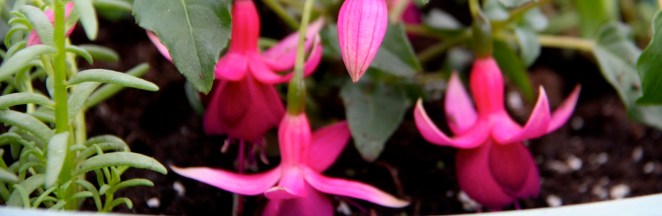
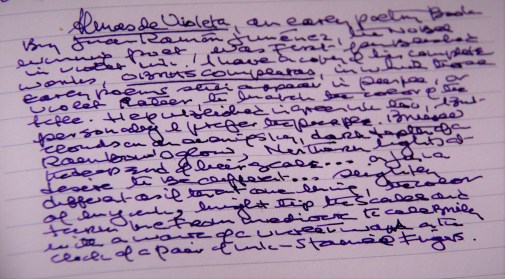
Almas de violeta, an early poetry book by Juan Ramón Jiménez, the Nobel winning poet, was first published in violet ink. I have a copy of his complete works, Obras completas, in which those early poems still appear in purple, or violet, rather, to match the color of the title. He published poems in green ink, too, but personally I prefer purple. Bruised clouds in an evening sky, dark depths of a rainbow’s glow, Northern Lights at the deep end of their descending scale … or is it just a desire to be different … slightly different, as if that one thing, the color of my ink, might tip the scales and turn me from mediocre to celebrity with a wave of a violet wand or the click of a pair of ink-stained fingers.

What else is there to do, other than meditate and walk your fingers across the keyboard, when rain mingles with snow and grey and white streaks fall at faster, slower rates to trace a network across window, trees, and garden? JRJ, Juan Ramón Jiménez, forgotten now by all but the scholars who read and teach him to the few ardent graduate students who clutter the ivy covered halls of academia and blow away the dry dust that settles on unused books when they languish on library shelves. Is that what will become of us, we poor poets of today? Are we to be reduced to the polvo seco de tesis doctoral / the dry dust of a doctoral thesis, as my good friend José María Valverde once wrote?

I guess the dry dust of a doctoral thesis is better than the silence of unturned pages, the empty sands of the voiceless desert, the dunes of forgetfulness shifting here and there along a sea-shore swept by shiftless winds. Forgetfulness: we must first be read … only then can we discarded and forgotten. And who will read us? Who will emerge from their twitter and their tweets to open a book and lift the written word from the page and carry it into their hearts so it can be placed on the soul’s altar and surrounded by incense and flowers?

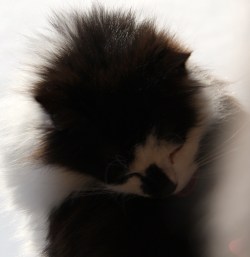
Purple ink on a purple page, the violence of violet, life with it’s doldrums and purple patches, the cat curled up in its basket, one paw out to test the weather on this rainy, snowy day, when coffee appears at my elbow, as if by magic, and words seek sanctuary in a ritual flow of  song.

Friday Fiction: It’s Snowing


img_0436

Friday Fiction
It’s Snowing
20 April 2018

I wish it was fiction, but it isn’t. Friday, 20 April, 2018: clouds fill the sky, thick, fluffy clots drift down nodding at me as they pass my window. An inch of snow covers  grass, deck, pathways, lawn.

It’s snowing.

I check the weather forecast: +6C / 43F with light rain forecast for today. So much for the computer and the weather forecast. Look outside: snow is tumbling down, and it’s getting thicker. The blonde bimbo who waves her arms across the weather map with its bars and contours tells me it’s raining. She’s trapped indoors, in a tv studio, reading from a teleprinter. Wake up, lady, and smell the green tea. Then look out the window. But wrap up warmly … because it’s snowing.

Why is it snowing? Several reasons:

  1. I took my snow tires off the car last week: a sure sign it will snow.
  2. I got my hair cut yesterday: that always brings a change, for the worst in the weather, especially when I get a summer haircut, nice and short.
  3. To reassure me that my choice in coming to Canada was the correct one: I could have gone to Australia where my cousins are in danger of being burned out yet again by their third major bush fire in ten years. Here, it just snows. And snows. And so …

It’s snowing on April 20. This is personal. This is a personal attack on my humanity and sanity. I know: I chose to come here, to spend my life here, and I love it … but snow on April 20, when the tv bimbo is calling for rain and wet weather?

What will the robins do? Yesterday, they wandered in little groups all over the grass, chirping happily, singing for their suppers, pulling worms out of the brown earth as fast as they could go. Today, not a robin in sight. Not one.

But the crows are back: ubiquitous, omnipresent, omniscient, eternal, the seculae seculorum crows squat, feathers fluffed, beaks to the wind, hunkered down in skeletal trees, counting the snow flakes as the fall … caw … caw … caw …

Crows and snow: I think of school porridge, burning for breakfast.  I can’t shake off those memories. They haunt me at breakfast time. Porridge suddenly appears as if from nowhere. The smell of burning tickles my nose. My cereal plate fills with the  grinning face of porridge. It makes faces at me, nurdling and grimacing as I try to picture Corn Flakes, Rice Crispies, and Sugar Frosted Flakes, robins, not crows, green grass, not this bright, white table cloth spread on the lawn before me.

Oh for the sweetness of the robin’s song, the dawn chorus of a thousand songbirds lighting up the morning, sunlight on the grass … not a hope … forget it … look out of the window …

It’s snowing.

Thursday Thoughts: Cricket


IMG_0027

Thursday Thoughts
19 April 2018
Cricket

            Street cricket. Played on cracked tarmac. The wicket: three sticks whitewashed on to the high stone wall of our cul-de-sac street that backed on the railway yards. The wall the boundary. And the neighbor’s front yards. Six and out if you hooked and hit behind the wicket and over the railway wall. You also had to retrieve the ball yourself. Game stopped until you climbed the wall, looked down at the rail yards thirty feet below, and shouted until someone emerged from a workman’s hut to find the ball or throw it back.

            No worker … no ball … no game. Then you had to run out of your street, down the main road, up the hill for two streets, beg permission at the locked rail yard iron gates: “Please, mister, can I go get my ball?” Then run all the way back down the railway lines to where the waiting players hung over your own street wall, shouting and cheering. Search for the ball among shiny rails, shunting rails, rusty rails, dandelions, thistles, and nettles, avoiding rolling stock and the occasional shunting engine. Find the ball. Try unsuccessfully to throw it back over the wall to the waiting hands. Try again. No good. Wall too high. Carry ball back to iron gates. Thank gate man politely so you can come back next time. Return ball to game. Game continues, rain or shine. Unless it’s real rain. The Lissingdowne / Pissingdown type. If so, run for nearest house and shelter by fire in kitchen.

            Basic rules. Six and out if you hit it over the railway wall. Two runs and fetch the ball yourself if you hit it into the to bomb buildings at square leg, next to the railway wall. No fielders there. Banned territory. Still piled with grass-overgrown bombed bricks and debris. Fragile, crumbling walls still still liable to tumble. Cellars that might open up. Low walls that might collapse. Four and out in a neighbor’s front yard. Some were nice and didn’t mind. Watch out for the old witch with the garden gate. If you hit her window, even with a tennis ball, she’d be out quick as a flash, steal your ball, and wouldn’t give it back. Otherwise, it was single-batsmen. Run the runs and walk back from singles. One hand, one bounce. Tip and run once you’d scored twenty. One hand off the wall if you didn’t clear it for a six and out. Out if your fox terrier got the ball and ran round and round in circles with it in his mouth. Damn difficult to catch. Also his sharp, terrier teeth might puncture the ball. Damned dog. Lost ball and stopped match if the dog ran into the house and gave the ball to your gran who was saving it for tennis.

            Cricket, in those days, was civilization. It had survived the bombing raids that missed the railway yards and bombed the bomb buildings. It had survived the machine-gun fire from the fighter-bombers that had strafed the street leaving bullet-holes, still un-repaired, in walls and shattering the glass of now-mended windows. It gave us a sense of rule and law, for the rules were strict and nobody broke them and stealing runs in tip and run was legal and not a crime.

            Cricket: a small, bright window on the back-street where I lived, a window filled with happiness and light, even when it’s over the wall and six and out, or the dog runs away with the tennis ball, or the ball vanishes down a mysterious rabbit-hole in the bomb buildings and slides down to someone’s ruined cellar.

            Game’s over. The Tests Match is on. The one primitive, tiny black-and-white screen in the street lights up with flickering figures and we sit around on the floor watching real men playing the real game on a grassy field in a fairy-book world, a world that most of us back-street boys and girls will never know or see, but that comes over to us as a dream of reality on this old black-and-white tv.

Wednesday Workshop: Vis Brevis


IMG_0068 (2)

Wednesday Workshop
18 April 2018
Vis Brevis

Rain. Persistent rain. Cornish mizzle that chills and wets. Basque chirrimirri penetrating flesh and bone. Low cloud blankets buildings, wraps itself round the windshield. Clings with the tenacity of Saran wrap. Visibility variable, now clear, now a muffler round the car’s headlights. Darkness gathered, still gathering. Lights moving, cars moving, the road moving, blending first with the lights then with the shadows, shape-shifting.

Down the hill now, out of the city lights, into the countryside. The road changing, patches and potholes, lights flickering in and out, darkness and light. Small animals of light, the potholes, shimmering, bumping by. Another pothole, moving, turning from side to side, a pothole with a ringed tail and two tiny eyes. A baby pothole, misses the front wheels, not the back. One dull, dry thump.

What were you doing there, in the middle of the road? Why alone? Why no mother, no brothers? Why so small? I didn’t mean to … I didn’t want to … Why me? Why now? If only …

Light breaks through the darkness clouding my mind. Memories: the driver on the road to Kincardine, chasing a jackrabbit, trapped in the headlights, a Belgian Hare, dodging down the middle of the country road. Laughing, the driver, with the joy of his hunt. Then: one dry thump. The car stopped, the hare, still twitching, held by its long ears, shown as a trophy at the car window, then thrown in the trunk. Memories: two lads in a half-ton, on a back road by Grand Lake. A sunny Sunday. Spotting the ground hog at the roadside. Driving at it with the truck. Swerving to hit it. The joy and laughter in their faces, looking back. One dry thump. The ground hog, front half viable, spine fractured, back legs paralyzed, dragging itself with its forearms to the roadside, dropping into the ditch.

Legend tells of the man who met Death in Cairo. Death looked surprised to see him. “What are you doing here?” he asked. Fear filled the man. He ran, packed his bags, left Cairo with its vision of Death. Travelled to Bagdad. Met there with Death, who welcomed him. “Why were you surprised to see me in Cairo?” the man asked. “Because we had a meeting here in Bagdad, tonight,” Death replied. “And I didn’t know if you’d show up.”

“Every morning, at day break,
oh Lord, this little prayer I make,
that thou wilt keep thy watchful eye,
on all poor creatures born to die.”

Dylan Thomas wrote those words in his poetry play for radio, Under Milkwood. All poor creatures born to die. That’s us. That’s you and me. We don’t know how, or why, or where, or when. And it doesn’t matter. That’s the whole point: it doesn’t matter. Our death is born with us, walks with us, lives inside us, and one day will take us, each of us, we poor creatures born to die. What matters is that we live while we can, rejoice while we can, thrive while we can, think while we can, write while we can …

Enlightenment came last night, at the darkest, wettest of times. It followed me home and crept with me into my bed. I thought of all the creatures found each spring morning, their lives cut short at night along the sides of our New Brunswick roads: deer, porcupine, squirrels, groundhogs, foxes, domestic and feral cats, dogs, skunks, and yes, one, very special, baby raccoon, a tiny raccoon, so small as to be almost invisible in chirimirri, mizzle, and mist.

His spirit came to me in the under-blanket dark, wrapped itself warm around me, and brought me comfort. “You too,” he whispered. “You too. But not just yet. My work is done. I can go now. But you still have lots of work to do. Remember: Vis brevis, ars longa,”  his raccoon spirit nuzzled me and I reached out and patted him. Then both of us settled down to dream our different dreams of a life and death that is surely nothing but a game of touch and go.


Scrambled Eggs

img_0363

Scrambled Eggs

The door to her father’s house opened before Tiggy could raise the brass knocker.

“At last,” said her father. “You’re just in time to cook breakfast. Come in. Come in,” He stood aside to let her pass and she pecked a kiss at his cheek as she hurried by, overnight bag in the hand closer to him. Tiggy held her breath as she went. She knew the smell emanating from her father would be as ripe as it was during her last visit, if not worse.

“I’ll make you breakfast in a moment, dad. I’ll just take these upstairs first.”

When she came down, her post-drive ablutions completed, she went straight to the kitchen. Her father sat at the breakfast table, restless fingers playing the piano of the table top in arrhythmic Morse Code messages.

“At last,” her father muttered. “Where have you been?”

“Just tidying up, dad,” Tiggy smiled. “You know it’s a long drive.”

“I want scrambled eggs. On toast. Make them like your mother used to.”

Tiggy thought of the dry overcooked eggs her mother used to scrape out of the burnt-to-a-crisp saucepan and sighed. Her almost-liquid, cordon bleu divinity was the real thing. Scrambled eggs, indeed. And so much salt. More like bacalao, dried salt cod with a little bit of turmeric to make it look like scrambled egg.

Tiggy picked up a saucepan. Filthy. She went to the sink and started to scrub.

“You don’t need to do that,” her father said. “It’s clean.”

“It’ll be cleaner when I’ve finished, dad. Don’t you worry.”

“Here,” her father handed her some plates. “You night as well wash these as well. They were clean enough for your mother but they won’t be good enough for you.” Greasy films layered the plates where yesterday’s bacon had solidified. Hard lumps of egg stuck to the cracks that road-mapped the plates’ surface.

“I’ll look after it, dad. You sit down and rest. I’m home now.”

“At last,” Tiggy’s father grunted.

Tiggy took in her father’s face. He had put on weight and veins ran red and blue tattoos across the unshaven surface. He breathed with difficulty, but she knew he angered with ease.

Tiggy looked for the end of the roll of paper towels she had bought on her last visit. When she found it, she dried saucepan, plates, and cutlery, putting the saucepan on the stove and laying cutlery and plates neatly in a space she created on the cluttered table. Her father pushed his setting aside and struggled to his feet.

“Here, let me help you.”

“That’d be great, dad. You do the toast, I’ll get the eggs,” Tiggy walked to the fridge, searched in vain for some butter, and carefully selected three large brown eggs.

Her father followed her to the fridge.

“Here, use up this cracked one,” he handed her a brown egg with a large fissure that mapped a thin contour from big end to little end.

Tiggy reached for the egg. She grasped it and felt the cold icy creep of the army of white maggots that seethed along the line. She shuddered and the egg slipped from her fingers and dropped to the kitchen’s flagstone floor where it shattered. A rich, ripe stench arose and ghosted through the air to tickle Tiggy’s nostrils. Her stomach heaved.

Having washed her hands, she cracked each egg individually into a saucer, inspected it, then poured it into the saucepan. Next, she took a wooden spoon from the drawer and started to blend the eggs.

Meanwhile, her father sat back down at the table, toast forgotten, and recommenced his Morse Code messages.

Tiggy opened one cupboard, then another, in search of bread. Finally, she found the remains of a sliced loaf in a dark corner and brought it out into the light. The first slice she extracted from the bag was a painting from Picasso’s Blue Period, the second, a breeding ground for mold, but the third might be salvageable …

“Don’t worry,” her father said. “Just scrape the blue stuff off. It’ll be fine. I eat it all the time.”

“You can’t eat that,” Tiggy threw the bread in the garbage. “I’ll just serve you the eggs on the plate.”

When they were cooked to her father’s satisfaction, Tiggy scraped the dried-out eggs from now charred saucepan. They landed on her father’s plate with a harsh, unforgiving sound.

“Lovely,” he said, licking his lips. “Just like your mum’s.”

Chronotopos


img_0195

Chronotopos

Chronotopos

A dialog with time and space.

But what is time? A river flowing? A long line leading from our beginnings to our end? Alpha and Omega? An instant held between finger and thumb and so swiftly forgotten? A dream we dream when we are awake. Or asleep. And which is the real dream, waking or sleeping? Sleeping or lying awake?

And what is space? This house in which Billy lives? The garden Billy watches from his window? What is Billy’s town? His district? His county? His province? His region?

And how does Billy relate to his “time” or his “place” and what is this being called “Billy”, this dream Billy dreams, this post-amniotic ocean of life in which Billy floats?

Billy dreams he is male. When he reads Carl Jung he learns a large part of him is female. Billy thought he was masculino / macho / male, yet when a large part of him is femenina / hembra / female, he’s no longer sure what he is.

Billy has ten fingers yet he uses only two to type. Two fingers manipulating twenty-six letters and Billy turns his black-and-white keyboard world upside down when he thinks his subversive thoughts and types them onto the page.

Time and place, male and female: Billy lay on his side in hospital and the young urologist shot him full of female hormones so his prostrate cancer would not takeover his inner organs and destroy his life.

Place and time: Billy lies awake at night and shapes disturbing dreams, dreams he never before dreamed of dreaming.

Billy senses the end is drawing near.

He fears it. Yet he loves it. He loves it because it’s his and nobody else’s.

In Billy’s beginning is his end.

Beginning and end: both belong to him.

Time and space, so sacred to Billy’s life … they will continue with or without him.

Billy may not be there to bear witness. But he has been here and parts of him will remain embedded in the mind of each and every one of those who knew him.

On an unusually Odd Sunday at Corked: raise a glass to Billy’s name when he is gone. Leave an empty glass on the table for Billy and he will be back.

Lorca

img_0150

Lorca

Solidarity screamed out from posters and stamps
that carried snapshots of the dead poet’s face.

We still haven’t found his body.
He said we never would.

They tortured him first, taunted him for being homosexual;
trussed him up; laid him face down; then shot him,
for a joke, in the offending area.

He took a long time to die. When he did,
they dumped his body in some hillside ossuary
above his home town. But first they carved
the bullets out of his corpse,
three from the anal tract,
keeping them as souvenirs.

Next day his followers were put to death.
Waverers were soon convinced by bullets
lodged at the base of another’s skull.

Later that week, Fascists, drunk, laughed
uproarious in their favorite bars.
They dropped the bullets into white wine,
watching the blood trail as it drifted down,
then drank to the re-establishment
of what they now called law and order.

Commentary:

Another Golden Oldie, also from Broken Ghosts (Goose Lane, 1986).  The Spanish poet and playwright, Federico García Lorca (poetic Generation of 1927), predicted the mystery surrounding his own death and the unknown location of his body in a poem from his surrealist collection, Poet in New York. The recent decisions in Spain to open Civil War graves and seek the identity of victims via DNA testing and other more modern means has also led to the controversial reopening of many of the wounds of a Civil War that never really healed in many parts of the country. The Basque problems and the recent troubles in Catalonia bear witness to the continued memories of Civil War and post-Civil War repression.

Friday Fiction: Teeth

img_0181

Friday Fiction
13 April 2018
Teeth

Lunchtime.

Tiggy opens a can of tom8to soup and heats it on the stove. She slices the remains of yesterday’s loaf of bread into one inch cubes and fries them in olive oil and garlic. Tom8to soup with croutons. Then she puts two slices of bread in the toaster. Her father will only eat toast soaked in butter and layered with Marmite when he eats tomahto soup.

“Lunch is ready,” she calls out.

The black American Cocker Spaniel, bought by Tiggy’s late mother, in a moment of madness, by telephone, unseen, camps in the kitchen. It nests at the far end of the table, by the stove, and defends its territory with warning growls and a snapping of yellowed teeth. Tiggy will not go near the dog.

“Lunch is ready,” Tiggy calls out, a little bit louder. Dog, as they call him, growls and clatters its teeth. It has hidden a treasure in the folds of its old, gray comfort blanket, and guards it with the fierce, loving worry of a dragon protecting its golden hoard.

Tiggy’s father enters the kitchen as she places the soup on the table.

“I’m not ready to eat. Put it back in the pot.”

“What’s wrong, dad? I thought you were hungry.”

“My teeth,” he mumbles through a mouthful of pink gums. “I can’t find my teeth.”

“Where on earth did you put them?”

“I don’t know. If I knew where I’d put them, I wouldn’t have lost them.”

Tiggy’s father circulates round the kitchen opening drawers, lifting saucepan lids, and shaking empty yogurt pots to see if they’ll rattle.

“I can’t find them anywhere. I can’t eat lunch without my teeth.”

“But it’s only soup, dad, tom8to soup.”

“I don’t like tom8to soup. Your mother always made tomahto soup. Why can’t you be more like your mother?”

“Sorry, dad. I’ll call it tomahto soup, if that will make you feel better. But it’s still made out of tom8toes.”

“Don’t be so sarcastic. Help me find my teeth,” Tiggy’s father stomps towards the stove and Dog growls fiercely from its blanket as it guards its treasure.

“Take that, you dirty dog,” Tiggy’s father lashes out at Dog with his stick and cracks it across the head.

“Dad, stop that. It’s not Dog’s fault.”

Dog howls and spits out what it is chewing.

“There they are,” Tiggy’s father bends down, picks up his teeth, still hairy from the blanket and bubbly from Dog’s saliva. He pops his teeth into his mouth.

“That’s better,” he says, “now I can enjoy my lunch.”

Thursday Thoughts: Secrets

IMG_0027

Thursday Thoughts
Secrets
12 April 2018

Thursday Thoughts: there are none. This morning, I read the online newspapers, I played a game of chess against the computer, I played two games of solitaire, also online, I checked my dwindling financial resources, and then I sat down to write.

The piece that I wrote was so personal, so deep, so full of darkness, that I will keep it under cover, hidden from the light of day. Writing that expresses the authenticity of being, indeed: but when that being is weak and full of fear, how can that writing be exposed?

A flower in the desert, blooming unseen? An exposé of that which is better kept unexposed? I think of the multiplicity of ghosts best kept safe, old bones in Mother Hubbard’s Cupboard.

‘He who fights and runs away, lives to fight another day.’ My grandfather explained to me that this was how he had survived the trenches in WWI. His medals in the cupboard upstairs, his oak leaves for bravery, belie the stories he spun when I was a child.

Yet today, this Thursday, discretion is the better part of valor. I am the guardian of my family’s secrets. Some of them will be kept. Many of them must be kept. That is my thought (and my decision) for today.

Wednesday Workshop: Reading

IMG_0167

Wednesday Workshop
11 April 2018
Reading for Writers

Miguel de Cervantes once wrote that he was so fond of reading he would pick up even the scraps of paper he found in the street to read them if anything was written on them. This is well-known. What is less known is that Don Quixote, his immortal novel (DQI, 1605, DQII, 1615) is a masterpiece, not only of writing, but also of reading.

From the initial sortie, a prose transcription of an earlier short play, to the Scrutiny of the Library, Cervantes demonstrates right from the start his awareness of current trends in poetry, theatre and prose. In addition, he shows (especially DQI, chapter 47) his acquaintance with contemporary literary theory, as E. C. Riley has so ably established in Cervantes’s Theory of the Novel.

Cervantes begins with the traditional Renaissance novel (DQI, 1605) in which he experiments with plays and poetry turned into prose, oral and written histories, pseudo-autobiographical episodes, the picaresque novel, the pastoral novel, the Italianate Novel, the picaresque novel (briefly), his own versions of the realistic Spanish short story, and then, after a ten year gap during which he receives all kinds of reader feedback, he invents (DQII, 1615), the self-referring modern novel. DQII refers back to DQI as if it were true history. Don Quixote on his ravels meets with people who recognize him, for they have read his story and know all about him. The fictitious character establishes himself as an almost flesh-and-blood living person.

What can we, as writers, learn from this? Above all, we must learn to read copiously, not just once in a while, but all the time. Not only must we read, but we must learn how to read. Yes, we can read for knowledge and information; yes, we can read for pleasure and enjoyment; yes, we can read to lose ourselves and wash away the cares of the world. However, as writers we must learn to read in a different fashion. We must read in search of the narrative structures that inspire other good writers. We must read in search of the iterative thematic imagery that binds a text with meaningful, repeated images. We must read in search of the poetry that sates the soul’s constant thirst for beauty. We must read in search of the dialog that cuts to the bone and reveals the hidden character of the protagonists. We must read in search of the layering that allows us to give extra meaning at all levels of the narrative. We must read in search of the secret that allows us to trim all unnecessary material in order that our stories may be spare and sparse with not an extra word or thought.

Reading: I have just finished taking an eight-week online course with the School of Creative Writing at the University of Toronto. In the course of those eight weeks, I read the following books.

  1. 3 short stories a week, recommended by the instructor, the wonderful novelist Kerry Lee Powell, to illustrate each week’s lesson. [24 stories]
  2. 14 first drafts, one from each of the magnificent students in the course (I had the honor of being the fifteenth student). [38 stories]
  3. 14 revised stories. [52 stories]
  4. 14 first drafts of a second story. The course asked for two stories to be written by each participant over the duration of the course. [66 stories]
  5. 14 revised drafts of this second story. [80 stories]
  6. My own voluntary reading included Raymond Carver’s What we talk about when we talk about love (17 stories), Cathedral (12 stories), and my own short story collection, Bistro (35 very short stories). Recognizing the errors, weaknesses, and inaccuracies in my own collection reduced me to tears. [144 stories]

I have spent eight wonderful weeks exploring creativity and the art of short story writing.  Am I a better writer for all that work? Undoubtedly. I can see and think much more clearly and I am beginning to gain a better understanding of how short narratives work. I am a better writer, but I am not yet a good one. There is still a long way to go.

I am retired. A long, cold, icy New Brunswick winter has kept me in the house, close to the fire. I have been gifted the time and mental energy to make the most of this course I have taken. I attended the University of Toronto, as a graduate student, back in the sixties. I was amazed at the quantity of work handed out by the professors in the School of Graduate Studies. My first decision, made very early on in my graduate career, was to take a speed reading course. Accelerating my reading speed and capacity for understanding was the only way I would be able to compete. I am still a fast reader, though not as fast as I was. This speed reading has left me time for long thought and slow writing.

Over the last eight weeks, in addition to the reading, as described above, I have written five new short stories, including two for the course. I have also revised and re-written a series of short stories for my next collection. As a good friend keeps telling me, we are not writers, we are re-writers. After eight very intense weeks, the acts of re-writing, re-reading, re-vising, and re-editing have become much, much easier.

Carpe diem, seize the day: pick up a book and start reading. Pick up your pen and start writing. No excuses. Participaction: don’t think about it, do it.