This is the audio of the reading. Click on the audio, then click on the text and read while you listen. Or listen, then read. Or just listen. So many choices and so much fun.
Monkey’s Book Burning (Remembering Cervantes’s Scrutiny of the Library
and Ray Bradbury’s Fahrenheit 451)
Who burnt Monkey’s books?
Who took them from their shelves,
evicted them into the courtyard,
built them into book stacks, like hay,
then applied gasoline, and a lighted match?
Monkey watches in horror
as smoke and flame devour his beloveds.
He tries to approach, but the fire is too hot.
One book jumps out from the smoke, still smoldering,
and monkey snatches it and carries it away beneath his coat,
the fire burn branded into its cover,
the skin still sizzling on monkey’s hand.
How many books were burned that day?
How many monkeys now walk in the woods,
trying to re-create their lives,
circulating their memories by word of mouth?
Moth is to candle as book is to flame.
Monkey runs his hand in and out of the candle.
He recalls the bonfires in the streets.
He coughs through the throat burn of smoke.
He touches the blistered scars of flame.
I am continuing today with my experiments with voice recordings, something that interests me very much. As I said earlier, my voice changes with audience and mood, and early morning, in Island View, with the microphone and Princess Squiffy as an audience, and the window open so the cool morning air can circulate before the heat of the day, is not the best way to induce mood, well, not in this reader anyway.
When I made the recording, I was reading from my book Though Lovers Be Lost (available on Amazon) my head was slightly turned away from the laptop’s built-in speaker, and, as a result, the reading is not as loud as I would have liked. It is also a little bit fast. I don’t mind the speed of it: when I was younger I would read this poem in a single breath, all 90 seconds or so of it. Now I need many breaths to get though it successfully. Ah, a young man’s fancy turned to dust …
I will do a retake of the poem, not on my laptop, but on my IMac, and I will add that later, below the first recording which will appear just below this introduction. Then I will add the text. Yesterday I offered text, then reading. Today I offer the reading first. That allows the listener to listen first and then read the text OR to start the audio recording and then follow the text as it is being read. This is a Wednesday Workshop and this is all part of my workshop experiments in reading. Wonderful fun and highly recommended. Thank you for being here with me and remember, your comments are more than welcome, they convert a workshop from a soliloquy into a dialog.
Second recording to follow
To be Welsh on Sunday
To be Welsh on Sunday in a dry area of Wales is to wish, for the only time in your life, that you were English and civilized, and that you had a car or a bike and could drive or pedal to your heart’s desire, the county next door, wet on Sundays, where the pubs never shut and the bar is a paradise of elbows in your ribs and the dark liquids flow, not warm, not cold, just right, and family and friends are there beside you shoulder to shoulder, with the old ones sitting indoors by the fire in winter or outdoors in summer, at a picnic table under the trees or beneath an umbrella that says Seven Up and Pepsi (though nobody drinks them) and the umbrella is a sunshade on an evening like this when the sun is still high and the children tumble on the grass playing soccer and cricket and it’s “Watch your beer, Da!” as the gymnasts vault over the family dog till it hides beneath the table and snores and twitches until “Time, Gentlemen, please!” and the nightmare is upon us as the old school bell, ship’s bell, rings out its brass warning and people leave the Travellers’ Rest, the Ffynnon Wen, The Ty Coch, The Antelope, The Butcher’s, The Deri, The White Rose, The Con Club, the Plough and Harrow, The Flora, The Woodville, The Pant Mawr, The Cow and Snuffers — God bless them all, I knew them in my prime.
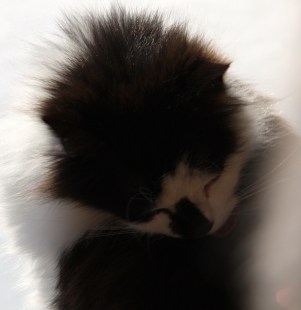
Photo Credit:Princess Squiffy, my favorite listener. She never complains, but she rarely stays awake.
I am the all-seeing eyes at the tip of Worm’s Head;
I am the teeth of the rocks at Rhossili;
I am the blackness in Pwll Ddu pool
when the sea-swells suck the stranger in and out,
sanding his bones.
Song pulled taut from a dark Welsh lung,
I am the memories of Silure and beast
mingled in a Gower Cave;
tamer of aurox,
hunter of deer,
caretaker of coracle,
fisher of salmon on the Abertawe tide,
I am the weaver of rhinoceros wool.
I am the minority,
persecuted for my faith,
for my language,
for my sex,
for the coal-dark of my thoughts.
I am the bard whose harp, strung like a bow,
will sing your death with music of arrows
from the wet Welsh woods.
I am the barb that sticks in your throat
from the dark worded ambush of my song.
Commentary:
Continuing with the audio experiments of the last couple of days, here is my voice recording of On Being Welsh. This poem can be found, along with several other Welsh poems, in Though Lovers Be Lost, available on Amazon.
Comments on the readings are very welcome. For my regular readers, if you have a favorite poem of mine that you would like to hear, just let me know and I will record it, specially for you!
I am indebted to my friend Jeremy Gilmer for this second reading of On Being Welsh. We will be collaborating on the creation of sound files and posting contrasting readings of various poems to see how different voices and rhythms change sound and meaning in poetry. Hopefully, this is the first in a longer series.
Monkey loves walking behind the gorillas.
He loves to see fear in faces,
tears in eyes as the gorillas smash
and grab and break down doors.
The gorillas break and enter:
and when they do,
monkey simply points
and the gorillas do their thing:
it’s that simple …
Monkey has a code word
that he took from his computer course.
“Delete!” he says with delight
and the gorillas delete
whatever he points to.
Monkey loves burning other people’s books.
He loves deleting parents in front of children,
and deleting children in front of their parents
can be just as exciting.
The delete button thrills monkey:
maneuvering the mouse
tightens his scrotum
and he feels a kick like a baby’s
at the bottom of his belly
as he carefully selects his victim
and “Delete!”
The gorillas go into action:
ten, twenty, thirty, fifty, seventy
years of existence
deleted with a gesture
and the click of an index finger
pointed like a gun.
This poem is from my book Monkey Temple. It is available on Amazon.
of failure
of success
of inadequacy
of being caught short
of being found out
of the blank page
of revealing intimate details
of feeling stupid
of typos or punctuation or bad grammar
of presumption
of being laughed at
of new things or old things
of something borrowed
of new topics or new methods
of research or hard work or perfection
of rejection or dejection or ejection
of losing yourself or finding yourself
of caring or not caring
of the unknown or the unknowable
of peer pressure
of speaking out loud
of being unable to write like …
of being wrong or right
of political or social consequences
of free speech
of hurting others
of being misunderstood or understood
of large or small audiences
of clothing or mechanical failure
of starting or finishing or writer’s block
of having nothing to say
of having nothing worthwhile to say
fear of fear
Commentary: Last Saturday, in Quispamsis, I facilitated a two hour workshop on things that writers fear. I began with a list of all the things that I have feared at various times during my writing career. This morning, I turned, with great trepidation, those fears into the list poem I reproduce above. If you wish to discuss any of these fears, or add other fears of your own to the list, and remember, this is a list of writers’ fears, then please do so. I will be happy to enter into a dialog.
As for the fear of feeling stupid, I often offer this small piece of advice. It has been known to comfort those who actually have a fear of feeling stupid. (1) buy a small fluffy toy, preferably a Teddy Bear, that will fit into your pocket or purse. (2) christen that small fluffy toy with the name of Stupid. (3) you carry Stupid around with you all day knowing that you can put your hand in your pocket or purse and feel Stupid all day and nobody is going to know or care.
The moral of the story is this: when you can laugh at your fears, you fear them no more. And remember: you can stop feeling Stupid whenever you want to.
grandfather said, finger-nails cracking red-
waxed parcel string. Bright sealing wax rained down
on the tablecloth, covering it with hard,
scarlet chips, wax cracked, tight knots emerging.
One by one, my grandfather first loosened
them, then sought the string’s free end, following
it along its snaking way from knot to
knot. Like Theseus following his twine
through the labyrinth below the palace, my
grandfather mused, hesitated, followed
the clues given him by the knotter’s mind.
Set free from its parceled knots and lashings,
he looped the string around his fingers and
tied the twine into a tight bow that he
stowed away for future use. Reef knots, slip
knots, sheep-shanks, bowlines, bowlines-on-the-bight,
he showed me how to tie them all. He taught
me too how to never tie granny knots.
“Never cut string with a knife: untie knots,”
strict his advice and followed still today.
Recycling 2
finger-nails
cracking red-waxed
parcel string
sealing wax rained down
staining snow white tablecloth
wax cracked
hard scarlet flakes
tight knots emerging
loosened
now seek the string’s
free end
then follow it
the way it snakes
linking knot to knot
muse
hesitate
unknot
the mind of she who tied
set free these
parceled knots and lashings
loop string around fingers
tie tight the twine
a child’s bow
to be stored
for future use
Recycling
Haiku 1
[7/11/7]
string yields blood-bright scarlet wax
a thread to lead through the parcel’s labyrinth
open now the magic box
Recycling
Haiku 2
[5/7/5]
blood-bright scarlet wax
a thread through the labyrinth
open now the box
Commentary: There are many ways to recycle. All are valid. Some are more valid than others.