Herding Cats

IMG_0790 (2)

Herding Cats

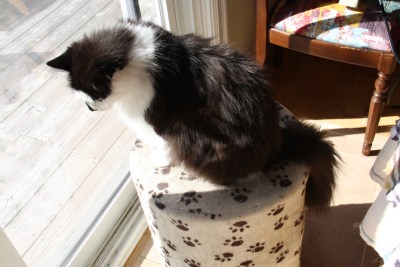
Finley herds cats. At least, she thinks she does.
She spots them with an eager eagle eye,
then herds them, Murdoch, Logan, and Jenkins.

Murdoch sleeps on top of the cabinet.
“Come down,” Finley shrieks. Logan seems to sleep
beneath the settee. “Come out,” Finley pleads.

Jenkins catalogues himself between books.
Finley can’t find him. She climbs on a stool.
Murdoch opens a round grey eye, checks the
distance between them, and goes back to sleep.

Finley gets down from the stool and searches
for Logan and Jenkins. They have disappeared.
IMG_0032

Commentary: Finley loves cats and misses the three she has left behind her in Ottawa. She wants to cuddle Princess Squiffy but Princess Squiffy aka Vomit does not like noisy little girls who pursue her shrieking loudly. Result: we have hardly seen PS for nearly a week. She hides throughout the day in those mysterious priest-holes known only to catholics and cats, and waits for nightfall and an almost quiet house. Soft and silent, she emerges from the shadows where she has been hiding to sleep at the foot of the bed.

PS doesn’t love me either, but she has become so needy of quiet, respectful human contact that she has started to tolerate me, just a little bit. She raises her ears instead of flattening them and plumes out her tail, just to encourage me. Now she permits me to touch her gently and scratch her in her favorite spots, behind the ears and at the root of the tail. I look on this as a great favor … but I still think she scorns me completely, showering me with  total disdain most of the time.

“Moo,” Finley asks me. “Do you have a pussy cat?”
“Yes, Finley.”
“Where is she?”
“I don’t know.”
“Is she hiding?”
“Yes, Finley.”
“Can I see her?”
“If you can find her …”

And the great cat hunt begins: upstairs, downstairs, in my lady’s chamber. Goose steps everywhere, but there is no sign of the cat.

“Moo.”
“Yes, Finley.”
“Are you sure you’ve got a cat?”
“Yes, Finley. I’m sure.”
“I want to play with her.”
“I’m sure she’ll come out and play with you one day soon.”
“I don’t think you’ve got a cat, Moo.”

Seeing is believing / ver es creer. Whether seeing is believing, or not, what we don’t want to see is A’r gath wedi sgrapo Finley bach / the cat has scratched little Finley. Oh the joys of learning Welsh, especially as the day drags on, the cat cannot be found, and Mae’r baban yn y crud yn crio / the baby in the cradle is crying and tears of sadness blend slowly into snores, as the cat creeps up from her hiding place in the basement, pushes open the door, mews for her last food, and cuddles up beside me on the chair beside which I type.

Here is a link to Sosban Fach sung  Welsh by Cerys Matthews.  Turn your sound on and up and enjoy!

https://parallel.cymru/sosban-fach/?lang=en


IMG_0425

Alphabet

Chaos

Alphabet

So everything is now as yellow as the yellow alphabet.
Bellow below cello, above fellow, saying “Hello,” jello,
always yellow, nobody eats orange jello, mellow, sello
or sellotape, tellow, as in “Tell old salt …” pronounced
“tellow salt” … so many verbal adventures, scales falling
from young eyes, and old ones as wello,
and the melody of music in tone,
on tongue, wonder in the eyes of everyone,
golden yellow, hair high-lighted in the early morning sun.

Commentary:

An endless jumble of words, all joined together rhythmically and linking one thought to another in a succession of jumps that wander from here to there and back again. Team tag: each one of us chosen for a moment, teased, played with, abandoned, picked up again, delight in each adventure.
My party tricks are e-cards, typing on the computer, her name, my name, the alphabet, her mother’ name, another name, and then another. Coloring is my trick too, and finding empty pages that can be followed with color and scrawl and everything that turns the blank page from a wilderness to a new world covered in endless manufactures of meaningful, meaningless scratches.
Joy in small things.  Albert Camus’s theory of the absurd present in almost every moment of the day. Moments that stretch into eternities, eternities seen in a grain of sand. Dw i mwynhau … what do I enjoy? These timeless moments, these glimpses back into my family’s past, Dych chi mind am dro? … these walks into my DNA’s future. Nach ydw: no, I will not be here. But tiny segments of my existence, words and phrases of my Welsh grandfather’s DNA and language, they will be here. Recycled. Again and again. Somehow. Somewhere. Forever. What more could I ask?

Finley at Two

IMG_1058 (2).JPG

Finley at Two

Blood of my blood, my daughter’s daughter,
I live too far away to watch each day the laughter
on your lips, the sparkle of your eyes.

I see them when we Skype. Such a miracle
this magic machine that reduces distance
and time and brings you here to me.

I see you trying to stand, to understand,
to hold my image in your mind, to figure
out these moving shadows on the screen.

Words, born from poetry in my heart
and music on my lips, sometimes fall short,
and fail. Perhaps I should carve you a Welsh

love spoon. But time is not on my side. So brief,
this life: I wonder if we will ever meet again.

Commentary: Seeing Finley again, now aged four, has made me question all my earlier poems about her. I am overwhelmed by her energy, her interests, her concentration. I am bowled over by her flexibility, her strength, her joy in simple things. The above is not a new poem: it is a rewrite of an older poem, one that no longer served its purpose. I reshaped it as a sonnet, not traditional, but a sonnet none the less. I doubt that I will have much time on my own over the next two weeks in which to write. I guess I will pick away at this blog, adding a little something every so often, when the energy runs down and tranquility descends. Bear with me: I’ll be back.


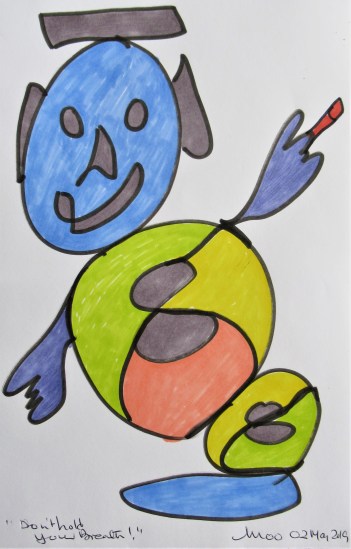
Don’t hold your breath

IMG_0718 (2).JPG

Don’t Hold your Breath 

    Two small gnomes camped last night, one in each of my lungs. All night long they played their squeeze-box, wheeze-box concertinas, never quite in unison. Sometimes they stamped their feet and my body rattled with their dance. Their wild night music caught in my throat and I coughed unmusical songs that spluttered and choked, while I lay awake counting sheep and window panes and struggling with my future and my past.

    An east wind rattled my window whistling a sad song as it herded flocks of stars from one constellation to another. Wind and stars followed the westering moon’s slim finger nail as it scratched at the sky. The planets danced to the rhythms of the accordion music playing in my chest, and the sky’s planetarium folded and unfolded its poker hands of silent cards marked with my fate.

    Black jack, bright jack, one-eyed jack: what do I care when fate’s cards tumble onto the table and I count their spots. Forty card baraja, fifty-two card standard, Tarot, or any of the many others, what do we believe and why? I pluck runes from a velvet bag and shuffle and cut multi-colored cards. I survey the skies, cast dice and I Ching pennies … The fault is not in our stars, but in ourselves, that we are underlings, I mutter, not believing a word of what I say.

    I look in the mirror and see myself as I am. Grey, ageing, diminished, withering … yet proud of who I am and where I’ve been. Upright, in spite of all my failures. Proud because of all the small things that I have achieved. Who am I? What have I done? Where am I going? The eternal questions thrust at the shadows in my silvered morning mirror. Silent, it grins grimly back.


Ghost Train

IMG_0251

Ghost Train

Old fair grounds, I remember them well, the coconut shy, the dodgems, the swing boats, what the butler saw, the bearded lady, the tunnel of love, the ghost train … with its skeleton that loomed out of the darkness, the spider webs that draped themselves over your face unless you ducked, the witch on her broomstick, cackling, the flashing lights, the eerie voices,  the laughter, the screams …

… I arrived early so I could sit in my usual place. I watched the men enter, tapping hesitant, unsteady, slow, leaning heavily on sticks. I saw the women bald and beautiful , naked skulls hidden beneath hats and head scarves. Haunted looks lurked behind staring, wide-open eyes as the outpatients waited for something to leap out and frighten them, not spider webs and skeletons,  but the ghastly visions of tubes, pills, chemo, needles, all the paraphernalia that tortured them first time round.

The annual check-up seems so much easier. Blood tests, screenings, fervent hopes that the devil in the detail, horned, fork-tongued, cloven hoofed, red tailed, hasn’t been hiding, like a wayward ghost, in the small print of blood tests, scans, urine samples, all too ready to break free, leap out and beat us once again into submission.

The ghost train: has that cancer really gone or could it come back, condemning us once more to hospice or ward, to chemo and radiation, to the knife, or to other things more radical?

I sniff the double hospital smells of despair and ill-health, of hope and cures for all those ills, and I am there again, arms folded across my chest, lying motionless on that moving bed of bleached white sheets, heading slowly into that tunnel that smells of polished steel, where machinery coughs and starts and stops as flashing lights whirl their cadences of kill or cure above my troubled head.

Tunnel of love or ghost train? I guess I’ll soon find out.

IMG_0265

F-F-F-Forgetting

IMG_0486

F-F-F-Forgetting

    The apps and programs that no longer work. The computer files you can no longer access. The photos that vanish leaving a blank space in the album.
Now your memory goes on the blink and you forget faces and voices, friends, phone numbers, addresses, street names, the houses where people live, when to turn, where the best parking spots are, how far you can walk, where you were really going, and what you were sent out to buy.
Snow banks don’t help: that banked-up whiteness, that sticking out of the car’s snout into traffic, that stretch of your neck peering round corners. How many number plates have vanished into those white mists? How many cars? How many phone numbers have you forgotten?
You have forgotten the birthdays of your closest family and friends. When was your father born? When did he die? When and where did you bury him? Did you actually scatter his ashes or did someone else do it for you? When was your cousin born? When did he die? How close were you at the beginning, in the middle, and at the end? What color were his eyes, his hair? Did he even have any, hair, I mean of course?
What happened to that carton of eggs you abandoned in the store? Do you remember buying it, let alone leaving it there? How about your brothers, their faces, the sound of their voices? Did your own voice change when you emigrated?
Have those who live in Australia forgotten that they are Welsh? Do they speak like Australians, now, or do they still have those rich Welsh voices and rhythms that nobody in Wales ever wanted because they made us stand out when we moved, unwanted, to England? How many times have we, the Welsh, heard those threatening words: why don’t you go back home to Wales. Countless times, no doubt. In fact you have forgotten how many and you have forgotten so much.
Do you remember the parking spot in which you left your car? Do you recall your number plate or what model your car is, or what color?
“What day is it today,” you ask, for the second or third time. “I’m sure I know you,” you say to a friend who stops to talk to you in the shopping mall, “but I’m sorry, I can’t remember where we met and I can’t remember your name.”

IMG_0452

Cell Phone

IMG_0135

Cell Phone

    Fingers slip across the telephone key board, pressing  wrong numbers or punching them in in the wrong order. Strange voices reply from the other end. This morning a woman spoke to me in a language I didn’t understand, Then a man came on the line and yelled at me in broken English to “Go away! Go away! Leave alone!” I imagined him tearing the telephone from his wife and berating her for answering this call from a total stranger.

    Often, I am too clever for my own good. I think I recall the right number for a friend, but when I punch it in, I find I have reversed two of the figures. I imagine other people doing that when they call me: “Sorry,” I say. “I think you have the wrong number.” “Is that 472 …?” they query. I say that it isn’t and they say sorry and end the call. Then they call me straight back and get the same answer.

    I hate running through my list of callers to get to the name that I want to call. But that’s what I have to do most days now. At least I don’t run into so many wrong numbers.

    And as for answering the phone … well … I am tired of robot calls, especially around election time. I am fed up with telephone surveys. I am driven crazy by heavily accented, high-pitched voices that call me from overseas, in the middle of the night or wake me early in the morning to tell me that my computer needs repair. “Suh, suh, we have discovered a werry nasty wirus [sic, or should that be sick] on your computer. Give me all your passwords and let me in to your computer and I will repair it instantly.”

    I have had calls from the telly-phony tax men who tell me the RCMP are about to knock on my door and arrest me if I don’t immediately give them my VISA Card number, passwords, and send them, right now, the $7,200 I owe them in taxes. I have grown to loathe the harbor boat hooter that announces I have won a cruise from Florida to Mexico on a super cruise ship …. probably a rusty tug boat that will take me twice around the harbor, be declared un-seaworthy, and leave me stranded, miles from anywhere, and paying a fortune to get myself home … and all I have to do, they say, is … I put the phone down. Click!

    I think it’s the marketing surveys that really get my goat though. I am no expert, but I have read up on surveys and designed some myself. What I love-hate about telephone surveys is the lack of real choice, the forced direction in which they push you, the pre-determined result on which the designers are fixated. I know it’s a waste of time, but I occasionally indulge: “On a scale of 1-5, where 5 is good and 1 is poor, how would you rate …” I explain that the question and the ratings do not work, but they are adamant that I must answer from 1-5. Yes, they understand that it can’t really be done, but yes, it must be done, because that’s what they are paid to ask me to do.  Click!

    O tempora o mores … the Latin phrase translates literally as Oh the times! Oh the customs! but more accurately as Oh what times! Oh what customs! or yet again, Alas the times, and the manners (Wikipedia). No wonder they call it a cell phone: all too often I feel I am a prisoner in the cell of the telephone system, incarcerated in my love-hate relationship with the cell.

Butterfingers

IMG_0730 (2)

Butterfingers

My fingers turn to butter, but they taste of nicotine, garlic, and soap when I bite my nails. These butterfingers encourage cups to slip, saucers to fly off, run out of energy, stall, and crash to the kitchen floor where they lie in broken pieces, resting in peace, waiting to be picked up, one by one, and buried in the waste bin.

Arthritic fingers, grown clumsy now, struggle with bottle tops and glass containers screwed up so tight they refuse to open, even when soaked under the hot tap. I stick those jars in door jambs, lid first, closing the door with one hand, and twisting the jar with the other. Sometimes it slips and crashes to the floor, often with a portion of the contents spilling out.

I hate layer after layer of plastic wrapping. Flagrant in its defiance, it wages its guerrilla war against these ageing, uncoordinated fingers. I am often forced to use a knife, but a knife can slip or twist so easily. Occasionally, blunt, it will not even penetrate indomitable, multi-folded Saran wrap. So many slips between plate, teeth, and lips. Multiple precious items drop to the floor.

I cannot always bend to pick them up, and I cannot easily grasp them, not even with my new mechanical claw.

Moon Walk

IMG_0456 (2).JPG

Moon Walk
Friday Flash Fiction

Full moon over the Bay.  For the second time this month I walk along the wharf and watch the moon’s perfect disc as it creates over the bayside mountain its miracle of geometry: a golden circle balanced on a high triangle of rock.  Moonlight carves its golden pathway across the waves. I want to walk that walkway and end my earthly existence.

At night, in my boarding school, that grey stone prison where I spend interminable days and fearful nights, lying awake, I watch the moonlight as it moves across the dormitory walls.  I lie awake so I will not be caught napping by those stealthy footsteps followed by the rough, punishing hands that still haunt my dreams.

Is that a face I see in the moon?  Is that the grinning visage I see in the beer glass on the Guinness advertisements that adorn the railway tracks behind my parents’ house where I am sometimes permitted to eke out my existence? In boarding school, the masters observe me. The prefects and monitors observe me. The school bullies observe me.  But in geography class, they have never taught me that the lunar body observes me with its unwinking eye.

I watch the moon as it swims in the water.  I sense the movement of the night fish as they shimmer beneath the waves and a shiver moves a chill finger up and down my spine. The moon is the other, the other that faces me, speaks to me, reasons with me, the unfathomable other. But what am I other than one of these cold fish swimming silent beneath the waves?

It’s very quiet tonight down here by the docks. I have been in this city for six weeks now and I still have no friends. There’s always a glass barrier into which I bump at various intervals. I do not leave for another six weeks, that’s what my tickets say anyway, but I am thinking of changing that.

Here, on the wharf I stand in the shadow cast by the Customs House. I taste the bitter salt of homelessness and I know that I will never belong in this world.

I look across the water. How beautiful is the bay beneath the moon.  I look up at the hills from whence cometh my salvation.

My grandfather walks towards me over the waves. He helps me choose stones and pebbles, helps me to fill my pockets with them. He takes me by the hand and gives me courage. He and I walk down the slip way, hand in hand, and then we walk out across the moon path and into the sea.

Hair of the Dog

IMG_0040 (3)

Hair of the Dog

I awoke to the dog’s tongue licking my hand. When I moved, he jumped off the bed, ran to the door, turned and barked. The hall clock chimed six times, early for me to get up, but I did because I needed a pee. The dog followed me into the bathroom, whimpering. Street noises seemed louder than usual. The dog started barking again and a voice called out from the hall below.
“Anyone home?”
The dog clattered down the stairs woofing wildly. Still in my pajamas, I looked over the balustrade to see the milkman standing below.
“Hello,” he said. “The door was open and I just dropped in to see if everything was all right. Where’s your mother?”
“In bed, asleep,” I dug with my index finger at the sleepy crackling gathered in the corner of my eye.
“Not if I know her,” the milkman said. “She’s run off again and taken a bottle with her. You’d better get dressed.”
I scowled at the milkman, went back upstairs, and looked in my mother’s bedroom. Her red flannel nightie lay in a heap on the floor by the unmade bed, with its rumpled sheets and pillows all higgledy-piggledy. The bed felt cold beneath my fingertips and the clothes she had worn the day before had gone.
“I’ll get dressed,” I shouted. “I’ll just be a moment.”
“Sure,” the reply floated up the staircase.
“You’re right,” I said to the milkman as I met him at the bottom of the stairs. “She’s gone.” The first rays of sunshine touched the stained-glass windows above the door, and fragmented colors danced with dust motes, turning the milkman’s white uniform into a harlequin suit of lights.
“Not the first time she’s gone AWOL,” the milkman winked at me.  “She’s got quite the reputation round here. You’d better go out and find her. I bet she’s in the park with the others. That’s where she goes when the mood takes her. I see her sometimes when I’m in the milk float. I’d take the dog, if I were you. He’ll find her. He usually does.”
The dog whimpered as we got to the end of the drive. I checked my watch: 6:30 AM. The early sun slowly sliced through the morning’s damp creating rainbows in the mist. I shivered.  The milkman waggled his fingers in a silent good-bye and his electric milk float hummed then lurched out into the street with a clinking of bottles.

I stood at the roundabout at the corner and didn’t know which way to go.
“Find mum,” I said and patted the dog’s head. He wagged his tail, put his nose down, turned right, and set off down the main road towards the city center.
Shadows danced on the lower ironwork of the locked park gates. A child’s swing creaked gently in the breeze. The dog sniffed at the gates, lifted his leg on them, gave them a generous squirt, then put down his nose and tugged at the leash.
I followed the dog as he went past the gates and pulled me towards a hole in the hedge, just large enough to squeeze through. The dog whined with excitement and pawed at the gap. I followed pushing aside the bushes.
The dog whined again and tugged me towards a sort of mound that lay on the nearest park bench. Newspapers offered scant warmth to the body that they covered. A hand hung down and the dog licked it frantically. I touched that hand and the dog’s lick joined us in an unholy matrimony. Beside the sleeping figure on the bench, an inch or two of what appeared to be whisky huddled at the bottom of a forty-ounce bottle. Other empty bottles lay on the wet grass, like spent cartridges, some of them pointing at the woman’s head.
Shuffling feet had worn down the grass where the woman lay. I saw traces of blood on bandages and empty syringes. Some needles had been wiped on the pair of torn pink panties that peeped out of the grass.
The dog continued licking at the woman’s hand then stopped, pointed his nose at the sky and let out a single, piercing howl.
I shook my mother’s shoulder.
“Mum, Mum,” I called, but she didn’t move. She was locked in a land where I dared not follow her. I took out my cell phone and called the police.

They arrived with a park attendant who opened the gates and let their car in. They took one look at my mum and called for an ambulance. When it got there, the ambulance men examined my mum, said she was alive, put her on a stretcher, and carried her to the ambulance. I told them I wanted to accompany my mum to the hospital.
“Not with that dog, you don’t,” the driver replied. He got in, started the engine, turned on the siren, and pulled away.

I took the dog home, called for a taxi, and it took me to the hospital. When I got to the room in which they had caged her, she was unconscious. She never woke up.
I buried what was left of my mum ten days later, after the autopsy.