Wednesday Workshop: The Poem Itself

Books

Wednesday Workshop
02 May 2018
The Poem Itself

One of the joys of downsizing one’s library is rediscovering old books, genuine treasures, that one wishes to read again. On my basement bookshelf I found an old copy of Stanley Burnshaw’s The Poem Itself (New York: Crowell, 1976). I thumbed quickly through it and found my old marginal notes on poems by Miguel de Unamuno and Antonio Machado. Reading the annotations to the poems I came across such literary and philosophical gems as these.

  • “Poetry gave (Unamuno) permanence to the temporary forms of the self” (p. 167).
  • “Unamuno’s God needs men to be sure of his own existence” (p. 171).
  • “The poetic element (for Machado) was not the word for its phonic value, nor color, nor line, nor a complex of sensations, but a deep palpitation of the spirit” (p. 172).
  • “In the life of every sensitive person there is much spiritual experience which cannot be given a name or a title” (p. 173).

These brief insights into the nature of poetry sent me back to the book’s first pages and I read with much joy and pleasure the opening essay entitled The Three Revolutions of Modern Poetry (pp. xvii-xliv).

The first revolution is that of Syntax (p. xxiii). Word order is changed substantially and words and thoughts are inverted. Sixteen lines of Mallarmé (p. xxiv) are composed of one sentence with five commas and a colon. There is no logical sequence of beginning, middle, and end as one thing runs into another and thoughts shape-shift and move. The structure becomes that of presences and dreams as Mallarmé writes to his new theory: “to paint, not the thing, but the emotion it produces” (p. xxv). Other analyses of syntactical distortion and fragmentation follow and Emily Dickinson’s Further in summer than the birds— leads into Cummings’ my father moved through dooms of love / through names of am through haves of give. When I link this most modern movement to Francisco de Quevedo’s ‘soy un fue, y un será, y un es cansado’ / I am a “was” and a “will be” and a  tired “is” … I realize yet again that all is not new in this modern world of ours. After all, Quevedo lived from 1580-1645, a modern poet indeed.

The second revolution is that of Prosody (p. xxvii). Rimbaud’s first poem in vers libre / free verse was written (probably in 1873) and published in 1886. Today, we are no longer shocked by the breaking down of the tyranny of verse. In fact, we are probably more shocked by people who use rhyming, metric poetry than by the many innovations in line length and word arrangement with which we are so steadily bombarded. That said, I still find some of Cumming’s innovations, Grasshopper / PPEGORHRASS for example (p.xxi) to be quite stunning and not always readily intelligible.

The third revolution is that of Referents, “the upheaval in poetic communication as a whole and specifically its referents” (p. xxxi). This is basically the writers of poetry turning to their private, interior worlds for inspiration. While poetry has always contained references to the self, modern poetry may be full of meaning for the writer, but that meaning doesn’t always extend to the reader. This is particularly true of automatic writing, surrealism, and the metaphoric poetry that floats, sometimes without factual substance, in the mind of reader and writer alike. Burnshaw isolates three moments in the development of this obscurity.

  • “a deliberate attempt to enrich the communicative content of language by expunging the unessential words” (p. xxxiii).
  • “to compress years of anguish, dreams, and projects into a sentence, a word” (p. xxxvii).
  • “the use of personal symbols and hence the creation of a private cosmology” (p. xxxviii).

These three elements contribute to the privacy and hermetic obscurity prevalent in certain poets. Le jeu ne vaut pas la chandelle / the game isn’t worth the candle … alas, while some difficult poems and poets are very worthwhile, some poetry is definitely not worth the valuable time wasted in trying to decipher it. That is my conclusion: nobody else’s.

This re-adventure back into modern poetry contributed to a delightful voyage through the verse of Baudelaire, Mallarmé, Nerval, Verlaine, Machado, and Unamuno (among others).  It is a voyage that I have started, but not yet finished. It is also a voyage that is generating new thoughts, fresh understanding, and a renewed desire to write. What more can a reader / writer desire than to be among friends, also sharing loneliness and despair and also held at bay by the living words of dead men, their voices and wisdom heard through ageing eyes that can still scan the printed page … vivo en conversación con los difuntos / y escucho con mis ojos a los Muertos // I live in conversation with the deceased / and listen with my eyes to the dead (in my friend Elias River’s translation) of Quevedo’s poem Retirado en la paz de estos desiertos.
Revisions

IMG_0261 (2)

Revisions

This carving may be gently touched

Original Version
(Pseudo-Jackpine-sonnet with a fifteenth line)

It doesn’t act like a bear. It has a
Spaniel’s stop. Its jaws are wedged in a
grin. Its tongue hangs still. No saliva drops
from its chin. Motionless eyes. This carving’s
tame. Children sit safely on its back, may
stroke the mighty muscles. It’s safe. Woodworm,
like moth, have left holes in its back. More:
many a crack ensures its tameness. Its shoulders
hunch. Sixteen claws probe at the concrete museum
floor. It’s nearer ear is chipped like my grandmother’s
tea-set. There’s lots of room for slips between cups
and this bear’s lips. Yet I can sense death’s closeness.
Suddenly, I know you’re in there, Bear, alive, alert,
angry, hungry. I feel you move: cold sweat covers
my false, carved skin.

Revised version:
(Meaning within each line rewrite)

It doesn’t act like a bear.
Its head bears a Cocker Spaniel’s short, sharp stop.
Its jaws are wedged in a grin.
Its tongue hangs still.
No saliva drops from its chin.
Motionless eyes.
This carving’s tame.
Children may sit safely on its back,
may stroke the mighty muscles.
It’s perfectly safe.
Woodworm, like moth, have left holes in its back.
More: many a crack ensures its tameness.
Its shoulders hunch.
Sixteen wooden claws chisel the concrete museum floor.
It’s nearer ear is chipped like my grandmother’s tea-cup.
There’s lots of room for slips between cups and this bear’s lips.
I can sense death’s closeness.
Suddenly, I know you’re in there, Bear,
alive, alert, angry, hungry.
I feel you move:
cold sweat covers my false, carved skin.

Comment:

Be careful how you revise your earlier work. The ‘revision’ often loses the impact of the original. By extension, don’t destroy you  original, ever: you may want to restore it one day. My horoscope said: ‘You will dither all day and never get anywhere. Take a firm grip. Drink less coffee.’

Movie rights to a sonnet

Balloon lady

Movie rights to a sonnet

Meg Sorick wrote on my blog yesterday and suggested that poetry had flown out of our world.  Here are her words: “Poets used to be rock stars. And not that I feel like poetry has fallen from popularity, because Lord knows it’s all over the place in social media and the blogging world. But I cannot think of one famous contemporary poet. And I’m not talking about famous people who also write poetry. How did that happen?”

Meg’s is a very acute observation. My reply follows. I have changed it slightly from my reply on yesterday’s blog, expanding and annotating it.

“You raise a series of major questions, Meg, ones I have been thinking about for a long time. What is poetry? Has it vanished from our contemporary world? Is poetry as important as it was? If not, why not?”

I will begin with one of my favorite jokes. I made it as an author and a poet: ‘I cannot wait to be offered the movie rights for one of my sonnets.’ Movie rights to a sonnet: beautiful. I love it.

Baltasar Gracián, writing in Seventeenth Century Spain, penned the following: “Lo bueno, breve, dos veces bueno.” What is good and brief is twice as good.

I quote Baltasar Gracián for several reasons. Above all, what he wrote in the 1600’s is still true today. Perhaps, in this age of tweets, twitter, and sound bytes, it is more relevant than ever. Poetry: keep it short. Keep it brief. I would add one more piece of advice: make it memorable.

The rhetorical tools of poetry have never really changed. Reduced to their minima, they are metaphor, witticisms, snappy word plays, repetition, rhyme, rhythm, brevity, and cutting, memorable discourse.

Today, this is the language of advertisement, sound byte, twitter, tweets, labeling. Poetry hasn’t vanished: it has descended to its lowest common rhetorical denominators and today it serves a different purpose.

Trump, for example, is a magnificent poet. He relabels and reclassifies the world in oh-so-memorable epithets according to his own world-view and self-interpretation. As a destroyer and re-creator of language, he is magnificent. We may not like him. We may not always understand him, but we doubt and mock, to our peril, his poetic abilities and his abilities to create narrative and myth in sharp, memorable language.

Rap and hip-hop have also revitalized and politicized language. Poetry is not dead: it has taken to the street where it blends with twitter and tweet. Poetry is not dead: it is regenerating.

Poetry, in our contemporary world, has lost many things. Above all it has lost what the academic critics call The Grand Myth or the Grand Narrative. In The Great Code, Northrop Frye’s book on literature and the bible, the Canadian critic shows how English literature is dependent on the bible. The bible: a code, a poetic language spoken by all great poets. I would suggest that we have now lost that great code and we are no longer bound, in poetry at least, by biblical conventions.

We can say the same of other great codes, The Elizabethan World Picture, The Great Chain of Being, Ovid’s Metamorphoses, Courtly Love … codes come and go. They wander the hillsides like lost sheep. They migrate like people.

Migrate like people: a lucky phrase, plucked from the air, yet oh so true. Migrants, emigrants, immigrants: displaced people, we wander the physical world, each with our own set of cultural baggage. Dissatisfied people: we have left one place to travel to another and are unhappy in both. And remember, there are regional migrants, workplace migrants, weather migrants … wanderers all, they have no time to put down roots, to settle into a code of culture.

Ut populi, poesis / as people, so poetry: fragmented poetry, poetry linked to the intensely personal, poetry that reaches out to friend and family but does not extend to a universal code of language, culture, or being … in our current world, how could it?

We few, we happy few, we band of siblings, we cultured poets … we are the forgotten voices of the ivory tower, of an ivy-league academia. We have become immersed in the past, in our own navel-gazing, in the never-never land of things that probably never were and definitely will never again be.

Sitting at our computers, at our desks, at our kitchen tables, we will never connect with the rhythms of the street, of the soup kitchen, of poverty, of bag-ladies, of old men sitting outside the supermarket, their Tim Hortons cups in their hands, hoping for, begging for money. Migrants we may be, but migrating from where, to where, and why? Is my migration similar to your migration? I very much doubt it. Yet, in one way or another, each of us is a migrant. And all migrants pack their own bags carrying with them their memories, their myths, and all too often their native language.

You want poetry? Get out among the gente perduta, the lost people, the garbage cans, the back alleys, the panhandlers. Mix with the migrants. Stand for an hour at the traffic lights with your hand held out to stopped cars whose drivers roll up the windows, lock all the doors, hold their noses, and look the other way.

The nymphs and shepherds of our inner cities wear garbage bags to keep out the rain. They panhandle. They sleep at night in cardboard castles. They lodge in shop doorways. They sleep, poor shepherds and shepherdesses, on park benches. They shoot themselves full of dope with shared, blunt needles. They smoke dope. Drink alcohol from shared bottles. They fight so as not to share that one remaining bottle that they call their own.

Poetry is the voice of the deprived, of the indigenous, of the migrant, of the once-rich toppled from their jobs and left to drown in the gutter. Poetry is the voice of the left out, the abandoned, the depressed, the oppressed. It is the rust of the rust belt, the grind of locked gears, the language of muddled, mixed-up fears.

Poetry uses the same devices as it always did. As it always will. Like water, it flows. It seeks its own levels. It wears away stone. It rises to drown us. It carries our verbal arks, our cultural arks, our Noah’s arks, and it bears us, each and every one of us, into our dreams, out of our dreams, into our realities, into the worlds it creates for us, into the dreams it allows us to dream, into the realities of our everyday nightmares.

Poetry is the rediscovery of ourselves, our voices, our language. Poetry is what gives meaning to our lives, all of our lives. It is what makes us, even now, sit up, and listen, and learn, and live.

Wednesday Workshop: Reading

IMG_0167

Wednesday Workshop
11 April 2018
Reading for Writers

Miguel de Cervantes once wrote that he was so fond of reading he would pick up even the scraps of paper he found in the street to read them if anything was written on them. This is well-known. What is less known is that Don Quixote, his immortal novel (DQI, 1605, DQII, 1615) is a masterpiece, not only of writing, but also of reading.

From the initial sortie, a prose transcription of an earlier short play, to the Scrutiny of the Library, Cervantes demonstrates right from the start his awareness of current trends in poetry, theatre and prose. In addition, he shows (especially DQI, chapter 47) his acquaintance with contemporary literary theory, as E. C. Riley has so ably established in Cervantes’s Theory of the Novel.

Cervantes begins with the traditional Renaissance novel (DQI, 1605) in which he experiments with plays and poetry turned into prose, oral and written histories, pseudo-autobiographical episodes, the picaresque novel, the pastoral novel, the Italianate Novel, the picaresque novel (briefly), his own versions of the realistic Spanish short story, and then, after a ten year gap during which he receives all kinds of reader feedback, he invents (DQII, 1615), the self-referring modern novel. DQII refers back to DQI as if it were true history. Don Quixote on his ravels meets with people who recognize him, for they have read his story and know all about him. The fictitious character establishes himself as an almost flesh-and-blood living person.

What can we, as writers, learn from this? Above all, we must learn to read copiously, not just once in a while, but all the time. Not only must we read, but we must learn how to read. Yes, we can read for knowledge and information; yes, we can read for pleasure and enjoyment; yes, we can read to lose ourselves and wash away the cares of the world. However, as writers we must learn to read in a different fashion. We must read in search of the narrative structures that inspire other good writers. We must read in search of the iterative thematic imagery that binds a text with meaningful, repeated images. We must read in search of the poetry that sates the soul’s constant thirst for beauty. We must read in search of the dialog that cuts to the bone and reveals the hidden character of the protagonists. We must read in search of the layering that allows us to give extra meaning at all levels of the narrative. We must read in search of the secret that allows us to trim all unnecessary material in order that our stories may be spare and sparse with not an extra word or thought.

Reading: I have just finished taking an eight-week online course with the School of Creative Writing at the University of Toronto. In the course of those eight weeks, I read the following books.

  1. 3 short stories a week, recommended by the instructor, the wonderful novelist Kerry Lee Powell, to illustrate each week’s lesson. [24 stories]
  2. 14 first drafts, one from each of the magnificent students in the course (I had the honor of being the fifteenth student). [38 stories]
  3. 14 revised stories. [52 stories]
  4. 14 first drafts of a second story. The course asked for two stories to be written by each participant over the duration of the course. [66 stories]
  5. 14 revised drafts of this second story. [80 stories]
  6. My own voluntary reading included Raymond Carver’s What we talk about when we talk about love (17 stories), Cathedral (12 stories), and my own short story collection, Bistro (35 very short stories). Recognizing the errors, weaknesses, and inaccuracies in my own collection reduced me to tears. [144 stories]

I have spent eight wonderful weeks exploring creativity and the art of short story writing.  Am I a better writer for all that work? Undoubtedly. I can see and think much more clearly and I am beginning to gain a better understanding of how short narratives work. I am a better writer, but I am not yet a good one. There is still a long way to go.

I am retired. A long, cold, icy New Brunswick winter has kept me in the house, close to the fire. I have been gifted the time and mental energy to make the most of this course I have taken. I attended the University of Toronto, as a graduate student, back in the sixties. I was amazed at the quantity of work handed out by the professors in the School of Graduate Studies. My first decision, made very early on in my graduate career, was to take a speed reading course. Accelerating my reading speed and capacity for understanding was the only way I would be able to compete. I am still a fast reader, though not as fast as I was. This speed reading has left me time for long thought and slow writing.

Over the last eight weeks, in addition to the reading, as described above, I have written five new short stories, including two for the course. I have also revised and re-written a series of short stories for my next collection. As a good friend keeps telling me, we are not writers, we are re-writers. After eight very intense weeks, the acts of re-writing, re-reading, re-vising, and re-editing have become much, much easier.

Carpe diem, seize the day: pick up a book and start reading. Pick up your pen and start writing. No excuses. Participaction: don’t think about it, do it.

Wednesday Workshop: Attending a Reading

weir 2

Wednesday Workhop
Wednesday, 04 April 2018
Attending a Reading

            Number one piece of advice: don’t arrive late. I thought last night’s reading at the Oromocto Public Library began at 7:00 pm. I used Google maps to locate the library and I left plenty of time to get to there early. The Oromocto Public Library is just off the main road, tucked sideways on, so you are driving past it before you see it. I didn’t see it.

            I drove to the first roundabout, went straight through that, looked again: no library where the library ought to be. So I drove to the second roundabout. Still no library, and now I was running out of road space and the highway beckoned. So, I went right around the second roundabout, scanning both sides of  the road for the library as I drove. Still no library. I returned to the first roundabout, went right around it, drove back to the second roundabout … I was becoming fixated on driving in circles … then back to the first again.

            Just past the first roundabout, I spotted a gas station. I pulled over to ask the way to the library and there it was, just in front of me, right beside the gas station, facing the new Japanese restaurant, and sideways on to the road. There was one parking spot left and I took it.

            When I got inside, the library was very silent. I asked directions to the reading room and was directed to the back of the building. The reader stood before the audience, with the podium at his back, and was already talking. It was 6:50 pm. “Wow,” I thought. “He must have started early.”

            I have known Chuck Bowie, the invited reader, for several years and we share the same writer’s group, a group which he organized. He invited me to join it and we meet regularly (there are seven of us), once a week, on Tuesdays. Regularly: this is Canada … regularly, when it isn’t snowing, when there’s no icy rain, when the temperature is above -30C, when the wind doesn’t threaten to blow the car off the road … regularly, you know what I mean. There are usually three or four of us at each meeting.

            “There’s Roger,” Chuck announced my presence as soon as he saw me.  The audience turned round and several people whom I knew gave me a smile and a wave. There were no vacant chairs. A lady at the back gave me hers and went to fetch another one for herself. I found out later that she was the organizer and I thanked her profusely for her generosity.

            Chuck, as I found out later, had started at 6:30 and was well into his stride. He mixed anecdotes from his stories with advice about writing. As I was settling, he was explaining how much research he had done into wine and wine growing for the winery scenes in his four Donovan novels (the series is called Donovan: Thief for Hire). I love wine and I have visited several excellent vineyards in Rueda and La Seca (Spain). Chuck’s deep knowledge of the vines impressed me. “Roots,” he told us, “sometimes going down twenty-one to twenty-four feet.”

            I thought of the Spanish wines with their denominations of Old Vines, Reserva, Gran Reserva as Chuck dragged me from the outside world to the inside world of the winery laboratory where the crime had taken place. Then he read an excerpt from his novel, four or five pages that illustrated the use to which he had put his knowledge of the vines (Book Four of the series, Body on the Underwater Road).

            Chuck then talked about writing from memory (Rumania) and emphasized that memory alone was not enough. Memory gives atmosphere but accurate details come from many places, including the ubiquitous, omnipresent, and virtually omniscient Google search. Thus, as he explained, cum grano salis, the churches in Rumania are circular, constructed that way “so the devil may not corner you.”

            From memory and Rumania, he moved to Manchester Gangs in the 1980’s (Book Three: Steal It All), a simple anecdote about how the neighborhood protection racket protected the local families who in turn protected the criminals, while all crime was committed outside the area. Chuck’s ability to turn a table-top conversation into the idea for a story, or in this case, a full novel, is exemplary. How many creative seeds are scattered on stony ground, never to come to full fruition?

            Violence can play a meaningful role in the crime thriller but it has to be meaningful, and it must be accurate. Chuck spent some time explaining how he had researched guns and armaments so that the right weapons would always be carried by the right people and used in correct fashion at the right time. He talked a little about entry and exit wounds and I had visions of Rumpole, in the Penge Bungalow Murders, stabbing a ketchup filled sponge in the kitchen of his suburban home on The Gloucester Road, to see how the stains spattered, much to the disgust of She-who-must-be-obeyed.

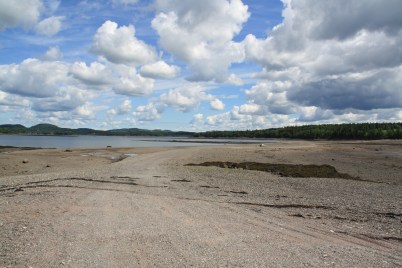
            Chuck’s next book, the fourth in the Donovan series, Donovan: Thief for Hire, is called Body on the Underwater Road. Much of this story takes place in St. Andrews, New Brunswick, and Chuck explained how he had scouted out the local area and, in particular, the ‘underwater road’ from the mainland to Minister’s Island. The Fundy Tides, the highest in the world, cause the roadway to disappear at high tide, thus making the island inaccessible for long stretches of time. It also makes the underwater road a natural fishing weir for dead bodies. This research work involved live interviews with the local RCMP and others on the movement of bodies in the Fundy Tides, where would they end up if they were inserted into the water at place A, B, or C. That sort of thing.

            Chuck ended with a request for questions and the audience announced their own engagement by asking questions on how to develop characters, how to name characters, how to thread narrative arcs, and on how much rewriting is necessary if an arc goes wrong. The answer: “Lots. Sometimes you need to abandon the arc completely; other times, you must rewrite it from top to tail. But cave scriptor / writer beware: if you make a change on page 272, make sure that it checks out all he way backwards, page by page, back to the book’s beginning on page 1.”

            The use of humor within a thriller series serves to illustrate the layers of complexity that the characters manifest. The insertion of this element serves notice that genre writers who are serious about their craft write with the intention of elevating words, their sense, and their impact on the discerning reader. It also serves to layer the novel with additional meaning. Such layers of complexity spark joy in the writer.

            An interesting evening, then. With some old friendships renewed and some words of wisdom cast before an appreciative audience by the Atlantic Provinces Director of The Writers’ Union of Canada and local Fredericton author, Chuck Bowie.  I attach his web page. Do some research: check it out.  http://www.chuckbowie.ca

Painting credit: Roger Moore. Fundy Weir Poles (acrylic), St. Andrews, NB.

Thursday Thoughts: Why I Write III

IMG_0027

Thursday’s Thoughts
Why I Write III
Intertextuality
29 March 2018

            In exile, in La Torre de Juan Abad, the Spanish poet Francisco de Quevedo wrote a sonnet entitled Retirado en la paz de estos desiertos / Withdrawn into the peace of these deserted lands. The first quatrain reads:

            Retirado en la paz de estos desiertos, / con pocos pero doctos libros juntos, / vivo en conversación con los difuntos, / y escucho con mis ojos a los Muertos. Reduced to an instant rough and ready English translation, this reads: ‘Withdrawn into the peace of these deserted lands, / together with a few quite learned books, / I live in conversation with dead men, / and listen to them speaking through my eyes.’

Talking to the dead by reading their live words on the page: this was my first introduction to the theory of intertextuality, written words speaking to written words across the medium of written texts. Intertextuality, then, living texts talking to living texts, be it in print, be it in digital form on the computer.

How does this relate to Why I Write? Orwell writes an article entitled Why I Write. Joan Didion reads that article, replies to it, and also writes an article entitled Why I Write, and her article is, in certain measure, an intertextual dialog with George Orwell. I read both these articles and I, in my turn, join in the conversation, responding, in my own way, first to George Orwell, and then to Joan Didier. Now I have introduced Francisco de Quevedo (Spain, 1580-1645) into this tripartite series and he too has joined the conversation linking why I write intimately to the theme of why I read. For a fuller discussion of Why I Read, consult the full version of Quevedo’s sonnet, particularly the final tercet. As you read these words, you too are drawn into this intertextual conversation, one that has gone on for much longer than we realize.

So, why do I write? In part, it is to join in and continue these conversations and thus to honor the memories of those who have gone on before, Quevedo writing to González de Salas, Joan Didion responding to George Orwell. However, I see writing not only as a conversation, a sharpening of arguments, a learning process in which speaker (writer) and spoken to (reader) exchange ideas, but also as a construction, like the well-wrought urn of Cleanth Brooks (new criticism), or the polished work of art of the phenomenologists. I see the written work of art as a construction, and I want that construction to be as polished and as well-made as I can make it. In addition, I have things I want to say, poems I want to write, stories I want to tell, and I want these things, poems, stories (constructs all) to be the best that they can be. I want to reach out to my reader (readers, if there are two or more of you) and say “Hey, stop awhile. Read this. What I have written is well-worth reading.”

Mikhail Bakhtin uses the term chronotopos, referring to ‘man’s dialog with his time and his place’. I write so that I too may dialog with my time and my place. More, I write in part to establish my time and to cement myself in my place. Time and place are both variable. Is Quevedo (Spain, 1580-1645) a part of my time (20th / 21st Century) or my place (currently Island View, New Brunswick, Canada)? The moment I draw him into the intertextual conversation, as I have done here, he shares time and place with me, and with you, as you read this. So, among other reasons, I write to establish my place not only within this time in which I live, but also within the great chain of intertextual writing that flows backwards and forwards from the earliest times. Only I can do that for myself. Nobody else can do it for me. Is it important that I do so? For me, yes, it is very important. Sometimes, in this life, we walk a long way across a very lonely shore. But we leave footprints behind us, footprints that the wind will fill with sand, footprints that the tide will wash away … we are aware of that but we still walk on, and we still leave footprints.

Reading as dialog, dialog as a means to establish ourselves, writing as a way to cement our ideas, to polish them, to craft them into the shape of that well-wrought urn, that well-wrought urn placed in public where it can be viewed, or in a private place where only close friends can see it and admire it … but something tangible, something solid, something well-wrought, something that will say, ‘yes, I have walked this way’ and ‘yes, I have left footprints’, however dainty, however small, however temporal, however fragile in light of wind and tide … but a footprint, the footprint of Man Thursday, on an otherwise deserted shore … to leave footprints …  to sketch the silver points of Lucifer, the light-bearer, the evening star, as he stands strong against the encroaching night … that is Why I Write.

Wednesday Workshop: Why I Write II

IMG_0055

Wednesday Workshop
Why I Write II
28 March 2018

Joan Didion’s autobiographical note did not appeal to me in the same way that George Orwell’s did, but then, I was born on the same side of the Atlantic as Orwell, and yes, that does make a difference. So much in Orwell is familiar, so much in Didion is alien.

For Didion, Why I Write (borrowed from George Orwell) is composed of three short words, each of them emphasizing the first person singular I + I + I. She sees writing as an ‘aggressive, even a hostile act’ in which she, as writer, imposes herself on other people (her readers) saying ‘listen to me, see it my way, change your mind’. From this idea of imposition springs the second idea of the ‘aggressive, hostile act’. This, in some ways, can be seen as a sort of combination of Orwell’s first, third, and fourth points (1) sheer egoism; (3) historical impulse; and (4) political purpose with possibly the first dominating.

That said, I like the idea Didion presents of ‘pictures in the mind’. She carries these pictures with her and then writes from them. She writes from the physical, the tangible, the ‘taste of rancid butter’, the ‘tinted windows on the bus’, the concrete nature of these things and her desire to describe them as accurately as possible, led her to discover herself as a writer.

When I apply her descriptions to my own writing, I gaze at my own memories of my childhood. They are like photographs, still, black-and-white photographs, like those we used to see when I was a child at the entrance to movie theaters. The skill for me in writing is to allow these pictures to spring back into life. Much of my writing, especially my stories about Spain, Mexico, or Wales, is autobiographical in its beginnings. However, as the pictures move and speak they tell me things and I write them down. What starts out as a story is very rarely the story that ends up on the page. A metamorphosis takes place. Words slip and shift and change their shapes and meanings according to the whims of characters and the situations in which they find themselves. In the beginning was the picture: that, I guess, is what Didion and I hold in common. But my writing is not her writing, and her pictures are not my photos, how could they be?

Interesting in my own original photos is the lack of sound, the lack of movement, the lack of taste and touch. First the figures are stiff and stolid. When I study them, they shift and move, and next they begin to speak. Alas, what they tell me when they speak to me in the shiftless shadows of my dreams at night is not necessarily what they lazily lisp in the full sun of my waking mind. A long time ago, I struggled to recall the exactness of that dream world and I tried to pummel the words and thoughts on my mind’s anvil and to hammer them into shape aided by the heat of my seemingly inexhaustible creative energy. Now I am more relaxed: I just listen to the daylight voices and allow them to shape themselves and their situations in their own way.

When I do this, background sounds and the tell-tale smells of time and place slip slowly in. Boarding school: the unforgettable stench of burned porridge. My auntie’s house: the whir of the cuckoo clock as it coiled itself up in preparation for the little bird to whip out and enchant the hours. My grandfather’s grandfather clock: the metallic lightness of the clock hands as I adjusted the minutes and the hours when the clock ran down and I sensed the tautness in the piano wires as I turned the key and wound the heavy brass pendulums back into their starting positions. My grandmother’s house: the bubble of water boiling on the hob, the warmth of constantly brewed tea, strong as a farrier’s horse and quite undrinkable without the second, third, or fourth watering and, of course, always the smell of boiled white fish cooling for the cats’ supper.

My best writing comes from deep inside myself. I find it  in the midnight coal mine of my mind where ghost-like figures drift and roam as they seek that special person, the one who will drag them to the surface and bring them back to life. Poor, pale, thin imitations of a reality that never was, I do my best to revive them. Often, my best is just not good enough and I must cast them away and drop them back into the depths to ghost away and prepare themselves for another day when perhaps, they and I will each be ready to deceive each other.

Why I Write

IMG_0055

Why I Write

In the online creative writing course that I am currently taking, we were invited to read two articles on why I write, one written by George Orwell and the other by Joan Didion.  Both articles set me thinking: why do I write? My response to these articles, borrowed from my course notes and suitably doctored for my blog, follows. Note: this is the first of three planned statements. The second, on Joan Didion, will appear tomorrow on my next Wednesday’s Workshop.

George Orwell … where do I begin?

Homage to Catalonia is, in my opinion, one of the great personal memoirs written about the Spanish Civil War. Orwell fought on the side of the Republic, the legally-elected government, but fell foul of the Russian-backed Communists as they tried to unify the left under a banner of total Communism. The other side in the Spanish Civil War was, of course, the solidified right of the Spanish Falange and the Fascist Party. Orwell was targeted by the Communists and, wounded at the front, escaped across the French border with falsified papers. As he himself says in Why I Write, the political realization of the nature of totalitarianism led him to his stance as a writer. Animal Farm borrowed heavily from his Spanish experience, as did 1984.

Orwell sets out four reasons for writing. (1) Sheer egoism; (2) aesthetic enthusiasm; (3) historical impulse; and (4) political purpose. I personally identify most strongly with #2. Above all, in my case, I write my poetry in praise of nature and in sorrow for how I see us failing the natural world around us. However, I must admit that I also write out of sheer egoism (#1) and yes, I enjoy thumbing my nose at all those who have in one way or another slighted me and upon whom I want literary revenge, even if it be posthumous. Several of my older friends also write this way, though many of the younger ones seem to be more interested in money than in art for art’s sake. I guess retirement and a small but relatively reliable pension added to the gradual onset of a blighting old age make me realize that there is not much time left in which to amass a fortune. This in turn also makes my professed credo of art for art and not for money more acceptable.

Having come to the conclusion that I never have, and never will, make any money through my writing, although publish or perish has walked side by side with me throughout my academic career, I now embrace the fact that I do not write for money. In fact, I usually give my independently published books away to my friends. Nor do I want the sort of fame that causes the paparazzi, with their microphones and videos, and camerasto flock to my doorstep, like starving sparrows or winter’s chickadees, in search of the breadcrumbs that fail to sufficiently nourish. To be appreciated, in my own small corner, like a well-loved local cheese or a craft beer, welcomed on a cool night for its fragrance and body … that is enough for me, although I must admit, that for one of my metaphors or images to be sniffed at, as if it were a glass of rare liqueur or specialized port or a welcome New Zealand Pinot Noir, also has its attractions.

This doesn’t mean that I am satisfied with who I am and how I write … I am not. I hope I never will be. I do want to be the very best that I can be. That’s why I keep writing and why I keep taking courses and workshops on writing. It’s also why I read and re-read, and why I keep reaching out to you and my other friends, and why I am so over-joyed when you, in your turn, reach out to me with the occasional word of praise for one of my stories or one of my poems.

However, warm as is the friendship of the beginning, failed and faltering writers’ support groups to which I belong,  most, if not all, writing is done in isolation: me and my memories, me and my invention, me and my keyboard, me and my blank page, me and my pen, me and a-penny-for-my thoughts as I refill that pen with Royal Blue ink in the hopes that something regal will actually fall from the nib and grace one of my pages, even though I am really wondering yet again whether I should start that first paragraph all over, just once more.

Alas, me and the cat and the keyboard do not share a healthy working relationship, especially when she walks across the keys, sticks her kitty-littered rear end in my face, scratches her itchy chin against the computer’s sharp edge, and purrs wildly for kibble while adding oft-repeated letters and deleting so many of the wonderful words that I have so carefully accumulated.

Thursday Thoughts

IMG_0027

Thursday Thoughts
22 March 2018

Washroom

Locate the nearest washroom …  I am growing old. Maybe I am the only one who needs the consolation of the proximity and known whereabouts of this item, but I am so much happier when I have located it and know where it is.  For me, it’s part of the pre-reading, ‘scouting out’ process that I wrote about yesterday.

The other thing I should have mentioned: work out for yourself a simple relaxation exercise that helps you to concentrate and brings your nerves back under control very quickly. Closing your eyes and breathing deep, one in, one out, does it for some. When uptight, I use a simple exercise from my early piano lessons. (1) Shrug your shoulders, relax your arms and let them hang down, then roll your shoulders, forwards and backwards; (2)  shake out your forearms and fingers; (3) close your eyes and breathe deep. This takes about five – ten seconds.

A personal anecdote: the first time I was due to read a paper at a major academic conference (in Laval University, Quebec) I was standing outside the lecture room listening to the chatter of a group of friends. I opened my mouth to join in and … squeak … no sound … speaker’s block … my voice had disappeared.

I eventually found a washroom,  did a series of  relaxing routines, including this one, sipped some water, and just like that, my voice came back. I returned to the conference and was able to read my paper, five minutes later, without further embarrassment.

Such narrow margins between success and failure.

Wednesday Workshop: Preparing a Public Reading

IMG_0167

Wednesday Workshop
Preparing a Public Reading
21 March 2018

Preparation is all important. You cannot prepare enough.

First question: how long do you have? Your reading must be tailored to your time frame. Our local open mic sessions are composed of 3 minute slots. I choose poems or prose passages that can be read in 2 minutes to 2 and a half minutes. Time passes very quickly at the podium. Well-prepared, you will not over-run your time. Read your piece out loud and time it. If you can record it, do so. Listen to it as you read it. Do you feel comfortable with it? If so, go ahead with the reading. If you feel uncomfortable, or awkward, if you feel that the piece isn’t right, then choose another piece. Comfort is everything. Familiarity with reading the piece and with listening to your own voice will be of great comfort to you. You will step up there knowing you can do it, not wondering if you can do it.

Second question: are you familiar with the room and the mechanics of the room? If so, no problem. If not, take the time to visit the space in which you will read. Attend an earlier session. Visit one afternoon when nobody is there. It is easier to read in a familiar place than an unfamiliar one. Check out the room in advance. The mechanics are also important. How many will be in the audience? Will you need a microphone? Will you be expected to project your own natural speaking voice? Is there a podium? A reading table? Will you be sitting or standing?  Knowing this in advance reduces nerves and gives you practical answers and takes away both nerves and the fear of the unknown. Mechanics are important. Familiarize yourself with the mic. Is there an assistant to help? Think height and adjustment and remember, if you start your reading with necessary adjustments, this will take time out of your reading. Always leave that little extra space.

Third question: Is someone introducing you or are you expected to introduce yourself? If the former, your reading time will start when you start to speak. If the latter, your reading time will start when you start to speak. If you are doing your own introduction, then write it out in advance and read it out in advance. Treat it like a part of reading and include it in your reading time. Whatever you don’t, don’t start by explaining what you are going to read: this wastes time. Your work should speak for itself. If you are very confident, you can ad lib, but this takes precious time away from your reading space.  If you are not confident, then stick to your text, and plan and time your text in advance.

Fourth question: how will you choose your text? My suggestion is that you apply to your choice of text exactly the techniques that you use when writing and revising your text. (a) which chapter pleases you most? (b) you must feel joy: which sections give you the most joy? (c) which words, which sequences spark joy? I would also ask whether you want to read a single long text or a sequence of smaller texts. That is your choice. Again, comfort is the key word. If you are not comfortable reading out the F word in public, do not choose a passage that is filled with F words: your discomfort will transfer to the audience. Select a couple of passages, read them out loud, time them … then concentrate on one passage (longer) or a contrasting or complementary set of passages (shorter).

Example: Last Sunday, I was gifted a twenty minute reading slot. I chose six short pieces of prose that formed two distinct but complementary sequences. The total reading time was 17 mins and 30 secs. I was introduced, then read. I did some ad libs (I always do, sorry). I shuffled feet and pages. Total time of the videoed sequence 23 minutes, of which the intro, my slow arrival, and my initial sorting took about 3 mins. And yes, I was nervous. You could see my hands shaking and the pages waving up and down! I knew the audience, and I knew there was a possibility that young children might be present. They weren’t. So I read my F-word story … and yes, it’s full of F-words. I had another story, much gentler, in reserve. Just in case. If you are an experienced reader, you can respond to the audience and change at the last second. If you are not, stick to the plan.