Apologia

weir 2

Apologia pro vita mea
(for Ana)

          Late last night, I opened Alistair Macleod’s book The Lost Salt Gift of Blood and I re-read the first story. I was soon dabbing my eyes with a tissue and blowing my nose.

This morning, I want to destroy everything I have written. I know I don’t possess the verbal and emotional genius of the great writers and I sense that I cannot write like them. Graduate school taught me to be passive, not active, and to write impersonally, choking every emotion when I write. Academia also taught me how to kiss and how to run away with my thirty silver pence. “Never challenge the status quo,” my professors told me. “Learn the rules and disobey them at your peril.”

But here, in this private space where I create and re-create, there are no rules. The enemy is not clear any more and the fight is not one of black against white. It is rather a choice between diminishing shades of grey, and all cats are grey in the gathering dark that storms against my closing mind. Should I destroy all my writing? I won’t be the first to do so; nor would I be the last. And I won’t be the first or the last to destroy myself either. Intellectual, academic, and creative suicide: as total as the suicide of the flesh.

I carry on my back the names of those who have gone on before me as if they were a pile of heavy stones packed into a rucksack that I carry up a steep hill, day after day, only to find myself, next morning, starting at the bottom once again. But this is not the point: the point is that if I cannot write like the great writers, how can I write?

I think of Mikhail Bakhtin and his cronotopos, man’s dialog with his time and his place. I have no roots, no memories, and that is where my stories must start: in the loss of self, the loss of place, the loss of everything. I was uprooted at an early age, soon lost my foundations, and only survival mattered.

I look at the first page of one of my manuscripts. My writing manifesto is clear before me: “And this is how I remember my childhood,” I read. “Flashes of fragmented memory frozen like those black and white publicity photos I saw as a child in the local cinema. If I hold the scene long enough in my mind, it flourishes and the figures speak and come back to life.”

I am aware of the words of T. S. Eliot that “every attempt / is a wholly new start, and a different kind of failure / because one has only learnt to get the better of words / for the thing one no longer has to say, or the way in which / one is no longer disposed to say it” (East Coker).

Are these stories an exercise in creativity or are they a remembrance of things past? How accurate is memory? Do we recall things just as they happened? Or do we weave new fancies? In other words, are my inner photographs real photographs or have they already been tinted and tainted by the heavy hand of creativity and falseness?

The truth is that I can no longer tell fact from fiction. Perhaps it was all a dream, a nightmare, rather, something that I just imagined. And perhaps every word of it is true.

I no longer know.

Herring Bones

IMG_0177 2

Herring Bones

Last winter, a heavy snowfall
toppled the garden wall.
Bricks and mortar now litter
the grass in untidy piles.

I take my child by an arm
and a leg and swing her round,
faster and faster till, dizzy,
she calls ‘no more’,
and I let her go.

She can hardly stand,
staggers like her grandfather
who lurches around the garden
leaning on a walking stick.

 He jabs at the red-brick wall
he wants me to rebuild
and claws,
with twisted fingers,
at words,
bricks laid
like herring bones
and
caught in his throat.

Tangled Garden

img_0274

Tangled Garden

Forget-me-nots twine
intricate designs,
periwinkle fantasies
dancing between
green pods,
red flowers:
runner beans.

Every night,
I pull them apart
with clumsy fingers,
yet they knot again,
fresh each day,
like tangles
in my daughter’s hair.

Onions push through
a pride of trumpeting
daffodils.
They were all
just bulbs
last fall
when my mother
planted them.

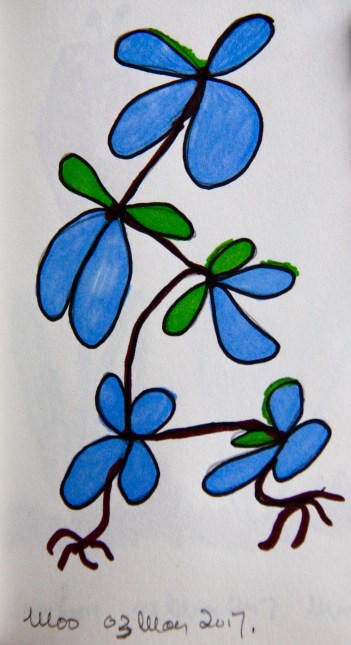
The painting that introduces my poem is by my good fried Jane Tims, a multi-talented creative artist. Her poetry and art work can be found on her blog. Please take time to look at her work on New Brunswick’s Covered Bridges and the wonders of our local foods that are all Within Easy Reach.

Braids

IMG_0080


Braids

All thumbs,
I can manage
two bunches,
one on each side.

But now,
with her mother gone,
it’s much more difficult
to part my daughter’s hair
neatly into three.

I work hard to perfect
that one thick plait
she loves down her back.

As for fish-bones
and French braiding…
she begs me to try

and I promise
that when my thumbs
turn into fingers,
I’ll give it a go.

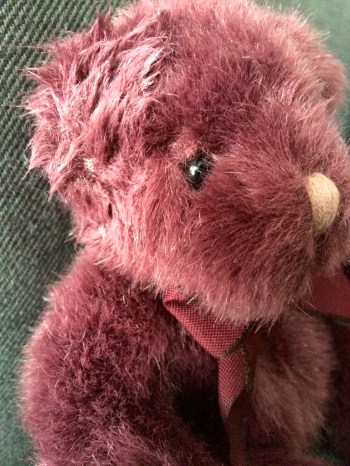
Bear

IMG_5811_2

Bear

This carving’s tame.
Children may sit
safely on its back.
They may stroke
the mighty muscles.

Its jaws are wedged in a grin.
Its red tongue hangs still.
No saliva drops from its chin.
Marble glass eyes.

Woodworm, like moth,
have left holes in its back.
More: many a crack
ensures its tameness.

Its shoulders hunch.
Sixteen claws
probe the concrete
museum floor.

Its nearer ear
bears small chips like
my grandmother’s tea-set.

There’s lots of room
for slips between cups
and this bear’s lips.

I can sense
death’s closeness
when I smell its breath.
I feel it move
beneath my hand.

I know you’re in there,
Bear,
alive, alert, angry, hungry.

Cold sweat covers
my false, carved skin.


Velásquez

IMG_0486

Portraits by Velásquez

 Velásquez sought asylum in Canada.
He set up his studio on the shore at Glace Bay.

He photographed short, stunted people
miners who worked underground
mining Cape Breton coal.

He waited while they shook or coughed,
had patience till they were still, then click.
When he had captured their spirits,
he blew up their photos to NHL size.

Slack jaws, puffy eyes:
“Man’s greatest sin
is having been born,”
one sighs.

Another seeks himself
through inner darkness.
He probes dark galleries
with Davy Lamps for eyes.
He finds no gold,
just seams of coal
that cling and clot his lungs.

Velásquez waits
for his cough to stop
and click he’s got him.
Sally Ann Second Hand clothes
lay siege to his tortured flesh.

“Life is a snap,”
Velásquez cries.
“And every photograph
a lie.”

Thursday Thoughts: An Old Song

Chaos

Thursday Thoughts
8 March 2018

An old song

… an old song, words and tune wrapping themselves around your neck, a loose scarf, brilliant in the sunshine, and oh so warm, flapping as you walk the streets, and people see the scarf’s frayed ends waving in the wind, so they wave back at you, and then they see those same ends tucked back in your jacket, hugging you tight, a pair of arms borrowed from your lover, and oh the light in your eyes, and the sun picking out the gold spots in your hair, and all’s well with the world …

… or left, left, left, right, left … it’s a marching song and the world falls away as you walk to work or to play and every day is a new day with blood stirring and this call to arms, to alarms, to alarums, and everything up for grabs, and you, marching in tune to the tunes in your head and the words wrapped around you, warming you, comforting, as you sing and stride along …

… or maybe it’s a sad song, and there’s rain in the sky, small drops gathering, a heavy mist, or a light mizzle, and you walk as if through a cloud, and yet you are still dry and warm and comforted and the words wrap themselves round and round you, and yes, you are sad, but you are comforted, as if in a verbal comforter, and the sun breaks through and hugs you and the raindrops radiate the brilliance of that sunlight, winking off your tears, as they gather at leaf’s end and spread sun’s twinkle from the radiance of flowers …

… and today it’s a Nor’Easter … snow in the air … on the trees … on the ground … a steady accumulation … you know how its is … and a fire in the fireplace … warm heart … warm heart … no travel today … books and the computer beckon … a time to read and write … to remember the old ways … the old days … those memories … a warm scarf wrapped around the neck … and the comforter … comforted … and comforting … so much to wrap around you … so much to wrap your head around …

Wednesday Workshop: Writing from Inside

IMG_0010

Writing from Inside
Wednesday Workshop
07 March 2018

Crave More: I hate those words.  I always choose a cart with the shop’s name on the handle. I can handle that. I can’t handle a shopping cart that screams Crave More at me every time I stoop down and place another item in the wire grid. If stores were honest they would write Think More and Crave Less on their shopping cart handles. But I bet that would quickly cut into profits.

Anyway, there I was, in LaLaLand, leaning on my cart, still half asleep, when this ghost drifted towards me. “Help me,” it said. “I’m hungry. I need food.” I woke up from my dream, looked at the ghost, tall, skeletal thin, cavernous eyes and cheekbones protruding, grey face drawn with shame. The single word “Sorry” came automatically to my lips. Then I too felt shame. I looked at him again. “I only carry plastic.” The excuse limped heavily across the air between. I saw something in his eyes, I knew not what, and I turned away.

In my mind, I added 120 lb of muscle to the scarecrow frame. Took forty years away. Filled his body with joy and pride, not shame, and remembered how he played the game, hard and fast, but true. I ran my hand through the card index of former players that I coached and knew: their moves, and attributes, the way they played the game, their stronger / weaker side, their playing strengths, their weaknesses. I remembered him holding up the Champion’s Cup. But I couldn’t remember his name.

I pushed the cart all over the store in a frantic search for him. He was nowhere to be seen. I went to the ATM and took out cash. I could hand it to him. I could tell him he had dropped it. I went through a thousand scenes. I could invite him to the snack bar. I could tell him to buy what he needed and follow me to the  check out lane. A single opportunity. One chance. That’s all we get. Miss it, and we blow the championship. Take it, and we win the game.


Brick

img_0185

Brick

Red brick the universe,
red brick crumbled
sparrow crumbs now.

Red brick,
not lily-white limestone,
nor chalk,
white cliffs,
will tumble,
tugged down
by fierce tides

Red brick
and rough:
sand-paper,
the builder’s hands,
life- lines fortified,
unfettered brick dust.

Red brick,
heart, liver, lungs:
red holes, not black,
where red roses
flourish.

Red brick,
shattered into red
dust and this sun
a dwarf brick
shrinking in its
innocence.

Red bricks:
their dust become
gas giants,
Saturn’s rings,
useless wooden wagons
drawn up
in second hand westerns.

The huff and the puff:
brick shit houses,
these red brick
universes, built to last
way beyond
those dreaming spires,
that failed, will fail,
and still fail to inspire.

“Here endeth
the second lesson:
Book of  Brick.”

Nobody’s There

IMG_0055

Nobody’s There

 Reality:
a red brick
sitting on the master’s desk
in the ivory tower
of a Cotswold Manor.

The history master enters,
sees the brick,
sizes it up,
seizes it
and, without looking,
hurls it at the window.

Summer term:
the days are warm.
The windows are open.

End over end,
the brick tumbles
through blue air
to land with a thud
on the quad’s black tarmac
right at the feet
of the school pastor.

He looks around.
There’s nobody there.
The brick must have
materialized
out of thin air.

The pastor shrugs,
stoops down,
picks up the brick,
puts it in his briefcase,
and carries it away.

“Here endeth
the first lesson:
Book of Brick.”