Shit Happens Flash Fiction

IMG_0186.jpg

Shit Happens!
Bistro 24

Pain in the joints so bad I decide to get in the bath and soak in hot water. I run the water, test the blend of hot and cold, if baby turns red, I remember, don’t insert elbow in bath, water too hot for elbow.

Bath water bubbles in. I set the fan for steam extraction. Test the water. Seems fine.

High the step into the bath and I cannot raise the right leg high enough. The left leg is worse. I lay flat along the bath edge, naked, of course, and think: “How do I get in?”

The left leg will not rise. I stand on tiptoe, pushing up from the right leg’s toes: cramp, shit! I slide back down, swivel, and my belly is cold against the bath’s edge.

I refuse to give in. I try again. I raise the left leg, ouch, cramp in the right toes, and slide the left leg over the bath’s edge. I slide weight to the left, raise the right leg and slip into the bath, on my knees, face down.

I grab the sides of the bath, flip myself over, and victory: I am on my back in warm water, feeling the comfort of the whirlpool’s heat seep into my bones.

Exercises: I raise my legs and move ankles, then do the windshield wiper, left right. I feel immediate benefits in hips. Then comes the slow military march, legs slightly raised against bath end, left, right, left.

Raise both hips now, then gyrate them, left to right, twenty times, and reverse. Now up and down, raising them in a familiar though nearly forgotten motion.

Twenty minutes, they say, or else you may suffer. So I call my wife and she runs upstairs and turns off the motor. The whirlpool ceases.

Now I must get out. I have a funny feeling that something is wrong. My wife pulls the plug and water drains from the bath. The last thing I want is to lie face down in an inch or two of water and drown.

I roll to the left and slip on the bath’s bottom. I roll to the right and slide again. I grasp the handle on the left … it comes out in my hand. With nothing to grasp, I can’t sit up. So I lie there with the water draining away.

I start to panic. Mustn’t panic. I’m in pain. Not that much pain. I must fight. I can’t give in. Again I try to turn over … and again.

Tears. Sweat. I get cramp in the toes, and in the lower legs, where I push against the bath’s end. Panic now and a tightness in my chest with bile edging up in my throat to choke me. I half-turn but fall again and bang my head. Don’t struggle. Don’t panic. Think.

I ask for the towel and my wife slips it under my feet. No good: my hips still slide. I need to pee. Hang on. I can’t hang on. I tighten my stomach muscles involuntarily and urine spurts. My wife slides the towel under my knees: I get more grip but my arms won’t hold. I slip and squeeze. Oh no: my bowels are turning to water. I groan and hope but I can’t hold on and bath and body are soiled. But I have rolled over and now I lie face down, in push up position, humiliated, soiled, tears streaming down my face, breathing above the absent water.

My wife goes downstairs to get the garden kneeler. It won’t fit in the bath. I experiment with my walking stick, but it’s no good, it slips and just won’t hold. Naked, shrunken, smelling like I don’t know what, I can’t face calling the neighbors or the fire department.

My wife kneels beside me. Together we haul the now wet towel beneath my torso and finally I gain a dry base on the slippery bath; no sliding now. I curse as my wife sinks sharp fingers into my fragile flesh and helps me to rise. Together we force me into a kneeling position. From here I can empower my arms and push myself up.

It has taken me twenty-five minutes to get out of that bath. I stink and I am no longer clean. Dipped in my own excrement, I hobble to the shower in the other bathroom and hose myself down.

Shadow Flash Fiction

IMG_0147.jpg

Shadow
Bistro 23

             The janitor said he saw LJ’s shadow lying down at midnight on the corridor floor. He dialed 911 and a police car came with a bucket and a mop to sweep the evidence under the carpet. LJ wasn’t there. He had climbed to his feet and scuttled away, a peregrine crab clicking his pincers over dry moonlight on a sanded floor.

He migrated to the elevator and the janitor watched as the needle jerked to a stop at every floor. Now they feared him in the washrooms. They stared at themselves in the mirrors and saw him as a kind of devil looking out with an offer of work for idle hands.

LJ is horned and hoofed and he breathes heavily as the customers clean their teeth and leave the cold tap running. When the water’s turned off, LJ’s long, thin fingers pluck the strings of their hearts and a quaint fibrillation fills the silence of this haunted house that breathes in and out, moving fine membranes of memory.

Upstairs, downstairs, a lonely route he treads while the wind at the window scratches tinkling notes. Something breaks loose in the confines of his mind and walks beside him. His twin brother stalks through this silvery sliver of splintered glass, this simian mirror wrinkling their troubled suits of skin.

LJ glimpses the old moon’s monkey face through a broken window. Jagged and coarse, it wanders like an itinerant snail, cobbled with clumsy clouds. A vagabond in a paving stone sky, it rumbles across metal cracks, a knapsack of nightmares humped on its old man’s back.

When the snail moves house who stores the furniture he leaves behind? The hermit crab lurks naked on the beach, seeking new lodgings. Two eyes in limbo watch LJ roll his snowman’s belly of flab across an unknown, clouded room. Who killed the candle and left him in the dark where a fallen star grazed by the lamppost?

A bouquet of golden sparks flew from an iron tree and sanctified the gutter. The gas lamps sputtered patiently in uniform rows. A scarecrow stuttered into the limelight and shook LJ’s hand. The skeleton was wearing LJ’s grandmother’s Easter bonnet, with all the flowers renewed, but she couldn’t keep his heart from last winter’s left over crumbs.

When a tulip thrust its tongue through the concrete. It became as red as a robin and flew into the lounge bar of a public house. The bronze leaf necklace circling LJ’s throat filled with a flow of springtime song. His heart stood upright like a warped piano and the skeletons in his cupboard emerged to tarry at the corner to play knucklebones with the wind.

Torn butterflies of news fluttered round the neighborhood. Yesterday’s horoscope winked its subversive eye and called to the hermit in his lonely cell: “Look out for the stranger with the tin can alley smile. Sharpen your knife and tie your heart to the tail of the first albino dog, white as a lily, that comes whistling down the street.”

Re-reading the Codices Flash Fiction

IMG0061_1.jpg

Re-reading the Códices
Bistro 22

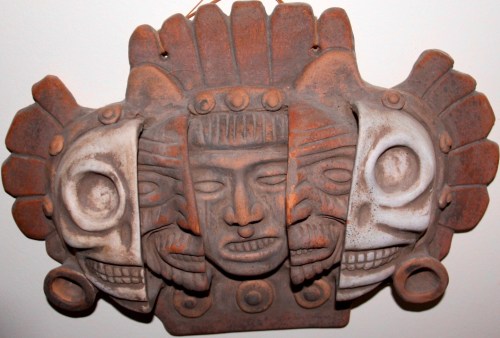
             The Mixtec Códices, indigenous screenfold books written on deer hide, 
are Pre-Columbian pictographs that record the history of the Mixtec peoples. 
There are no words: only brightly coloured scenes containing information about rituals, gods, heroes, and ceremonies. 
Only a few very precious documents
(Zouche-Nuttall, Vindobonensis, Borgia etc) survived the ravages of time
 and the continued purges of the Spanish priests. 
The following text, self-explanatory for the main part, verbalizes typical symbols from the códices. 
Clearly, such symbols, as the poems suggest, are ambiguous 
and open to radically different interpretations.

           “Two breasts: one green, one yellow, symbolic of the hill where the church stands; the church itself bi-colored, strong stone walls, a spire. A large red heart symbolic of the love we bear for you, our masters. Two feet walking the path of enlightenment you opened before us; two hands pointing the way. The feet below the heart; the hands above the heart, like wings; and the heart becomes the body of the new place you have built for us. And in the heart is our sacred symbol: the Earthquake, a sign of leadership and power used only by those of Royal Stature and the Noblest Blood. Attached to the heart is the Numeral One which means Lord of the Earthquake; for you are Number One in our Hearts. Attached to the heart is a speech scroll showing felicitous words of praise; below it is the sacred earthworm, and beneath that the serpent head of wisdom and the flint knife promising strength through sacrifice.

            But be wary: for our symbols are double-edged.

            The colors of the hill are divided, as the hill is divided, showing strife and division. The church is on top of the hill, for the symbol has conquered the people, and the people are starving, subject, and destroyed. The feet are pointing in opposite directions, for the people are stalled. They have no forward movement, nor will of their own. For they are conquered by the sword and not by love. And the hands are pointing in opposite directions; for the right hand knows not what the left hand is doing. And the hands are reversed showing anguish and distress. The sign of the heart is the sign of the disembodied heart, torn from the heaving chest of the vanquished and thrown to the dogs. The sign of the earthquake is also the sign of movement. And that movement is a bowel movement. And one movement in the middle of the sacrificed heart is the victor excreting on the vanquished and treating them with scorn and contempt. The scroll protrudes from the nether part and says that the victors are speaking words of excrement, that verbal diarrhea issues from their lips. And the serpent has no feathers; it cannot fly. It is as a snake treacherous and bitter, crawling on the ground. The head of the serpent is two tongued and tells of treachery and of deceit. The flint is attached to a heart; it speaks of the heart that is as hard as flint, knowing no mercy.

            And at the end that heart will receive no mercy in its turn.”

Raptors Flash Fiction

IMG_0236.jpg

Raptors
Bistro 21

“Falcon, Richard?”
“Here, sir.”
“Finch, Thomas?” Mr. Shrike’s predatory eyes squinted out over half-rimmed glasses.
“Thomas Finch?”
“Not here, sir,” Dick Falcon answered.
“Why not? His trunk’s here.”
“Don’t know, sir.”
“Hawk, Peter?” Mr. Shrike continued.
“Here, sir.”

* * *
“Tom Finch not back?” Mr. Shrike perched by the fireplace with his conspicuous, upright stance. “Why not?” He addressed the staff room then spat in the fire.
“Tricky business,” Mr. Slaughter replied. “Important birthday, his mother said when she called. He’s at home but his trunk’s here. He’ll be back.”
“Pity,” Mr. Shrike winced. “That boy’s spineless. I’d like to…”
“Impale him on a thorn and hang him out to dry like the butcher you were in the war?” Mr. Slaughter peered down the long beak of his nose. “Not on school grounds, I hope,” he sniggered.

* * *
Tom and his mother lived with her parents. His birthday cake had thirteen candles that year. He blew them out and made a silent wish: “Let me be brave enough to do it.”

* * *
After tea, Tom’s mother sent him into the kitchen while she talked with her mum and dad.
“He’s got to go back to school,” Tom’s grandfather cleared his throat and spat in the fire. Tom’s mum recoiled at the stench of burning phlegm.
“He doesn’t want to go,” she murmured. “The boys bully him and the masters are worse.”
“Just like the army: he’ll get used to it. It’s me paying his fees; it’s my money you’re wasting when he’s not at school,” he spat again.

* * *
Tom leaned over the chipped porcelain sink in the kitchen. His fingers brushed against the damp red flannel and the soap dish. Then he touched the leather case of his grandfather’s cutthroat razor.
The folded razor lay cradled in his left hand. He nursed it, swaying back and forth on his feet. He found the groove and pulled the cold steel blade from its protective casing.
The razor formed a glittering right-angled claw. Then it became the sinister half-wing of a hawk that fluttered for a second, hovering above his wrist.
It pounced.
A fierce talon slashed into Tom’s wrist and a red river of pain sprang out. Tom fought the urge to scream as he stared at the flowing blood. The great claw of the triumphant hawk lay deep in his wrist. Strong wings flapped and bore him away.

* * *
“Falcon, Richard?”
“Here, sir.”
“Finch, Thomas?” Mr. Shrike’s strident voice pierced the classroom. “Thomas Finch?”
“Not here, sir,” Dick Falcon answered.
“Why not?” Mr. Shrike surveyed the class.
“Don’t know, sir. But he won’t be back.”
“How do you know that?”
“Saw his trunk being sent home, sir.”
“Finch, Thomas: absent,” Mr. Shrike looked down at his list and skewered the boy’s name with the absentee’s black cross. He smiled a cruel, calculated smile, and returned to his list.
“Hawk, Peter.”

* * *

Remembrance Day Flash Fiction


039

Remembrance Day
Bistro 20

Previously published on
http://commuterlit.com/2015/12/wednesday-remembrance-day/

            The old man watched a drop of red wine slide slowly down the side of the bottle. It was November 11, his birthday.

Seventy-three years ago, Father John had taken the boy’s ear lobe between thumb and forefinger and pinched the nail deep into the flesh until the blood ran.
“This afternoon you will go down to the bamboo grove and cut a cane. Bring that cane to me and I will bless it.”

That night, the boy woke up. Snuffles, snores, and an occasional sob broke the dormitory’s silence. The bamboo was a long, cold serpent drawn up in bed beside him.

The next day, he awoke to his seventh birthday.

Father John beckoned and the boy followed him to his cell and knelt with his hands stretched out like those of Christ on the Cross. The priest struck him with the bamboo cane six times on each hand.
“Your Savior, blessed be His name, suffered more, much more for you,” the priest sighed. “Examine your soul. Find fault with each flaw, for you are unworthy. Remember: the eye you see is not an eye because you see it,” Father John droned on. “It is an eye because it sees you. Christ sees you as you kneel there. He sees. He knows. He judges. Examine your soul with care and stay there until I return.” The priest raised his right hand and made the sign of the cross in the empty air.

The boy spent his birthday kneeling before the crucifix in prayer. He contemplated the wounds of Christ. He imagined each blow of the hammer and imagined the pain of cold nails biting into his warm flesh. He tasted bitter vinegar as it dripped off the sponge, gasped at the thrusting spear, felt the lash’s sting as it fell across his flesh. He became the flagellated Christ and knelt before the crucifix, staring at himself eyeball to eyeball in the same way he looked at himself in the morning mirror. The crucified Christ gazed back at him, his brother, his soul mate, his double.

After an hour, a red drop of paint slipped slowly from the nail hole in Christ’s right hand. The boy blinked. The red drop trembled then fell.
After two hours, Christ opened his eyes and smiled at the boy.
After three hours, salt-water formed at the corner of Christ’s eye. It glistened in a sunbeam that entered through the cell’s narrow window.
After four hours, tears began to flow down flesh and painted wooden face.
It was Remembrance Day, the boy’s birthday. He was seven years old.

Seventy-three years later, the old man sat at the table. He watched the red wine trickle down the bottle. He remembered it all and his tears flowed again.

Recalcitrant Flash Fiction

IMG_0013

Recalcitrant
Bistro 19

            The annual Old Boys Reunion took place in the sixteenth-century cellar of a world famous winery that also ran a restaurant and banquet service for pecunious customers. A man in a penguin suit, with a foreign accent, and a suspicious looking bulge under his left armpit, ushered the recalcitrant towards a set of well-worn of steps.
            “You are arriving slightly on the late side, sir,” the penguin whispered, staring mockingly at the checkered, American-style sports jacket worn by the man he escorted. “And not dressed like the others. But not to be troubled, I myself will escort you down to the place of the guests.”
As he descended the steps that led down to the former wine cellars, the recalcitrant heard the well-remembered, high nasal bray as his former headmaster’s brass voice pierced the ruminations of the penguin-suited herd that, having sniffed the glorious nature of the gregarious watering-hole, was intent on reminiscing, drinking, and feeding.
“Wonderful place … so fortunate … to be here … thank you … ” the old man neighed.
It was indeed a wondrous place, a semi-whitewashed room, warm in the center where bees wax candles in gold candlesticks blazed on antique tables and cool by the one wall left untouched since that same sixteenth century. Here the damp gathered in great grey clots and the spider webs, also untouched, sparkled and glistened, like “the mythical lights of fairyland” as the winery brochure announced to the limited circle of the wealthy to whom it was circulated.
Empty kettle … the recalcitrant thought as he remembered his old headmaster and then they were, face to face, the head and his obstinately defiant and anti-authoritarian pupil, staring each other down.
“You!” It was an authoritarian call to battle. “I remember you. The boy who denied all authority.”
“Yes, me,” the recalcitrant, eyeball to eyeball with the old enemy rejoiced in his newfound glory. And here he was, back in the old country on a lecture tour of six major universities, one of them being in this city, a full professor now, with international honors, multiple publications, department chair in a well-known university, a household name in his subject, and all of this at forty-two years old. “Yes, me,” he repeated.
“You have done well for yourself,” the ageing donkey brayed.
The gunman in the penguin suit, sensing the tension, placed himself in the gunslinger’s position from which he could survey the whole room. He lovingly stroked the armpit bulge, eyes gleaming with hope.
“Tell me,” the head drew a handkerchief from his pocket and honked his nose into it like a storm-bound goose. “How did your career take off?”
“Well, in two stages,” the recalcitrant paused, partly for effect, partly to gather his thoughts. “Just like a rocket: stage one was when I left your school and stage two was when I left your country.”
The old donkey, blinked, threw back his head, trumpeted down his nose with intense nasal wrath, and turned away with a wave of his hand towards another latecomer who had just descended the stairs. “Ah, there you are Smithers,”the fog horn blared. “At last. Saved me you have. This man was just about to …”
The rest of the sentence was lost in the rush and a hubbub as a new series of delights arrived, tapas, hors d’oeuvres, little sticky creations on fiddly little sticks, they all circulated from hand to hand along with the exquisitely chilled champagne, the single malt whiskies, and the ultimate in estate wines.
Not a penguin spoke to the sports-coated recalcitrant. Nobody offered him a hand. Nobody shared a memory with him. As he arrived at each little group, the penguins gathered in a tight circle, turned their black backs to him, and shut him out. Throughout the feasting, he sensed the gimlet eyes of the gunman glued to a spot mid-way between his shoulder blades.
The recalcitrant didn’t partake of the food or the drink, he just watched. Then, after an hour or so, he turned and climbed the sixteenth-century stairs, the gunman in the penguin suit right behind him, and walked away into the freedom of starlight and the cool night air.
He never returned for another reunion.
He never received another invitation.

Old Man Flash Fiction

IMG_0051

Old Man
Bistro

Old Man

I’m an old man now, discontent with the rumbles of incontinence that surge like an express train through my guts. They told me the after effects would last a year to eighteen months after the cancer treatment, and it’s nearly a year, and it should be over, but it isn’t, so I sit here, in my car, outside the washroom in the local park, waiting for that urgent call that will send me limping to my destiny and soon now, I know it will be soon now, as the cold shiver grips me, and then I start to sweat, great pearls of salt water, trickling down forehead to nose, and I open the car window, and there she is again, in a green and yellow string bikini, the twelve year old who has haunted me for the last ten minutes, ghosting round, staring at me, looking at the car, and behind her, her parents, her grand-parents, her family, muttering in some strange and ancient tongue, about this old man sitting in his car by the public washroom, being stared at by the girls, the boys, the young people as they enter and leave, bees around the honey-pot, and they gather by my car, and mutter and grumble, raising their voices and pointing their fingers at me, at the car, and always that surging wave of grumbled accusations, rising like this tide, this hot, red tide that now rushes through my guts and rumbles me towards my destiny, a plastic seat in a tin shack at the edge of the woods in a public place, this park, where I have every right to be, and the girl’s long blonde hair whisks again and again past my window, and she points and the old ones mutter, and there’s the boy again, squeezing himself, and looking cute, and I can guess what they’re thinking and saying, even though I don’t understand a word of their language, yet their grumbles are loud and their fingers are sharp and pointed in my direction, and I can see a cell phone, now, with a man taking pictures of me and the car and the number plate, and someone else is dialing, I can see their fingers punching the keys and I know they would rather be punching me, my face, anything they can get their fists into and why not, because it’s a free world and if I am what they seem to think I am, a predator after their children, not an old man, incontinent, in urgent need of the washroom yet afraid to brave the crowd and leave the safety of his car, then they would indeed have every right to be pointing at me in this way …. but hey, everybody is innocent until they are found guilty by twelve honest men, and twelve of them now gather out there pointing at me as I sit, glassy-eyed, sweating, afraid to move in case I make it worse, just hoping that they and this terrible pain will go away, this pain, this train, this express train, rumbling through my guts to its inevitable conclusion … and too late, I’ve left it too late, dammit … and so, rooted to the earth and this spot, I soil myself again.


Quack: Fast Fiction


IMG_0183.jpg

Quack
Bistro 18

Previously published on CommuterLit.com

            I tug my grandfather’s sleeve and we leave the bowling and walk along the sands towards the swing boats and the merry‑go‑rounds. He stops, holds me with one hand, and points with the other to a space beside the sea‑wall.
“That’s where the quacks used to put up their stands when they came to town.
“What’s a quack, grandpa?”
“Well, a quack’s a salesman who sells patent medicine. Watch now,” my grandfather stands in front of me. “I’m a miner, see, and I can hardly talk,” his voice changes as he speaks and the words limp out all hoarse and scratchy.
“Now I’m the quack,” he takes three steps to one side and his words emerge strong and healthy. “Good sir, I see you are in need of my aid,” my grandfather draws an imaginary bottle from his coat and holds it high for all to see. “Pretend you’re the crowd,” he whispers to me, “you have to hiss and boo.”
“Hiss and boo. Boo.”
“That’s right,” my grandfather smiles, then he speaks again. “Now, sir: just take a sip of this patent medicine and your voice will be restored,” he hands the bottle into space, strides across the gap, and the miner holds out a weak and palsied hand to receive the offering.
“Thank you,” the miner croaks, “will this help?”
“One sip, good sir, and all will be well.”
“Hiss,” I shout, “Boo.”
The miner puts the bottle to his lips, closes his eyes, drinks, and his glorious voice pounds out a hymn: “Changed from glory into glory / till in heaven we take our place.”
“Hiss,” I go and “boo.”
“No, no,” says my grandfather, “this is where you cheer.”
“Hooray.”
My grandfather becomes the quack again: “This marvelous potion is yours for a silver three penny piece.” He bows, nods to the crowd, hands over imaginary bottles, and places coins in his invisible pocket while I clap and cheer.
“This performance,” my grandfather tells me, “never failed to sell a great number of bottles.”

Decisions

DSC02057.JPG

Decisions

We make them all the time: what shirt to wear, jeans or dress pants, black of brown shoes, loafers or lace ups, sandals … socks or not … and then there’s breakfast … tea or coffee, cereal or toast, sugar or honey … most days, we don’t even realize we are making decisions. We certainly don’t need to write out a page of pros and cons in order to choose between coffee or tea …

Then there are the big decisions, like where to go next on this blog. I have been weighing up the pros and cons and I am finally getting close to a decision. My blogging possibilities include Literary TheoryWriting about WritingHow to ReadRevising Older TextsReading Don Quixote OnlineWriting New TextsPreparing Books for Publication Offline … These are much more difficult decisions but I must think about them and make them.

Literary Theory sounds good. But what do I know about it? Nothing but the dry academic literary theory of an abandoned academia that wasn’t really very interesting anyway. An occasional question arises in the blog world, one on which I feel competent to comment, and that for me, is the way I go with my literary theory: a quick response. All that academic literary theory is money in the savings bank that I can draw on if I, or anyone else, needs to access it. But to access it on a daily basis and pontificate my way to the limbo of a blogger’s boredom? I don’t think so!

Writing about Writing also sounds good, but in many ways it is a poor person’s literary theory, rather like literary theory without the long, obfuscating technical terms. Again, if the need is there, I can contribute; but it’s not the way I want to go, not here, not on this blog, not on this particular watch.

How to Read is a subject on which many books have been written and I recommend that all people not just read, but learn to read deeply and properly. In some cases, depending upon the quantity of material that crosses the computer screen (it used to be the desk), speed reading is essential and I recommend speed reading for everybody except poets and those who love poetry. To speed read a sonnet is not the way to go. I would love to sell the film rights to some of my sonnets, but apparently, that’s not the way to go either. Ah well, we can’t have everything …

Revising Older Texts is another excellent way to run a blog. The material is always there in one form (old) and the reworking of it into another form (new) is regular, instructive, and creative. I have done that on this blog with At the Edge of Obsidian > Obsidian’s Edge and loved both the process and the result. However, at least three of my commentators, Al Lane, Chuck Bowie and Kevin Stephens, suggested that the past is in the past and should remain there, while the future lies ahead of us and needs to be created. After much thought, I have come to the conclusion that Al and Chuck and Kevin are right. I will put older material up on the blog, but I will no longer review it for future re-publication, except in exceptional circumstances, and these are yet to be determined.

Reading Don Quixote Online has been in my wish bucket for a very long time. It is something that I would love to do one more time. I have already done online readings on several occasions. I have twice taught DQ in an online hybrid environment: hybrid — an online portion and an in-class face to face portion –. To return to DQ is, for me, to return to academia, an academia that I rejected several years ago. No: much as I would like to re-formulate this project and to lay out online my definitive This Is How To Read Don Quixote, I feel in so many ways, that this is not yet the time to do so. I want so much to turn back that particular clock, but I know how much work, reading, and commitment is needed and I am not yet ready. Perhaps, like the Flowers of Scotland, those days are past now and in the past they must remain. We’ll see. I checked my DQ notes last night … they are all there, ready and waiting … and I can set out on that adventure anytime … alas, through the mists of time, I can hear those bagpipes playing Will ye no come back again? I will, my friends, but not just yet.

Writing New Texts is fun. This is a new text and it is helping me to focus  on what I want and do not want to do. There is always room here for new texts. But new texts need revisiting and revising. Maybe some of my creative texts just aren’t ready for publication yet and yes, online writing is a form of publication. Thankfully I can revise these texts, and I may yet revise this one; indeed, I will probably come back both to this text and to these decisions. And maybe I won’t and that’s another decision for another day.

Preparing Books for Publication is where I am right now in my offline life and I think this is where I want to be online as well. I have two texts in preparation: Bistro (Flash Fiction) and Echoes of an Impromptu Metaphysics (poetry). I have thus far shared 17 pieces from Bistro on this blog. There are another 17 to go. Each time I prepare a piece of Flash Fiction for publication here, I re-read it, re-think, re-frame it, re-structure it, and re-write it. Those of you who know me offline are well aware of the nature of that re-processing. Sometimes the pieces are merely sharpened and polished; often they are totally re-written. And yes, when flaws are pointed out or doubts expressed, the texts are changed. I deeply value the comments of my below the line commentators. Echoes is the other text I need to re-write. I will share that online as well. The sharing will be difficult … Echoes is a difficult and very personal text … but it will be done.

Decisions have been taken and my thought process has been shared. There will be no turning back of the clock even though I am always looking over my shoulder. Here, then, are my decisions, but remember, they are always open to revision.

  1. I will re-publish on this blog Though Lovers Be Lost, one of my favorite poetry books. I will do this as and when necessary if I need more time between blogs with my re-writing.
  2. I will finish publishing the other stories from Bistro online on this blog as I prepare it for offline publication.
  3. I will start the re-write of Echoes online. I have been away from this book for about eight months now and re-reading it earlier today I saw how and where it could be improved.
  4. I will add in literary and philosophical commentaries when and where I see the need to do so. I consider this particular article to be a literary commentary with philosophical connotations, or is it the other way round? As an academic, I could prepare a treatise on the question; as a blogger, I can leave that question in the capable minds of those who read and follow this blog.

    Vale!
    Et vade mecum!

Obsidian’s Edge 29


IMG_0150.JPG

El sueño de la razón produce monstruos.
When reason sleeps, monsters are born.

Francisco de Goya.

5:00 AM

… bright flowers of penance purchased for a pittance finger knitted spider webs of silence spun into wrinkles between stars and evensong while an old film shadow boxes black and white photographs and a rowing boat lurches over the waves as if a soggy brown cardboard box had dropped down on a moonbeam to pluck the mote from a one-eyed jack-in-the-truck who surveyed his road map for the dead days lying in ambush next to the sudden bonfire that flared on Guy Fawkes night and ignited the world like a Jacky-jumper vaulting a Roman Candle as Catherine spun on her wheel and a sky full of stars wheeled round the North Pole and slid down the Big Dipper’s handle to launch a long white scar of lightning that scared night’s velvet mask and plucked a diamond feather from the peacock’s tail as it strutted through the garden of bifurcating paths where Borges left his summer footprints at low tide in the sandy grief of the autumn leaf that the red fox dripped and dropped as he fled in vain like blood sizzles drizzling from an open vein and observe I say the play of light as it glistens on the voices of young children reaching to pluck the church bells as if they were ripe fruit dangling before us in our dreams and the world is a handkerchief so small it is and now not so clean and so we dream these dreams and pluck this unripe apple from the eternal branch where it lay hidden kicking and struggling up like the float that bobbled then sank through deep water and memory bent itself into two like that fragile reed dead in the water lying as straight as a bowing string at a crazy angle   at the pillows edge where mouths flap open as shadows walk and talk and we slide back into sleep’s dark waters where there are no dreams and nothing from those dark depths is ever recalled …

IMG_0152.JPG


6:00 AM

a clicking of claws
needles knitting outwards
towards dawn’s guillotine

the alarm clock shuffles
its pack of sleeping hours

the church bell
lurches into action

IMG_0140 2.JPG

We have come full circle and the sequence of rewrites that I have dedicated to At the Edge of Obsidian / Obsidian’s Edge ends here, with the start of a new day in Oaxaca that will be very similar to the old day that has just passed us by. For those of you who wish to read the full sequence, in its correct order, it will appear (some time soon) under Obsidian’s Edge at the top of this page.

I would like to thank all those readers who have accompanied me on this journey. In addition, I would like to thank all of you who lent your voices to this sequence either below the line with your comments or, and I refer specifically to those who are close enough to know me in the flesh and blood of real life, with your verbal comments and telephone conversations.

I hope this will be the first of many journeys that we make together. My best wishes go out to you. I trust you will consider joining me in my next verbal adventure on this blog.

IMG_0149.JPG