Help!


img_0372

Help!

The world turns full circle
and my mother is on the phone.
It’s four AM. “Help me!” she cries,
from the far side of the Atlantic.

Her ship is sinking fast and she’s
nine sheets to the wind.
“I’ll stick my head in the oven,”
she says, “and turn on the gas.”

What can I say? What can I do?
She makes so many threats.
She’s crying “Wolf!” and her words
now bounce off this duck’s back.

Yet still I wake at night to hear
her whispered words, and they still
chill with their razor’s edge of
“Help me! Help! Please help!”’

Cramp

Chaos

Cramp
(Jackpine Sonnet)

Late last night, lying in bed,
cramp laid siege to my lower limbs.
I crawled out of that bed and stretched,
left leg, right leg, in the bathroom.

Aching still, the fear of more cramp
to come weighed heavy on my mind.

I didn’t want to wake my wife
with panic and alarums, so I slept
in the spare bed in the other room.

A great round moon sailed its pale-
faced boat on a sea of silent clouds.

I lay on the life raft of my bed
and prayed for cramp to stay away
and for the mattress to keep me afloat.

Lost

img_0363

Lost

My body’s house has many rooms and
you, my love, are present in them all.
I see you here and there, glimpse your
shadow in a mirror, and feel your breath
brush on my cheek when I open a door.

Where have you gone? I walk from room
to room, but when I seek, I no longer find,
and when I knock, nothing opens. Afraid,
sometimes, to enter a room, I know you are
in there. I hear your footsteps on the stair.
Sometimes your voice breaks the silence.

It whispers my name in the same old way
I remember … how can it be true, my love,
that you have gone, that you have left me
here alone? I count the hours, the days,
and snatch at sudden straws of hope,
embracing dust motes to find no solace
in the sunbeams, salacious as they are,
that drag me from my occasional dreams.

Bearing Witness

IMG_0176

Bearing Witness

Pen on paper,
words falling like tears,
salt waters that erode
the hardest of stones.

This man bears witness
to thought, word, and deed.
He’s the outsider who sees
the interior world
and drags forth its spirit
for others to see,

not painted in paint,
not sculpted in stone,
not a breeze through
bound river reeds,
just words on the page
lined up in thin lines
to flower and flourish
like an army that conquers
the world of the soul,
and leaves fresh footprints
on eternal snow.

Nobody’s Child

IMG_0466.jpg


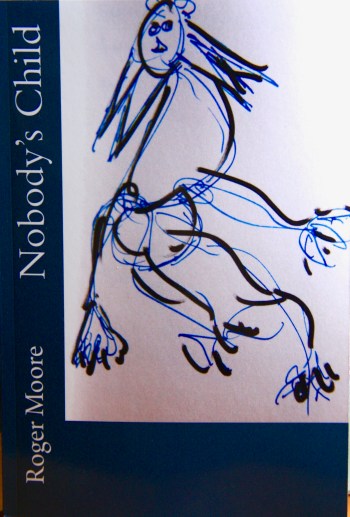
I ordered Nobody’s Child on Monday and it arrived on Thursday, two days after A Cancer Chronicle. Two books, two days apart. Wow. Nobody’s Child is a collection of short stories and Flash Fiction that deals with some difficult topics. A couple of the shorter pieces have appeared on these pages and will be familiar to the followers of this blog. Most of the material is new, some of it, very recent. Some of the stories have been published, others have received awards and honorable mentions. A shortened version of the collection, under the same title, was given an Honorable Mention in the David Adams Richards Fiction Prize of the Writers’ Federation of New Brunswick in 2016.

Let the fiction begin: “… so this is earth day and we light candles in our house and turn off the telly and the computers and sit there reading and writing, watching each other through the flicker of the candle flames, and listening to the sounds of the house, such subtle sounds, the creak of the siding, the click of a door, a blind moving in the room overhead, the tick of the grandfather clock in the hall … and the smoke rises from the candles and makes dark patterns in the stillness of the air … and yet, through the blackness, the bleakness of the candle smoke, a hand reaches out and holds me by the nape of the neck, and thrusts me back into a past which once again has come back to haunt me …”

Nobody’s Child    is available on Amazon.

A Cancer Chronicle

IMG_0467.jpg

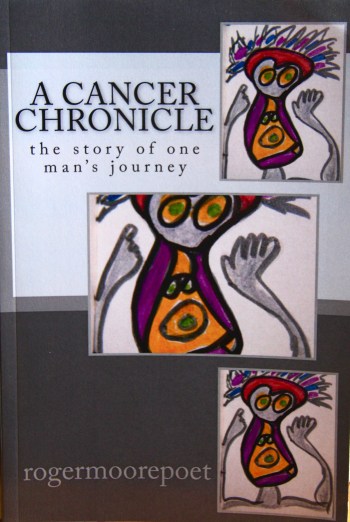
I wrote A Cancer Chronicle between 2014, when I was diagnosed with prostate cancer, and 2016, when my recovery was complete and confirmed. The book was meant to reach me before Easter, but there were some delays. Last Sunday, when working with one of my writing groups, I saw the first hard copy of the book. A good friend had ordered a copy from Amazon and I was able to see it and sign it. My own copies arrived last Tuesday, late, but very welcome.

It is in the spirit of friendship and comfort that I offer these poems to any and all who, in their own turn, follow me on this long and difficult journey. Many forms of cancer can be beaten. Early diagnosis, good doctors and specialists, optimism in the face of difficulties, faith and belief, all these positive elements will help pull patients and fellow sufferers through the ordeal of diagnosis, treatment, and recovery.

I would like all sufferers to know that they are not alone, even on the darkest of nights. I would like them to know that others have walked this way before them and are there on the path ahead to offer their advice, comfort, and help. I call this A Cancer Chronicle because that’s what it is: the chronicle of one man’s journey from sickness back to health. My thanks go to all of those, too many to be named, who helped me along the way. I dedicate this book to them and to any who, like it or not, follow in my footsteps.

Pax amorque: may you all share peace and love.

A Cancer Chronicle is available online at Amazon.

Rain

Empress 005 (2)

Rain

Rain walks thick lines
down the window pane.
They wander into the garden
and slip out again,
sliding down to the river.

The waters below the dam
churn like white shirts
tumbled up and down
in nature’s laundromat.

The radio calls for rain,
more rain, four inches,
they say,
in the next two days.

The moose have already
migrated to higher,
drier ground.

They stand on the highway,
head to head with cars,
stubborn and steaming
in the never-ending rain.

Le mot juste


img0137_1

Le mot juste

Searching for what exactly?
For the exact word, le mot juste,
the word that sums it all up,
catches the essence of the thing
and holds it in the mind forever.

Le mot juste? Think color.
Think color blind. Think blind.
Think of the world we see
reduced to grey scale.
Think of the seven colors
that stripe the rainbow sky,
each with a unique name:
it seems so easy, so simple.

But the world has changed.
Think now of the computer,
its screen more accurate
than the human eye and color
coordinated by a million or more
tiny little pixels that multiply
the seven rainbow colors
by a million or two and every
color numbered beyond
the recognition point
of the human eye: le mot juste
reduced to precision of number.

Think flowers. Think scent.
Think of the limited ways
we describe the smell of things.

I look across the breakfast table
and see my wife of fifty years,
a teenager reborn, walking into
the café where we first met.
I search my memory and my mind
for the words to describe that beauty,
that surge of excitement,
but I cannot find les mots justes.

Picaresque Novels

img_0177


The Picaresque Novel
Wednesday Workshop
3 May 2017

The Picaresque Novel

             Think of a pendulum: at one end of the swing, we have the pastoral novel and the novel of chivalry. The knights errant meet shepherds and shepherdesses on their travels, and all are cultured and can read and write. The main characters, heroes and heroines, if you wish, express high ideals and maintain a cultured standard of thought and living. The knights, in particular, follow the path of chivalry and defend the poor and maidens in distress. The ladies, especially the shepherdesses, are all ‘as pure as driven snow’ and they go to their graves, in the immortal words of Miguel de Cervantes, ‘as virgin as the mothers who bore them’.

            At the other end of the pendulum swing and positioned there partly in contrast to the ‘perfect society’ of knights, shepherds, and shepherdesses, we find the picaresque novel. Most pícaros are men, though female pícaras do exist (la pícara Justina, for example), and the pícaro is an anti-hero. He writes in the first person singular and tells the story of his survival in the lower ranks of a corrupt and impoverished society.

            Wikipedia phrases it this way: “The picaresque novel (Spanish “picaresca,” from “pícaro,” for “rogue” or “rascal”) is a genre of prose fiction that depicts the adventures of a roguish hero or heroine of low social class who lives by his or her wits in a corrupt society. Picaresque novels typically adopt a realistic style, with elements of comedy and satire. This style of novel originated in 16th-century Spain and flourished throughout Europe in the 17th and 18th centuries. It continues to influence modern literature.”

            Lazarillo de Tormes, considered by many to be the first picaresque novel, was written in Spain and three editions appeared in 1554. Lazarillo is given by his mother to a blind man who agrees to look after the young boy in return for the boy’s services as a guide. Even today, a person who guides a blind man is still called a lazarillo in some places. The book describes the life of Lazarillo as he moves from master to master until he eventually establishes himself ‘at the peak of all happiness and the height of his career’ as the local town-crier, married to a cast-off woman with whom the celibate village priest has created three children.

             Lazarillo de Tormes, a book that never uses the term pícaro, establishes the basic rules for the genre. (1) It is an autobiography, or pseudo-autobiography, of the main character. (2) That character leads a peripatetic life, wandering from master to master, usually at the bottom end of society, but sometimes working in the kitchen or lower service of the great. (3) The picaresque novel also contains elements of humor and satire and in some cases, Guzmán de Alfarache, for example, has a moralizing purpose that is used to justify the immorality of the book.

            The church did not receive the picaresque novel well, especially when the satire and humor were aimed at the church. In the Lazarillo, for example, Lazarillo works for a seller of Papal Bulls who sets up an elaborate and deceitful charade in order to increase his sales. This charade involves a friend who poses as a doubter, is then cursed and goes into a fit, but recovers almost immediately with the blessing of the Papal Bull. Lazarillo de Tormes was censored by the Inquisition and appeared in an even shorter version that was called El Lazarillo Castigado, Lazarillo Punished, with all unwholesome references to the church removed.

            Perhaps the most famous picaresque novel, after Lazarillo, was El Buscón / The Swindler. It was written by Francisco de Quevedo in 1601 and circulated in manuscript form until it was published, illegally I should add, in 1627. The novel was so scandalous that it was denounced to the Inquisition and Quevedo often denied writing it. His intricate and heavily conceited style is inimitable, however, and the book contains several references to his own life. It is difficult imagining any other person as author.

            Wikipedia translates pícaro as ‘rogue’ or ‘rascal’ and this illustrates the pleasant and humorous scallywag style that the character often has. However, the darker, more murderous side of the pícaro emerges more clearly when ‘swindler’ (Penguin Translation) or a stronger term is used. In this fashion, the pícaro (rascal or rogue) can be associated with Tom Jones or Oliver Twist, while his darker, more reprehensible side may be associated with by Bill Sykes or Fagin himself.

            More important, perhaps, is the long life that the picaresque has had in Western Literature as the traveler, the journeyer, the observer, the young man who is ‘down and out’,  works his way across the land, surviving, adventuring and commentating.

Brain Drain

img_0162


Brain Drain

I do the daily crosswords,
first on the computer,
and then in the newspaper
when later it arrives.

My wife does the Sudoku,
but I hate numbers
though I adore
the restless energy of chess.

Online games of point and click
deaden my brain and kill my eyes.
I lengthen my winning streak of patience
every day. Twice I have climbed
to fifteen hundred wins, then wiped
them out to start again.

Boring? Not at all.  Anything to keep
the old grey matter ticking over;
anything to keep me
lively and alive.