Gramm’er uh?

img_0177

Gramm’er uh?
Wednesday Workshop on a Saturday

One year I volunteered to teach the Introduction and Welcome to University course that I had helped design. It lasted twelve weeks (a single semester) and introduced students to the basic survival skills needed to study Liberal Arts at the university level. These included reading a single book, planning and writing essays on that book, examination techniques and sitting mini-exams, how to set about research, thinking and analytical skills, all that sort of thing.

I chose to read Room with a View by E. M. Forster, partly because the film would allow students to better visualize and understand what they were reading. We read a couple of chapters a week, and every week I held a mini test on the chapters read. The test included (1) give the meaning of five words chosen from the chapter; (2) a commentary on any 2 from 3-5 single sentence extracts from the chapter; and (3) an invitation to point out (a) what was going right with the course, (b) what was going wrong; and (c) an invitation to request a one on one meeting with me. There were initially 36 students in my section of the course and although half of them had never before read a book in its entirety, 34 of them successfully completed the course.

A dictionary was one of the key components. On day one I outlined the syllabus and exhorted the students to “use the dictionary” every class, every day. In response to my request for “any questions” a young lady raised a tentative hand and whispered … “I know it’s a stupid question, sir, but …” I stopped her right there. “There’s no such thing as a stupid question,” I stated. “Whatever you want to ask, there are probably five other people who also want to ask that question, but who are afraid to raise their hands. You are the brave one. You are the first to ask. Congratulations. Now: what do you want to know?” I cannot remember what her question was, but I do know that many of the students wrote down the answer I gave her.

I followed up this speech with another one. “This is first year university. All of you have questions. Whatever your background, you may feel ignorant and lacking in knowledge. There’s no crime in that. However, if after four years you have never asked a question and you are still ignorant and lacking in knowledge, then shame on you. You have wasted four years of your life.”

The first two tests were dummy runs: no marks, just the answers. Within two weeks you could tell the students from my section of this course: they were the ones with well-thumbed dictionaries in their back-packs. They asked questions, they checked the spelling and meaning of every word, and they got their money’s worth in education.

I want to say the same thing about grammar, spelling, and punctuation. We are bloggers, we are writers, we want to be the best we can be. So: work at it. In the tabs under Review, MSWord has three very useful tools: Spelling and Grammar, Thesaurus, and Language. When I click on Spelling & Grammar, I get a message stating thatmy heading, Gramm’er uh?, is not in the dictionary. Well, surprise, surprise. S&G make several suggestions (none of them useful in this instance) but the tag Check Grammar suggests the direction my heading should be taking. Use this tool. Work with it. It will help you, if you are having difficulties. It may suggest alternatives ways of expressing yourself, one of which may turn out to be useful.

The Thesaurus tool is also very useful. As an active poet and writer I am always looking for different ways to express my thoughts, and synonyms (words of the same meaning) and antonyms (words with the opposite meaning) are most useful since they assist me in my search for better ways to express myself. When I clicked on Thesaurus, better was highlighted and well over fifty different ways of expressing better (and its opposites) were laid out before me. Scanning them rapidly, I thought of various ways in which the sentence that included the word better could be bettered / enhanced / improved / ameliorated / developed / or simply changed for the better.

As for the Language tab, well: I was educated in Wales and England (English UK) but moved to Canada (English Can) and published widely in the USA (English USA). Spelling changes, as do word meanings, and the English I now speak and write just isn’t the English I learned in school. I need to check my spelling across three variants. Auto-correct will do this for me. But I need to be aware of which spelling system I have clicked upon, or all will not be well. MSWord will also auto-correct punctuation for me. I do not like this tool, especially when writing poetry, as I use punctuation for different ends within poetry. However, it does keep an eye on my writing and how I punctuate it. Speaking and writing three languages, English, French, and Spanish can also be a problem, and differentiating between, for example, profesor, professor, and professeur can sometimes be a problem: one –f- or two, one –s- or two? Auto-correct just changed my Spanish into English by adding an extra –s- … not good in a document written in Spanish.

The modern answer to the dictionary in the pocket (hence pocket dictionary, wow!) is Google. Almost anything can be Googled: grammar, punctuation, spelling, doubts, memories, facts. You can check them all out on Google. It takes only a few moments to search for something and, if necessary, to refine that search until you finally get what you are looking for. A word of warning: get your muse-inspired writing down on the page. Only check your words after you have written them. The flow of inspiration is paramount. The second thoughts that come as a result of revision and checking will usually improve your work, but there is no substitute for that initial flow of creativity.

Main message: never surrender. Never give up. We are writers. We are bloggers. We are here to explore language and to get the better of it. We want to make it work for us. There are many ways of doing this. Find the ones that suit you and slowly, bit by bit, inch by inch, turn yourself into the writer you aspire to be. And remember: if you want to break the rules, no problem. But it helps to know them first … then you know what you are breaking and are conscious of the results.

Dulcinea

img_0282

Dulcinea

 Men of La Mancha

Insubstantial dream
extracted from a madman’s mind,
who dares to magic her back to this world?

Who could want what with her now?
She exists nowhere.
Can you conjure her up from mists?

Once she was Echo: her voice
dependent on a mad rogue’s tongue.

Moonlight through the glade.
White foam atop the sea.
Betrayal of every dream
once she is found.

For he who creeps into her bed
finds plain Aldonza there.
The enticing breasts that made him drool
are shrunken dugs when seen up close.

Her horse is but a donkey
and she herself is but a dream
woven from the fabric of another’s whim.

Begone.
Allow Dulcinea her well-earned rest.
Take care lest she roll over and start to snore:
Dulcinea turned Aldonza ever more.

People Poems 4

img_0202-1

People Poems are dedicated to people who, for one reason or another, have distinguished themselves in my life. People Poem 4 is dedicated to Jane Tims who first encouraged me to start this blog. So, Jane: please accept this bouquet of flowers, just for you!

Jane is a wonderful poet who researches deeply into the past of New Brunswick. Her current project on New Brunswick schools and the early education system in the province takes her back in time to study the names and places on the old censuses. She then travels the back roads and visits the small country communities where the old often one-room school houses still exist. This is the research part. Then Jane imagines what life would have been like walking to those schools and working in them, in summer and winter. The result is an old world, re-created.

Other projects of Jane’s include the covered bridges of New Brunswick, all photographed, sketched, and recreated in verse. She has worked too on the fruit and vegetables of the province, all of them Within Easy Reach, the title of her latest book. An efficient and competent multi-tasker, Jane is also working currently on meniscus, a science fiction fantasy story in poetic form. I have had the privilege of reading an early version of the manuscript. In addition, I have heard Jane read extracts from it. It is a wonderful creation and I look forward to seeing it thoroughly finished.


img_0274

Jane is also a great artist and I love the drawings and sketches she includes in her books. Above all, I really enjoy her paintings. This one, Apples, she gave to me not long ago when Clare and I visited her in her studio home. It hangs in our kitchen beside my chair and reminds me of the beauty of art and the nature of friendship: light, kindness, generosity, and a love for the world in all its many forms. Thank you for being here, Jane: the world is a better place with people like you in it.

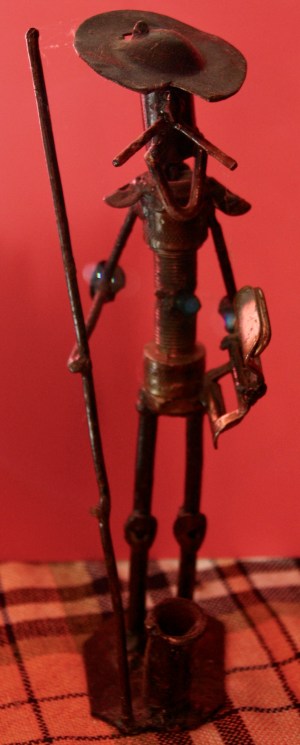
Don Quixote

IMG_0282.jpg

Donkey Hotay

 Men of La Mancha

Saddle his steed
and let him ride
uphill and down.

The world is wide
enough for a knight
and his faithful squire
to find at road’s end
what they most desire.

Let him obey his vow.
Let him best portray how
a true knight,
worthy of the name,
guards from shame
his knightly honor
and his beloved’s fame.

Let no mage
despoil that Golden Age.

Onward, ever onward,
to glory and renown,
and let him once again

tilt at windmills and knock
falsehoods down.

Gifts: Wednesday Workshop

img_0177

Gifts
Wednesday Workshop
16 November 2016

Gifts or blessings? I am never sure which is which for many a gift is a blessing and many blessings are gifts and sometimes the ones come disguised as the others.

So here I am, in retirement from a career in teaching. I miss my students. I miss the hurry and scurry of the classroom, the deadlines for essays and exams, the highs and lows, the setting of goals, the solving of problems, the light at the end of the tunnel when, after four years, the students, armed with their degrees, set out to face the world, their world, their  brave new world fit for brave new students.

Nowadays, I feel like the lost man, the forgotten man. The deadlines have gone. There is no more rush and tumble. Peace rules the office in my house and dust and spider webs gather in the corners of my mind. I am reminded of the words of Francisco de Aldana: “lo mejor es estar muerto en la memoria del mundo” / best of all is to lie dead and forgotten in the memory of the world. Then I look around me and see the gifts.

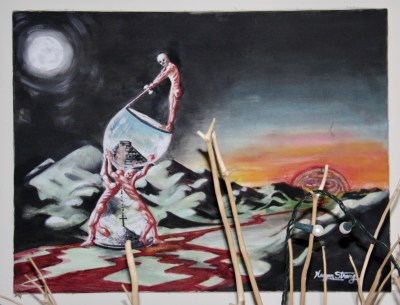
From Megan Strong:

IMG_0297.jpg

“Do I have to write an essay?” Megan asked me. “Couldn’t I do something else?”
“What would you like to do?”
“A painting. I’ll explain it in Spanish.”

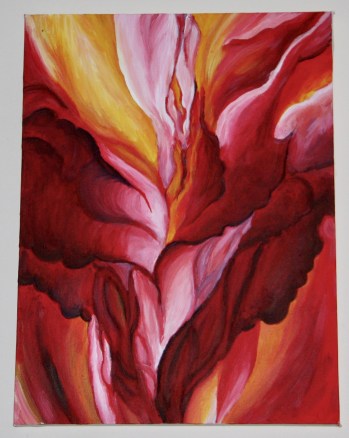
And she did. There are no essays pinned to my walls, but this gift of a painting reminds me of something very precious: a student’s will to be creative, the presentation of knowledge in formats that are not necessarily the expected ones, the ability to be flexible, to understand, to open one’s eyes to the world around one, to see and encourage talent. These were the blessings, some of them anyway, that came with Megan’s gift and her ability to paint.

From Jane Tims:

IMG_0274.jpg

Clare and I visited Jane in her studio home. We drank tea and shared the afternoon sunshine together. Then, just before we left, Jane asked us to choose a painting. Clare chose this one: Apples. We went home and, after much thought, placed it on wall in our kitchen, just beside my chair. I see it everyday and so does Clare. It brings light and warmth to the room and reminds us of Jane’s gifts: her writing, her poetry, her research skills, her drawings, and her paintings. This one above all, for it is so meaningful to us and brings us light, peace, and stillness: such precious gifts.

From Jan Hull:

IMG_0279.jpg

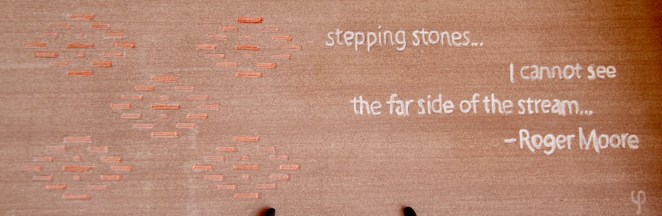
I cannot say enough about this stone sculpture gifted to me by Jan Hull in Shediac, New Brunswick, on November 4, 2016. Jan Stoneist has taken one of the motifs from my book Stepping Stones and has placed it on the left hand side of the carving. On the right hand side she has taken one of the verses from the book and added my name. The result is both a gift and a blessing. Jan searched carefully for the right surface on which to carve her offering and finally found it: Welsh Red Sandstone. What better gift for a poet from Wales … and indeed, Jan makes me feel truly blessed.

From Ainsley Swift:

IMG_0294.jpg

In the days immediately after my retirement, when I found myself at the bottom of the well, looking up at the daylight through a long, dark tunnel, Ainsley appeared at my door and asked me if I would be willing to mentor her as she was having some difficulty with certain aspects of her studies.  Brightness descended upon me and Ainsley and I have worked together for some time now. One day, she turned up with a brown paper parcel and announced that “This is for you.” I didn’t even know that she painted, let alone that she was a talented artist. Another gift, another blessing, light breaking where no light shone, and that brightness still surrounding me.

From Juanra Sánchez:

IMG_0290.jpg

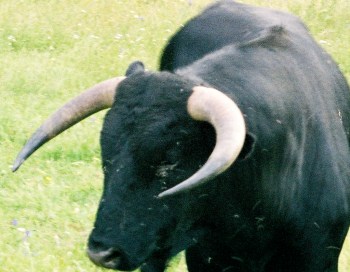
What does one say about the man who persuades the retired stone-cutter in Avila to make one last carving in the style of the verracos that were carved by the Celt Iberians thousands of years ago? Here it is, my own verraco, gifted to me by the best of friends who, every Sunday for four consecutive summers, drove me around the Province of Avila and showed me the love he held for his land. Thanks to Juanra, I saw places and things, too many to enumerate,  that no tourist will ever see. A weighty gift indeed, and a true blessing that will last as long as granite bulls stand firm beneath wind, rain, and snow.

This verraco comes with a story. It is very heavy and very solid. I placed it in my carry-on bag and hoped that nobody would think to weight it. Tired of carrying it on my shoulder at the airport in Madrid, I stood in line, then placed the bag upon the ground. The line wasn’t moving, so I walked a few paces to the wall and leaned up against it. Lines shuffle and flex, as we all know, and that’s what happened. Gradually a small space opened up between my bag and the man in front of me. The man behind me was impatient to close that gap. He looked at me as I leaned against the wall. I half-closed my eyes and watched him. The line shuffled forward. He brought his leg back and gave my bag a mighty kick, right on the rear end of my granite bull. I can still see that man hopping on one leg, cursing, and my bag sitting there, having moved not an inch.

Gifts and blessings, along with kind words and actions, move the heart and soul. I will write more on this subject at another time. Meanwhile, remember the old song: if you can’t sleep, “count your blessings instead of sheep.” I just did and five of them are listed right here.

Desaparecidos

IMG_0137.jpg

Desaparecidos

Last year, in Fredericton Mall,
a mother lost her little girl.
They found her in the women’s washroom
where two old ladies were cutting off her hair
and dressing her in a young boy’s clothes.

Wanted in Winnipeg.
Vanished in Vancouver.
Cheap alliterations in tabloid headlines
disfigure each tragedy.

Sometimes we think we recognize their faces.
This young girl with an old woman’s body
standing at a Yorkville window.
That other girl on Yonge Street
selling her body for drugs.
That flash of underage flesh
mounted by strangers
and glimpsed in a pirate video.

Do you call for call girls when you travel?
That midnight knock on your hotel door
is someone’s missing daughter.
You saw her once before on an airport advert
or on the carton of milk you opened
for your family’s breakfast.

What traveling salesman would you trust
to take your only daughter’s body and treat it well
while she promised him the sexiest time
he would ever have?

But in Goya’s Spain
it’s the males who disappear
usually during the night.

Most times, their families never see them again.
Sometimes, as in this etching,
their bodies are found, nailed to a tree
or dumped in a side street with the garbage.

Mad Dog Wind

img_0154

Mad Dog Wind
Barcelona

from
Last Year in Paradise
(1979)

It rushes through the city,
loses itself in hotel lobbies,
comes out to snatch and snuffle
at the empty hands of children.

It hustles leaves,
leaves paper-trails
of flighty pigeons
flapping, indignant,
across the square.

Delayed by doors,
it snorts at windows,
shudders
tight-closed shutters,
rages at rooftops,

chases
a ragged herd of clouds
around the sky
high above the Ramblas.

¡Olé!

F1000008

¡Olé!

The vaquilla charges the picador, bravely,
receiving her wound, then returning for more.
¡Olé!

Braveness in the stance, the head erect,
eyes open, watching the teenage torero,
suit of lights sparkling, sequined sequences,
feet dancing, cape held low, the vaquilla
on train tracks, gliding past.

¡Olé! ¡Olé!

The vaquilla charges at shadows,
plays her role in this meta-
theatre of cape and sword.
But it’s only make believe.
The vaquilla pauses at centre stage,
flanks heaving heavily, baffled, mocked.

¡Olé!

The farmer leaps the barricade, grabs her tail,
tugs her to the ground, stands on her neck,
and shears her horns.
The maiden, mocked and marked,
escapes through the gate:
the scent of the fresh blood flowing
arouses the waiting herd.

¡Olé! ¡Olé!

Planners, Pantsters, and Thinksters: Wednesday Workshop

img_0177

Planners, Pantsters, and Thinksters
Wednesday Workshop
9 November 2016

Two new writers (John King and Amy … ) have joined our writers’ group (Chuck Bowie, Kevin Stephens, John Sutherland, and Roger Moore) and now we are six (with apologies to Winnie the Pooh). In addition, we have a virtual member (Allan Hudson) and a potential member (Victor Hendricken). Amy has joined on a first name basis. Alas, there were only four of us last night: Amy, John K, Kevin and Roger; Chuck and John S were both indisposed. We wish them good health.

This leads me to the question: what is the best way to integrate new members into an already established group of writers? I have no answer. Last night’s activities seemed quite successful.  First we introduced ourselves, first names only (oh dear!) and then we invited Amy to tell us about her writing. What an adventure. She has completed one novel, 110,000 words, and has two more planned in the series. She is questioning her opening chapter: is it the right one or should she begin after chapter three? Without having read the work, I personally find it difficult to give advice.

We explored some of the themes Amy presented to us and discussed a series of images that recurred and seemed to link the novel together. The idea of iterative thematic imagery serving as a leitmotiv came forward and we analyzed how repeated images can tie a novel (or a poem, or a short story) together. We spent some time on triggers that motivate actions and reactions from the characters. What is the trigger or the hook that draws the readers in, makes them look to the future, and persuades them to want to continue finding out more about the characters?

We also discussed Kevin’s favorite topic: planners and pantsters. Kevin is a planner who works everything out in advance. His charts, photos, character guides, outlines, and plans are an exemplary work of art in themselves and are highly admired by the group members. Many writers are pantsters; that means to say they pick up their pens or sit by their key-boards and write by instinct and fly by the seat of the pants. I find myself in between these two extremes, for, like Fray Luis de León and Juan de Valdés long before me, I think most of my writing out and keep it in my head until it comes time to put it down on the page. Perhaps this makes me a thinkster; I would like to think it did.

We also discussed the importance of The First Five Pages (Noah Lukeman’s book, sub-titled: a writer’s guide to staying out of the rejection pile). We invited Amy to send us her first five pages for an online critique. Our next step will be to look at the first five pages of the chapter with which she is proposing to start. It was an exciting conversation. I hope it was not a scary one for Amy’s first time out.

John K has been to one of our previous meetings, plus we had a long series of discussions with him at the WFNB meetings last weekend in Shediac. He and I helped close the hotel bar in Shediac at 1:30 am, so we are very proud of our efforts there. He presented us with the outline of a ‘tale’ that he is developing. Good man: he writes with a pen in a notebook, jotting down his ideas as they come to him and elaborating them in pen and ink, just as I do. Kevin and Amy had their tablets and their computers while John K and I had our pens and notebooks.

Without going into the details of his story and giving anything away, he walked us through the tale as he has it at present. he has great ideas, but at present is in search of a format in which to present his ‘tale’. Is it a short story? Too long and too many episodes. A novella? Could be. A full length novel? We didn’t see why not, and more and more potential episodes suggested themselves as we went along. In many ways it sounded like a film or a televisions series and John K’s active photographic mind, he has done courses in film and script writing, painted an engaging series of linked pictures, all of them with great potential. We are hoping that John K will send us an outline sketch, maybe even a storyboard,  of what he is planning. Perhaps we should also ask Amy for a chapter plan, or would that be too ambitious?

As for Kevin and I, we joined in the conversation, presented commentaries and ideas, outlined some of our own plans and directions, and had a thoroughly enjoyable time. Kevin’s book DiAngelo will be released on 22 February 2017. He is at the final editing stage right now and is busy, busy, busy with the final version of the text. We are all excited for him and are pushing him to keep at it and get the first novel of his planned five novel series out, and up, and running.   He is also planning a series of pre-release advertisements scenarios, all of which are sure to catch the eye of potential readers.

And that may well be the topic for another day: how do we market our books and what is the best way to attract readers?

Pilgrim

IMG0024_1.jpg

Pilgrim

Santiago de Compostela

She drew me out from inner darkness,
told me to rise and walk.
“But first,” she said, “your wounds.”

She washed them in laughter,
dried them with her smile.

I left that night
walking west beneath the stars
to where the red sun
dips beneath the horizon.
South I wended my way,
where winds are warmer.

Hope flowered anew each day.
Dew on the morning grass
gifted both food and water.
Birdsong raised its morning voice
to the creator and her creation.

Sunlight flooded my body.
It flowed out through my heart,
a beacon to light my way.

At night, when star song
brightened the owl’s path,
I saw my road
stretched high above me.

Pilgrim through once barren lands,
the light she lit for me
burns within me still.

 Rain, sleet, snow, ice, fire:
they’re all the same.
No lion shall me fright.
I’ll with a giant fight.

“Constant,” she said to me.
“Come wind, come weather.”