Bistro 6 Flash Fiction

Crazy Glue

Late last night, a fallen star grazed by the lamp-post. A bouquet of golden sparks flew from an iron tree and sanctified the gutter. The gas lamps sputtered patiently in uniform rows. A scarecrow stuttered into the limelight and shook my hand. She was wearing my grandmother’s Easter bonnet, with all the flowers renewed, but she couldn’t keep my heart from last winter’s left over crumbs. Suddenly a tulip thrust through the concrete. It became as red as a robin and flew into the lounge bar of a public house. The bronze leaf necklace circling my throat filled with a flow of springtime song. My heart stood upright, a warped piano in my breast, and my skeleton tarried at the corner to play knuckle-bones with the wind. Torn butterflies of news fluttered round and round and kissed my eyelids when they closed. Yesterday’s horoscope winked its subversive eye and called to the hermit in his lonely cell: “Look out for the stranger with the tin can alley smile. Tie your heart to the tail of the first stray dog that comes whistling down the street and follow it home to the empty house that breathes in and out, moving thin membranes of memory.”
IMG_0167 2.JPG
That’s where I now live. Upstairs, downstairs, a lonely route I tread while the wind at the window scratches tiny notes. Something breaks loose in the confines of my mind and walks beside me. My twin brother stalks through this silvery sliver of splintered glass, this simian mirror wrinkling our troubled suits of skin. I glimpse the old moon’s monkey face through a broken window. Jagged and thin, it wanders like an itinerant snail, cobbled with clumsy clouds. Once, I descended the playground slide in a shower of sparks. A vagabond in a paving stone sky, I rumbled across metal cracks, a knapsack of nightmares humped on my old man’s back. Tell me: when the snail moves house, who stores the furniture he leaves behind? The hermit crab lurks naked on the beach, seeking new lodgings. Who killed the candle and left us in darkness?
IMG_0186.jpg
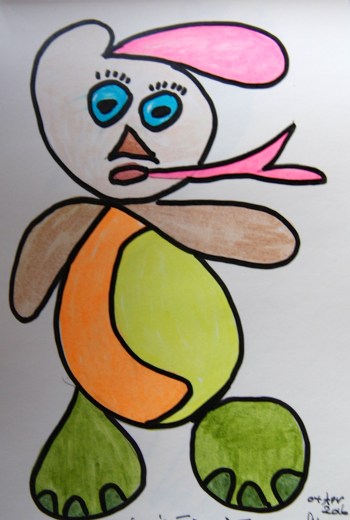
Two eyes in limbo watch me roll this snowman’s belly of flab across an unknown, clouded room where yesterday I got lost in the mirror. I know how to swim, but I would have drowned, except the light was too shallow and my feet touched bottom when I let the wheels down. I swam on and in looking for a deserted island on which to build my idle sand castle dreams. Two people said they saw my reflection swimming like a goldfish in the silver of that secret space. They said I stared back out at them with circles of longing ringing my eyes; but I laughed when they said they had seen me, for when I looked in the mirror this morning to shave, I just wasn’t there. My razor dragged itself over an empty space and its sharpened blade scraped white music from the margin of a cd rom that spun on edge like dust rings round a vanished planet. Now there is a black hole where my passport photo used to thrive. Someone plucked me from the circle and cut me out in the dance last night. Today I’m looking for a scrapbook in which to stick myself with crazy glue that never, never, ever comes undone.
Comments: A Beginner’s Guide

Comments: A Beginner’s Guide

(for Al, again;
written tongue in cheek
as a follow-up to
Winning not Whining
to be read cum grano salis)

When a poet enters a poetry competition, comments are sometimes offered as part of the fee for entering. These may be made by the judge(s) or by a pre-selection committee. The pre-selection committee, in large poetry competitions, will sometimes filter the many entries, sending a filtered short list through to the judges.

Filtering Committee

IMG_0150.jpg

Basic rules of commenting (1):

Say nothing negative. Always find something positive to say. Whatever you do, do not turn the competitors away from future competitions. The organizers need the money the hopeful entrants provide.

Rhyme:

When faced with an entry that rhymes, the judge is encouraged to encourage the entrant to think of alternate forms of writing. Comments like: “Have you considered writing this poem in free verse?” or “This might work as a prose poem. Have you tried that format?” are considered better than “Your verse sucks”or “Your rhyming words make no sense except as rhyme words. Couldn’t you find anything else?” Equally abrupt and dismissive is “Read more rhyming poetry: your almost non-existent rhyme scheme needs national assistance.”

Free verse:

When faced with an entry in free verse, stick to the alternate approach “Have you considered making the poem rhyme?” or “This might work better as a prose poem.” Such comments are considered more acceptable and polished than “Stick to essay writing” or “Read more free verse: you need to understand where to put words in appropriate places on the page.” or “Blank spaces must have meaning.”

Judge Mark I

IMG_0146.JPG

Individual words:

As soon as an unacceptable word is found, and in some cases the sooner the better, the entry may be rejected. Examples: Adverbs ending in -ly “Stephen King advises against the use of adverbs ending in -ly.” or less used words like upon or amongst   or “Upon / amongst — so out of fashion: use your computer’s Thesaurus for contemporary expressions.” The commentator is advised against using chic continental expressions like very passé or très outmoded as they create a sense of absolute inferiority in the competitor. Latin and things like that should, ipso facto, never be countenanced as they may upset the competitor’s  status quo.

Meaning:

If the judges cannot understand a word of what is before them, then phrases like very cryptic style or highly personal language are preferable to “Total nonsense.” or “Absolute Jabberwocky.” or “Never heard of Fowler?” or “This needs Footnotes.”

Punctuation:

The rules here are simple. If there’s punctuation, then suggest dropping it. If there is no punctuation, suggest adding it. Same thing with capital letters.

Judge Mark II

IMG_0147.JPG

Length of submission:

Short poems can be dismissed with a comment like “You have some potential here: the poem could be lengthened in order to develop that potential.”

Long poems can be dismissed with comments like “The judge(s) find this a little bit wordy. You should consider shortening it.” Avoid attempted wit along the lines of “Nice: have you tried writing rhyming telegrams” or “This could (avoid should) be reduced to a rhyming couplet.”

Basic rules of commenting (2):

Find something positive to say and remember, sincerity has nothing to do with it; in fact, forget sincerity, unless you wish to end your comments with a phrase like “in sincerity”.  If the judges are really at a loss for something positive to say, then a warm general comment will always be welcome. For example: “I love your use of the definite article.” “You have a wonderful way with small words.” or “All your commas are in the right places.” Such positivity will probably keep the competitor competing and the entrance money rolling in.

Winning not Whining!

Winning not Whining:
For Al

To be taken with a large pinch of salt.

Judgement by Committee:

IMG_0130

The committee gathers and sorts through the evidence: whatever will they find? Piece by piece, they sift the data. Some take it to great heights and drop it on the rocks to see how fragile it is. Will it break like a clam or a mussel released at the sea-side? Others use the Christmas Cracker technique. For this you need two judges: each holds an end, and both tug as hard as they can. When the evidence rips apart, then the opinion of the one with the larger segment of the manuscript holds good. They take care to avoid the cracker-jack bang in case the item is explosive, but more often than not it is good, solid fodder for thought, endless thought, and the longer they think, the more the liquids flow and more good food goes down, and the more their camaraderie strengthens. Finally, when all the energy is spent and the manuscripts are reduced to tiny shreds, a winner appears. If the last fragment of evidence is still large enough to be read, this is then showcased and the winner is announced. That is why those precious manuscripts are never returned and that’s why competitors should always send a copy, because the original, especially when dropped from a great height or caught by the explosion of cracker-jack, might be lost in the tidal wave of anguish that sweeps the sea-shore clean.

“What is the definition of a camel?”
“It’s a horse designed by a committee.”

Anonymous, or Aristotle, I don’t know who said it first; but it’s very true. And manuscript selection by committee can bring about some interesting selections. On several occasions I have received the damning note: “We really liked this: but one person on the committee said they didn’t like how you used this word …    (insert word in blank space after dots).”
Judgement by committee is judgement by consensus … and, as the TV game-show host so often repeats: “… And the survey says …”

There is only one way to deal with committee decisions in a writing competition: lots of laughter, a large pinch of salt, and water off a duck’s back.

Judgement by a single judge

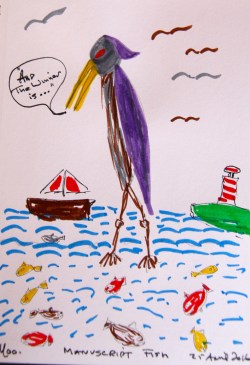
This is probably much better than judgement by a married judge who will always pick his partner’s work, if it has been submitted. With only one judge circumstances change and the chances of winning operate under different rules. Imagine that one judge as a Great Blue Heron standing in tidal water, beak poised, incoming tide, and the manuscripts swimming past. Some swim too fast, some too slow; some are too heavy and sink to the bottom; some are too light and float to the top. But look, the judge is tense, the perfect manuscript at the perfect depth glistens silver beneath the surface then … swift jab of the judge’s beak and we have a winner … and the judge holds it aloft to glisten in the sunlight while the losers swim happily away to survive as honorable mentions or silent witnesses that can be entered in another competition on another, perhaps happier day, when they can be judged by a committee of Great Blue Herons.

IMG_0131

It’s not always easy to be a good loser. However, as you swim freely away from the Great Blue Heron (GBH) remember you have avoided Grievous Bodily Harm (GBH) and that may be better than you think for: “It’s often good to not be a winner: you might end up as the judge’s dinner.”

And if you win? IMG_0130.JPG

And if you win? Well, the judge (or the judges if you survived the survey), was very good, very intelligent, very hard-working, and just perfect; in fact, the very model of a wise old bird who knew just what it was looking for, and found it.

And as for the winner: “The winner, he was a wise old bird. The more he spoke, the less he heard. The less he spoke, the more he heard. There never was such a wise old bird.” (Anonymous or Aristotle)

Chance Encounter

Chance Encounter
(Overheard last night at the bar)

“Meeting her, unexpected,
with another man,
and me, with another woman,
all four of us looking
bemused by what the other
had chosen in each
others absence
— suspense —
and the halted, faltering
politeness of a nod,
a handshake, ships
passing in the night,
signals no longer recognized.”

 IMG_0138.JPG

“You only find
what you leave behind.”

Codices

Re-reading the Códices

The Mixtec Códices, indigenous screen-fold books written on deer hide, 
are Pre-Columbian pictographs that record the history of the Mixtec peoples. 
There are no words: only brightly coloured scenes 
containing information about rituals, gods, heroes, and ceremonies. 
Only a few very precious documents 
(Zouche-Nuttall, Vindobonensis, Borgia etc) survived the ravages of time
 and the continued purges of the Spanish Inquisition. 
This prose-poem, self-explanatory for the main part, 
verbalizes typical symbols from the códices. 
Clearly, such symbols, as the poems suggest, are ambiguous 
and open to radically different interpretations.

IMG_0144 (1).jpg

“Two breasts: one green, one yellow, symbolic of the hill where the church stands; the church itself bi-colored, strong stone walls, a spire. A large red heart symbolic of the love we bear for you, our masters. Two feet walking the path of enlightenment you opened before us; two hands pointing the way. The feet below the heart; the hands above the heart, like wings; and the heart becomes the body of the new place you have built for us. And in the heart is our sacred symbol: the Earthquake, a sign of leadership and power used only by those of Royal Stature and the Noblest Blood. Attached to the heart is the Numeral One which means Lord of the Earthquake; for you are Number One in our Hearts. Attached to the heart is a speech scroll showing felicitous words of praise; below it is the sacred earthworm, and beneath that the serpent head of wisdom and the flint knife promising strength through sacrifice.

But be wary: for our symbols are double-edged!

The colors of the hill are divided, as the hill is divided, showing strife and division. The church is on top of the hill, for the symbol has conquered the people, and the people are starving, subject, and destroyed. The feet are pointing in opposite directions, for the people are stalled. They have no forward movement, nor will of their own. For they are conquered by the sword and not by love. And the hands are pointing in opposite directions; for the right hand knows not what the left hand is doing. And the hands are reversed showing anguish and distress. The sign of the heart is the sign of the disembodied heart, torn from the heaving chest of the vanquished and thrown to the dogs. The sign of the earthquake is also the sign of movement. And that movement is a bowel movement. And one movement in the middle of the sacrificed heart is the victor excreting on the vanquished and treating them with scorn and contempt. The scroll protrudes from the nether part and says that the victors are speaking words of excrement, that verbal diarrhea issues from their lips. And the serpent has no feathers; it cannot fly. It is as a snake treacherous and bitter, crawling on the ground. The head of the serpent is two tongued and tells of treachery and of deceit. The flint is attached to a heart; it speaks of the heart that is as hard as flint, knowing no mercy.

IMG_0146.jpg
And at the end that heart will receive no mercy in its turn.”

K9

K9

I had a little doggy and my doggy loved me,
I fed my little doggy on cookies and tea.
My little doggy had a very sweet tooth
and when he needed feeding he went woof, woof, woof.

One day my little doggy fell down and died.
Something had broken in his inside.
I wanted another doggy but my wife said “No!
I’m not cleaning up the floor when he wants to go.”

IMG_0154.jpg

I Googled an e-dog and found one on E-bay.
E-dogs are nice and clean, that’s what they say.
They make you smile and take away your frown
and they’ll sit and guard the car when you go to town.

Now I’ve got an e-dog and he’s very, very nice.
I wind him up each day and recharge him twice.
My wife loves my e-dog and she also loves me
because my e-dog needs no feeding and he doesn’t go pee.

Twisty-Twerky

Twisty-Twerky

Twisty turns everything upside down,
Twerky steals your smile and makes you frown.

IMG_0139.jpg

Twisty makes you doubt both self and friends,
Twerky’s malevolence never ends.

Twisty turns good into evil deeds,
Twerky bites every hand that feeds.

Watch Twerky twist, see Twisty dance:
he didn’t pick on you just by chance.

Twisty-Twerky slithers through your head,
climbs into your clothes, and freezes you in bed.

Now you doubt the sun and you doubt the rain.
You’ll never trust another person again.