Scrambled Eggs

img_0363

Scrambled Eggs

The door to her father’s house opened before Tiggy could raise the brass knocker.

“At last,” said her father. “You’re just in time to cook breakfast. Come in. Come in,” He stood aside to let her pass and she pecked a kiss at his cheek as she hurried by, overnight bag in the hand closer to him. Tiggy held her breath as she went. She knew the smell emanating from her father would be as ripe as it was during her last visit, if not worse.

“I’ll make you breakfast in a moment, dad. I’ll just take these upstairs first.”

When she came down, her post-drive ablutions completed, she went straight to the kitchen. Her father sat at the breakfast table, restless fingers playing the piano of the table top in arrhythmic Morse Code messages.

“At last,” her father muttered. “Where have you been?”

“Just tidying up, dad,” Tiggy smiled. “You know it’s a long drive.”

“I want scrambled eggs. On toast. Make them like your mother used to.”

Tiggy thought of the dry overcooked eggs her mother used to scrape out of the burnt-to-a-crisp saucepan and sighed. Her almost-liquid, cordon bleu divinity was the real thing. Scrambled eggs, indeed. And so much salt. More like bacalao, dried salt cod with a little bit of turmeric to make it look like scrambled egg.

Tiggy picked up a saucepan. Filthy. She went to the sink and started to scrub.

“You don’t need to do that,” her father said. “It’s clean.”

“It’ll be cleaner when I’ve finished, dad. Don’t you worry.”

“Here,” her father handed her some plates. “You night as well wash these as well. They were clean enough for your mother but they won’t be good enough for you.” Greasy films layered the plates where yesterday’s bacon had solidified. Hard lumps of egg stuck to the cracks that road-mapped the plates’ surface.

“I’ll look after it, dad. You sit down and rest. I’m home now.”

“At last,” Tiggy’s father grunted.

Tiggy took in her father’s face. He had put on weight and veins ran red and blue tattoos across the unshaven surface. He breathed with difficulty, but she knew he angered with ease.

Tiggy looked for the end of the roll of paper towels she had bought on her last visit. When she found it, she dried saucepan, plates, and cutlery, putting the saucepan on the stove and laying cutlery and plates neatly in a space she created on the cluttered table. Her father pushed his setting aside and struggled to his feet.

“Here, let me help you.”

“That’d be great, dad. You do the toast, I’ll get the eggs,” Tiggy walked to the fridge, searched in vain for some butter, and carefully selected three large brown eggs.

Her father followed her to the fridge.

“Here, use up this cracked one,” he handed her a brown egg with a large fissure that mapped a thin contour from big end to little end.

Tiggy reached for the egg. She grasped it and felt the cold icy creep of the army of white maggots that seethed along the line. She shuddered and the egg slipped from her fingers and dropped to the kitchen’s flagstone floor where it shattered. A rich, ripe stench arose and ghosted through the air to tickle Tiggy’s nostrils. Her stomach heaved.

Having washed her hands, she cracked each egg individually into a saucer, inspected it, then poured it into the saucepan. Next, she took a wooden spoon from the drawer and started to blend the eggs.

Meanwhile, her father sat back down at the table, toast forgotten, and recommenced his Morse Code messages.

Tiggy opened one cupboard, then another, in search of bread. Finally, she found the remains of a sliced loaf in a dark corner and brought it out into the light. The first slice she extracted from the bag was a painting from Picasso’s Blue Period, the second, a breeding ground for mold, but the third might be salvageable …

“Don’t worry,” her father said. “Just scrape the blue stuff off. It’ll be fine. I eat it all the time.”

“You can’t eat that,” Tiggy threw the bread in the garbage. “I’ll just serve you the eggs on the plate.”

When they were cooked to her father’s satisfaction, Tiggy scraped the dried-out eggs from now charred saucepan. They landed on her father’s plate with a harsh, unforgiving sound.

“Lovely,” he said, licking his lips. “Just like your mum’s.”
Chronotopos


img_0195

Chronotopos

Chronotopos

A dialog with time and space.

But what is time? A river flowing? A long line leading from our beginnings to our end? Alpha and Omega? An instant held between finger and thumb and so swiftly forgotten? A dream we dream when we are awake. Or asleep. And which is the real dream, waking or sleeping? Sleeping or lying awake?

And what is space? This house in which Billy lives? The garden Billy watches from his window? What is Billy’s town? His district? His county? His province? His region?

And how does Billy relate to his “time” or his “place” and what is this being called “Billy”, this dream Billy dreams, this post-amniotic ocean of life in which Billy floats?

Billy dreams he is male. When he reads Carl Jung he learns a large part of him is female. Billy thought he was masculino / macho / male, yet when a large part of him is femenina / hembra / female, he’s no longer sure what he is.

Billy has ten fingers yet he uses only two to type. Two fingers manipulating twenty-six letters and Billy turns his black-and-white keyboard world upside down when he thinks his subversive thoughts and types them onto the page.

Time and place, male and female: Billy lay on his side in hospital and the young urologist shot him full of female hormones so his prostrate cancer would not takeover his inner organs and destroy his life.

Place and time: Billy lies awake at night and shapes disturbing dreams, dreams he never before dreamed of dreaming.

Billy senses the end is drawing near.

He fears it. Yet he loves it. He loves it because it’s his and nobody else’s.

In Billy’s beginning is his end.

Beginning and end: both belong to him.

Time and space, so sacred to Billy’s life … they will continue with or without him.

Billy may not be there to bear witness. But he has been here and parts of him will remain embedded in the mind of each and every one of those who knew him.

On an unusually Odd Sunday at Corked: raise a glass to Billy’s name when he is gone. Leave an empty glass on the table for Billy and he will be back.

Friday Fiction: Teeth

img_0181

Friday Fiction
13 April 2018
Teeth

Lunchtime.

Tiggy opens a can of tom8to soup and heats it on the stove. She slices the remains of yesterday’s loaf of bread into one inch cubes and fries them in olive oil and garlic. Tom8to soup with croutons. Then she puts two slices of bread in the toaster. Her father will only eat toast soaked in butter and layered with Marmite when he eats tomahto soup.

“Lunch is ready,” she calls out.

The black American Cocker Spaniel, bought by Tiggy’s late mother, in a moment of madness, by telephone, unseen, camps in the kitchen. It nests at the far end of the table, by the stove, and defends its territory with warning growls and a snapping of yellowed teeth. Tiggy will not go near the dog.

“Lunch is ready,” Tiggy calls out, a little bit louder. Dog, as they call him, growls and clatters its teeth. It has hidden a treasure in the folds of its old, gray comfort blanket, and guards it with the fierce, loving worry of a dragon protecting its golden hoard.

Tiggy’s father enters the kitchen as she places the soup on the table.

“I’m not ready to eat. Put it back in the pot.”

“What’s wrong, dad? I thought you were hungry.”

“My teeth,” he mumbles through a mouthful of pink gums. “I can’t find my teeth.”

“Where on earth did you put them?”

“I don’t know. If I knew where I’d put them, I wouldn’t have lost them.”

Tiggy’s father circulates round the kitchen opening drawers, lifting saucepan lids, and shaking empty yogurt pots to see if they’ll rattle.

“I can’t find them anywhere. I can’t eat lunch without my teeth.”

“But it’s only soup, dad, tom8to soup.”

“I don’t like tom8to soup. Your mother always made tomahto soup. Why can’t you be more like your mother?”

“Sorry, dad. I’ll call it tomahto soup, if that will make you feel better. But it’s still made out of tom8toes.”

“Don’t be so sarcastic. Help me find my teeth,” Tiggy’s father stomps towards the stove and Dog growls fiercely from its blanket as it guards its treasure.

“Take that, you dirty dog,” Tiggy’s father lashes out at Dog with his stick and cracks it across the head.

“Dad, stop that. It’s not Dog’s fault.”

Dog howls and spits out what it is chewing.

“There they are,” Tiggy’s father bends down, picks up his teeth, still hairy from the blanket and bubbly from Dog’s saliva. He pops his teeth into his mouth.

“That’s better,” he says, “now I can enjoy my lunch.”

Thursday Thoughts: Secrets

IMG_0027

Thursday Thoughts
Secrets
12 April 2018

Thursday Thoughts: there are none. This morning, I read the online newspapers, I played a game of chess against the computer, I played two games of solitaire, also online, I checked my dwindling financial resources, and then I sat down to write.

The piece that I wrote was so personal, so deep, so full of darkness, that I will keep it under cover, hidden from the light of day. Writing that expresses the authenticity of being, indeed: but when that being is weak and full of fear, how can that writing be exposed?

A flower in the desert, blooming unseen? An exposé of that which is better kept unexposed? I think of the multiplicity of ghosts best kept safe, old bones in Mother Hubbard’s Cupboard.

‘He who fights and runs away, lives to fight another day.’ My grandfather explained to me that this was how he had survived the trenches in WWI. His medals in the cupboard upstairs, his oak leaves for bravery, belie the stories he spun when I was a child.

Yet today, this Thursday, discretion is the better part of valor. I am the guardian of my family’s secrets. Some of them will be kept. Many of them must be kept. That is my thought (and my decision) for today.

Friday Fiction: Big Blue Sea

IMG_0024

Friday Fiction
6 April 2018

Big Blue Sea

bad story I shout … because anger is stronger than fear … and I can’t analyse this story … I can’t look at it objectively … lucidity fails me … because I’ve been there … and because this story takes me back … returns me to that dark tunnel of the machine’s mouth … back to those flashing lights … back to the clacking teeth of the surgical saws … back to my own biopsies … those invasive surgeries … so deliberately concealed … so little understood … back to the memories of my mother … lying there … silent … needles taped to her arms … motionless but moving … ceiling lights casting orange shadows over African violet bruises on her arms … I communed with her in silence … my spirit seeking her spirit … in a wordless dance of two spheres … bonded by a common gravity yet circling suns … each in a different universe … spheres that would never again meet … not in this life … not in this dance … a beach … she was … with the tide running out … abandoned … empty … and nobody told me … nobody … said … a … word … as I sat there … and now … as I sit here … I find … I cannot write a word …

 … yet when I dream … I revisit these scenes … or do they drop round to visit me … returning like dream-ships in the night … white sails flashing beneath the moon … pale figures restless on spider-fine cordage … and the sequence a black-and-white conjunction of something just beyond my fingers … shy sparrows that I reach out for … yet cannot quite grasp … nor can my night mind exceed them …an Easter flower on a white-clothed altar … flickering candles snuffed out between finger and thumb … dark ghosts of spirits spiraling … surreal images dredged up from the unconscious and paraded at the tide-mark edge of the semi-conscious mind … only to be flayed by the rays of the rising sun and scattered into a million diamond drops that cling to the eye-lashes … and I remember looking at the pastel-paint walls of her hospital room … or looking out at the place I parked the car … beneath her hospital window … and a black dog played in the car park … ran round in circles … chasing its tail … as my dreams chase their tails and weave their willow-wand images in and out of my Mind’s flawed flower basket … weird this fishing weir … these circled sticks netting dreams on the open sea … as a dream-catcher traps them at the window and holds them … stopping them from coming in … and they perch like chirping sparrows in search of breadcrumbs … welcome on the window-sill … singing their mourning chorus … and no … I will not mourn … I cannot mourn her passing … for she is long gone now … I watch the last bus … the last train … pulling out of the station … and me in my dreams abandoned on the platform … and the train pulling away … like a sailing ship … bearing her to her final holiday … a cruise across the big blue sea …

Thursday Thoughts: Downsizing


IMG_0188

Thursday Thoughts
05 April 2018
Downsizing

“The time has come,” the Walrus said,
“To talk of many things:
of shoes, and ships, and sealing wax,
of cabbages and kings,
and if the sea is boiling hot,
and whether books have wings.”

Downsizing: such a sad time. Over the last few weeks we have slowly and steadily packed seventeen boxes with a part of our precious book collection. We are giving it to the Harriet Irving Library at the University of New Brunswick, our local provincial university. The collection contains several specialist areas including Mexico, the State of Oaxaca, and five pre-Columbian Mixtec codices, the 1492-1992, quincentennial facsimile editions. Today the Mexico collection, minus the codices (which we will deliver later, by hand), departed.

Their departure has left an emptiness on our shelves and a sadness in our hearts. Old friends, they are. We sought for them in Oaxaca, chasing through old books stores, market places, state institutions, and the houses of friends. The result: a steady accumulation of literary gems. Clare, in particular, took a delight in the codices, learning first to read them, then to analyze them. Much of the Mexican collection centres on how to interpret these precious documents, one of which still bears the burn marks where a wise priest drew the manuscript codex from the Inquisitional flames and saved it for posterity.

When the Mexican collection settled down in the boxes, a little space remained and we filled one box with the first set of books from our Quevedo collection. This was La Perinola, the Revista de Investigación Quevediana. I lay awake most of the night agonizing on whether or not I should let this review series go. Then, at 4:00 am, I got up, put on my dressing gown, went downstairs and photographed the Perinola, in all its glory. When this was done. I returned to bed and was finally able to fall asleep.

IMG_0192

The Perinola meant (and still means) so much to me. I still remember the thrill of being asked to sit upon the consejo honorífico, the only Canadian scholar, and one of only two Anglophones to be so honoured, my external reader being the other. To read my name next to that of the external examiner for my doctoral thesis on the love-poetry of Francisco de Quevedo (University of Toronto, 1975) was, and still is, an extraordinary honour. I still get butterflies when I see my name attached to this review. The butterflies settled, bit by bit, as I realized that I could preserve my personal memories with a photo while donating the series to the greater glory of Quevedo Studies in the wider world of Hispanic Academia.

IMG_0187

Thursday Thoughts: Why I Write III

IMG_0027

Thursday’s Thoughts
Why I Write III
Intertextuality
29 March 2018

            In exile, in La Torre de Juan Abad, the Spanish poet Francisco de Quevedo wrote a sonnet entitled Retirado en la paz de estos desiertos / Withdrawn into the peace of these deserted lands. The first quatrain reads:

            Retirado en la paz de estos desiertos, / con pocos pero doctos libros juntos, / vivo en conversación con los difuntos, / y escucho con mis ojos a los Muertos. Reduced to an instant rough and ready English translation, this reads: ‘Withdrawn into the peace of these deserted lands, / together with a few quite learned books, / I live in conversation with dead men, / and listen to them speaking through my eyes.’

Talking to the dead by reading their live words on the page: this was my first introduction to the theory of intertextuality, written words speaking to written words across the medium of written texts. Intertextuality, then, living texts talking to living texts, be it in print, be it in digital form on the computer.

How does this relate to Why I Write? Orwell writes an article entitled Why I Write. Joan Didion reads that article, replies to it, and also writes an article entitled Why I Write, and her article is, in certain measure, an intertextual dialog with George Orwell. I read both these articles and I, in my turn, join in the conversation, responding, in my own way, first to George Orwell, and then to Joan Didier. Now I have introduced Francisco de Quevedo (Spain, 1580-1645) into this tripartite series and he too has joined the conversation linking why I write intimately to the theme of why I read. For a fuller discussion of Why I Read, consult the full version of Quevedo’s sonnet, particularly the final tercet. As you read these words, you too are drawn into this intertextual conversation, one that has gone on for much longer than we realize.

So, why do I write? In part, it is to join in and continue these conversations and thus to honor the memories of those who have gone on before, Quevedo writing to González de Salas, Joan Didion responding to George Orwell. However, I see writing not only as a conversation, a sharpening of arguments, a learning process in which speaker (writer) and spoken to (reader) exchange ideas, but also as a construction, like the well-wrought urn of Cleanth Brooks (new criticism), or the polished work of art of the phenomenologists. I see the written work of art as a construction, and I want that construction to be as polished and as well-made as I can make it. In addition, I have things I want to say, poems I want to write, stories I want to tell, and I want these things, poems, stories (constructs all) to be the best that they can be. I want to reach out to my reader (readers, if there are two or more of you) and say “Hey, stop awhile. Read this. What I have written is well-worth reading.”

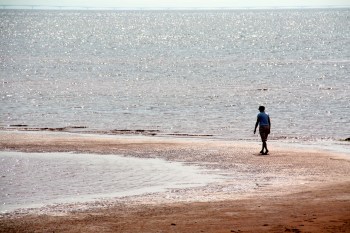
Mikhail Bakhtin uses the term chronotopos, referring to ‘man’s dialog with his time and his place’. I write so that I too may dialog with my time and my place. More, I write in part to establish my time and to cement myself in my place. Time and place are both variable. Is Quevedo (Spain, 1580-1645) a part of my time (20th / 21st Century) or my place (currently Island View, New Brunswick, Canada)? The moment I draw him into the intertextual conversation, as I have done here, he shares time and place with me, and with you, as you read this. So, among other reasons, I write to establish my place not only within this time in which I live, but also within the great chain of intertextual writing that flows backwards and forwards from the earliest times. Only I can do that for myself. Nobody else can do it for me. Is it important that I do so? For me, yes, it is very important. Sometimes, in this life, we walk a long way across a very lonely shore. But we leave footprints behind us, footprints that the wind will fill with sand, footprints that the tide will wash away … we are aware of that but we still walk on, and we still leave footprints.

Reading as dialog, dialog as a means to establish ourselves, writing as a way to cement our ideas, to polish them, to craft them into the shape of that well-wrought urn, that well-wrought urn placed in public where it can be viewed, or in a private place where only close friends can see it and admire it … but something tangible, something solid, something well-wrought, something that will say, ‘yes, I have walked this way’ and ‘yes, I have left footprints’, however dainty, however small, however temporal, however fragile in light of wind and tide … but a footprint, the footprint of Man Thursday, on an otherwise deserted shore … to leave footprints …  to sketch the silver points of Lucifer, the light-bearer, the evening star, as he stands strong against the encroaching night … that is Why I Write.

Wednesday Workshop: Why I Write II

IMG_0055

Wednesday Workshop
Why I Write II
28 March 2018

Joan Didion’s autobiographical note did not appeal to me in the same way that George Orwell’s did, but then, I was born on the same side of the Atlantic as Orwell, and yes, that does make a difference. So much in Orwell is familiar, so much in Didion is alien.

For Didion, Why I Write (borrowed from George Orwell) is composed of three short words, each of them emphasizing the first person singular I + I + I. She sees writing as an ‘aggressive, even a hostile act’ in which she, as writer, imposes herself on other people (her readers) saying ‘listen to me, see it my way, change your mind’. From this idea of imposition springs the second idea of the ‘aggressive, hostile act’. This, in some ways, can be seen as a sort of combination of Orwell’s first, third, and fourth points (1) sheer egoism; (3) historical impulse; and (4) political purpose with possibly the first dominating.

That said, I like the idea Didion presents of ‘pictures in the mind’. She carries these pictures with her and then writes from them. She writes from the physical, the tangible, the ‘taste of rancid butter’, the ‘tinted windows on the bus’, the concrete nature of these things and her desire to describe them as accurately as possible, led her to discover herself as a writer.

When I apply her descriptions to my own writing, I gaze at my own memories of my childhood. They are like photographs, still, black-and-white photographs, like those we used to see when I was a child at the entrance to movie theaters. The skill for me in writing is to allow these pictures to spring back into life. Much of my writing, especially my stories about Spain, Mexico, or Wales, is autobiographical in its beginnings. However, as the pictures move and speak they tell me things and I write them down. What starts out as a story is very rarely the story that ends up on the page. A metamorphosis takes place. Words slip and shift and change their shapes and meanings according to the whims of characters and the situations in which they find themselves. In the beginning was the picture: that, I guess, is what Didion and I hold in common. But my writing is not her writing, and her pictures are not my photos, how could they be?

Interesting in my own original photos is the lack of sound, the lack of movement, the lack of taste and touch. First the figures are stiff and stolid. When I study them, they shift and move, and next they begin to speak. Alas, what they tell me when they speak to me in the shiftless shadows of my dreams at night is not necessarily what they lazily lisp in the full sun of my waking mind. A long time ago, I struggled to recall the exactness of that dream world and I tried to pummel the words and thoughts on my mind’s anvil and to hammer them into shape aided by the heat of my seemingly inexhaustible creative energy. Now I am more relaxed: I just listen to the daylight voices and allow them to shape themselves and their situations in their own way.

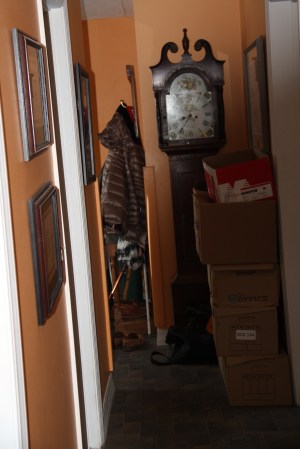
When I do this, background sounds and the tell-tale smells of time and place slip slowly in. Boarding school: the unforgettable stench of burned porridge. My auntie’s house: the whir of the cuckoo clock as it coiled itself up in preparation for the little bird to whip out and enchant the hours. My grandfather’s grandfather clock: the metallic lightness of the clock hands as I adjusted the minutes and the hours when the clock ran down and I sensed the tautness in the piano wires as I turned the key and wound the heavy brass pendulums back into their starting positions. My grandmother’s house: the bubble of water boiling on the hob, the warmth of constantly brewed tea, strong as a farrier’s horse and quite undrinkable without the second, third, or fourth watering and, of course, always the smell of boiled white fish cooling for the cats’ supper.

My best writing comes from deep inside myself. I find it  in the midnight coal mine of my mind where ghost-like figures drift and roam as they seek that special person, the one who will drag them to the surface and bring them back to life. Poor, pale, thin imitations of a reality that never was, I do my best to revive them. Often, my best is just not good enough and I must cast them away and drop them back into the depths to ghost away and prepare themselves for another day when perhaps, they and I will each be ready to deceive each other.

Why I Write

IMG_0055

Why I Write

In the online creative writing course that I am currently taking, we were invited to read two articles on why I write, one written by George Orwell and the other by Joan Didion.  Both articles set me thinking: why do I write? My response to these articles, borrowed from my course notes and suitably doctored for my blog, follows. Note: this is the first of three planned statements. The second, on Joan Didion, will appear tomorrow on my next Wednesday’s Workshop.

George Orwell … where do I begin?

Homage to Catalonia is, in my opinion, one of the great personal memoirs written about the Spanish Civil War. Orwell fought on the side of the Republic, the legally-elected government, but fell foul of the Russian-backed Communists as they tried to unify the left under a banner of total Communism. The other side in the Spanish Civil War was, of course, the solidified right of the Spanish Falange and the Fascist Party. Orwell was targeted by the Communists and, wounded at the front, escaped across the French border with falsified papers. As he himself says in Why I Write, the political realization of the nature of totalitarianism led him to his stance as a writer. Animal Farm borrowed heavily from his Spanish experience, as did 1984.

Orwell sets out four reasons for writing. (1) Sheer egoism; (2) aesthetic enthusiasm; (3) historical impulse; and (4) political purpose. I personally identify most strongly with #2. Above all, in my case, I write my poetry in praise of nature and in sorrow for how I see us failing the natural world around us. However, I must admit that I also write out of sheer egoism (#1) and yes, I enjoy thumbing my nose at all those who have in one way or another slighted me and upon whom I want literary revenge, even if it be posthumous. Several of my older friends also write this way, though many of the younger ones seem to be more interested in money than in art for art’s sake. I guess retirement and a small but relatively reliable pension added to the gradual onset of a blighting old age make me realize that there is not much time left in which to amass a fortune. This in turn also makes my professed credo of art for art and not for money more acceptable.

Having come to the conclusion that I never have, and never will, make any money through my writing, although publish or perish has walked side by side with me throughout my academic career, I now embrace the fact that I do not write for money. In fact, I usually give my independently published books away to my friends. Nor do I want the sort of fame that causes the paparazzi, with their microphones and videos, and camerasto flock to my doorstep, like starving sparrows or winter’s chickadees, in search of the breadcrumbs that fail to sufficiently nourish. To be appreciated, in my own small corner, like a well-loved local cheese or a craft beer, welcomed on a cool night for its fragrance and body … that is enough for me, although I must admit, that for one of my metaphors or images to be sniffed at, as if it were a glass of rare liqueur or specialized port or a welcome New Zealand Pinot Noir, also has its attractions.

This doesn’t mean that I am satisfied with who I am and how I write … I am not. I hope I never will be. I do want to be the very best that I can be. That’s why I keep writing and why I keep taking courses and workshops on writing. It’s also why I read and re-read, and why I keep reaching out to you and my other friends, and why I am so over-joyed when you, in your turn, reach out to me with the occasional word of praise for one of my stories or one of my poems.

However, warm as is the friendship of the beginning, failed and faltering writers’ support groups to which I belong,  most, if not all, writing is done in isolation: me and my memories, me and my invention, me and my keyboard, me and my blank page, me and my pen, me and a-penny-for-my thoughts as I refill that pen with Royal Blue ink in the hopes that something regal will actually fall from the nib and grace one of my pages, even though I am really wondering yet again whether I should start that first paragraph all over, just once more.

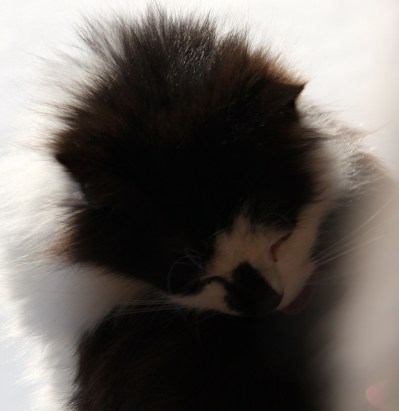
Alas, me and the cat and the keyboard do not share a healthy working relationship, especially when she walks across the keys, sticks her kitty-littered rear end in my face, scratches her itchy chin against the computer’s sharp edge, and purrs wildly for kibble while adding oft-repeated letters and deleting so many of the wonderful words that I have so carefully accumulated.

Monkey Teaches Sunday School


IMG_0040 (2)

Monkey Teaches Sunday School on Mondays
(With apologies to Pavlov and his dogs)

Younger monkeys e-mail elder monkey
and expect an answer within two minutes.
Elder monkey drools and writes right back.

He is turned on by the bells and
whistles of his computer.
“Woof! Woof!”
His handlers hand him a biscuit.

Elder monkey has grown to appreciate
tension and abuse:
the systematic beatings,
the shit and foul words hurled at his head.

The working conditions in his temple
kennel are overcrowded.
Elder monkey is overworked.

Yet he has managed to survive,
to stay alive and fight
what he once believed was the good fight.

Now he no longer knows:
nor does he drool anymore
when bells and whistles sound
and his handlers bait him with
an occasional, half-price biscuit.