April Ducks

IMG_0462.jpg


April Ducks … in Spanish … Patos de abril. Patos … because the double two of 22 look like two little ducks … and April … that’s the month we’re in … so Patos de abril … the twenty-second of April, or 22 abril … aka todaythough you wouldn’t think so from the phototaken today … just a few minutes ago …

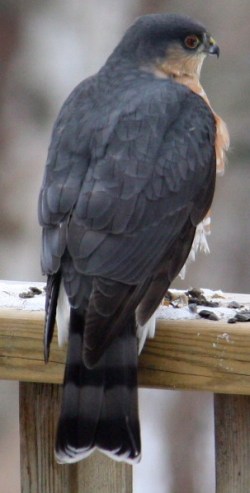
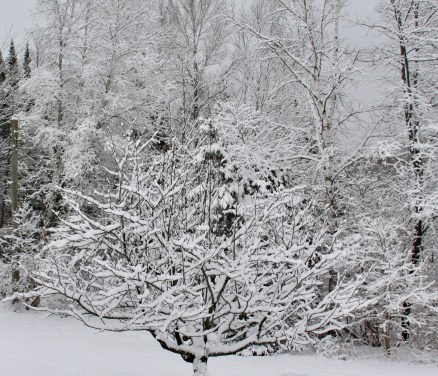
Nice weather for ducks we say when it’s raining. But what do we say when late snow falls and we have between 4 and 6 inches of fresh snow down on the ground … on April 22nd … and it’s meant to be spring … and yesterday everything was green … and this is meant to be a color photograph … would you believe it? … and yesterday that Mountain Ash was full of birds … a downy woodpecker, creepers, purple finches, American Goldfinches, chickadees … robins were patrolling up and down the garden and juncos gathered with the early morning mourning doves beneath the feeders to pick up fallen seeds …

IMG_0463.jpg


Patos de abril … and winter has returned … we know the snow can’t last too long … we hope the sun will emerge and take it all away … I was late changing my snow tires this year … was that an omen? … I go in on Monday and get them done … we haven’t changed the garage around yet … the snow-blower sits by the garage door … a lion in winter in waiting and ready to roar … soon we will banish him to the back of the garage and bring out the mowers … soon … but not just yet … and certainly not today …

IMG_0464.jpg

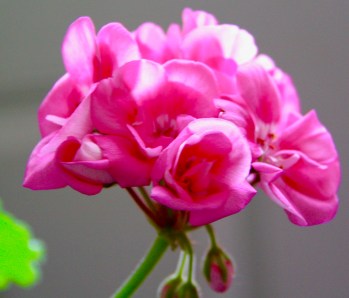
Patos de abril … our indoor geraniums have survived the winter and defy the snow … they are sure the sun will return and the snow will emigrate somewhere … we don’t care where … if only we could build a wall … a great, big, expensive wall to keep winter away … an enormous, gigantic wall … a beautiful wall that unwanted snow storms wouldn’t cross … a wonderful wall … for which, of course, someone else will pay …

Scarecrow

IMG_0085

Scarecrow

Flash Fiction
Friday, 21 April 2017

            Sometimes at night I hear nocturnal animals walking across the lawn outside my bedroom window. Intruders in the garden, they rattle the feeders, walk dark through the woods, and sometimes howl at the coyote moon. My heart pumps sudden blood, rapid, through my veins and toes and fingers twitch as I toss around, restless, in my bed.

            Below me, in the hall, the grandfather clock ticks the night away. I stitch myself up in my dreams, count the black sheep in the family, and iron old ghosts upon the ironing board until they are as flat as the white shirts we wore in boarding school on Sundays.

            If I close my eyes, they rise up before me, those Sunday shirts, flapping their arms, and mouthing their apologies for the sorry life they made me lead. No, I didn’t need to spend those days praying on my knees before the stations of the cross. Nor did I need to ask forgiveness for all the transgressions pulled from me, like teeth, in the weekly confessional.

            Marooned in a catholic cul-de-sac, I went around and around in rigid circles like an academic puppet trapped in the squared circle of an endless syllogism. Who locked me into this labyrinth of shifting rooms where sticky cobwebs bind windows, doors, and lips? Why does the razor blade whisper a love song to the scars crisscrossing my treacherous wrist? Who sealed my lips and swore me to secrecy?  And why?

            A tramp with a three-legged dog, I sleep beneath a pier at midnight and watch the waves rolling up the summer beach to catch me out. Sometimes I steal a deckchair, place it at the edge of the sea and bid the tide to cease its climb. The moon winks a knowing eye and the waves continue to rise. Toes and ankles grow wet with wonderment and I shiver at the thought of that rising tide that will sweep me away to what unknown end?

            Last night I wrapped myself in a coward’s coat of many-colored dreams. My senses deceived me and I fell asleep in a sticky web spider-spun by that self-same moon that hid among the clouds and showed her face from time to time. My fragile fingers failed to unravel all those knots and lashings and I was a child again walking the balance beam that led from doubt to knowledge.

            A thin line divides the shark from the whale and who knows what swims beneath the keel when the night is dark and the coracle slides sightless across the sea? I gathered the loose ends of my life, wove them into a subtle thread, and made myself a life-line that would bind my bones and lash my soul to my body’s fragile craft.

            What could I possibly have dreamed as I paraded the promenade a stone’s throw from the barracuda? I crossed my fingers and the beggar at the gate rolled up his sleeves and bore witness to my penitential wounds.

            “How many times,” he asked, “can you pay those thirty silver pence? Don’t they lie heavy on your eyes and heavier on your heart?”

            “Indeed they do,” I answered. “Yet the debt must be paid, but I don’t know how, and where, and when, and to whom?”

            Carnivorous was the carnival he promised and he turned my small world upside down. With coals for eyes and a carrot nose, a scarecrow descended and devoured my town in a clash of flashing teeth. Beneath the waves, the conga stamped its sudden feet of flame. A sea parrot scraped its red and yellow beak against a rainbow of crusty, feathered rage. I awoke to the dog’s sudden tongue in my mouth: an invasion of salt, saliva, and wet, crumbling biscuit.

            That night I opened a bottle of Scotch and drained it dry. I took no prisoners. Around me, the dead and dying licked their wounds as they sank lifeless to the bottom of the glass.

            “Hickory-dickory-dock,” said the mouse as he ran up the grand-father clock. But that particular clock stopped long ago, at midnight, when the Queen of Hearts tied a dead rat to the pendulum, the house slipped sideways, and my heart was filled with woe.

            This morning, fresh snow. The garden basks white beneath pale sunshine. The back porch bears no footprints. The raccoon has abandoned me and chipmunk and squirrel have turned their backs. Today, the scarecrow will scare those nightmare crows away and not a memory will survive to haunt my waking dreams.

Chaos

Chaos

Chaos

Chaos theory:
it states that we don’t know
what we’re doing and
it wouldn’t really matter
anyway, even if we did,
because life lacks meaning,
chance rules, and Lady Luck
with her lusty locks attached
to her forehead and she,
all bald and hairless
from behind, must be caught
as she arrives, because later
is much too late, and when past,
she’s gone for good and
our good luck’s gone with her,
and we’re left for ever,
sitting there, head in hands,
bemoaning all that milk spilled
before we ever had a chance
to actually taste it.


Naming Names

Another good article from Meg Sorick. NB Don’t forget the local telephone directory …

Meg's avatarMeg Sorick, Author/Artist

How do you choose a name for a character?  Some of my characters’ names came from deceased relatives, old family friends, and a particularly useful website:  behindthename.com.  Since names fall in and out of popularity throughout the years, one way to name your character realistically is to see what names were popular for the year in which they were born. That’s what this website can tell you –the most common names given to the children of that age.

For choosing surnames, I carefully watched film and TV show credits, paid attention to the last names of athletes, people in the news and even place names. Detective Jack Staley, for example, arose from – Jack: a consistently strong male name (think Jack Kennedy, Jack Ryan, Jack Reacher, Jack Bauer) and Staley which I borrowed from former Philadelphia Eagles’ running back Duce Staley. (Also giving it a Philly connection). Maya Kaminsky is…

View original post 173 more words

Spring

img_0344

Spring

Winter whiteness slowing now,
and the tide that full bore crashed
white waves against our house
receding to garden’s foot where
warm roots wait their waking.

But winter still stalks the land
and April brings snow, more snow,
as if there will never be an end
to these waves of whiteness,
thinner, trimmer, true, but
unwelcome as spring days grow
longer and sunrise beckons
ever more early with crow
and Blue Jay breaking the morning’s peace
into raucous pieces
as they bounce from branch to branch …

.. and brown the earth, and barren,
and bare, the robins finding no food
and flying on, while the passerines
just call and pass us by, finches at the feeder,
purple and gold, yet singing no songs,
and the robins, hop-along casualties
of this long delayed spring that promises,
but never comes …

Three Unities

img_0177

The Three Unities
Wednesday Workshop
19 April 2017

The Three Unities

The Three Classical Unities are those of Time, Place, and Action. They are usually associated with classical theatre. It is worth remembering that, in the sixteenth and seventeenth centuries, when poetry and theatre ruled the artistic world of the west, the novel was relatively undeveloped and narrative form was concentrated in epic poetry. In fact, one of Cervantes’s greatest innovations was to draw a parallel between the modern narrative, as he developed it, and epic poetry. “También la épica puede escribirse en prosa,” he wrote in Don Quixote, I, 47. ‘Epic poetry may also be written in prose.’ Lyric and epic poetry had a different construct to the theatre, so it is really the classic theatre that we are discussing here, rather than poetry and prose, though all forms of creativity benefit from a knowledge and understanding of the three unities. Let us look at these unities one by one.

Unity of Time: The play should take place within a time frame of a day, twenty-four hours. This concentrates the action at the moment of maximum impact, or crisis, when the major decisions are being taken. In order to fill in the background details of what happened before, a confidant is often used, especially in French theatre, and this confidential person, or adviser, assists the main characters in coming to their decisions by providing missing background information.

Unity of Place: The play should take place in the same house, as a minimum, and preferably in the same room of the house. This limits travel, and the wanderings of Odysseus, for example, would be impossible in the classical theatre. This is a restriction that was blown away by epic poetry. The narrative forms also rejected this type of unity as they developed, and contemporary film, with its total mobility really reduces Unity of Place to the realms of history and the Absurd.

Unity of Action: All action within the play should be subordinated to the main plot and the main characters. There should be only one plot, but a minor plot is permitted provided it echoes, mirrors, and reflects upon the main plot. Unity of action is interesting in that, to a certain extent, it has remained with us. Television shows, especially police and crime shows, may have multiple actions, but they all link together to form a pattern of events that are linked within a series of unified patterns. It is these patterns of unified action that so often reveal the criminal.

Unity of Theme: Spanish classical theatre, under the watchful eye of Lope de Vega, broke all the unities as established above, but created a new unity: unity of theme. This, too, has demonstrated its longevity and is still with us. Thematic unity is common to all forms of literature and is a binding thread in poetry and prose, theatre, film, and novel. Unity of theme suggests that beneath the surface movement of the art work, there is a thematic unity, a set of deeper ideas, if you like, that provides links to all the action and thought.

Closely linked to these four unities is what I call Unity of Language. Unity of Language is consistent within characters, the way they speak, the way they use language. It is also consistent within a poem or a book. Sometimes it is based on the concept of Associative Fields according to which each word is surrounded by a series of associations (the Associative Field) that links words to each other at one level and to a central theme at another level. The use of Associative Fields is greatest in poetry and those forms of writing that base themselves on poetical repetition. In fact, the Associative Field may be looked upon as a form of repetition that provides emphasis by repeating a theme while avoiding the repetition of the same word within that theme.

I look on the development of art and culture as akin to the movement of a pendulum on a grandfather clock. On one side, let’s call it the right, the pendulum demands rules, immutable rules, and writers that stick to those rules. On the other side, let’s call it the left, there are no rules and chaos reigns in a creative land where the broken rule is the law of the day.

Classicism, in the sixteenth and seventeenth centuries, was followed by Neo-Classicism, in the Eighteenth Century, and this was an even more stultified form than classicism itself. The Romantic Movement, on the other hand, broke the rules of Classicism and brought energy and freedom to all forms of art. As Victor Hugo said: “J’ai mis un bonnet rouge sur le vieux dictionnaire.” ‘I have place a red [French revolutionary] bonnet on the old dictionary.”  Romanticism is Revolution. In art, we need regular revolutions. The next major revolution is always just around the corner. Or, as the pendulum theory suggests, maybe the next revolution, waiting just around the corner, is a swing of the pendulum back from freedom (Romanticism) to restraint  (Classicism).

Certainly we modern authors may exercise our choices in a way that older authors could not. We can and should be aware of all that has gone before us. Knowing the traditions from which we write allows us to write better and to choose better, taking or rejecting that which we want and that which suits us best in our own artistic endeavours.
Skeleton in the Cupboard: Flash Fiction


Skeleton

Skeleton in the Cupboard

Spring sunshine and I pull out my old summer coat, the one with its pockets stuffed full of memories and dreams. It hides all winter in the clothes cupboard and I free it each spring with the melting snow and the tiny tongues of grass that push through the winter debris that covers the lawn in early April.

Battered and bruised, its elbows discolored where the dry cleaner’s chemicals left disfiguring splodges, it has served me for twelve long summers. It is my constant warm-weather companion, hanging on my arm, my shoulders, gracing me with its comforting presence. Everywhere I travelled for the last twelve years, it has accompanied me.

It is shabby now and grubby. Wine from the bars in El Rincón, El Rastro, El Portalón, Casa Guillermo and many other landmarks have fallen upon it. Octopus, squid rings, mussels, clams, shrimp, goose barnacles, and various types of omelet have left their marks upon it. The English language, with its fish and chips, its bangers and mash, and its sosi, jegg and chips, all bourgeois meals, can never do justice to the pure poetry of Spanish tapas whose names roll off the tongue: pulpo, calamares, mejillones, almejas a la marinera, gambas a la plancha, percebes, tortillas españolas y vegetales. Here I spot a golden stain from riñones al jerez and there a black one from calamares en su tinta.

Weathered by wind and rain, this coat has climbed El Zapatero and walked with the transhumance herds up and down the old Roman road of the Puerto del Pico. It has followed the Ruta de la Plata, the silver trail that led from South America to Sevilla and up the Silver Road past Ávila to Madrid. It has walked through the house in El Barco de Ávila and seen the kitchen where they tore down a wall and found a walled up library, just like the one described by Miguel de Cervantes in the Quixote. It held books proscribed by the Spanish Inquisition that had been hidden away since 1556. It has walked through Piedrahita, San Miguel de Corneja, and Villatoro. It has walked the streets and squares of St. Teresa’s walled city of Ávila on multiple occasions and knelt with me, in prayer, before many a saint on many an altar.

It kept me warm in the hills around Gredos when the mists dropped suddenly down and turned warm day into freezing night. It accompanied me to the Monasterio de Yuste, where the Holy Roman Emperor, Charles the Fifth, retired to live out his days in prayer. It visited the spice towns of La Vera, and ventured into Garganta de Olla, to walk those ancient streets with me. It walked with me in the birthplace of St. John of the Cross and entered with me the depths of the earth where the verdejo is stored in huge oak barrels deep below the town of La Seca.

This old coat keeps its secrets. It remembers the moon hanging its lantern above the battlements on the Paseo del Rastro. We wandered there, she and I, arm in arm, entranced by the shadows that danced on the Medieval walls. When she shivered, I wrapped her in that coat and still it holds the perfumes of her body, the warm touch of her skin, the enchantment of those magic nights when the world stood still and we lay alone at its centre. Oh, and that green stain, there, at the back: that’s where I lay my coat on the grass in the little park under the walls by El Puerto de San Vicente, the one where the lovers go, late at night, beneath the trees, to be together in their loneliness …

Comment: A long time after posting this story, enlightenment knocked at my door. The new cartoon that I had used to illustrate My Old Coat was called Skeleton. Surely, I thought to myself, given the story’s ending, Skeleton in the Cupboard would make a better title. And it would. And I have changed it. A little bit of serendipity at a time (+3C outside the week after Easter) when I need some sunshine in my life. Any comments on the use (or overuse) of Spanish in this story would be very welcome. Best wishes to all my faithful (and unfaithful) readers.

Scribblings

img_0186

Scribblings

Words and thoughts
and symbols and images and
metaphors and myths
and all things missing and
some present in-between sheets
lined and unlined as a line of ants
crosses the kitchen floor
in search of sugar so sweet
these dreams where truth
and lies and smiles and
sighs seize highs and lows
and the light and
dark of a life as it might
have been and was perhaps
on another planet
in my darkest dreams
and my sharpest awakenings and
if I am dreaming then let me sleep
on and on and never wake up
to what passes as reality


Fall

IMG_0186

Fall

 Just one leaf
dropping from the tree
and the fall
a call of nature
and no freak chance of fate.

What throw of the dice
eliminates
Lady Luck?

None at all,
or so the poet says,
lying there,
indisposed,
his ribs cracked
hard against
the wooden boards
and his right foot
caught in such a way
that the hip slips
slightly from its socket
and try as he may
he cannot stand
but lies there
in the chill evening wind,
a lone leaf,
getting on in age,
plucked from his tree
and cast to the ground.

Comment: In light of my last fall, last Tuesday, this is a re-organization of an earlier poem also called Fall, available here. That particular fall took place in 2014. I stumbled and fell off a step on the back porch while I was trying to photograph a black bear that had wandered into our garden and was guzzling bird seed at the bird feeder. We saw this particular bear on half a dozen occasions. The poem was published in my poetry chapbook Triage (2015).

Sinister

IMG_0186

Sinister

What the left hand does
when the right hand doesn’t
know what it’s doing
is an attempt to re-pattern
the brain, to slow it down,
as the pencil spider-walks
its wandering way over the page
like my father’s did when,
stroke-stricken in the right hand,
he transferred his pencil to the left
and sought to-re-establish control
over tiny, manageable things,
and yes, he often cut himself
shaving, but he didn’t like beards
so he never gave in and shaved
every day, died fighting,
and did not go gentle,
and neither will I.

Comment: This is a very raw poem, in more senses than one. I fell over on Tuesday, on the back porch. One of the porch nails, forced up by the winter ice, caught in my open-toed sandal and over I went. My head had hit the deck before I even knew I was falling. It wasn’t as bad as the tumble I had when chasing the black bear and trying to photograph it, but this fall left me quite stunned. You can read about the fall HERE. The actual bruising, not the fictional ones, can be found in #3 of that sequence. I wrote the above poem, on Thursday evening, with my left hand, while my right hand was being iced. Funny how we think of one thing while doing another: I had visions of my father, stroke-stricken as I say, trying to write with his left hand. He fought so hard to do just the smallest things. Oh yes, I have a nice bump on my head, too, and as I told the chiropractor when I visited her later that Tuesday afternoon: “I think I have already had my back adjusted once today.” The other thought that comes to me: how slow we are to heal, once we pass a certain age, or, as my good friend Jan the Stoneist says, “an uncertain age.” With that latest fall, I have indeed entered into The Age of Uncertainty.